
1723534562.png)

CAT Geometry Syllabus 2026 PDF Download [Important Topics and Weightage]
January 12, 2026
Overview: CAT geometry syllabus covers fundamental geometric concepts, including lines, angles, triangles, circles, polygons, and three-dimensional figures. Read on to know more details about it!
- Every year, around 3-4 questions were asked from the geometry topic of the QA section.
- Having a good grasp of the key concepts of the geometry section of the CAT 2026 exam can help you fetch 10-12 marks.
Continue reading to know the detailed CAT geometry syllabus 2026 here!
Read more: CAT Arithmetic Questions with Answers
Read More: How to Prepare for Data Interpretation for CAT Exam?
Why Geometry Matters for CAT 2026?
Geometry isn't just about memorising formulas; it's about developing spatial reasoning, logical deduction, and problem-solving skills, all essential for acing the CAT.
Questions from the CAT syllabus frequently test your ability to visualise, apply theorems, and think critically under pressure. Mastering geometry can significantly boost your overall score and percentile
CAT Geometry Syllabus 2026: What to Expect?
While the official CAT notification doesn't provide a granular syllabus, analysing past papers reveals a consistent focus on the following core topics:
1. CAT Geometry Syllabus Topic: Lines and Angles
Here are the basic concepts you need to understand about lines and angles:
|
Topic |
Subtopics |
|
Basic Concepts |
Points, lines, line segments, rays, parallel and perpendicular lines |
|
Angle Properties |
Types of angles: acute, obtuse, right, straight, reflex Angle bisectors Vertically opposite angles Complementary and supplementary angles |
|
Properties of Parallel Lines |
Transversal lines Corresponding angles Alternate interior and exterior angles Consecutive interior angles |
Check: Logical Reasoning Questions for CAT


2. CAT Geometry Syllabus Topic:Triangles
Some important topics covered under the triangle section of the CAT geometry syllabus 2026 include:
|
Topic |
Subtopics |
|
Types of Triangles |
|
|
Angle Sum Property |
The sum of angles in a triangle is always 180∘ |
|
Congruence & Similarity |
|
|
Area of a Triangle |
21×base×height, Heron’s Formula, Trigonometric Area Formula: 21absinc |
|
Special Triangles |
Equilateral, Isosceles, and Right-angled triangles – properties and theorems (e.g., Pythagoras' Theorem) |
|
Triangle Elements & Concurrency |
Medians, Altitudes, Angle Bisectors, Perpendicular Bisectors – concurrency points: centroid, orthocenter, incenter, circumcenter |
|
Inequalities in a Triangle |
|
Read more: CAT Geometry Formulas with Explanation
Quantitative Ability Individual Topics Formula Sheets
| Number System Formula PDF | |
| Arithmetic Formula PDF | |
| Number Theory Formula PDF | |
| Quadratic Equation Formula PDF | |
| Inequalities Formula PDF | |
| Logarithms, Surds & Indices Formula PDF | |
| Time, Speed & Distance Formula PDF | |
| Linear Equations Formula PDF | |
| Ratio, Proportion & Variations Formula PDF | |
| Simple Interest - Compound Interest Formula PDF | |
| Profit & Loss Formula PDF |
3. CAT Geometry Syllabus Topic: Quadrilaterals
Here are the topics usually covered in the quadrilaterals section of the CAT geometry syllabus 2026:
|
Types of Quadrilaterals |
Parallelogram, rectangle, square, rhombus, trapezium (trapezoid), kite – definitions and key properties |
|
Area and Perimeter |
Formulas for calculating the area and perimeter of various quadrilaterals |
|
Diagonals and Properties |
Properties of diagonals – their lengths, how they intersect, and how they divide the quadrilateral into triangles or congruent parts |
Check: Number System CAT Questions


Practise with: CAT Trigonometry Question with Solutions
4. CAT Geometry Syllabus Topic: Circles
The questions are asked from the following topics of the CAT geometry syllabus 2026:
|
Basic Definitions |
Radius, diameter, chord, arc, sector, segment, circumference |
|
Properties of Chords |
Equal chords subtend equal angles at the centre A perpendicular from the centre to a chord bisects the chord |
|
Angles by Arcs |
The angle subtended by an arc at the centre is double the angle subtended at any point on the remaining part of the circle |
|
Cyclic Quadrilaterals |
Properties of quadrilaterals inscribed in a circle |
|
Tangents and Secants |
Properties of tangents and secants Relationships with radii and chords |
|
Length Formulas |
Formulas involving the lengths of tangents and secant segments |
Explore: CAT Trigonometry Questions
5. CAT Geometry Syllabus Topic: Polygons
Here are the topics covered under the polygons section of the CAT geometry syllabus 2026:
|
Types of Polygons |
Regular and irregular polygons Convex and concave polygons |
|
Angle Properties |
Sum of interior angles = (n−2)×180∘ Sum of exterior angles = 360∘ |
|
Regular Polygon Properties |
All sides are equal All interior angles are equal |
Check: Latest Changes in CAT Exam Pattern
| CAT VARC Mock Test 2026 | |
| CAT DILR Mock test 2026 | |
| CAT QA Mock Test 2026 |
6. CAT Geometry Syllabus Topic: Mensuration (2D and 3D)
|
Perimeter & Area (2D Shapes) |
Triangles, quadrilaterals, circles, and other polygons – formulas and applications |
|
Surface Area & Volume (3D Shapes) |
Cube, cuboid, cone, cylinder, sphere, hemisphere – formulas and their applications |
|
Coordinate Geometry |
|
|
Cartesian Coordinate System |
Understanding coordinates, x-axis, and the y-axis, and the four quadrants |
|
Distance Formula |
Formula to calculate the distance between two points: (x2−x1)2+(y2−y1)2 |
|
Section Formula |
A formula to find the coordinates of a point dividing a line segment in a given ratio |
|
Area of a Triangle |
Area using coordinates of vertices: (\frac{1}{2} \left |
|
Slope of a Line |
Concept of slope and its relation to parallel and perpendicular lines |
|
Equations of Lines |
Various forms: slope-intercept, point-slope, and two-point form |
|
Circles (in Coordinate Geometry) |
Equation of a circle: (x−h)2+(y−k)2=r2, where (h, k) is the centre and r is the radius |
Read more: CAT Mensuration Questions with Solution
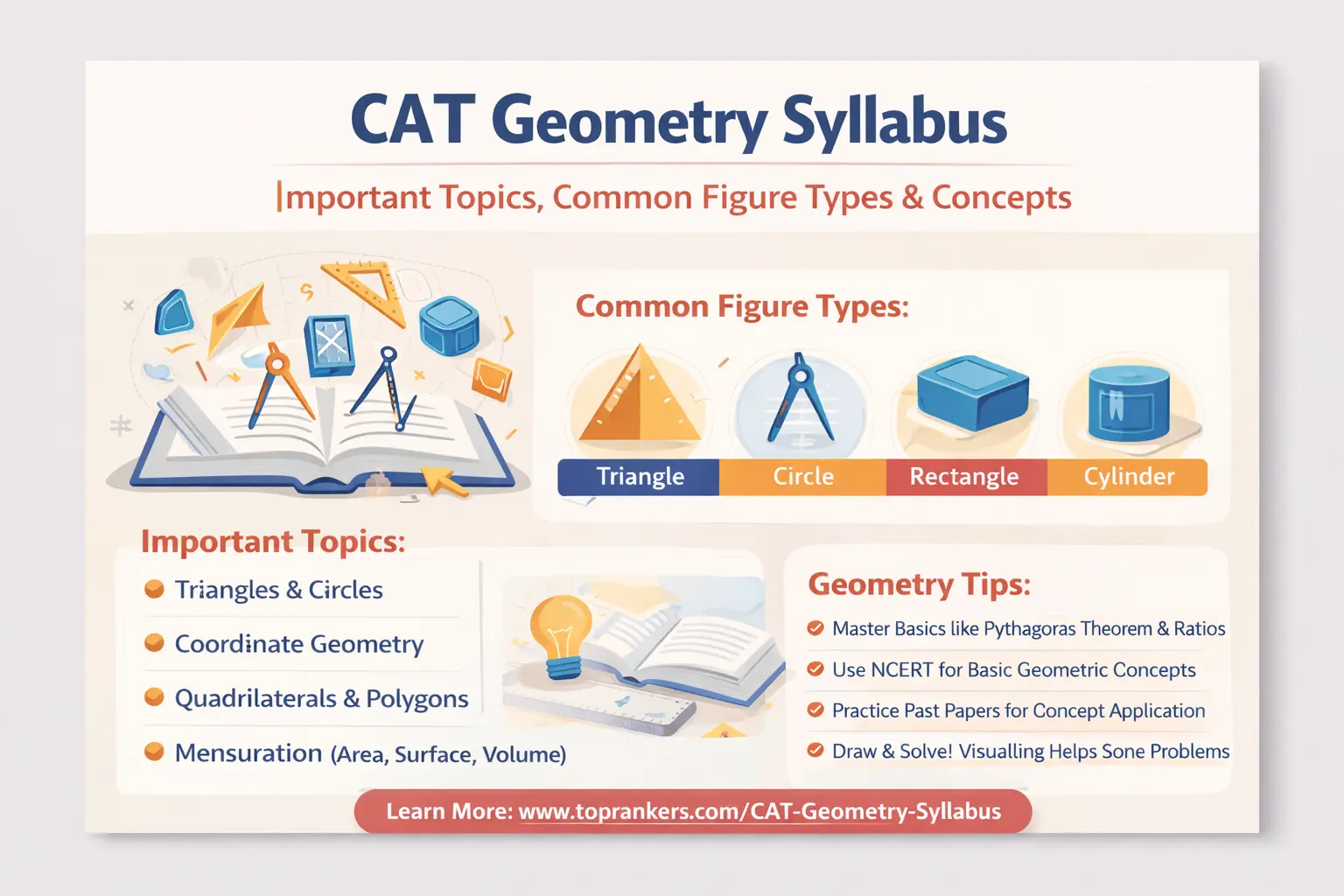
Strategic Approach to Mastering the CAT Geometry Syllabus 2026
Geometry can feel intimidating at first, but with the right approach, it can become one of the most scoring areas in CAT. Here’s a smart and practical strategy to help you master CAT Geometry for 2026:
✅ Build a strong foundation first
Start with the basics like lines, angles, triangles, and circles. Make sure you clearly understand definitions, properties, and core theorems before moving on to advanced problems.
✅ Draw diagrams for every question
Geometry is visual by nature. Always draw neat diagrams, even for simple questions. The more you practise visualising problems, the faster and more accurate your solutions will become.
✅ Focus on concepts, not just formulas
Instead of memorising formulas blindly, understand why they work. Conceptual clarity helps you apply the same theorem across multiple question types.
✅ Master key 2D and 3D formulas
Learn the area, perimeter, surface area, and volume formulas of standard shapes. Regularly practise direct application-based questions to build confidence.
✅ Score well with coordinate geometry
Coordinate geometry is highly formula-driven and scoring. Once you know the basic formulas, practise applying them to find distances, areas, slopes, and equations efficiently.
✅ Analyse previous years’ CAT questions
Solving past CAT geometry questions gives you a clear idea of difficulty levels, frequently tested concepts, and recurring question patterns.
✅ Take mock tests seriously
Regular CAT mocks help you track progress, improve speed, and identify weak areas. Analyse your mistakes to avoid repeating them.
✅ Aim for clarity, not cramming
Deep understanding beats rote learning every time. A clear conceptual base will help you crack even tricky and unconventional geometry questions in CAT.
Conclusion
Mastering the CAT geometry syllabus is crucial for achieving a strong score. By focusing on essential topics like lines, angles, triangles, and circles, you can enhance your problem-solving skills and spatial reasoning.
With around 3-4 geometry questions typically appearing each year, a solid understanding of these concepts can help you secure valuable marks. Make sure to practice regularly and familiarise yourself with the key formulas and properties.
With dedication and preparation, you can confidently tackle the geometry section and improve your overall performance in the exam. Good luck!
Check: Practise CAT Previous Year Question Papers with Answers

Smart Prep for CAT: Join Our Free Demo Class
Fill your details
Frequently Asked Questions
How many geometry questions are typically asked in the CAT exam?

How many marks can be fetched by having a good grasp of the geometry section in the CAT exam?
What are the main topics covered in the CAT Geometry Syllabus?
Why is geometry important for the CAT exam?
What skills are tested in the geometry section of the CAT exam?

Lalita Vishwakarma
Content Writer


SHARE