
1723534562.png)

CAT 2025 Topper Krishna Bansal Interview: Strategy, Section-wise Scores & Preparation Journey [Supergrads]
December 27, 2025
Overview: In this CAT topper interview, CAT 2025 Topper Krishna Bansal walks through his prep journey in a refreshingly honest way, right from feeling overwhelmed after the exam to feeling relieved when the answer key looked “satisfactory.”
A first-time CAT aspirant from Indore, Krishna’s story is all about building fundamentals, staying accuracy-first, and keeping his performance balanced across VARC, DILR, and QA.
He also shares what he’d change if he could restart his preparation—especially around starting earlier.
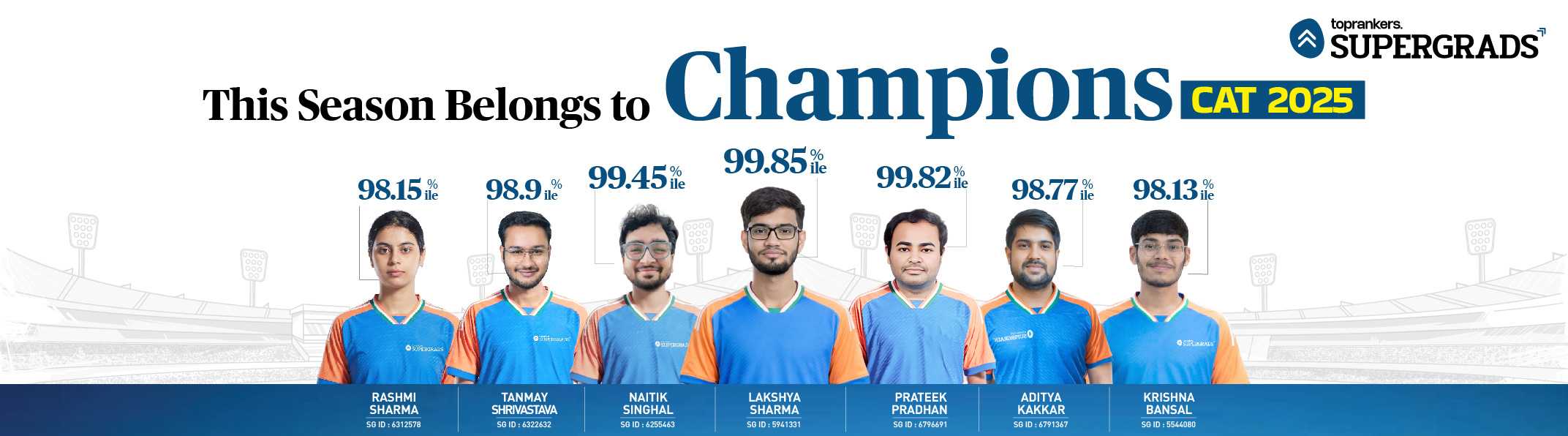
CAT 2025 Topper Krishna Bansal (98.13%ile): Snapshot
- Name: Krishna Bansal
- City: Indore
- Background: Business family; born and raised in Indore
- Education: B.Com student (regular college student at IIPS DAV)
- CAT Attempt: First attempt (CAT 2025)
- Section-wise Scores:
- DILR: 24
- QA: 20
- VARC: 34
- Prep Start: January 2025 (he feels he should have started ~3 months earlier)
- Mock Count: Fewer than 10 (but with deep analysis and accuracy-first focus)
- Core Belief: CAT is repetitive—practice is everything. No shortcuts.
From Indore to CAT 2025 Topper Krishna Bansal: His Real Reaction After the Exam
What makes CAT 2025 Topper Krishna Bansal easy to relate to is how real his post-exam reaction was.
He genuinely felt his attempt “was not up to par,” mainly because the paper felt tougher than expected.
But then the answer key happened—and that changed the mood. The answer key was “satisfactory,” and the final result was a pleasant surprise for him.
When Did CAT 2025 Topper Krishna Bansal Start Preparation?
CAT 2025 Topper Krishna Bansal started preparing in January 2025. And here’s the honest part: he admits that starting earlier would have helped a lot, especially for DILR, where thinking patterns take time to develop.
Key takeaway: If someone is attempting CAT for the first time, delaying preparation is risky. Starting early makes DILR feel like a skill—not a panic zone.

CAT 2025 Topper Krishna Bansal’s Preparation Strategy (Month-wise)
Phase 1: Jan–Jun 2025 (Foundation Building)
In the first phase, Krishna didn’t follow a rigid strategy. He mostly leaned on faculty guidance and kept it simple: practice-first, concept-first, and stay consistent.
Phase 2: Jul–Aug 2025 (Strengthening Fundamentals)
Around July and August, CAT 2025 Topper Krishna Bansal became more structured. He focused on practice formats and sheets to make his fundamentals “stronger.”
Phase 3: Nov 2025 (High-Intensity Practice)
Closer to the exam, Krishna shifted into full grind mode—putting in long practice hours (up to ~8 hours at home). This phase mainly included:
- DILR sets practice
- QA LOD-1 and LOD-2 practice
- VARC practice through reading and previous-question-style practice
Section-wise Strategy of CAT 2025 Topper Krishna Bansal
✅ VARC Strategy of CAT 2025 Topper Krishna Bansal (Score: 34)
A common belief is that VARC is the most unpredictable section, where scores swing randomly. But CAT 2025 Topper Krishna Bansal didn’t agree with that at all. For him, the CAT VARC section was a strong fallback.
His VARC lesson: If VARC is appropriately prepared, it can become the safest scoring section—not the most surprising one.
✅ DILR Strategy of CAT 2025 Topper Krishna Bansal (Score: 24)
Krishna’s biggest learning in DILR was simple: DILR needs time. Doing a one-month DILR sprint rarely builds the calm thinking needed for set selection and execution.
What worked for CAT 2025 Topper Krishna Bansal:
- Regular set practice over time
- Developing thought process (not just learning formulas)
✅ QA Strategy of CAT 2025 Topper Krishna Bansal (Score: 20)
For QA, Krishna focused on practice by difficulty levels (LOD-1 to LOD-2) and kept everything aligned with one non-negotiable priority:
Accuracy first. Always.


Mock Strategy of CAT 2025 Topper Krishna Bansal: “Less Mocks, Deep Analysis”
Unlike many toppers who attempt 20+ mocks, CAT 2025 Topper Krishna Bansal attempted fewer than 10 mocks. He’s also pretty upfront that this might not have been the best approach.
But what he did right was how he handled the mocks he did take.
How CAT 2025 Topper Krishna Bansal Analysed Mocks
He focused intensely on:
- Questions he got wrong
- Questions he didn’t attempt
Then he asked the fundamental questions that actually matter:
- What happened in that moment?
- Was it a concept gap, time pressure, or decision error?
From there, he built strategies to apply in the next mock and finally in the actual exam.
His Priority: Accuracy Over Attempts
Even when attempting fewer questions, CAT 2025 Topper Krishna Bansal preferred maintaining accuracy over chasing a high attempt count.
Mentor suggestion (important): His mentor recommended 15–20 mocks with thorough analysis for even better improvement, because mocks build decision-making, not just speed.


Role of Toprankers in CAT 2025 Topper Krishna Bansal’s Journey
CAT 2025 Topper Krishna Bansal clearly credits two big things:
- Supergrads Faculty mentorship (the most significant impact)
- A seamless learning ecosystem
He specifically highlights:
- Smooth online portal experience
- Cassroom + homework sheets aligned to CAT level
- Practical insights that “add up to the score ultimately”
He also felt the mocks were relevant and close to CAT—especially since they were designed slightly tougher, making the actual exam feel more manageable.
Advice from CAT 2025 Topper Krishna Bansal for CAT 2026 Aspirants
If CAT 2025 Topper Krishna Bansal had to give one rule, it would be:
“Practice. No shortcuts.”
And he backs it with logic:
- CAT rewards repetition and pattern familiarity
- Short tricks don’t reliably work—especially in DILR
- Starting early helps thinking mature (particularly for DILR)
- Accuracy should guide the attempt strategy


Conclusion
The journey of CAT 2025 Topper Krishna Bansal proves something important for first-time aspirants: a perfect strategy on Day 1 isn’t required—but consistency is.
If someone is preparing for CAT 2026, these are the takeaways from CAT 2025 Topper Krishna Bansal:
- Start early (especially for DILR)
- Make VARC a strength, not a fear
- Don’t chase mock counts—chase learning per mock
- Practice is the only real “hack”
Frequently Asked Questions
What are the section-wise scores of CAT 2025 Topper Krishna Bansal?

When did CAT 2025 Topper Krishna Bansal start preparing?
How many mocks did CAT 2025 Topper Krishna Bansal attempt?
What is CAT 2025 Topper Krishna Bansal’s biggest advice?

Lalita Vishwakarma
Content Writer


SHARE