
1723534562.png)

IPMAT 2026 Sample Papers: Download, Practise & Improve Your Score with a Smart Strategy
January 29, 2026
If you are serious about cracking IPMAT, practising IPMAT 2026 Sample Papers is one of the fastest ways to build speed, accuracy, and real exam confidence. But sample papers work best only when you use them with a structured method: timed attempt, detailed analysis, and targeted improvement.
This page covers what IPMAT 2026 Sample Papers are, what they typically include, how many you should solve, when to start, and how to analyse your performance like a top scorer. You will also find a practical weekly plan and FAQ-style answers that match what most IPMAT aspirants search online.
What are the IPMAT 2026 Sample Papers?
IPMAT 2026 Sample Papers are practice papers designed to simulate the IPMAT exam experience. They usually follow a similar structure and difficulty range as the actual test, helping you practise the right question types under realistic time pressure.
What is the difference between IPMAT sample papers and previous year papers?
Previous year papers are the actual papers asked in past IPMAT exams, while IPMAT 2026 Sample Papers are curated practice sets built on the current pattern and expected difficulty. The best preparation approach is to use both: sample papers for consistent practice and previous year papers for pattern familiarity.
Are the IPMAT 2026 sample papers useful for beginners?
Yes. Beginners can start with topic-wise and sectional sample papers first. Full-length IPMAT 2026 Sample Papers become more useful after your basics are clear, and you can attempt questions with reasonable accuracy.
IPMAT 2026 Exam Pattern: A Quick Snapshot
Before you practise IPMAT 2026 Sample Papers, you should understand what the exam tests: quantitative aptitude, verbal ability, and your ability to manage pressure within strict time limits.
What is the exam pattern for IPMAT 2026?
The exam typically includes sections from Quantitative Ability and Verbal Ability. Within Quant, you may encounter multiple-choice and short-answer style questions, depending on the latest pattern. The key is not just solving questions, but choosing the right questions to attempt within time.
| Section Area | What It Tests | Common Challenges | How Sample Papers Help |
|---|---|---|---|
| Quantitative Ability | Logic, calculation speed, concepts, and accuracy | Time traps, lengthy questions, calculation errors | Builds selection strategy + speed under pressure |
| Verbal Ability | Reading, comprehension, vocabulary, grammar | RC speed, inference-based questions, and option confusion | Improves RC stamina + accuracy in close options |
How is IPMAT different from other aptitude exams?
IPMAT rewards smart selection and time management more than brute solving. Practising IPMAT 2026 Sample Papers helps you master which questions to attempt, which to skip, and how to maintain accuracy under time pressure.
What Do IPMAT 2026 Sample Papers Usually Contain?
Good IPMAT 2026 Sample Papers include a balanced mix of conceptual, moderate, and slightly tricky questions across Quant and Verbal. They help you practise both speed-based questions and thinking-based questions.
What topics are covered in the IPMAT 2026 sample papers?
Most IPMAT 2026 Sample Papers cover arithmetic, algebra, number system, modern math basics, and verbal topics like reading comprehension, vocabulary-in-context, grammar, and logical sequencing.
| Area | Common Topics Included | Typical Difficulty Range | Priority for Practice |
|---|---|---|---|
| Quantitative Ability | Arithmetic, Algebra, Number System, Percentages, Ratio, TSD, T&W, P&L, Averages | Easy to Tough | High |
| Verbal Ability | Reading Comprehension, Vocabulary, Grammar, Para-jumbles, Sentence Correction | Moderate to Tough | High |
Do IPMAT sample papers include reading comprehension?
Yes. Reading comprehension is a high-impact area in Verbal, and most IPMAT 2026 Sample Papers include RC sets with inference-based and tone-based questions.
Benefits of Solving IPMAT 2026 Sample Papers
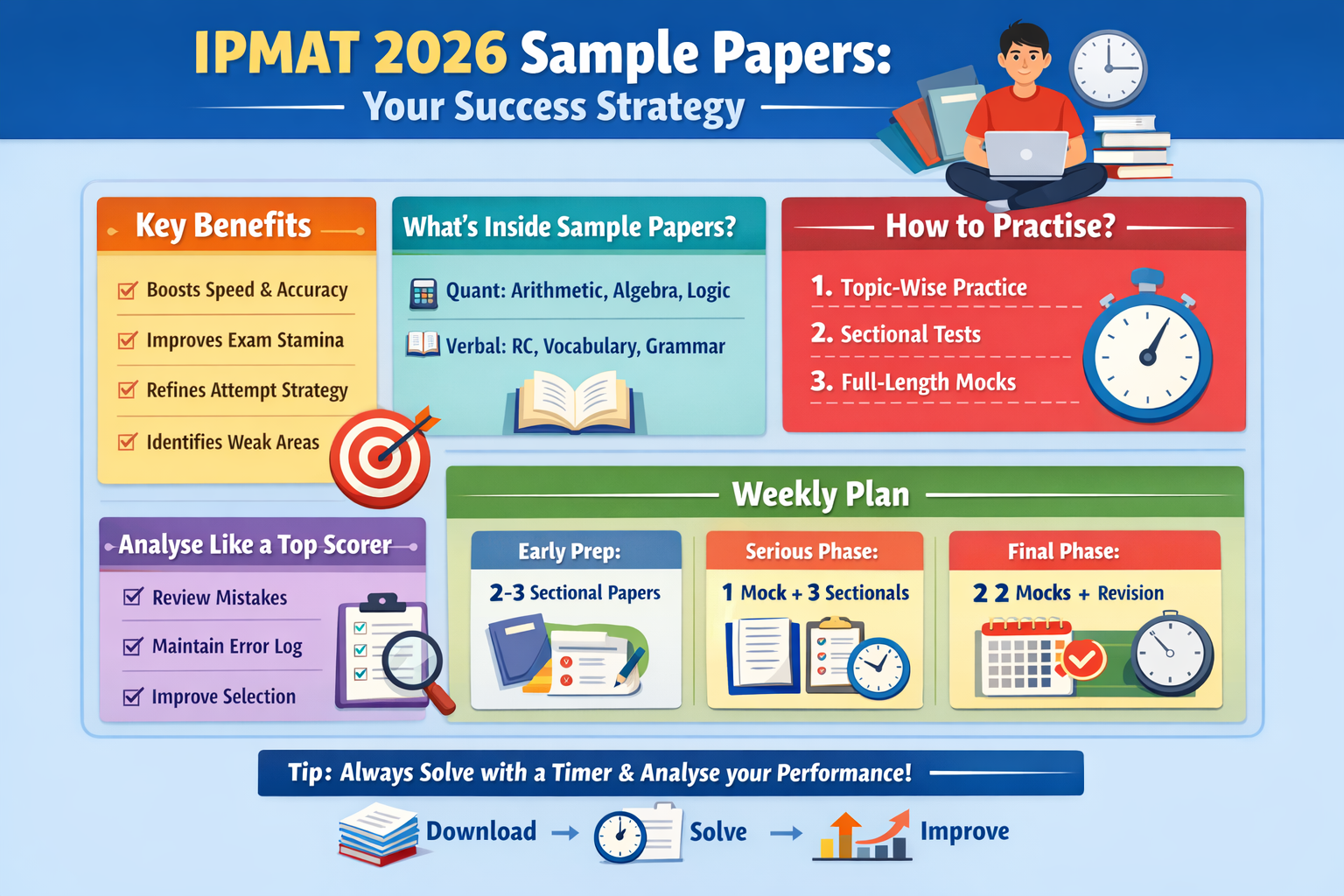
- Improves speed: you learn faster calculation patterns and quicker RC navigation.
- Builds accuracy: repeated question-types reduce silly mistakes.
- Creates exam stamina: full-length practice trains your focus.
- Refines attempt strategy: you learn what to skip and what to solve.
- Shows weak areas clearly: your analysis points out topic gaps.
How do IPMAT 2026 sample papers improve speed and accuracy?
By practising IPMAT 2026 Sample Papers under a timer, you naturally improve calculation speed, reduce hesitation, and build better decision-making. Over time, your accuracy improves because you stop repeating the same error patterns.
Do sample papers really help in cracking IPMAT?
Yes, especially when you analyse them properly. Sample papers help you convert “concept knowledge” into “exam performance” by training timing, selection, and consistency.
How to Solve IPMAT 2026 Sample Papers (Step-by-Step Strategy)
The most effective way to use IPMAT 2026 Sample Papers is to follow a progression: topic-wise practice, then sectional papers, and then full-length papers.
How should I use the IPMAT 2026 sample papers for maximum improvement?
- Start with topic-wise practice to build confidence.
- Move to sectional sample papers to master timing.
- Attempt full-length IPMAT 2026 Sample Papers weekly.
- Analyse every paper and fix gaps before attempting the next one.
Should I solve IPMAT sample papers with a timer?
Yes. If you solve without a timer, you miss the main benefit of IPMAT 2026 Sample Papers, which is learning to perform under time pressure.
How long should I take to analyse one IPMAT sample paper?
A strong benchmark is 1.5x to 2x of your attempt time. For example, if you spent 2 hours attempting the paper, spend 3 to 4 hours analysing it to understand errors, shortcuts, and missed opportunities.
| Step | What You Do | What You Track | Outcome |
|---|---|---|---|
| Attempt | Solve with a timer in one sitting | Attempt count + time pressure points | Real exam simulation |
| Analyse | Check every wrong + skipped question | Error types + time traps | Clear improvement roadmap |
| Error Log | Write what went wrong and why | Concept vs calculation vs strategy | Prevents repeated mistakes |
| Reattempt | Redo wrong questions after 3-5 days | Accuracy improvement | Long-term retention |
How Many IPMAT 2026 Sample Papers Should You Solve?
The right number depends on your preparation stage. Instead of chasing a big number, focus on consistent practice with deep analysis of the IPMAT 2026 Sample Papers.
How many IPMAT 2026 sample papers are enough?
A practical range is a mix of sectional and full-length papers spread across your preparation. What matters is whether you are improving your accuracy, time management, and decision-making with every paper.
How many sample papers should I solve per week for IPMAT 2026?
Start with 1 full-length paper per week, then scale up during the revision phase. Sectional papers can be added more frequently to sharpen weak areas.
Best Time to Start Solving IPMAT 2026 Sample Papers
When should I start solving the IPMAT 2026 sample papers?
Start solving IPMAT 2026 Sample Papers once your basics are in place. If you are early in the journey, begin with topic-wise and sectional sample papers first.
Can I solve sample papers before completing the syllabus?
Yes, but start small. Use sectional sample papers and topic-wise practice while you complete the concepts of the IPMAT Syllabus 2026. Full-length IPMAT 2026 Sample Papers are most useful when you can attempt most topics.
Weekly Plan: IPMAT 2026 Sample Papers Practice Schedule
A sustainable routine helps you practise IPMAT 2026 Sample Papers without burning out, while still leaving time for concept revision.
What is the best weekly plan for the IPMAT 2026 sample papers?
| Preparation Stage | Full-Length Papers/Week | Sectional Papers/Week | Analysis + Revision Time |
|---|---|---|---|
| Early Prep | 0 to 1 | 2 to 3 | High focus on concepts |
| Serious Prep Phase | 1 | 3 to 4 | Analyse every paper deeply |
| Final 60 Days | 2 | 4 to 6 | Revision + error-log reattempts |
How do I balance sample papers with concept study?
A simple rule: do not attempt a new paper without fixing the insights from the previous one. Use IPMAT 2026 Sample Papers to identify gaps, then spend concept-study time only on those gaps.
Common Mistakes Students Make While Solving IPMAT Sample Papers
- Solving without a timer and assuming it will translate to exam speed.
- Not analysing mistakes and moving directly to the next paper.
- Chasing attempt count instead of accuracy and smart selection.
- Ignoring Verbal analysis, especially RC inference mistakes.
- Not revisiting wrong questions and repeating the same error types.
What mistakes should I avoid while solving IPMAT sample papers?
Avoid solving IPMAT 2026 Sample Papers casually. Treat them like mini exams and always follow a fixed analysis routine to convert practice into score improvement.
Why is my score not improving even after solving sample papers?
Usually, the issue is incomplete analysis. If you are not maintaining an error log, not improving selection strategy, or not revising weak topics, solving more papers will not help. Your score improves when every sample paper changes your preparation plan slightly.
How to Analyse IPMAT 2026 Sample Papers Like a Top Scorer
How do I analyse IPMAT 2026 sample papers?
Analyse every paper using three lenses: accuracy, time, and decision-making. Your goal is to increase your “score per minute,” not just solve more questions.
What is an error log, and how do I maintain it for IPMAT?
An error log is a record of every repeated mistake pattern. For each wrong or skipped question in the IPMAT 2026 Sample Papers, write the reason: concept gap, calculation error, misread question, or poor time allocation.
| Checklist Item | What to Review | What to Note |
|---|---|---|
| Accuracy | Wrong answers + guessed answers | Concept gap vs silly mistake |
| Time | Questions that took too long | Time traps + shortcut opportunities |
| Selection | Skipped easy questions | Why you skipped and how to spot them next time |
| RC Review | Wrong inference/tone questions | Which line misled you, and why |
| Reattempt Plan | Weak topics | What will you revise before the next paper |
Topic-Wise Focus Areas from IPMAT 2026 Sample Papers
Which topics are most important for IPMAT 2026?
The most repeated topics in IPMAT 2026 Sample Papers usually come from arithmetic, algebra, number system, and reading comprehension. A strong plan focuses on high-frequency areas first and then builds breadth.
Which section is tougher in IPMAT: Quant or Verbal?
It depends on your strengths. Quant often feels tougher due to time pressure and calculation load, while Verbal can be tricky due to close options in RC. The right mix of IPMAT 2026 Sample Papers helps you stabilise both.
| Topic | Frequency in Sample Papers | Difficulty | Priority |
|---|---|---|---|
| Arithmetic (Percentages, Ratio, Averages, TSD, T&W) | High | Easy to Moderate | Very High |
| Algebra (Equations, Inequalities, Functions basics) | High | Moderate | High |
| Number System | Moderate | Moderate | Medium |
| Reading Comprehension | High | Moderate to Tough | Very High |
| Vocabulary + Grammar | Moderate | Moderate | High |
Sample Papers vs Previous Year Papers: What Should You Prioritise?
Should I solve IPMAT sample papers or previous year papers first?
Start with IPMAT 2026 Sample Papers to build your solving rhythm and timing. Add previous year papers after you are comfortable with the structure, especially in the final phase for pattern familiarity and confidence.
Are sample papers harder than IPMAT previous year papers?
Some sample papers are intentionally designed slightly tougher to improve your readiness. That is useful, as long as the paper is well-designed and aligns with IPMAT-level logic.
| Practice Type | Best For | When to Use |
|---|---|---|
| IPMAT 2026 Sample Papers | Regular practice, timing, and strengthening weak topics | Throughout preparation |
| IPMAT Previous Year Papers | Understanding real exam style and confidence-building | Mid to final phase |
Where to Get Reliable IPMAT 2026 Sample Papers
Reliable IPMAT 2026 Sample Papers should match the latest pattern, include detailed solutions, and offer a graded difficulty level. Avoid random PDFs that do not explain solutions, as they can reinforce wrong methods.
Where can I find IPMAT 2026 sample papers with solutions?
Look for platforms that provide solved IPMAT 2026 Sample Papers with clear explanations, time-saving shortcuts, and analysis support. Solutions matter because they teach you faster approaches, not just the final answer.
Are free IPMAT sample papers enough for preparation?
Free papers can be a good starting point, but serious prep usually needs a structured library of papers, reliable solutions, and performance tracking to know exactly what to fix.
Why Supergrads by Toprankers Is a Smarter Way to Practise IPMAT 2026 Sample Papers
Practising IPMAT 2026 Sample Papers becomes more effective when it is backed by structured guidance. Supergrads by Toprankers supports aspirants with a practice ecosystem that focuses on paper quality, detailed solutions, and consistent improvement.
- Level-wise papers that match your preparation stage
- Detailed solutions that teach shortcuts and better methods
- Structured practice plan so you know what to do next
- Performance tracking to measure improvement beyond scores
How can coaching help with IPMAT sample paper practice?
Coaching helps you convert practice into improvement. With guidance, you learn how to analyse papers, fix weak topics systematically, and build a realistic attempt strategy using IPMAT 2026 Sample Papers.
What is the best platform to practise the IPMAT 2026 sample papers?
The best platform is the one that gives you updated papers, strong solutions, and a consistent improvement plan. A structured ecosystem like Supergrads by Toprankers helps you practise with direction rather than guessing what to do next.
Conclusion: Use IPMAT 2026 Sample Papers to Build a Score-Boosting System
The biggest benefit of IPMAT 2026 Sample Papers comes from how you use them: timed attempts, detailed analysis, a clean error log, and focused revisions. If you practise consistently and improve your selection strategy, sample papers can become the turning point in your preparation journey.
If you want a more structured path, practise with a planned library of papers, strong solutions, and performance tracking so every paper moves your score forward.
Frequently Asked Questions
Are IPMAT 2026 sample papers based on the latest pattern?

How do I improve my accuracy using IPMAT sample papers?
How many hours should I spend daily on sample papers?
What should I do if my score is stuck?

Admin
Subject Matter Expert


SHARE