
1723534562.png)

How to Avoid Common RC Traps in CAT and Boost Your Percentile: Know Here
July 23, 2026
Overview: Overview: Learning how to avoid common RC traps in CAT 2026 is one of the highest-return VARC skills you can build. Most aspirants understand the passage but still lose marks - because CAT Reading Comprehension options are engineered to mislead. This guide breaks down the six most common RC traps in CAT, with worked examples and a quick anti-trap checklist to lift your VARC percentile.
Key Takeaways
- CAT Reading Comprehension questions include trap options designed to mislead test-takers.
- Memorising lines from the passage is not enough - real comprehension is required.
- Keywords in options mislead when the surrounding context shifts their meaning.
- Inference questions reward controlled deduction, not imagination.
- Matching the author's tone is often the difference between two close options.
- A structured anti-trap checklist, used before you commit to an answer, cuts avoidable errors.
What You Will Get in This Blog
- The most common RC traps in CAT VARC
- Practical hacks to avoid misleading answer choices
- Strategies to improve Reading Comprehension accuracy
- A quick anti-trap checklist for solving RC questions in the exam
- Actionable tips to boost your CAT VARC percentile
Reading Comprehension Makes or Breaks Your CAT VARC Score
Reading Comprehension makes up the majority of CAT's VARC section, so how you handle the passages largely decides your sectional percentile. In recent CAT years, VARC has carried 24 questions in a 40-minute section, with RC forming the bulk (typically around 16 RC questions across four passages) and Verbal Ability - para jumbles, summary, and odd-sentence questions - making up the rest. (Confirm the CAT 2026 structure in the official notification, expected around 26 July 2026; CAT 2026 is expected on 29 November 2026. Verify on iimcat.ac.in.)
The paradox most aspirants hit: you finish a passage feeling confident, then lose marks anyway. That is rarely a comprehension failure - it is an options failure. Based on Supergrads faculty analysis of past CAT VARC previous year papers, wrong options cluster into a handful of predictable patterns rather than being random. Learn to name each pattern and you stop reacting to familiarity and start eliminating with logic. That single shift is the core of how to avoid common RC traps in CAT.
Build the underlying skill alongside this guide with our Reading Comprehension for CAT resource and how to improve VARC for CAT.
Why CAT Reading Comprehension Feels Easy but Scores Drop
CAT examiners frame each RC question so that at least one wrong option feels more attractive than the right one. These distractors test whether you truly grasped the passage's argument or merely recognised familiar words. Understanding how these distractors are built is the foundation for avoiding common RC traps in CAT.
Below are the six recurring CAT Reading Comprehension traps, each with the pattern, a worked example, and the fix.
1. The Echo Trap: Familiarity Is the Danger
The trap: An option closely mirrors a line from the passage, so it feels familiar and you pick it on recognition. But it usually swaps in one meaning-changing word - always, never, only, completely, entirely.
Worked Example
Passage: "Renewable subsidies often accelerate adoption in early markets."
Trap option: "Renewable subsidies always accelerate adoption."
Why it's wrong: "Often" became "always" - a qualified claim turned absolute.
The hack: Before reading the options, predict the answer in your own words. Then choose the option that conveys the same meaning, not the one that echoes the same wording. Treat absolute qualifiers as red flags unless the passage is equally absolute.
2. The Keyword Obsession Trap: Context Over Words
The trap: An option reuses exact keywords from the passage - "industrial revolution," "economic reforms," "environmental crisis" - but twists the context so the statement no longer reflects what the author said.
Worked Example
Passage: "Economic reforms reduced inflation but widened inequality."
Trap option: "Economic reforms improved overall economic well-being."
Why it's wrong: Same keyword, opposite emphasis - it ignores the inequality the author stressed.
The hack: Focus on the idea behind the words. CAT frequently recycles keywords while flipping their meaning, so always verify that the option's context matches the passage, not just its vocabulary.
Practise this on real sets: CAT Verbal Ability questions and VARC reading tricks for CAT.
3. The Overthinker Trap: Reading Beyond the Passage
The trap: Inference questions tempt you to add your own interpretation or upgrade a hedged claim into a stronger one the author never made.
Worked Example
Passage: "This policy tends to improve efficiency."
Trap option: "This policy guarantees efficiency."
Why it's wrong: "Tends to" is probabilistic; "guarantees" is absolute. The small upgrade breaks the meaning.
The hack: Inference in CAT is controlled deduction, not imagination. Read on the lines, not between them - stick strictly to what the author's words support. If an option needs an assumption the passage doesn't provide, eliminate it.
4. The False-Connection Trap (VARC Reasoning)
Note: Para Jumbles are a Verbal Ability question type, separate from Reading Comprehension. In CAT they are currently TITA - you type the four-digit sequence, with no options to eliminate. The reasoning skill below still transfers directly into RC.
The trap: Two ideas seem strongly linked because they share a common noun, a cause–effect cue, or a similar theme - so you assume they must connect. In a jumble you pair them; in RC you assume the passage links them.
Worked Example
Two sentences both mention "urban migration," so they feel like a mandatory pair - but one discusses its causes and the other a different era's effects, breaking the paragraph's logical flow.
The hack: Test the connection against the whole structure, not the two lines in isolation. In para jumbles, confirm the sequence preserves global flow; in RC, verify the link holds across the passage before using it to answer an inference or structure question. If it disrupts the overall logic, it is a false connection.
Master this question type separately with Para Jumbles for CAT and the full Verbal Ability topics for CAT.
5. The Politeness Trap: Match the Author's Tone
The trap: An option sounds balanced, measured, and professional, so it feels reasonable and safe to pick - even when the author's tone is anything but neutral.
Worked Example
Passage tone: sharply critical of a government scheme.
Trap option: "The author offers a balanced assessment of the scheme."
Why it's wrong: A critical author is not "balanced" - the option's tone contradicts the passage's.
The hack: Identify the author's tone - critical, sarcastic, sceptical, appreciative, neutral - before choosing. Your answer must match the tone of the passage, not just its facts. Tone questions are where careful readers gain the most ground.
6. The True-but-Irrelevant Trap: Correct, but Not the Answer
The trap: An option is factually accurate according to the passage, so you feel safe selecting it - but it doesn't answer the specific question asked.
Worked Example
Question: "The primary purpose of the second paragraph is to…"
Trap option: A true detail from the passage that is real but merely supporting, not the paragraph's purpose.
Why it's wrong: Accurate content, wrong job - it doesn't respond to what the question demanded.
The hack: Re-read the question stem before locking an answer. Ask: "Does this option answer this question, or is it just a true statement?" Truth is necessary but not sufficient - relevance to the stem decides it.
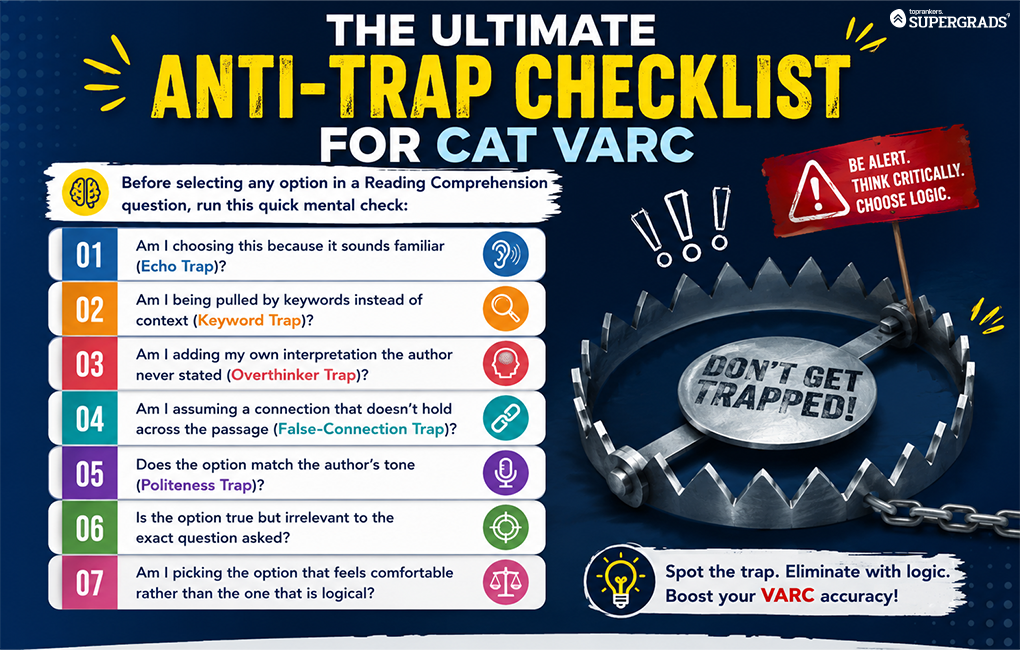
The Ultimate Anti-Trap Checklist for CAT VARC
Before selecting any option in a Reading Comprehension question, run this quick mental check:
- Am I choosing this because it sounds familiar (Echo Trap)?
- Am I being pulled by keywords instead of context (Keyword Trap)?
- Am I adding my own interpretation the author never stated (Overthinker Trap)?
- Am I assuming a connection that doesn't hold across the passage (False-Connection Trap)?
- Does the option match the author's tone (Politeness Trap)?
- Is the option true but irrelevant to the exact question asked?
- Am I picking the option that feels comfortable rather than the one that is logical?
Used consistently, this checklist is one of the most reliable ways to avoid common RC traps in CAT and protect your accuracy under time pressure.
How to Practise Trap-Spotting for CAT 2026
Reading trap-awareness only sticks when you drill it on real passages and review your errors:
- Solve 2 RC sets daily from CAT previous-year papers, then label why each wrong option was wrong using the six trap types above.
- Read widely from quality long-form sources to internalise tone and argument structure - see what to read for CAT VARC.
- Maintain an error log and review it after every mock; learn the method in how to analyse CAT mock tests.
- Take timed sectionals using Supergrads CAT VARC free resources, and calibrate volume with how many mocks are enough for CAT.
For a longer horizon, follow the structured CAT VARC 1-year preparation strategy.
CTA: Access the Supergrads CAT & OMETs test series to practise trap-spotting on full-length VARC sets.
Conclusion
The VARC section of the CAT exam is not unfair - it is precise. Every wrong option exists for a specific reason: it echoes the passage, borrows its keywords, over-extends an inference, forces a false connection, mismatches the tone, or states something true but irrelevant. By learning how to avoid common RC traps in CAT, you can identify these patterns quickly and eliminate them with confidence.
Approach every Reading Comprehension question like a detective: question each option, verify each idea against the passage, and trust logic over familiarity. Build the habit through daily practice and honest mock analysis, and you will move from a VARC struggler to a confident RC solver - and a stronger CAT 2026 percentile. Next, sharpen your overall approach with how to crack the CAT exam.
Frequently Asked Questions
What are common RC traps in the CAT exam?

Why do students fall for RC traps in CAT?
How can I identify trap options in CAT Reading Comprehension?
What is the “too extreme” trap in CAT RC questions?
What does “true but irrelevant” mean in CAT RC options?

Zubeen Siddiqui
Content Writer | MBA & CAT Preparation


SHARE