
1723534562.png)

DI LR for CAT 2026: Section-wise Syllabus, Questions, and Preparation Tips
July 2, 2026
Overview: Struggling with the DI LR for CAT preperation? Unlike Quant, there are no fixed formulas, and it can seem quite daunting. However, understanding the DILR syllabus for CAT is the first step to mastering this section with confidence. This blog serves as your comprehensive guide to approaching Data Interpretation and Logical Reasoning effectively and strategically.
- The Common Admission Test (CAT) is an essential examination for students aspiring to pursue business and management careers at prestigious IIMs (Indian Institute of Management) and other leading business schools in India.
- Clearing the CAT entrance exam not only opens doors to IIMs but also provides access to a robust alumni network, which can significantly contribute to career development.
- Recognised as one of the most challenging exams, CAT evaluates an individual's aptitude and readiness for admission to high-calibre management programs.
- The examination authorities will release the notification for the MBA entrance exam 2026 after the completion of the current examination cycle.
Table of Contents
- What is DI LR in the CAT 2026?
- Basics of Data Interpretation for CAT 2026
- Tips on How to Prepare DI LR for CAT 2026
- Data Interpretation for the CAT Syllabus 2026
- DI LR for CAT 2026 - Marking Scheme
- Best Book for DI LR for CAT 2026
- How to Improve DI LR for CAT 2026?
- How to Improve DI LR for CAT - Bonus Tips
- Conclusion
What is DI LR in the CAT 2026?
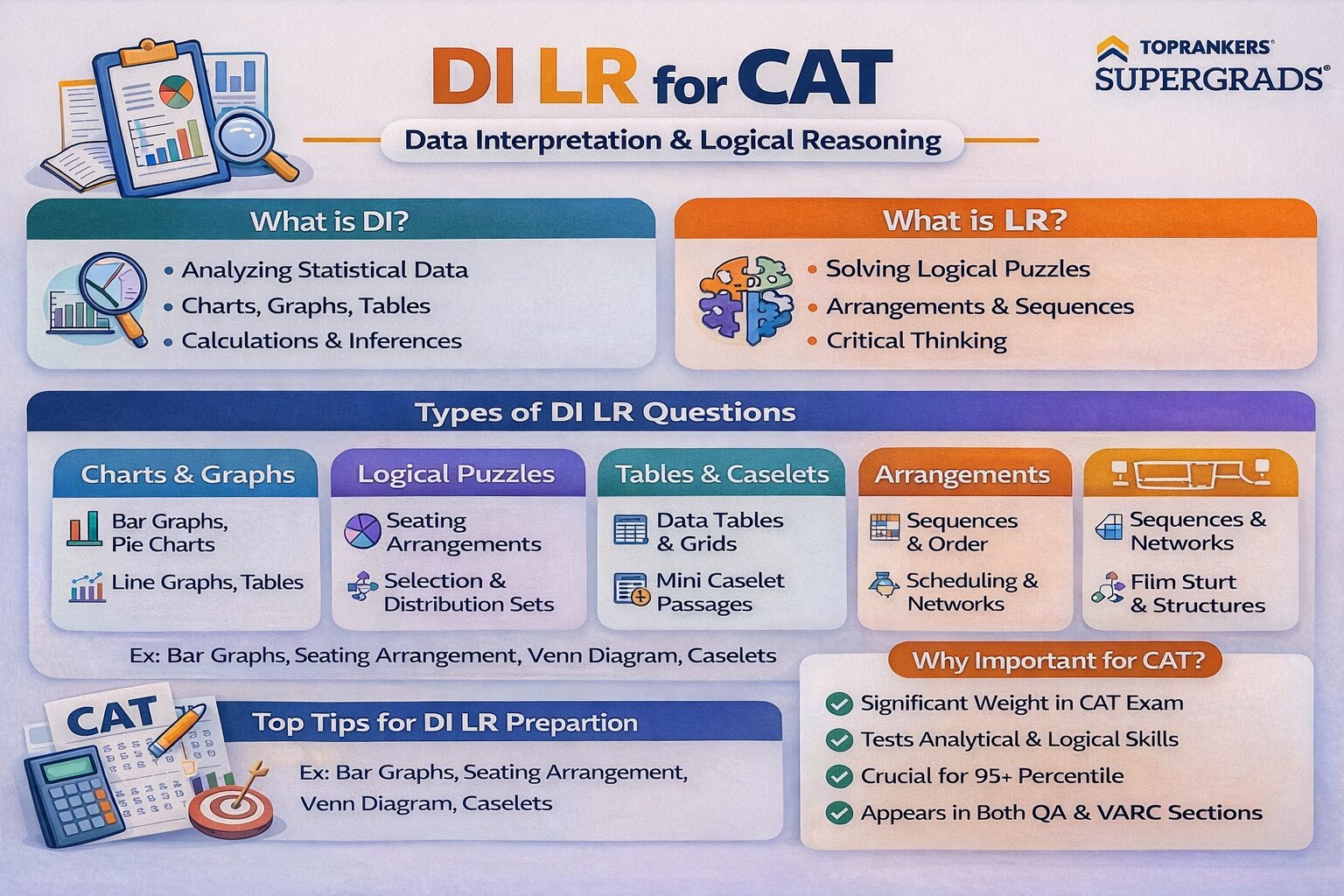
The Data Interpretation and Logical Reasoning (DI LR for CAT) section tests your ability to analyse data, recognise patterns, and solve complex problems using logic and reasoning.
- Total Questions: Approximately 20 questions (varies slightly each year)
- Time Duration: 40 minutes
- Question Types: Combination of Multiple Choice Questions (MCQs) and Type in the Answer (TITA) questions
- Difficulty Level: Moderate to High
- This section is typically divided into two parts:
- Data Interpretation (DI): Involves charts, graphs, tables, and data sets that require analysis and calculations.
- Logical Reasoning (LR): Tests your ability to solve puzzles, arrangements, blood relations, and other logical constructs.
Basics of Data Interpretation for CAT 2026
DI LR for CAT refers to Data Interpretation and Logical Reasoning for CAT. This vital section evaluates your ability to analyse data, solve problems logically, and make informed judgments. Below are the key points:
Data Interpretation (DI)
Interpretation questions in the CAT test your ability to interpret data in diverse formats, such as charts, tables, graphs, and paragraphs. You'll be required to extract crucial information, spot trends, and answer questions based on the data.
Logical Reasoning (LR)
LR DI questions for CAT assess your capability to analyse arguments, identify patterns, and draw logical conclusions. You'll encounter various reasoning problems, such as syllogisms, arrangements, puzzles, and more.
Tips on How to Prepare DI LR for CAT 2026
- Diversify your practice: Familiarise yourself with various LR DI questions for CAT to build your confidence.
- Enhance data visualisation skills: Learn to effectively represent data through sketches or diagrams to understand relationships better.
- Hone critical thinking: Train yourself to identify assumptions, biases, and logical fallacies in arguments.
- Master time management: Given that DI LR practice for CAT can be time-intensive, develop a strategy to answer questions efficiently.
- Emphasise accuracy: Since there's negative marking, focus on providing correct answers rather than attempting everything during DI LR for CAT practice
By grasping the fundamentals of the DI LR syllabus for CAT and maintaining consistent DI LR practice for CAT, you can cultivate the necessary skills to excel in this crucial section of the CAT.
Use Supergrads Free Resources 2026 Strategically
| CAT VARC Mock Test 2026 | |
| CAT DILR Mock test 2026 | |
| CAT QA Mock Test 2026 | |
| CAT VARC Prep Videos 2026 | |
| CAT DILR Prep Videos 2026 | |
| CAT QA Prep Videos 2026 | |
| CAT Syllabus 2026 | |
| CAT PYQs | |
| CAT VARC Questions |
Data Interpretation for the CAT Syllabus 2026
Listed below are the topics of DI LR syllabus for CAT:
| S.No | DI LR syllabus for CAT |
| 1. | Radar Charts |
| 2. | Pie Charts |
| 3. | Team Formations |
| 4. | Column Graphs |
| 5. | Scatter Plot |
| 6. | Order & Rankings |
| 7. | Bubble Charts |
| 8. | Tables |
| 9. | Bar Graphs |
| 10. | Venn Diagrams |
| 11. | Arrangements |
| 12. | Route and Network |
| 13. | Line Charts |
| 14. | Binary Logic |
| 15. | Data Caselets |
| 16. | Games and Tournaments |
DI LR for CAT 2026 - Marking Scheme
Before CAT 2019, there were 32 DI LR questions distributed across 8 sets in the CAT section. There has been a slight change in the pattern in recent years. In the CAT 2023 exam, out of 66 questions, 20 were in the LR DI section. This year, the sets were divided equally, with 4-5 LR DI questions per set for the CAT. While it's not feasible to solve all 4 sets, a candidate can start with the easiest sets and work up to the most difficult to achieve a good score based on the easier questions.
Below is the CAT exam pattern for the LR DI questions for CAT 2026.
+3 awarded for every right answer
1 mark deducted for a wrong answer
No negative marking for TITA
| S.no | Data Interpretation and Logical Reasoning for CAT - Section-wise | DI LR For CAT - Detail |
| 1. | Total questions in DILR for CAT | 20 |
| 2. | Division of questions | 4 sets of 5 questions each |
| 3. | Total time for sections | 40 minutes |
Best Book for DI LR for CAT 2026
| S.no | Best Book For DI LR For CAT | Author | Description |
| 1. | How to Prepare for Data Interpretation for CAT | Arun Sharma | A thorough guide recognised for its detailed clarifications and a diverse set of practice problems at different levels of complexity. Includes all the vital data analysis principles assessed in the CAT test. |
| 2. | Logical Reasoning and Data Interpretation for the CAT | Nishit Sinha |
This book is also widely chosen and provides a methodical way to learn DILR for CAT concepts. It contains quick problem-solving techniques and methods to solve problems efficiently. It offers a balanced combination of explaining concepts and providing practice questions. |
| 3. | A Modern Approach to Logical Reasoning | R.S. Aggarwal | A fantastic tool for individuals new to developing a solid understanding of logical reasoning. Clearly elucidates concepts and presents a methodical method for addressing issues. Includes a diverse set of practice inquiries of different levels of complexity. |
How to Improve DI LR for CAT 2026?
The Logical Reasoning and Data Interpretation for the CAT exam can be a formidable opponent. But fear not! With a well-defined strategy and consistent practice, you can crack this section and score high. Here's a breakdown of effective strategies to help you improve in DILR practice for CAT:
1. Building a Strong Foundation
- Conceptual Clarity: Ensure you understand the fundamentals of logical reasoning and data interpretation. Many online resources and coaching materials offer explanations and practice for CAT questions for each concept.
- Data Representation: Get comfortable with various data formats like tables, charts (pie, bar, line), and graphs. Practice interpreting data trends, comparisons, and relationships within the data sets.
2. Develop Problem-Solving Techniques
- Data Sufficiency: Master the art of identifying whether the information provided in Data interpretation questions for CAT is sufficient to answer a question. This saves valuable time during the exam.
- Logical Reasoning Techniques: Learn and practice various approaches to solve logical reasoning problems. This includes methods for tackling arrangements, puzzles, blood relations, and calendar-based questions.
3. Sharpen Your Skills with Practice
- Regular Practice: Consistent practice is key. Aim to solve 3-4 logical reasoning and data interpretation problems for the CAT sets daily, gradually increasing the difficulty level.
- Mock Tests: Take regular mock tests (ideally once a week initially, increasing frequency closer to the exam). Analyse your performance to identify strengths, weaknesses, and time management issues.
- Previous Year Papers: Solve logical reasoning and data interpretation for the CAT questions from past year exams to get familiar with the actual exam format and question difficulty.
4. Time Management is Crucial
- Develop a Strategy: Experiment and find a time allocation strategy that works for you. A common approach is to spend the first few minutes skimming all sets, then tackling the easier ones first. Allocate a maximum time limit per set to avoid getting stuck.
- Learn to Skip: Don't waste time on difficult logical reasoning and data interpretation for the CAT sets initially. Move on and revisit them later if time permits. Focus on maximising attempts in your comfort zone.
5. Develop an Exam Day Mindset
- Stay Calm: Anxiety can cloud your judgment. Practice relaxation techniques, such as deep breathing, to stay calm during the exam.
- Maintain Accuracy: While speed is essential, prioritise accuracy. Don't get tempted to guess blindly. A well-asked question is better than a random guess.
- Read Carefully: Avoid careless mistakes by thoroughly reading questions and data sets.
How to Improve DI LR for CAT - Bonus Tips
- Develop an "analytical eye": Start noticing and analysing data presented in everyday life (newspapers, advertisements, etc.). This will improve your data interpretation skills.
- Practice Mental Math: Sharpen your mental calculation abilities to solve data interpretation questions quickly and efficiently.
- Work on Puzzles: Regularly solving puzzles like Sudoku, crosswords, or brain teasers can enhance your logical reasoning and problem-solving skills.
Remember: Consistency is key. With focused practice and the right strategies, you can conquer the DI LR for the CAT section and achieve your target score!
Conclusion
The DI LR for CAT section can be mastered. Through regular practice with mock exams and previous CAT papers, you will improve your ability to identify solvable questions and gain insights from your errors.
Hone both your data interpretation and logical reasoning skills to become a versatile problem-solver.
Lastly, tackle the CAT exam with an effective time management strategy and a positive attitude. By implementing these suggestions, you'll be on track to effectively navigate DILR for CAT 2026 and attain success in CAT 2026
Learn more: How Many Students Appear for CAT Exam Every Year

Smart Prep for CAT: Join Our Free Demo Class
Fill your details
Frequently Asked Questions
What strategies can I use to help me prepare for Data Interpretation for the CAT?

How can I improve my speed in Data Interpretation for the CAT?
What resources can I use to help me prepare for Data Interpretation for the CAT?
How important is data interpretation in the CAT?

Zubeen Siddiqui
Content Writer | MBA & CAT Preparation


SHARE