



NID Storyboard and Comic Strip Questions: Solved Examples, Format & PDF
November 24, 2026
NID storyboard and comic strip questions are visual-storytelling tasks in the NID DAT where you tell a short story in a sequence of frames. They come in two forms - theme-based (you're given a problem area and told to invent your own story) and story-based (you're given a ready-written story and must illustrate it in a set number of frames).
A storyboard requires you to illustrate scenes across frames of the same size with descriptions written below, while a comic strip uses speech bubbles and varying panel sizes.
Marks are given mainly for story clarity, character consistency, originality, and presentation, not for perfect drawing.
Key Highlights - NID Storyboarding and Comic Strip Questions
- What does NID storyboarding questions test: visual storytelling, imagination, sequencing and clarity
- Standard format: a theme/problem → a short abstract → character sketches → 4-5 key frames.
- Difference between comic strip and storyboard: comics use speech bubbles and panels that can vary in shapes + sizes, but storyboards focus on actions drawn in frames of the same size with textual explanation below.
- Where they appear: NID Prelims (subjective drawing) and the Studio Test (Mains).
- Marking: story idea, character appropriateness, originality, and presentation quality.
- Color: permitted (dry colors - color pencils, oil pastels, sketch pens) but not required - always follow each question's instruction, since some say "color optional" and some say "do not use color."
- Biggest edge: a strong, clear idea and readable sequencing win over detailed rendering.
What Are NID Storyboard and Comic Strip Questions?
In the NID DAT, storyboard and comic strip questions ask you to tell a short story in a sequence of frames. They come in two formats, and spotting which one you've been given is the first thing to do in the exam:
| Format | What You're Given | What You Do |
|---|---|---|
| Type 1 - Theme / problem-based | A context or problem area (e.g., drought, dengue, extinction) | Invent your own story, characters and frames around the theme |
| Type 2 - Story / situation-based | A ready-written story or situation (e.g., a girl panicking over a bug, a guru and a man) | Illustrate the given story in a set number of frames - don't change the plot, interpret and sequence it |
- In Type 1, you're the writer and the illustrator - you create the narrative from a theme and often add a 5-line abstract and character sketches.
- In Type 2, the plot is handed to you - your job is comprehension and visual sequencing. Read the story, pick the key moments, keep characters consistent, and show the beginning, middle and end clearly (sometimes with a title and moral).
Whichever format appears, the skill being tested is the same - thinking and communicating visually. NID isn't checking whether you can draw like a professional, it's checking whether you can take a story, break it into a clear beginning-middle-end, keep your characters consistent, and sequence it so a stranger understands it at a glance.
That's the core skill of a communication or animation designer, which is why these questions appear so often.
Comic Strip vs Storyboard: What's the Difference in NID?
Students mix these up constantly, and the wording of the question tells you which one is expected. Here's the distinction as it applies to the NID DAT:
| Aspect | Comic Strip | Storyboard |
|---|---|---|
| Speech | Uses speech bubbles and dialogue inside the frame | Focuses on action; description written below the frame |
| Frame size | Varying sizes (often a row of ~5 panels) | Usually same-sized frames |
| Narrative | Short, usually one specific event | A longer sequence, often multiple events |
| Lead character | Can be drawn large (frames are flexible) | Shown within limited, uniform space |
| Real-world use | Made for newspapers, magazines | Made before producing a film, video or animation |
NID often blends the two at times. Many questions say "comic strip" but ask for a story told in key frames, so you'll use clear sequencing either way. Read the instruction carefully. If it mentions dialogue or speech bubbles, it’s comic and if it says key frames, actions or a storyboard for a film/animation, solve like a storyboard with short captions.
To see the most recent trend, look at the drawing questions in the NID 2026 question paper.
Where Do Storyboard and Comic Strip Questions Appear in NID?
- NID DAT Prelims: the subjective/drawing part of the paper often includes a storyboard or comic strip question worth significant marks. (For reference, DAT Prelims is a time-pressured paper of textual and visual questions completed in about three hours.)
- NID Studio Test (Mains): storyboarding and visual narrative tasks are common, sometimes with more time and larger sheets.
- Animation Design prompts: the "problem area – animation design" questions (drought, extinction, disease awareness) are classic storyboard/comic tasks.
Because these questions recur across stages, strong storyboarding practice pays off through the whole NID journey.
Storyboarding and visual-narrative tasks are also common in the NID Studio Test, so prelims practice carries straight into the Mains.
The Standard NID Storyboard and Comic Strip Question Format (Decoded)
For theme/problem-based questions (Type 1), almost every prompt is built from the same five parts. Learn this template and you can attempt any theme:
| Part | What You're Asked | What to Deliver |
|---|---|---|
| 1. Context / problem | A theme or issue (e.g., drought, dengue, extinction) | Understand the message you must convey |
| 2. Story abstract | A short story, often 5 lines | A clear beginning → conflict → resolution |
| 3. Characters | Invent characters; often 3 alternate sketches each | Distinct, theme-appropriate designs |
| 4. Storyboard | The story in 5 key frames | Clear, sequenced, readable frames |
| 5. Colour | Allowed but not required – follow the question's wording | Use only if permitted and it adds clarity, not decoration |
For story/situation-based questions (Type 2), the plot is already written for you, so the flow is shorter:
(1) read the story and find the key moments
(2) split them into the exact number of frames asked (4 frames, 3 scenes, etc.)
(3) draw each frame keeping characters consistent
(4) add dialogue or captions, and
(5) add a title and moral if the question asks.
Here you're not invited to change the plot - you're judged on how faithfully and clearly you illustrate it.
Evaluation criteria (what examiners actually score, in both types):
| Criterion | What It Means |
|---|---|
| Story / abstract | Is the idea clear, original and complete? |
| Character appropriateness | Do the characters fit the theme and read clearly? |
| Originality | Is the storyboard fresh, not a cliché? |
| Presentation quality | Is it neat, sequenced and easy to follow? |
Strong, consistent characters come from regular drawing practice, so build the habit with our NID sketching questions.
Solved Past-Year NID Storyboard & Comic Strip Questions (with model approach)
Here are two solved NID storyboard and comic strip questions and answers that show exactly how a strong response looks - one as a comic strip (with speech bubbles) and one as a storyboard (action-led key scenes).
Question 1 "Bug in My Hair" (4-frame comic strip)
One day Luna saw a bug in her room and screamed in panic. As she ran around shouting, the bug sneakily landed in her hair! Luna freaked out even more, calling for help. Her mom rushed in, confused, while Luna kept yelling about the creepy intruder in her hair. Frame a story in 4 frames, and mention the title and moral of the story.
Model answer:
- Title: Bug in My Hair
- Moral: Don't panic - stay calm and face your fears.
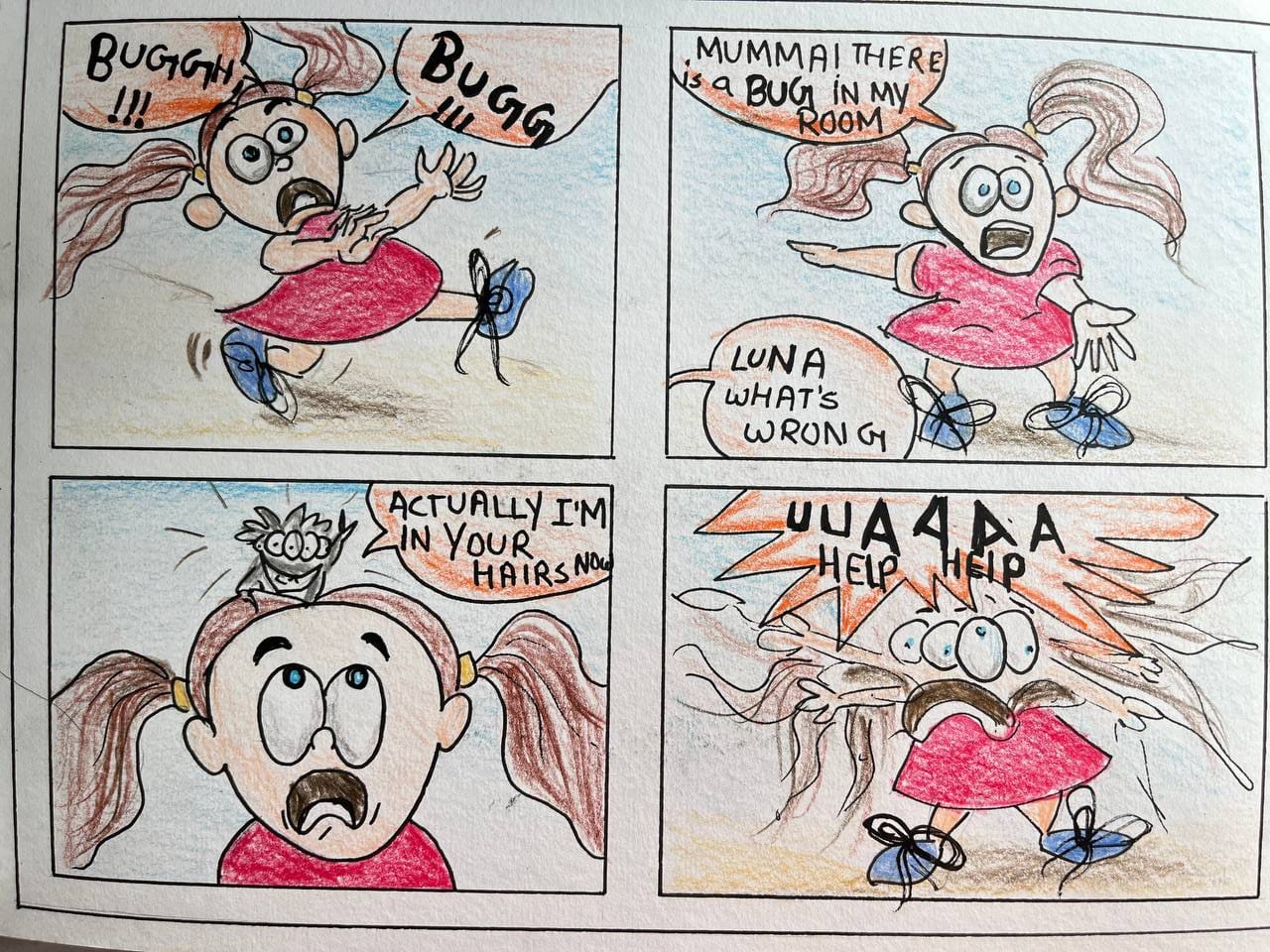
| Frame | What Happens | Speech |
|---|---|---|
| 1 | Luna runs in panic, arms flailing, the bug on the floor | “Bug!!! Bug!!!” |
| 2 | Mumma rushes in; Luna points, terrified | Mumma: “Luna, what's wrong?” · Luna: “Mumma! There is a bug in my room!” |
| 3 | Close-up: the bug now sits in Luna's hair, which goes wild as she panics | Bug: “Actually, I'm in your hair now.” |
| 4 | Luna shocked and scared, hands up | “UAAAAA HELP HELP” |
Note that his question is a true comic strip - speech bubbles drive it, the sequence has a clear setup → twist → climax, the single character stays consistent across frames, and the title + moral are included exactly as asked.
Question 2 - "The Guru and the Idiot Man" (3-frame storyboard)A Guruji travels in a palki with his disciples. An idiot man stops the procession and insists the Guruji come down to meet him. The Guruji calmly steps out; the man asks, "Guruji, can you please show me the way to heaven?" The Guruji replies, "Raise your hand towards the sky and stand here at this very place," then continues his journey. Twelve years later the Guruji passes again and finds the man still standing, hand raised, beard long, clothes torn — and realises the man's -soul is now rising to the sky, having attained heaven through devotion and patience.
Task: Illustrate three key scenes from the story, highlighting transformation over time.
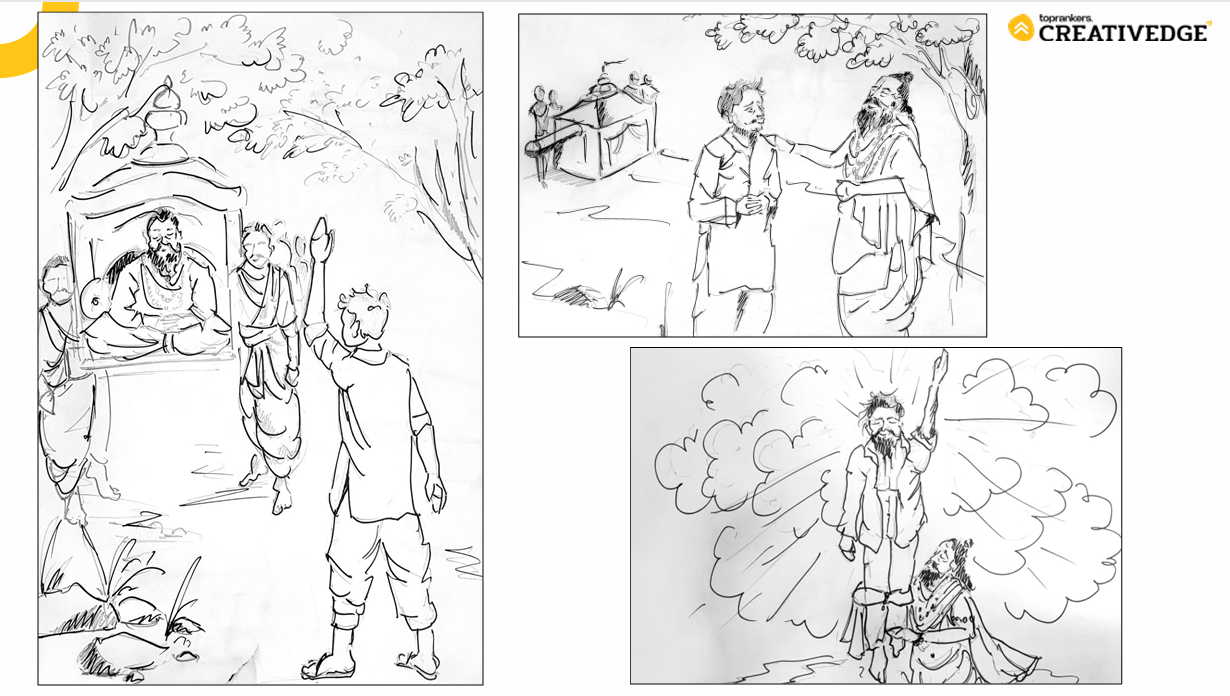
| Scene | What It Shows | Story Beat |
|---|---|---|
| 1 | Guruji in the palki with disciples; the idiot man stands in the path, hand raised | Beginning – the conflict |
| 2 | Guruji steps out of the palki and speaks with the man beside a hut | Middle – devotion & time lapse |
| 3 | The man's soul rises into the clouds; the Guruji holds his feet as both ascend | End – spiritual resolution |
This is a storyboard, not a comic - it's action- and scene-led (no speech bubbles), the three frames clearly separate beginning → middle → end, and the transformation over time reads instantly. High-scoring NID responses always make those three beats unmistakable.
Storyboard and comic strip questions sit in the drawing part of the paper, alongside the other NID subjective questions you’ll need to practise.
More Real NID Storyboard and Comic Strip Questions (Past-Year Examples)
These are actual NID-style problem-area questions in the standard format. Use them exactly as practice prompts.
Q1) Create a comic strip on theme 'Drought' of five key frames with three characters - a farmer, a politician and God - using text and images.
(a) Draw three alternate sketches for each character.
(b) Represent the storyboard in five key frames; color optional.
Judged on character portrayal, originality, and presentation.
Q2) With tigers and sparrows near extinction, create a comic strip of five key frames featuring a tiger, a sparrow and a poacher.
(a) Five-line abstract.
(b) Storyboard in five key frames; color optional.
The best way to build this speed is under real conditions, so attempt a timed NID DAT mock test and review every frame.
5 NID-Level Sample Storyboard and Comic Strip Questions (with Solution Approach)
Here are a few practice questions exactly how they appear in the real exam. Spend ~5 minutes planning, then draw. Each includes a solution approach - the idea and frame breakdown, so you learn the thinking, not just copy a drawing.
Sample 1 - Plastic pollution in the ocean
Create a comic strip of five key frames with a sea turtle, a plastic bottle (as a villain) and a child. Write a five line abstract, illustrate in five frames and give a suitable title to the story.
Solution:
Title of the story - “Say NO to Plastic”
- A turtle mistakes a floating plastic bottle for food
- gets tangled
- a child on the beach spots it
- the child frees the turtle and bins the plastic
- the clean shore and happy turtle close the story.
Characters used in the sketch (as per question)
- turtle (gentle, expressive eyes)
- plastic bottle as a villian (sharp, smirking label-face)
- a child (hero, curious, kind)
To see which question types and themes are trending, read the latest NID exam analysis.
Sample 2 - Smartphone addiction among teenagers
Comic strip, five key frames - a teenager, a smartphone (personified), and a friend/parent.
How to solve:
- Show a teenager on a glowing phone - a character that grows bigger and more controlling
- misses a real moment (a friend waiting, a meal, sunlight)
- friend/parent gently intervenes
- teen looks up, phone shrinks
- ending that clearly tells the message (phone used, but life first).
Sample 5 - Air pollution in a city
Storyboard, five key frames: a tree (personified), a factory owner, and a schoolchild.
How to solve this question:
- A coughing, grey tree like character that cry beside smoking factories
- a school child notices
- child's poster/campaign reaches the factory owner
- filters added, saplings planted
- The tree revives, green and smiling.
Shows cause → awareness → action → change.
This is as much a test of imagination as of drawing, which is why it pairs well with the NID creativity test questions.
How to Attempt NID Storyboard and Comic Strip Questions (Step by Step)
The NID DAT Prelims is a 3-hour paper with several questions (objective and subjective), so a storyboard or comic strip question is just one part of it - not your whole time.
Budget by marks - a full question with an abstract, character sketches and five frames usually deserves around 25-30 minutes, while a shorter "illustrate this story in 4 frames" task needs less.
The step split below scales to whatever time the question's marks justify. For story-based questions (Type 2), skip inventing the plot and spend that time reading closely and picking the right key moments.
| Step | What to Do | Rough Share of Your Time |
|---|---|---|
| 1. Read & underline | Mark the deliverables – number of frames, characters, abstract or not, colour allowed or not | ~1–2 min |
| 2. Lock the idea | Fix the beginning, conflict and resolution in one line (for Type 2, pick the key moments from the given story) | ~3 min |
| 3. Write the abstract | Only if asked – a 5-line story in simple, specific sentences | ~3 min |
| 4. Design characters | 2–3 quick alternates each; pick the clearest and keep them consistent | ~4 min |
| 5. Thumbnail the frames | Sketch all frames tiny first to fix the sequence before committing | ~2 min |
| 6. Draw the final frames | Bold, clear line work; keep figures readable and all frames at the same finish level | ~10–12 min |
| 7. Add words | Speech bubbles for a comic; short captions below frames for a storyboard | ~2 min |
| 8. Final pass | Number the frames, add a title/moral if asked, check neatness and sequence | ~2 min |
Mentor’s Tips:
- Finish all your frames (roughly) before starting with final finishing work for any of them, and check the clock after the thumbnail stage
- If you realise you don’t have much time, simplify the drawing, not the story.
The students who score highest treat it as storytelling under time pressure, not as a finished illustration.
Fit this into your wider plan by checking where storytelling sits in the full NID DAT syllabus.


Common Mistakes in NID Storyboard and Comic Strip Questions
- Over-rendering one frame and running out of time for the rest - the story breaks. Keep all five frames at the same finish level.
- No clear conflict or resolution - a sequence of pretty frames with no story scores low.
- Characters that don't fit the theme or that look identical frame to frame.
- Ignoring the instruction - drawing speech bubbles when a storyboard (action + captions) was asked, or vice versa.
- Cluttered frames - too many elements make the sequence unreadable.
- Forgetting the abstract or character sketches when the question explicitly asks for them.
- Treating it as an art test - spending all your effort on shading instead of story clarity.
Storyboard questions sit in the subjective part of the paper, so it helps to know the full NID DAT exam pattern before you plan your time.
How to Prepare for NID Storyboard and Comic Strip Questions (Roadmap)
With NID exam 2027 about a month away, here’s a focused 4-week plan to sharpen your storyboarding specifically. It’s just one topic among many, so aim for 30-45 minutes a day on it alongside your other prep.
(If you’re targeting the 2028 NID DAT exam, follow the same four phases, but you have around 12 months, so you can spend more time on fundamentals.)
| Week | Focus | What to Practice |
|---|---|---|
| Week 1 | Fundamentals & formats | Learn the comic-vs-storyboard difference and the 4- or 5-frame structure; practice stick-figure storytelling, sequencing and expressions – one short story a day |
| Week 2 | Characters & themes | Design 2–3 reusable hero/villain characters, and practice theme-based (Type 1) prompts on common issues like pollution, health and wildlife |
| Week 3 | Timed, both types | One full question a day under time - mix Type 1 (invent) and Type 2 (illustrate a given story), solve NID previous-year questions, and self-review against the marking criteria |
| Week 4 | Peak & revise | Speed and neatness, clean sequencing, titles, captions and morals; a couple of full mock attempts early in the week, then light revision and rest before the exam |
Most repeated themes in such questions:
- environment (drought, pollution, water, wildlife/extinction)
- public health (dengue, hygiene, screen addiction)
- and civic/social issues (traffic, cleanliness, kindness)
Free NID Storyboard and Comic Strip Resources
Everything you need to practice NID storyboard and comic strip questions - download the question sets, test yourself under time, and get mentor feedback on your frames.
| Resource | What You Get | Download / Purchase Link |
|---|---|---|
| NID Storyboard & Comic Strip Questions PDF | All the past-year and sample questions above in one printable practice sheet, plus a blank 5-frame template | |
| NID Previous Year Question Papers Book | Real NID papers with QR-based video solutions for each drawing question | |
| NID Sample Papers Book | Hundreds of exam-level practice questions to build speed and range | |
| NID DAT Mock Test | Attempt a full, timed drawing section the way it appears in the real exam | |
| NID Previous Year Papers (PDFs) | Real Exam Papers (memory-based) with Answer Key | |
| NID Sample Papers (PDFs) | Exam-level practice questions to build speed and ideation | |
| NID Crash Course by Creative Edge | Guided storyboarding practice with mentor feedback on your frames |
Storyboarding is one piece of the puzzle, so fit it into a full plan for how to prepare for NID.
Conclusion
Marks in NID storyboard and comic strip questions are rewarded for one thing above all - clear visual storytelling.
Whether you’re given a theme to build from or a full story to illustrate via sketches, the formula stays the same:
- Decide on a simple beginning and a final resolution
- Keep your characters consistent (in form, appearance, build, etc.)
- sequence your frames so anyone understands them at a glance
Drawing skill helps, but a strong, readable idea is what scores.
Practice both question types with the past-year and sample questions above, download the NID storyboard and comic strip questions PDF, and attempt a few under the clock before NID DAT 2027. Do that consistently, and this becomes one of the most scorable parts of your paper.
Preparing for NID 2027? For guided storyboarding practice with mentor feedback on your frames, explore NID online coaching by Creative Edge.


Attempt a Free NID Mock Test
Fill your details
Frequently Asked Questions
What are NID storyboard and comic strip questions?

Is a comic strip the same as a storyboard in NID?
How many frames are needed in a NID storyboard question?
Do I need to colour my NID storyboard?
How are NID storyboard and comic strip questions marked?
Are NID storyboard and comic strip questions hard if I can't draw well?
Where can I get NID storyboard and comic strip questions and answers in PDF?
Which NID programs ask storyboard and comic strip questions?

Vineeta Agrawal
Communications Executive
SHARE