
1723534562.png)

How to Prepare for NID in 2 Months: A Realistic DAT 2027 Study Plan
September 25, 2026
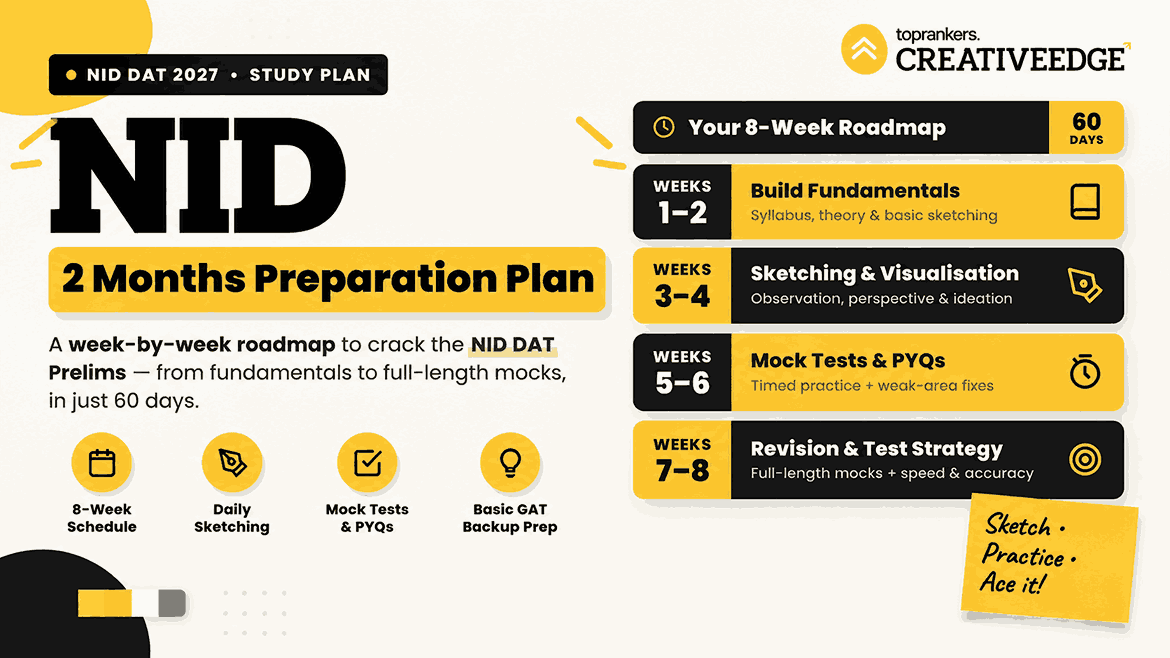
For completing NID preparation in 2 months, use the time to clear the Prelims, not to master everything at once. With the NID DAT 2027 Prelims on 20 December 2026, a focused 8-week sprint of 3-4 hours a day on drawing, visualization, design thinking and timed mock practice is enough to get shortlisted.
Since 2026, Prelims is a Creative Ability Test (drawing and idea-based tasks) with no separate aptitude/GK section, so your two months should go almost entirely into sketching speed, observation and clear visual thinking - not rote theory.
Key Highlights- NID Preparation in 2 Months
- Exam date: NID DAT 2027 Prelims - 20 December 2026 (offline, 3 hours, 100 marks, no negative marking).
- Real goal in 2 months: clear Prelims and get shortlisted. Prelims carries 0% weight in the final merit, but you can't reach Mains without passing it.
- What to focus on: perspective, object and figure drawing, visualization, storyboarding, design thinking, and timed practice.
- What to skip: heavy GK/quant (the GAT section was removed in 2026) and Mains-only studio work - that comes after you're shortlisted.
- Daily commitment: 3-4 focused hours, ending most weeks with a full-length mock.
Two Months Is Enough - If You Aim at the Right Target
If you've landed here with about eight weeks on the clock, take a breath. NID isn't an exam you "finish" by memorizing a fixed syllabus. It rewards how clearly you see, think and put ideas on paper - and that's a skill you can sharpen fast with daily practice.
Most students who search how to prepare for NID in 2 months make the same mistake - they treat it like a full-syllabus cram. In a two-month window, that spreads you too thin.
The smarter move: point all your energy at one target - clearing the Prelims.
Here's why that framing matters:
- Prelims is a shortlisting round. As per NID's 2027 schedule, it holds no weight in your final selection.
- Mains decides everything. Your final result comes entirely from the Studio Test and Interview.
- But you can't skip the gate. You still have to clear Prelims to be shortlisted for Mains.
So your two months have one clear job: build the drawing and thinking skills that get you past the qualifier. Mains preparation is a separate phase - it starts after Prelims, when you'll have several more weeks before those rounds.
Note: Always confirm the latest dates on the official NID admissions site, since NID can revise its schedule.
What Is the NID DAT 2027 Exam Pattern You're Preparing For?
Before building any plan, you need to know what the paper actually looks like today - because it changed recently and most older guides haven't caught up.
Since the 2026 cycle, the NID DAT Prelims is a Creative Ability Test (CAT) - a drawing-and-ideas paper with tasks like scene creation, perspective drawing, storyboarding, product redesign, observation and design thinking.
The objective General Ability Test (GAT) - reasoning, quantitative aptitude and general knowledge was removed. NID doesn't publish an official syllabus, and the exam is known for being unpredictable, so a small GAT-style element could reappear; but as of now, your two months belong to drawing and visual thinking.
|
NID DAT 2027 Prelims |
Details |
|
Date |
Sunday, 20 December 2026 |
|
Mode |
Offline (pen/pencil & paper) |
|
Duration |
3 hours (B.Des typically 10 AM–1 PM) |
|
Total marks |
100 |
|
Question style |
Drawing & design-thinking tasks (approx. 6 questions with sub-parts) |
|
Negative marking |
None |
|
Language |
English |
|
Weightage in final merit |
0% (qualifier only) |
For the full breakdown, keep the NID exam pattern and NID syllabus pages open as reference while you plan.
After Prelims: What Happens Next
Once you've cleared the 20 December Prelims, you'll be shortlisted for the DAT Mains - the Studio Test and interview that decide your final selection.
For B.Des, the Studio (Sensitivity) Test carries the larger weight, with the in-person round making up the rest, and Mains is usually held around April-May 2027. That gives you a fresh block of time to prepare model-making, material handling and interview readiness.
So don't spend your two months there now - clear the qualifier first, then shift gears. When you reach that stage, the NID Studio Test guide and interview questions will be your next stops.
NID 2027 Preparation in 2 Months (Week by Week Plan)
In these 8 weeks, think of building skill first and speed after. In the first month work on your drawing and visual vocabulary; in the second month turn that into exam-appropriate speed and idea clarity through practice with a timer.
|
Week |
Focus |
What to do / How to practice |
|
Week 1 |
Understand the exam and set fundamentals in place |
Get an idea of the exam pattern and changes introduced over the years, study a few previous year NID papers (just observe), practice daily line-control, shapes and object sketching |
|
Week 2 |
Perspective & composition |
1-point and 2-point perspective, object sketching from different angles, design problem-solving, human figure proportions, basic shading techniques |
|
Week 3 |
Visualization & observation |
2D & 3D, top/front/side views, memory drawing |
|
Week 4 |
Ideation & design thinking |
Idea generation, product redesign, composition with a focal point |
|
Week 5 |
Storytelling & scenes |
Storyboarding (4-6 frames), scene creation from a theme, expressions and quick characters |
|
Week 6 |
Practice under time per question |
Solve individual NID style drawing/design questions against the clock, undergo few topic tests, get feedback, and do theme-wise analysis of past papers |
|
Week 7 |
Give full mocks |
2-3 full length 3-hour mock tests under exam conditions, analyze and rework on your weakest areas |
|
Week 8 |
Improve and sharpen |
1-2 final mocks early, then ease off, revise your best scored papers, finishing touches & presentation, sort out exam-day logistics |
Confirm the exact age limit and category relaxations in the full NID eligibility criteria, before investing time and effort in exam preparation.
Daily Study Plan for NID Preparation in 2 Months (3-4 Focused Hours)
Short but focused study sessions are better than long but distracted hours. Here's how experts suggest you can plan your schedule on most days and even cut back when you have board-exam commitments.
|
Time block |
Activity |
|
30 min |
Warm-up: circles, ellipses, boxes, quick object sketches |
|
90 min |
Skill focus for that week (perspective, rendering, ideation, etc.) |
|
60 min |
Application: a timed CAT-style task |
|
20 min |
Review one past-paper question; note the idea, not just the drawing |
Consistency is the whole game and is the sole reason why few make it to the top in a skill-heavy subjective design exam like NID DAT, while others don’t.
Forty focused minutes every single day will take you further in two months than a seven-hour Sunday you can't repeat.


What to Focus On - and What to Skip - in the Final 2 Months
With limited time, what you don't do matters as much as what you do. This is where the NID DAT 2 months preparation plan differs from a leisurely six-month one.
|
Skill area |
Priority |
Why |
|
Perspective, object & figure drawing |
High |
The backbone of nearly every CAT task |
|
Visualisation (2D↔3D, views) |
High |
Frequently tested; improves fast with drills |
|
Design thinking & ideation |
High |
NID rewards original ideas over polished art |
|
Storyboarding & scene creation |
High |
Common, high-mark question types |
|
Timed practice & full mocks |
High |
Two months is too short to leave speed for later |
|
Presentation (labels, clean linework) |
Medium |
Easy marks students routinely lose |
|
GK / quantitative / reasoning |
Low |
GAT was removed in 2026 - a light newspaper habit is plenty |
|
Mains studio/model-making & portfolio |
Skip for now |
That's the phase after you clear Prelims |
If you're deciding where to start, the section-wise preparation guide and NID DAT drawing tips will help you allocate effort within these priorities.
Is the 2-Month NID Plan the Same for B.Des and M.Des?
Similarities (the shared core)
Both B.Des & M.Des candidates appear for the Prelims paper on the same day- 20th December 2026, and both are judged on the same creative fundamentals, but different academic & difficulty levels.
So the week-by-week skill build, the daily 3-4 hour routine, and the final-weeks mock strategy apply to everyone without change.
Differences (what exactly changes)
|
Particulars |
B.Des / Integrated M.Des |
Regular M.Des |
|
Who |
Class 12 (any stream); Integrated is the 5.5-yr pathway at Ahmedabad, Bengaluru, Gandhinagar |
Graduates (any discipline); final-year students can apply |
|
Prelims focus |
Creative Ability Test - broad, general creativity tested |
CAT + a discipline-specific test for your chosen field |
|
Prelims filter |
Tighter - shortlist is ~2.5× seats, so speed and idea clarity matter more |
Wider - ~4.5× seats per discipline, slightly less Prelims pressure |
|
If applying to 2 disciplines |
N/A |
Longer paper (up to ~4.5 hrs) depending on number of streams chosen - build stamina in your mocks |
|
Mains weightage |
Studio Test 60% + Personal round 40% |
Studio Test 40% + Interview 60% (interview-heavy) |
|
Gap after Prelims |
Longer - Mains around Apr-May 2027 |
Shorter - results and Mains come earlier (Feb-Apr 2027) |
How to do NID preparation in 2 months for each:
- B.Des / Integrated: Because the Prelims in B.Des filter out more candidates after stage 1 than M.Des, spend the weeks from 6 to 8 pushing hard on speed and clear ideation. It will also help you in Mains afterwards.
- Regular M.Des: Same core, plus two adjustments. First, carve out 30-40 minutes a day for discipline-specific prep - domain awareness, visual reasoning and current affairs for your chosen field.
Second, because the gap in your Prelims & Mains is very small and your interview carries 60% weightage in the final result, keep a solid SOP drafted beforehand and your "why this discipline" story ready, real & impactful even during the Prelims preparation phase, so you can pivot faster once shortlisted.
NOTE: NID doesn't publish an official syllabus and the M.Des discipline-test format has shifted before, confirm the exact structure in the official 2027 handbook.
How Should You Use Mock Tests in the Last Weeks?
Mocks, if utilized correctly, can help you crack the exam with just 2 months of dedicated prep. Ideally, from 6th week onward, they stop being optional. A full-length, three-hour mock under real conditions will teach you what random sketching practice could never, and that is managing time in a lengthy paper without losing idea quality.
After each mock, spend as long in analysis as you did while attempting it. Ask three major questions for each attempt:
- Was the idea clear?
- Was the drawing readable?
- Did I finish on time?
Patterns will show up - maybe you get stuck in detailing and run out of time, or your ideas are strong, but your linework is not clean.
Fix one pattern per mock. Working through NID previous year question papers and full-length mock tests in these final weeks is the single highest-return habit you can build.
Common Mistakes to Avoid in the 2 Months NID Preparation
1. Chasing "beautiful" art.
Examiners look for clarity of thought, observation and communication - not gallery-ready illustration. A simple, well-labelled idea beats a fussy, unclear one.
2. Leaving timed practice for the end.
Speed is a skill as important as drawing. Start timing yourself by Week 4, not Week 8.
3. Over-preparing removed topics.
Pouring hours into GK and quant is the classic trap in older guides. Don't.
4. Skipping mock analysis.
An unreviewed mock is just a tiring afternoon. The learning is in the review.
5. Front-loading burnout.
Eight-hour days in Week 1 lead to a crash in Week 5. Protect a sustainable daily rhythm.
Can You Crack the Exam with the NID 2 Months Preparation Plan Even if You Can't Draw Well?
Yes, and this is worth saying clearly: NID is not looking for the best artist in the room. It's looking for someone who observes carefully, thinks originally and communicates ideas on paper. Those are learnable skills, and two months of daily practice moves them a lot.
However, what’s important is getting feedback on your sketches from mentors who actually understands what this exam and the examiners are looking for.
Use the thumbnail & stick-figure method to get proportions right before you worry about details. Draw what you actually see rather than what you think things look like. Keep your linework confident and your ideas legible. If you're coming in without any formal art background, the guide on preparing for NID without a design background is built exactly for you.
How Does 2 Months Compare to Longer NID Preparation?
Two months is a sprint, not the ideal runway - but it's workable if you're consistent. If you happen to have more time, or want to see how the plan scales, compare it with the longer versions:
|
Time left |
Best approach |
|
2 months |
Skill-build fast, then heavy timed mocks; aim to clear Prelims |
|
3 months |
Same structure, more room to strengthen weak areas |
|
Fundamentals → skill → mocks, with deeper coverage |
|
|
Comfortable pace with time for basic Mains prep as well. |
Whichever window you're in, the principle holds: build the skill, then build the speed.
Final Thoughts: What Your 2-Month NID Plan Really Comes Down To
Strip away the week-by-week detail, and a successful NID DAT 2 months preparation plan rests on a few decisions that actually move your score:
1. Aim at the Prelims first, not the whole exam. Your only focus in these two months should be to clear the Prelims. Mains is a separate phase with its own runway after shortlisting.
2. Build skill first, speed second. Master perspective, visualisation and design thinking in month one; let month two be mostly timed mocks and honest review.
3. Keep Ideas over perfection. A clear, well-communicated idea will always get better scores than a pretty but confusing drawing. Draw to think, not to impress.
4. Don't skip GAT prep entirely. Although aptitude section was removed in 2026, but NID is highly unpredictable and it could reappear without notice.
So prepare lightly for the aptitude subjects- basic GK & design awareness, quant, reasoning, & visualization, only enough to not be caught off guard. Don’t spend more than that or it will eat into your drawing hours.
5. Let mocks be your weapon in the final weeks. Reviewing a mock teaches you more than attempting a new one. Fix one recurring weakness per paper.
Do these five things consistently and you'll walk into the exam hall on 20 December prepared - not panicked.
The honest truth about how to prepare for NID in 2 months- it's not about doing everything. It's about doing the few high-return things every single day, without breaking the chain.
Preparing for NID 2027? We can help you with exact strategic roadmap, study material and crucial feedback required to ace this exam.
Join Creative Edge, India’s leading NID online coaching and coaching for other design/architecture exams like NIFT, UCEED, CEED, NATA & JEE B.Arch, and get expert guidance on all NID 2027 subjects.
You can enroll in offline NID batches at your nearest centres also!



Attempt a Free NID Mock Test
Fill your details
Frequently Asked Questions
Can I really crack NID in 2 months?

How many hours a day should I study for NID in 2 months?
What should I focus on in the last 2 months before NID DAT?
Is drawing skill compulsory to clear NID in 2 months?
Does the NID Prelims score count in the final result?
What is the NID DAT 2027 exam date?
Can I prepare for NID in 2 months without coaching?
What is the best 2-month study plan for NID DAT 2027?
Do I need to prepare general knowledge for NID in 2 months?
What happens after I clear the NID DAT Prelims?
How can I improve my sketching speed for NID quickly?
Are previous year question papers useful for a 2-month plan?

Vineeta Agrawal
Communications Executive
SHARE