
1723534562.png)

NATA Preparation for Beginners: Start From Zero With a 3/6-Month Study Plan (2027)
October 12, 2026
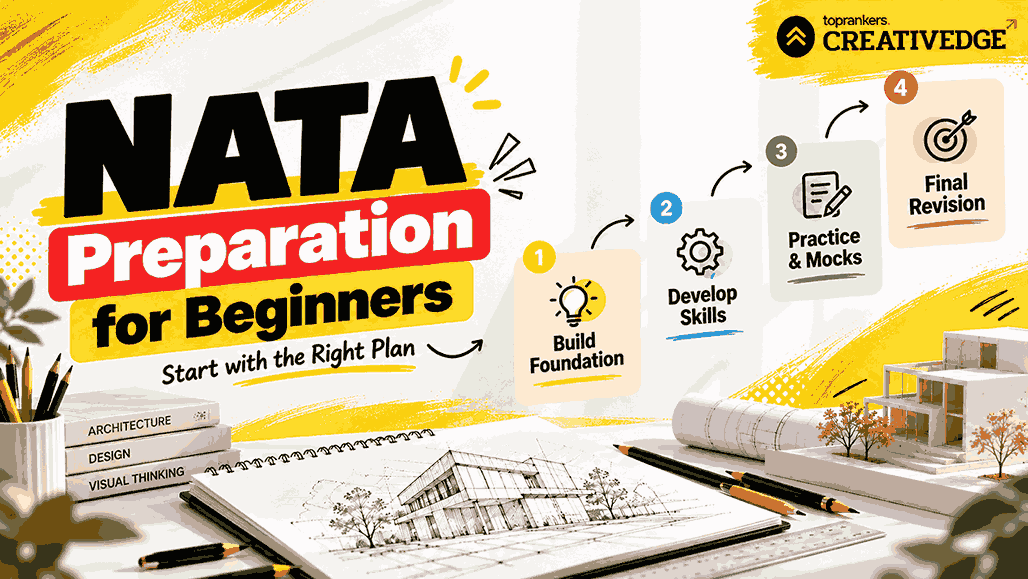
NATA preparation for beginners can be worked out in three stages.
- First, learn the exam - Part A is an offline drawing test worth 80 marks, Part B is an online aptitude test worth 120 marks, 200 in total, with no negative marking.
- Second, build daily habits - roughly 30 minutes of sketching, 30 of basic maths, 15 of architectural awareness.
- Third, from about the halfway point, move to timed mock tests and previous year papers - Give it four to six months at two to three focused hours a day.
Key Highlights
- What NATA is: the Council of Architecture entrance test for admission to five-year B.Arch courses across India.
- 2027/2028 pattern (expected same as 2026): Part A - three drawing tasks, 80 marks, offline, 90 minutes + Part B - 50 aptitude questions (42 MCQ + 8 NCQ), 120 marks, online and adaptive, 90 minutes.
- Total 200 marks in 180 minutes, no negative marking.
- Attempts: up to two in a single admission cycle, and your best score is the one colleges use.
- What "good" looks like: above 120 is a strong score, above 150 puts top colleges in reach, and 75 won't take you far.
- Starting from zero is fine: dedicate month 1 to lines, shapes, and daily practice - not perfect drawings. Simultaneously solve basic sets of Maths & Reasoning questions as well.
If you are preparing for architecture, NATA is the gateway to a B.Arch seat. Maybe you can't draw a clean perspective yet. Maybe you've opened five websites and each one lists a slightly different syllabus. Let's make it simple.
This guide to NATA preparation for beginners lays out what the exam is actually expected to test in 2027, how to prepare for the NATA exam at home without coaching, which books and free PDFs are worth your time, and a week-by-week plan you can start tonight. No art background needed. Just a plan you'll follow.
What Is NATA, and Who Is It For?
NATA, the National Aptitude Test in Architecture, is run by the Council of Architecture (CoA). It's the entry route into five-year B.Arch courses at most architecture colleges in India.
It doesn't test how much physics and formulas you've memorized. It checks whether you think like an architect or not, can you see in three dimensions, judge proportion, reason through a pattern, and put an idea on paper under time pressure?
Here's who can apply:
- You've passed or are appearing in Class 12 with Physics and Mathematics as compulsory subjects, plus one more from Chemistry, Biology, Computer Science, IT, Informatics Practices, Engineering Graphics, Business Studies or a technical/vocational subject. A 10+3 diploma with Mathematics also qualifies.
- For admission to B.Arch, you need at least 45% marks in aggregate in that qualifying exam (the same 45% applies to the 10+3 diploma route). These requirements are subject to change, the exact numbers will be available after the 2027 official brochure releases on nata.in (expected around March 2027).
- There's no upper age limit.
If you're in Class 11 right now, you're at the ideal starting line. In Class 12 or dropping a year? You can still build a strong score with a focused plan.
Check the full NATA eligibility criteria before you register.
What Is the NATA 2027 Exam Pattern and Marking Scheme?
Before you prepare for anything, get a clear picture of the paper. Since 2025, NATA has run in a hybrid format, and 2026 kept it unchanged, so expect the same for 2027 and 2028. There are two parts, taken on the same day.
Part A is your drawing and composition test, done the old way: on paper, at the centre. Three tasks, 90 minutes, 80 marks. Part B is an online aptitude test that adapts to you. Answer well and the questions get harder; slip and they ease off. Fifty questions, 90 minutes (108 seconds each), 120 marks.
| Part | What it covers | Mode | Questions | Marks | Time |
|---|---|---|---|---|---|
| Part A | Drawing & composition: A1 colour, A2 black-and-white sketch, A3 3D composition | Offline (paper) | 3 | 80 | 90 min |
| Part B | Aptitude: B1 (42 MCQs) + B2 (8 numerical, NCQ) | Online, adaptive | 50 | 120 | 90 min |
| Total | Hybrid test, one sitting | Hybrid | 53 | 200 | 180 min |
Two things every beginner should remember. There's no negative marking, so you never leave a Part B question blank - a guess costs nothing.
And Part B alone carries 120 of the 200 marks, so aptitude and speed matter at least as much as your sketching. For the official breakdown with the latest notes, keep NATA marking scheme and exam structure pages handy.
What Should a Beginner Study First? The NATA Syllabus, Section by Section
The smartest first move isn't to study everything at once. It's to study what carries marks. As per official NATA syllabus, Part A includes three drawing tasks, while Part B spreads 120 marks across five areas, and a few of them are highest weightage like Maths & Architectural Awareness.
Part A (drawing, 80 marks):
- A1 Composition & Color (25): arranging shapes into a balanced, colored composition.
- A2 Sketching & Composition, black-and-white (25): freehand sketching, proportion, light and shade.
- A3 3D Composition (30): building and drawing three-dimensional forms with depth and shadow. This one task is the highest-scoring piece of the whole exam, so it earns daily practice.
Part B (aptitude, 120 marks):
| Part B area | What it covers | Approx. marks |
|---|---|---|
| Numerical ability | coordinate geometry (2D/3D), algebra, arithmetic, basic calculus | 25-30 |
| Logical & visual reasoning | mental rotation, paper folding, mirror images, 2D/3D visualization | 25-30 |
| Architectural awareness | famous buildings, architects, history, materials, construction | 25-30 |
| GK & design sensitivity | art, design and environment awareness, observation, analysis | 15-20 |
| Language interpretation | comprehension, grammar, vocabulary | 8-10 |
So where should a beginner point their energy first?
At the three 25-30 mark blocks- numerical ability, visual reasoning, and architectural awareness. Together they make up about three-quarters of Part B.
Architectural awareness is the quiet winner. It's pure recall and test of memory, it rewards curiosity more than talent, and most students leave it till the last week. Start a running list of landmark buildings and their architects from day one.
Practice all of this with exam-level curated NATA sample papers.
How Many Months Does a Beginner Need? A 3-Month and 6-Month Plan
For someone starting NATA exam preparation from scratch, 4-6 months is optimal. It is long enough to build drawing skills and short enough to stay motivated.
If you only have a few weeks? You can still crack it, but you'll have to lean more on aptitude and awareness, where marks come faster than raw drawing skills (especially if drawing is already not your strong suite).
Here's a six-month run a three-month prep plan – compare based on phases:
| Phase | 6-month plan | 3-month plan |
|---|---|---|
| Foundation | Months 1–2: drawing basics (lines, shapes, perspective), NCERT maths, start an awareness list | Weeks 1-3: learn the pattern, fast-track basics, daily sketching, high-weightage maths |
| Build-up | Months 3–4: 3D composition, reasoning sets, weekly sectionals | Weeks 4-7: 3D composition, reasoning, two sectionals a week |
| Practice | Month 5: full mocks, previous year papers, error log | Weeks 8-10: full mocks and previous papers back to back |
| Polish | Month 6: timed mocks, revise weak areas, build drawing speed | Weeks 11-12: timed mocks, revise, fix pacing |
A workable daily rhythm for the foundation phase - 30-45 minutes of drawing, 30 of Maths or reasoning, 15 of awareness reading. As the exam nears, that flips, and mock tests eat the biggest slice of your week. Want a plan mapped to your exact start date? If you're unsure about timing, when to start NATA preparation.
How Should a Beginner Practise Drawing for NATA?
Drawing is what aspirants fear most when they think about the NATA exam, but it's also the part that improves fastest with daily practice.
The usual trap- jumping straight to complicated perspective scenes, getting frustrated, and quitting by week two. Build in order instead.
- Weeks 1–2: begin with trying to draw straight lines without a ruler, circles, ellipses, basic shapes. This might feel boring, but hand control comes from here.
- Weeks 3–4: then get to one-point and two-point perspective. Observe and draw boxes, roads, a row of buildings receding into the distance.
- Weeks 5–6: Then pick everyday objects from observation, plus light and shadow. A cup, a chair, your study table.
- Week 7 onward: full compositions and 3D arrangements, timed. This is what A3 (30 marks) actually asks for.
Experts and NATA toppers, all suggest that 15 to 45 minutes of practice everyday consistently will yield better result than long sessions once a week.
Keep a sheet of frequent errors and review it monthly. If possible, get feedback from mentors. Watching your own lines steady is the best motivation there is. For structured drills and sample sheets, the NATA drawing preparation guide walks through each stage.
Which Are the Best NATA Preparation Books for Beginners?
You don't need a shelf full of books. You need a few good ones, used properly. Here's a starter set that covers every part of the paper, with a note on why each earns its place for someone new.
| What it's for | Book | Why it suits beginners |
|---|---|---|
| One-stop guide | A Complete Self-Study Guide for B.Arch (Arihant) | Aptitude, maths and drawing basics in a single volume |
| Question practice | NATA & B.Arch FREE Mocks by Creative Edge | Topic-wise questions to drill after each chapter |
| Reasoning | A Modern Approach to Verbal & Non-Verbal Reasoning (R.S. Aggarwal) | The visual and logical reasoning Part B leans on |
| Maths | NCERT Class 11 & 12 Maths | Exactly the level NATA tests, nothing heavier |
| Drawing basics | Engineering Drawing (N.D. Bhatt) + a daily sketchbook | Perspective and construction fundamentals |
NOTE: Treat the drawing book as a reference and your daily sketchbook as the real teacher. For current editions and a longer list, the best NATA books page tracks what's worth buying.
Where Can You Get a NATA Preparation for Beginners PDF Free Download?
The resources that matter most are free and official. Start Here:
Subject-wise NATA Study Material PDFs:
- Previous year papers. Nothing teaches the exam better than the exam’s past versions itself. Work through solved NATA previous year question papers section by section.
- Important topics and sample drawing questions solved, useful for seeing how A1, A2 and A3 are framed.
- Free aptitude and reasoning sets to practice the Part B aptitude question styles.
Check the following resources you can start with immediately:
How to Prepare for the NATA Exam at Home
Plenty of students clear NATA from their bedroom with free resources and a routine. Coaching can help, but it isn't the deciding factor. Consistency is. Here's a home setup that works.
1. Get the real exam in front of you. Download the official brochure from nata.in and one NATA previous year paper. Read the pattern until you can recite it. You can't prepare for a target you can't picture.
2. Fix a daily slot, not a daily total. "I'll study when I'm free" quietly fails. "6:30 to 8:00 every evening" sticks. Protect it like a class you can't bunk.
3. Split the time by weightage. A simple beginner block: 30 minutes sketching, 30 minutes Maths and reasoning, 15 minutes architectural awareness. Four or five days a week beats one heroic Sunday.
4. Use one book per area, not ten. Switching books every week is procrastination with extra steps.
5. Turn your phone into a study tool. Follow architecture pages, save photos of buildings you like, and sketch one each weekend. Observation is on the paper too.
6. Test yourself weekly. From week three, attempt a timed sectional or a short mock every weekend. Preparing without testing is like net practice where you never face a ball.
The students who struggle at home usually aren't the ones without coaching. They're the ones without a schedule. Build the schedule and most of the battle is won. If you'd rather have the structure handed to you, a ready NATA study plan saves you the trial and error.
Do You Actually Need Coaching for NATA?
You're usually fine on your own if you can hold a daily schedule, you're comfortable with Class 11-12 Maths, and you're willing to sketch every day and mark your own weak spots. If that's you, follow the plan above and test yourself weekly.
But if you're starting late, dropping a year, if drawing feels too much, if you procrastinate, or if one area keeps dragging your mocks down, trusted institutes like Creative Edge can help.
| What Creative Edge gives you | Why it helps a beginner |
|---|---|
| Expert drawing feedback | Personal review of your A1, A2 and A3 sheets, so small mistakes don't harden into habits |
| A structured day-by-day plan | A clear 90-day and 6-month roadmap, so you're never guessing what to study next |
| Adaptive mock tests | Part B practice that mirrors the real computer-adaptive format and 108-second timing |
| Previous year papers with solutions | Learn the exam from the exam, with worked answers for every question type |
| Mentorship and doubt support | Ask and get unstuck the same day, instead of stalling on one doubt for a week |
| Complete set of study material and architecture awareness modules | The easy-marks section, organized so you never leave it to the final week |
| Performance tracking | Mock analytics pinpoint your weak areas, so revision is targeted rather than random |
| Counselling and college guidance | Match your final score to the right B.Arch colleges |
A free counselling call is the quickest way to find out where you stand and what you actually need. Talk to mentors who've guided thousands into top NATA colleges like CEPT and Nirma University, before you commit to any plan.
What Are the Most Common Mistakes NATA Beginners Make?
Most lost marks come from a handful of avoidable habits. Catch these early.
- Treating NATA like JEE. It isn't a maths-and-physics grind. Students who ignore drawing until the final month walk in underprepared for 80 marks. Sketch from week one.
- Chasing perfect sketches instead of daily consistent practice. One flawless drawing a week teaches you less than rough sketching every day.
- Skipping architectural awareness. It's the easiest 25-30 marks on the paper and yet the most ignored. A little reading daily quietly adds up and gives you the edge most pass over.
- Never practicing on a clock. Part B gives you 108 seconds a question. If your first timed test is the real exam, pacing will wreck you.
- Leaving Part B answers blank. There's no negative marking. A blank and a wrong answer score the same, so every guess is free marks waiting to happen.
None of these need talent to fix. They need awareness, which you now have.
What Is a Good NATA Score, and Where Can It Take You?
NATA is scored out of 200. As a rough map above 120 is a good score, above 150 is excellent and opens the better colleges, and 75 or below will struggle to land a solid seat. A valid score makes you eligible for B.Arch admission at a long list of government and private colleges, through state counselling and institute-level processes.
So your target depends on the college you want. Aim a notch above the cut-off you're chasing, because cut-offs shift with each year's difficulty and applicant pool. Once your mocks are landing, read how to improve your NATA score, and to match scores to seats in top Architecture colleges from NATA.
How Should Beginners Use Previous Year Papers and Mock Tests?
Previous year papers are the most honest preview of the exam you'll find. Use them in two passes. The first time, go untimed and open-book- the goal is to understand how questions are framed, not to score. The second time, sit it like the real exam, clock running, phone in another room.
Keep an error log. Every question you miss goes in a notebook with one line on why. Was it a silly slip, weak concept, or you ran out of time? Review it weekly and your weak areas shrink in front of you. For Part-A drawing, practice exam-level sample questions and get feedback on your ideas/sketches for maximum improvement.
A set of solved NATA previous year papers plus weekly timed NATA mocks will teach you more in a month than passive reading does in three.
Conclusion:
Here's the honest truth about NATA preparation for beginners - you don't need to be an artist, you don't need expensive coaching, and you don't need it all figured out from Day 1.
You just need crystal clarity on NATA exam pattern in your head, a daily slot for prep you don’t miss no matter what, and the willingness to draw badly for a few weeks until you draw well.
Note your exam date. Download a previous year papers tonight. Sketch ten straight lines before bed. That's it for week one (but every day).
If you'd like a mentor to map a plan around your timeline and current level, the Creative Edge team runs free counselling and a demo class for NATA aspirants, with free previous year papers and mock tests ready to practice. Start where you are. The seat is closer than it looks.


Attempt a Free NATA Mock Test
Fill your details
Frequently Asked Questions
Can a beginner with no drawing skills crack NATA?

How many hours a day should a beginner study for NATA?
Can I prepare for the NATA exam at home without coaching?
How many months are enough for NATA preparation for beginners?
Is NATA tougher than JEE Main Paper 2?
Is there negative marking in NATA?
How many attempts does a beginner get, and which score counts?
What is a good NATA score for government colleges?
Where can I get a NATA preparation for beginners PDF free download?
Do I need Physics and Chemistry for NATA?
When should a Class 11 student start NATA preparation?

Vineeta Agrawal
Communications Executive
SHARE