
1723534562.png)

AILET English Language Important Topics 2027: Topic-Wise Weightage & Preparation Strategy
May 22, 2026
Overview: If you are preparing for AILET 2026, one thing you must understand early is that the English section is no longer limited to basic grammar and vocabulary. Over the past few years, the exam has become far more comprehension-oriented and analytical. Students who focus only on grammar rules often struggle because AILET now tests reading ability, contextual understanding, tone recognition, and inference skills.
To score well, you need clarity about the most important AILET English Language topics and how frequently they appear in the exam.
Here is a topic-wise breakdown of the areas you should prioritize during preparation.
| Topic | Expected Importance | Difficulty Level |
|---|---|---|
| Reading Comprehension | Very High | Moderate to Tough |
| Vocabulary in Context | High | Moderate |
| Tone & Inference Questions | High | Moderate |
| Grammar & Error Spotting | Moderate | Easy to Moderate |
| Para Jumbles | Moderate | Moderate |
| Sentence Completion | Moderate | Easy |
| Synonyms & Antonyms | Moderate | Easy to Moderate |
| Idioms & Phrases | Low to Moderate | Easy |
The table clearly shows that Reading Comprehension should be your biggest priority. In recent AILET papers, RC passages have dominated the English section, and many vocabulary questions are now asked contextually through passages rather than direct word meanings.
Why is the English Language Section Important in AILET 2027?
Before we dive into the AILET English Language Important Topics 2027, let’s pause and reflect on why this section holds so much weight. Law is all about words, how you interpret them, how you argue with them, and how you connect ideas through them. Whether it’s reading a lengthy judgment, analysing a case brief, or writing your arguments in court, your ability to understand and use language effectively becomes your strongest weapon.
That’s why the examiners test you not just on vocabulary or grammar in isolation, but on your overall comprehension skills, critical reasoning, and ability to extract meaning from complex passages.
Genres You’ll Encounter in AILET Passages 2027
The reading comprehension section is the star of the English part of AILET 2027. But what makes it interesting is the range of genres from which the passages are picked. If you want to master this section, you need to know the kind of material the exam draws from. Let’s look at the most relevant ones:
- Literature – Short stories, excerpts from novels, or literary analysis pieces. These often test your grasp of tone, theme, and figures of speech.
- Sociology & Psychology – Passages here focus on human behavior, society, and culture. They demand careful reading to identify assumptions or arguments.
- Technology & Economy – Articles on AI, digital transformation, or global markets from sources like The Economic Times or The Atlantic can appear.
- Philosophy & Self-help – These passages test your ability to grasp abstract ideas and condense them into the main idea or summary.
- History & Indian Context – Expect narratives rooted in historical analysis or current socio-political contexts in India.
- Environment & Education – Topics on climate change, sustainable development, or reforms in education policies are also popular.
- General Awareness & Miscellaneous – These are usually opinion essays or explanatory articles covering global or Indian issues.
- Legal & Commerce – Don’t expect direct law-related questions, but you may see themes on governance, justice, or trade.
So, when we talk about AILET English Language Important Topics 2027, we’re not just talking about “grammar” or “vocabulary.” We’re talking about exposing yourself to a wide range of reading materials so that nothing surprises you on exam day.
Read more: AILET 2027 English Language Syllabus
Question Types You Must Prepare For
Now that we’ve discussed genres, let’s focus on the specific skills tested. Here’s a breakdown of the AILET English Language Important Topics 2027 based on the kind of questions that frequently appear:
1. Main Idea Identification
- What’s the central argument of the passage?
- Train yourself to spot the essence in one or two sentences.
2. Primary Purpose & Titles
- Why did the author write this? To argue, to explain, to criticise?
- Can you create an apt title summarising the core theme?
3. Summary & Logical Organisation
- Summarising without losing the message is tricky.
- You’ll also need to notice how ideas flow logically from one to the next.
4. RC Tones
- Is the author being sarcastic, optimistic, analytical, or critical?
- Tone-based questions are subtle but high-scoring if you practice regularly.
5. Grammar & Usage
- While heavy grammar drills aren’t the focus, you’ll need comfort with error spotting, sentence correction, and parallelism.
Read more: How to read a newspaper for AILET 2027?
6. Figures of Speech
- Metaphors, similes, and irony, these tools are often embedded in literary passages.
7. Contextual Vocabulary
- Forget rote memorisation. You need to learn how words work within a passage.
8. Conclusions, Arguments & Assumptions
- These questions demand critical reasoning. Can you distinguish between facts, opinions, and assumptions?
9. Detail-based & Negative Questions
- These test whether you read carefully. They may ask, “Which of the following was NOT stated in the passage?”
Each of these falls under the umbrella of AILET English Language Important Topics 2027, and the best way to practice is to solve questions while consciously categorising them under these heads.
Best Books for AILET English Preparation 2027
Choosing the right resources can make preparation much easier.
Recommended Books
| Book Name | Purpose |
|---|---|
| Word Power Made Easy | Vocabulary Building |
| Wren & Martin | Grammar Practice |
| Objective General English by SP Bakshi | Mixed English Practice |
| Editorials from The Hindu & Indian Express | Reading Comprehension |
| Previous Year AILET Papers | Pattern Understanding |
Avoid using too many books at once. Limited but consistent practice works better.
Read more: AILET 2027 Preparation Books for English Language
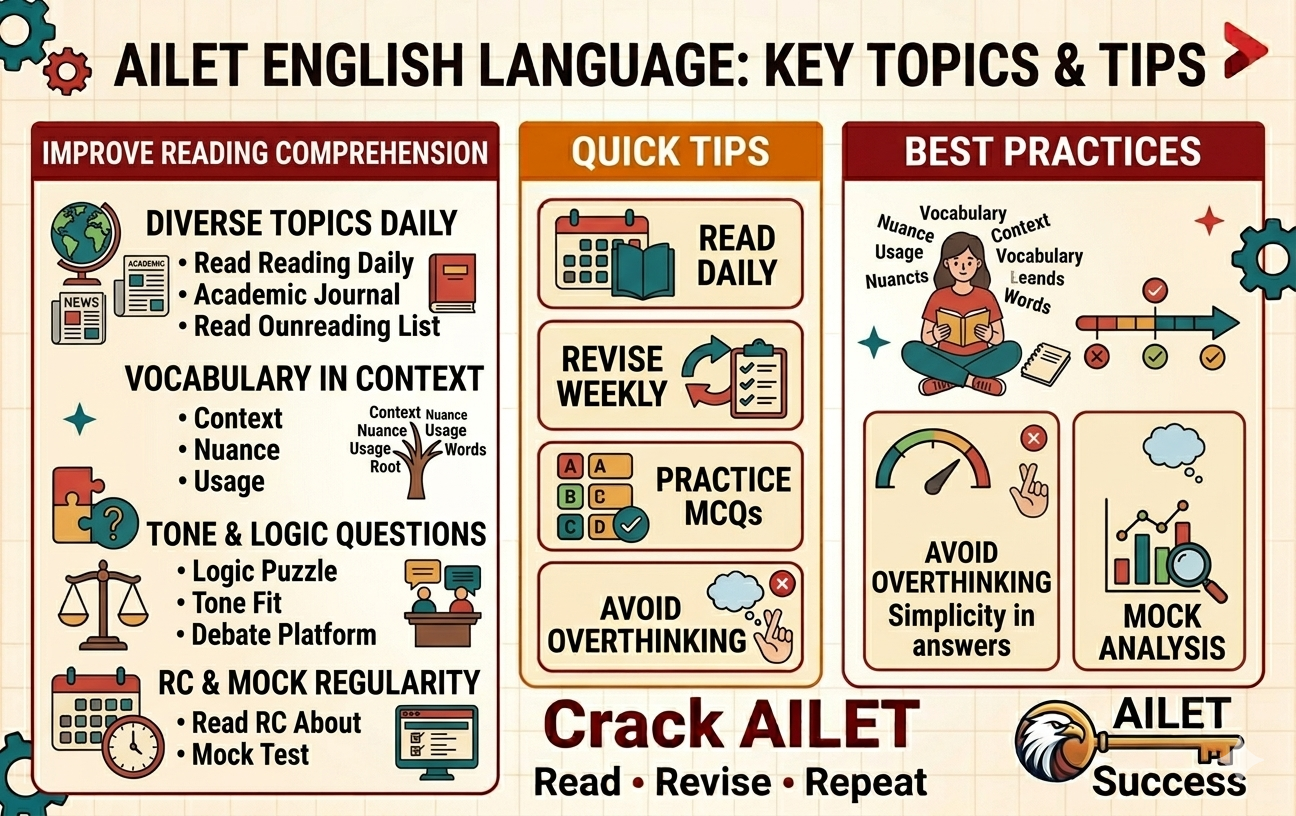
Previous Year Trends in AILET English Section
One of the biggest mistakes aspirants make is ignoring previous year trends. AILET follows certain recurring patterns, especially in the English section.
Important Observations from Recent Papers
- Reading Comprehension has gained more weightage every year.
- Vocabulary is mostly contextual now.
- Questions are becoming more analytical.
- Tone and inference questions are increasing.
- Direct grammar questions have reduced slightly.
- Editorial-style passages are common.
This trend clearly shows that students must focus more on reading skills rather than rote learning.
30-Day Preparation Plan for AILET English Language Section
If you are short on time, a structured revision plan can help you improve quickly.
Week 1
- Build reading habit
- Practice basic RC passages
- Revise grammar fundamentals
- Learn 20 new words daily
Week 2
- Solve sectional English tests
- Practice inference-based RC questions
- Revise vocabulary notebook
- Attempt para jumbles
Week 3
- Solve previous year AILET English questions
- Focus on tone and assumption questions
- Improve reading speed
- Analyze mistakes carefully
Week 4
- Attempt full-length mocks
- Practice time management
- Revise grammar shortcuts
- Focus on weak areas only
Consistency matters far more than studying for long hours occasionally.
How to Improve Reading Speed for AILET
Reading speed plays a huge role in AILET because passages require careful understanding within limited time.
Tips to Improve Speed
- Read editorials daily
- Avoid subvocalization
- Practice timed reading sessions
- Highlight important ideas mentally
- Learn to identify the author’s tone quickly
Initially, focus on accuracy. Speed improves naturally with practice.
How to Approach Preparation
Let’s make things practical. Here’s a step-by-step plan to master the AILET English Language Important Topics 2027:
Step 1: Build a Reading Habit
Dedicate 30–45 minutes daily to reading diverse genres. Don’t just skim, analyse the flow, the tone, and the author’s purpose.
Step 2: Maintain a Vocabulary Journal
Note down unfamiliar words, but don’t stop at definitions. Write a sample sentence or note how the word was used in context.
Step 3: Practice RC Daily
Use AILET previous year papers, mock tests, or sectional tests. After solving the problem, revisit every wrong answer and understand why.
Step 4: Sharpen Grammar in Context
Rather than drilling endless grammar rules, focus on application. Identify errors when you read newspapers or essays.
Step 5: Learn Critical Reasoning
For questions on arguments and assumptions, practice with logical reasoning questions. This cross-pollinates with the English section beautifully.
Step 6: Review & Reflect
Once a week, summarise an article in 100 words. This habit builds your summary-writing skills while reinforcing comprehension.
Common Mistakes Students Make
While working through the AILET English Language Important Topics 2027, here are the traps you should avoid:
- Over-focusing on grammar – Remember, the exam isn’t about spotting commas; it’s about understanding meaning.
- Neglecting tone and purpose – These are high-weightage areas and often overlooked.
- Rote learning word lists – Vocabulary is useful only when you know its contextual meaning.
- Reading without analysis – Passive reading doesn’t help. Actively question the author while you read.
Tips to Stay Ahead
- Diversify your reading: Don’t limit yourself to one type of article. Today’s passage may be on Indian history, tomorrow’s on psychology.
- Time yourself: AILET passages are lengthy. Practice under timed conditions.
- Use online resources smartly: Follow The Atlantic or Aeon online for free, thought-provoking articles.
- Revise weekly: Consolidate what you’ve read, especially vocabulary.
Conclusion
At first glance, the English section might seem unpredictable. But once you map out the AILET English Language Important Topics 2027, the unpredictability fades away. You realise it’s not about mugging up lists or solving grammar drills in isolation. It’s about training your mind to read critically, think logically, and articulate clearly.
When you prepare this way, the passages stop feeling like “traps.” Instead, they become opportunities to showcase your skills. Remember: every line you read and every article you analyse is one step closer to not just cracking AILET but also becoming a sharper, more confident law student.
So, start today. Pick up an editorial, read it actively, and try summarising it. That’s your first practical step towards mastering the AILET English Language Important Topics 2027.
Frequently Asked Questions
What are the most important topics for AILET English Language?

How can I improve my reading comprehension for AILET?
Do I need to study advanced grammar rules for AILET?
How should I prepare vocabulary for AILET?
Are AILET English Language Important Topics different from CLAT English?

Samriddhi Pandey
Content Writer
SHARE