


NIFT Preparation in 1 Month: 30-Day Plan + 15 Tips to Crack 2027 Exam
October 5, 2026
NIFT preparation in 1 month can only be meaningful if you target areas that can help score maximum marks instead of the whole syllabus. In 30 days, focus on the fashion/textile-heavy GK, build CAT idea-generation speed, raise English reading speed, and master GAT's -0.25 negative-marking discipline.
Keep CAT drawing daily (it can't be improved with random practice), take weekly mocks, and in the last week only revise and simulate.
B.Des aspirants should also keep the Situation Test in mind for Stage 2.
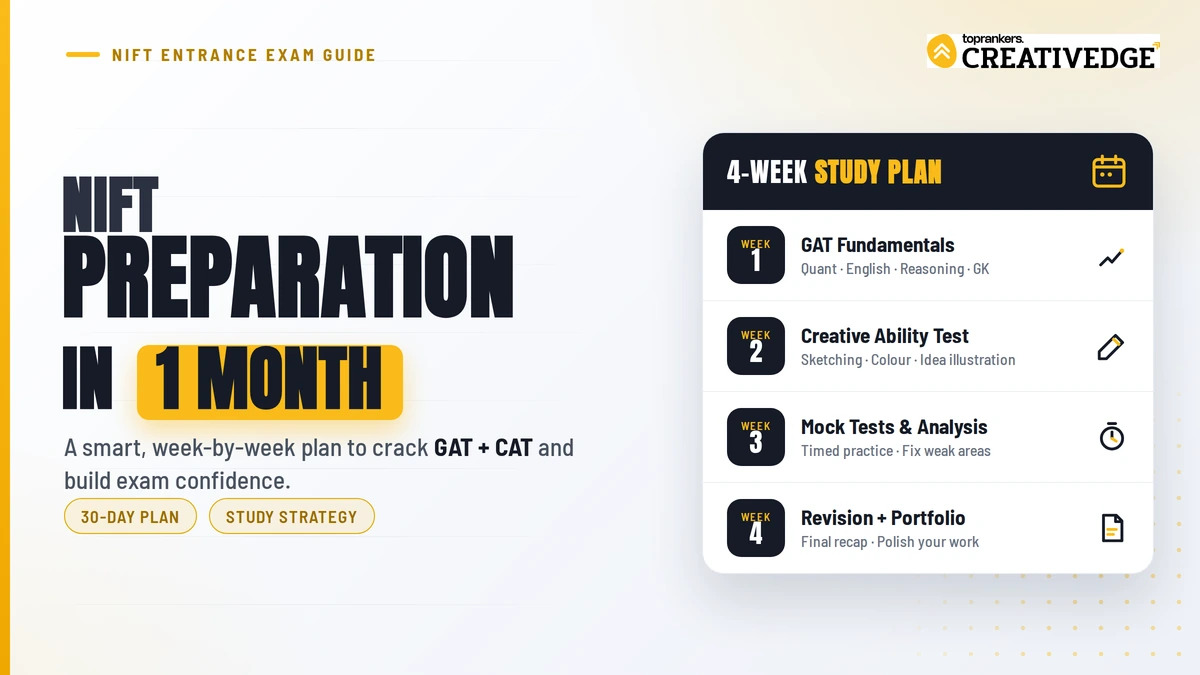
Key Highlights - NIFT Preparation in 1 Month 2027
- Exam Date: 10 January 2027 - GAT (computer-based) + CAT (offline drawing) the same day.
- The 30-day : NIFT's fashion/textile/craft GK & Current Affairs (25 marks) - the most easiest to score, most memorizable, yet most ignored zone.
- CAT can only be cracked with innovative ideas, not just perfect drawing - train concept-generation daily.
- English (40 marks) is mostly reading comprehension and the passages are usually fashion-themed.
- -0.25 negative marking in GAT - accuracy beats attempts.
- B.Des Stage 2: Situation Test (hands-on model making round) follows once you are shortlisted after stage 1.
The Complete 30-Day NIFT Study Plan for 2027 (Day-by-Day)
Here's exactly how to spend your month. The plan runs four phases, and three things stay constant every single day- your GK recall sheet (morning), 3 ideas for each CAT question, and practice at least one NIFT sketching question (exam-style). Everything else rotates.
Phase 1 - Diagnose & Build the Base (Days 1-8)
| Days | GAT focus | CAT focus |
|---|---|---|
| 1 | Give mock & note weak sections | Attempt one past NIFT CAT question paper freely & untimed |
| 2–3 | Start English (comprehension + vocab) | Product-design basics (user + ‘in use’) |
| 4–5 | Begin fashion-GK reading embroideries, fabrics | Observational sketching (everyday objects) |
| 6–7 | GK - weaves, designers, brands | Theme & color practice for NIFT |
| 8 | Review week 1 - rework on weak areas | First timed CAT task |
Phase 2 - Attack High-Return Zones (Days 9-16)
| Days | GAT focus | CAT focus |
|---|---|---|
| 9-10 | High-frequency Quant (percentage, ratio, geometry - basic 10th level) | Pattern/objects transformation/unconventional uses of everyday objects |
| 11-12 | Reasoning (series, relations, figures) | Product design/redesign under time |
| 13-14 | GK sprint- textile history, color theory, CA | Themed NIFT sketching questions under time |
| 15 | Full-length mock (GAT + CAT) | (part of mock) |
| 16 | Mock review- guess vs knew ratio | Fix weak CAT question types |
Phase 3 - Simulate & Sharpen (Days 17-24)
| Days | GAT focus | CAT focus |
|---|---|---|
| 17-18 | Timed sectional practice - fix per-question time cap | All 3 CAT types rotating, timed |
| 19 | Full-length mock | (part of mock) |
| 20 | Mock review and revise GK sheet fully | Caption and labelling practice on sketches |
| 21-22 | Negative-marking and section attempt order strategy | Weakest CAT question type, repeated |
| 23 | Full-length NIFT mock | (part of mock) |
| 24 | Deep review - target top 3 recurring errors | Light, confidence sketching |
Phase 4 - Taper & Peak (Days 25-30)
| Days | Plan |
|---|---|
| 25-26 | One full GAT + CAT simulation each day + revise your hand written GK sheet daily |
| 27-28 | Keep sketching but don't exhaust + light revision |
| 29 | Ready documents (admit card, ID, city slip, allowed CAT materials) + GK revision |
| 30 (exam eve) | Rest, short GK skim, early sleep - no new learning |
Before you start, make sure you know the test cold - here's the full NIFT exam pattern.
What Can 30 Days Actually Fix in NIFT 2027? (An Honest Faculty View)
Before you open a single book, understand where a month helps and where it doesn't. This is the triage I run with every late-starting student.
What 30 days can fix - your focus areas:
- Fashion & design awareness (GK): almost entirely learnable in a month. This is your biggest, fastest gain.
- CAT idea-generation: you can dramatically speed up how fast you think of a concept, even if your rendering is average.
- English reading speed: trainable quickly with daily reading.
- Attempt strategy & negative-marking control: pure technique - fixable in days.
What 30 days can't fully fix - so don't obsess:
- A complete overhaul of raw drawing talent. You can't, so stop trying - instead, make your ideas clear and your sketches readable, that will actually help you score.
- If maths is not your strong suit, don't chase every chapter - focus only on the easy, frequent ones. It is only one of several GAT sections, so the same hours spent on analytical ability, GK and current affairs, and NIFT communication ability questions usually earn more marks.
How to Start NIFT 2027 Preparation in 1 Month?
Start with one section that almost all aspirants skip due to it's unpredictable nature - GK. However, how you should actually look at it is that these are the most achievable 25 marks that can give you a serious edge if you are well read.
Looking at the actual papers, this section is a two-part blend - about half is fashion, textile and design awareness, and the other half is general knowledge and current affairs (polity, geography, history, art, literature and basic science).
Track 1 - Fashion, Textile & Design GK
| Cluster | What to lock down (from real papers) |
|---|---|
| Fibres & fabrics | Natural vs protein vs elastomeric fibres (silk = protein, spandex = elastomeric); fabrics like Malmal, Pochampally Ikat |
| Embroideries & crafts | Embroidery-to-state matching - Zardozi, Kashida, Kantha, Kasuti, Phulkari, Chikankari |
| Textile history & bodies | Flying Shuttle Loom (John Kay), National Handloom Day, VisioNxt |
| Color & garment terms | Monochromatic colors, tints/shades, how line direction affects a garment |
| Design heritage | Greek/Roman garment pins (Fibula), traditional crafts and cottage industries |
Map what's actually tested against the official NIFT syllabus before you plan your 30 days.
Track 2 - General Awareness & Current Affairs
This is the half aspirants wrongly skip - and it's very scorable.
| Cluster | What to lock down (from real papers) |
|---|---|
| Polity & governance | Rajya Sabha nominated members, who appoints a Governor, basic Constitution facts |
| Geography | States and statehood (e.g., Sikkim as 25th state), rivers (Statue of Unity - Narmada), lakes, border districts |
| Art & literature | Famous paintings and authors |
| Basic science | Everyday science - ozone/UV, properties of fibres and materials |
| History & current affairs | Figures like Vasco da Gama, plus recent national and fashion-industry news |
How to make most of 1 month for this section:
- Spend 40-45 minutes daily, alternating the two tracks so neither is neglected.
- Keep separate sheets covering both halves and revise it every morning - spaced repetition is what makes GK stick in a month.
- For general awareness, focus current affairs on the last 6-8 months - older news is low-yield, especially in a short preparation window.
- NIFT GK questions on these topics repeat year to year, which is exactly why a focused coverage of them converts into reliable marks.
Spend 45 minutes daily on these topics and keep a one-page running sheet you revise every few days. By exam day, a section that terrifies most candidates becomes your scoring edge.


How to Build CAT Ideas Fast for NIFT 2027 in 30 Days?
Here's what I tell every student panicking about the drawing paper- CAT is more about original thinking and visual communication of ideas, and less about how perfect it looks. Examiners prefer a clear, relevant, original concept that's shown in use - a neat sketch of weak idea wouldn’t cut. The good news? Idea-generation is a muscle you can train fast.
CAT repeats three task types. Learn to attack each:
| CAT task type | How to attack it in a month |
|---|---|
| Product design | Pick a user, name their real problem, design for that problem, and draw the product being used |
| Themed rendering | Translate a theme into a scene and respect any medium limit (e.g., pencil color only) |
| Pattern / transformation | Build one clean motif and repeat it with consistency or transform an object step by step |
Daily Exercises to Build Ideation Skills (15 minutes):
Pick a random object or theme and aim to generate 3 different concepts in five minutes - don’t start drawing just yet. Create thumbnails first and prepare a one-line logic. This builds the speed that saves you in the exam hall, where your first 2-3 minutes of thinking decide the performance.
For step-by-step walkthrough of how toppers do it- check how to attempt CAT in NIFT.
How to Crack NIFT 2027 English in 1 Month Without Relearning Grammar?
English is 40 marks, the biggest GAT section and in a month you won't rebuild grammar from scratch, nor do you need to. English leans heavily on comprehension, and the passages often carry fashion, sustainability or design themes. So, train the two things that move fastest: reading speed and vocabulary.
- Read one longer article daily ideally on fashion, design or sustainability and summarize it in two lines. This builds both speed and topic familiarity.
- Keep a vocabulary page - new words, synonyms/antonyms, idioms, one-word substitutions.
- In mocks, practice skimming a passage as fast as possible for structure before answering - comprehension is a time game.
This single habit lifts your largest section without a grammar textbook. It's one of the most underrated tips to crack NIFT in 30 days.
NIFT Quant and Reasoning Preparation in 1 Month (The 80/20 Rule)
NIFT's Reasoning (15 marks), and Quant (20 marks) are Class 9-10 level - don't drown in them. Apply the 80/20 rule- master the handful of high-frequency types that return the most marks.
- Quant: percentages, ratio & proportion, averages, profit-loss, basic geometry, time-speed-distance.
- Reasoning: series, blood relations, seating, figure/pattern logic, mirror images.
Skip the rare, lengthy chapters - in 30 days they're a poor trade.
Practice Thinking Like a Designer for 30 Days
This is the habit that separates serious aspirants from just exam givers, and it quietly feeds both your GK and your CAT. For these 30 days, observe the world like a designer:
- Notice how products, packaging and storefronts are designed - and why.
- Pay attention to color combinations, fabrics people wear, and brand logos around you.
- Keep a small visual diary - a daily sketch or note of something you observed.
- Follow fashion and design news so current-affairs questions feel familiar.
Ten minutes a day of deliberate observation sharpens the design sensitivity this exam tests everywhere - from CAT ideation to GK to the eventual Situation Test. This is how we train it at Creative Edge.
How to Train for NIFT Negative-Marking Rule in 1 Month?
GAT carries -0.25 for every wrong answer, and in a crash month, careless attempting undoes real effort.
- Answer everything you're confident about first - lock in your known marks.
- For the rest, guess only if you can eliminate two of the four options; otherwise leave it.
- Never blind-guess a whole section just to "finish it" - that's how ranks leak.
From Week 3, treat every mock as negative-marking training- review not just what you got wrong, but what you guessed. CAT has no negative marking, so there you attempt everything.
Turn attempt strategy into a habit with these tips to avoid negative marking in NIFT.
15 Tips to Crack NIFT 2027 in 30 Days
These are toppers-tested tactics for your final month - the small levers most aspirants miss, not the basics you already know.
| # | Tip | Why it works in 30 days |
|---|---|---|
| 1 | Solve the last 5 years' GAT papers before any new topic | Reveals actual repeat patterns fast, so you study what's tested - not everything |
| 2 | Create GK notes from each study session and read them every morning | Spaced daily revision is better than re-reading notes- fashion GK sticks through repetition |
| 3 | Time CAT at real exam duration from Week 1 | Running out of time, not weak drawing, is what sinks most CAT scores |
| 4 | Carry a three-quarter-view habit for every product sketch | Shows form and proportion to examiners far better than flat front views |
| 6 | Pre-decide your GAT section order (strengths first) and rehearse it | Removes decision-making in the hall- protects your highest-accuracy marks |
| 7 | Set a per-question time cap in GAT and move on when it's hit | One stuck question can cost you five easy marks elsewhere |
| 8 | Keep CAT materials exam-ready (allowed pencils, colors) and practice with only those | Avoids exam-day surprises- builds muscle memory with your real tools |
| 9 | After each mock, note how much you gussed vs knew, not just the score | Exposes where negative marking is quietly draining your rank |
| 10 | Practice captioning your CAT sketches in 3-4 words | A labelled idea reads instantly to an examiner and lifts a borderline sheet |
| 11 | Do the exercise to generate at least 3 unique innovative ideas about the design of a random object | Trains the fast ideation that first exam minutes demand |
| 12 | Revise color theory basics (tints, shades, harmony) specifically | Recurs in both CAT rendering and GK - double return for minimal time |
| 13 | Track fashion current affairs from only the last 6-8 months | NIFT aptitude section mostly includes recent news, running after older news is low-yield in a crash month |
| 14 | Simulate the full GAT + CAT in one sitting at least twice | Builds the stamina for a long exam day that sectional practice can't |
| 15 | Prepare your admit card, ID and city-slip checklist a week early | Last-minute document panic wrecks focus on the one day it matters most |
Your Final 7 Days: The NIFT 2027 Exam-Week War Plan
The last week before the exam is not for learning new topics or those you couldn’t cover before- it's for revising what you’ve already studied.
- Days 7-4: one full GAT + CAT simulation daily under real timing. Also revise your GK notes every day.
- Days 3-2: test weak areas only, fix frequent error types, keep sketching but don't exhaust yourself.
- Day 1: rest, do light GK revision, pack your essentials - NIFT admit card, ID and CAT materials. Sleep well.
- Exam day: in GAT, secure your strong sections first and in CAT, spend the first few minutes locking your concept before you draw.
Calm, rested and strategic beats frantic and sleep-deprived - every single year.
NIFT 2027 Preparation in 1 Month - What After Stage 1?
Clearing Stage 1 (GAT + CAT) is not enough to get admission in NIFT- a few more stages decide your final seat. Here's the quick picture so you know what's ahead (timeline tentative, based on the 2026 cycle, confirm on the official NTA site):
| Stage | What it involves | Expected timing |
|---|---|---|
| Stage 1 written exam | GAT + CAT | 10 January 2027 |
| Answer key & objections | Verify your GAT score | February 2027 |
| Stage 1 result | Shortlist for the next stage | ~March 2027 |
| Situation Test (B.Des) / Interview (M.Des) | Hands-on model + concept note / personal interview | ~May 2027 |
| Final result & counselling | Merit from GAT + CAT + Stage 2; choose campus | ~June 2027 |
Two things to remember- your final B.Des merit combines GAT, CAT and the Situation Test - so no single stage decides it - and the shortlist-to-Situation-Test window is shorter than it looks, so start Stage 2 prep the moment results are out.
Conclusion
Thirty days won't take you from complete beginner to fully prepared, but it's plenty of time to walk into NIFT having maximized every mark within reach. Every year we see the students who focus on the GK that everyone else ignores, train their ideas daily, read like it matters, and refuse to give marks away, make it to their dream NIFT colleges.
Preparing for NIFT 2027? We can help you with exact strategic roadmap, study material and crucial feedback required to ace NIFT exam.
Join the best NIFT Online Coaching by Creative Edge and get expert guidance on all subjects.



Attempt a Free NIFT Mock Test
Fill your details
Frequently Asked Questions
Is 1 month enough to prepare for NIFT?

How to prepare for NIFT entrance exam in 1 month without coaching?
What are the best tips to crack NIFT in 30 days?
Which NIFT section is easiest to improve in one month?
Can I clear NIFT in 1 month if I can't draw well?
Should I focus on GAT or CAT in the last month?
How many hours a day should I study for NIFT in one month?

Vineeta Agrawal
Communications Executive
SHARE