
1723534562.png)

NID Marks vs Rank 2027: How Your DAT Score Decides Your Rank
September 28, 2026
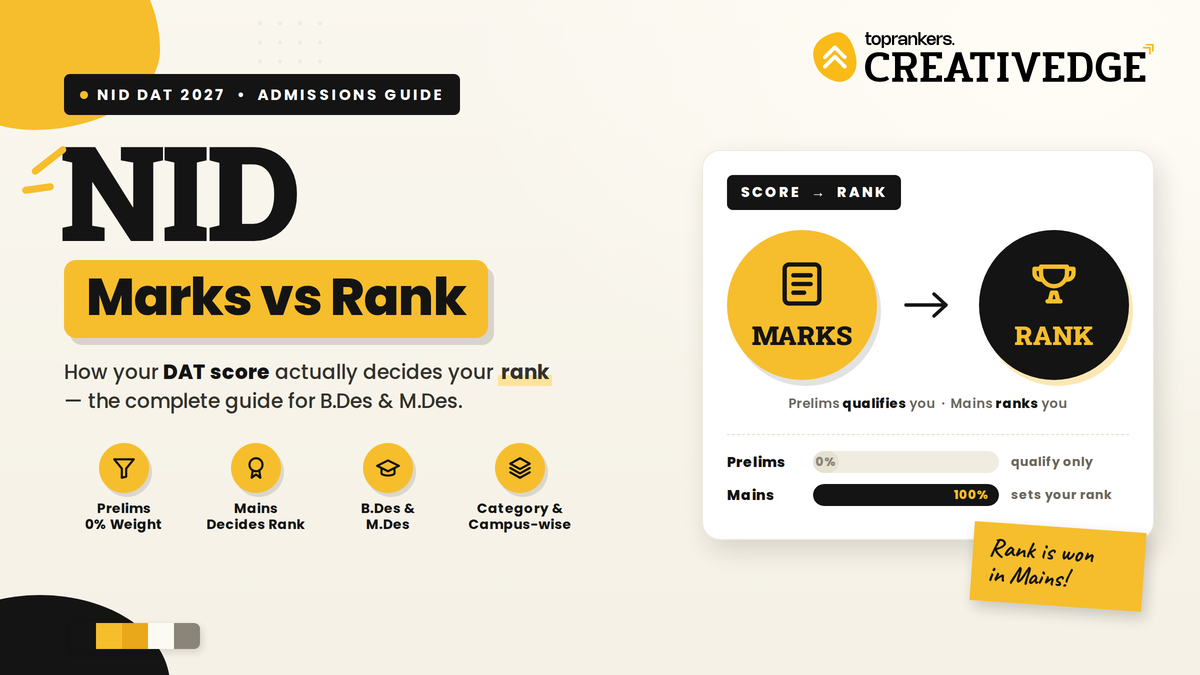
For NID marks vs rank, DAT Prelims is qualifying only (0% weightage) - your rank is decided 100% by DAT Mains (B.Des- Studio Sensitivity (60%) + In-Person Sensitivity (40%); M.Des- Studio Test (40%) + Interview (60%)).
What the official 2026 data shows:
- the B.Des Open seat closed at rank 47 / score 67.28 (NID Ahmedabad)
- easing to rank ~202 / 57.39 (NID MP) and
- up to rank ~587 / 39.78 (NID Andhra Pradesh).
- M.Des closed at tiny ranks (Open ~5-19) but widely varying scores (~45-76) by discipline.
What we expect for 2027:
With B.Des shortlisting widened to 2.5× seats (from 1.5×) and fresh UG seats added via the new 5.5-year Integrated Pathway, the Prelims cutoff should ease slightly and B.Des closing ranks may run deeper than 2026 - while your final NID DAT score vs rank still depends entirely on Mains.
Use the officially published closing scores / ranks of 2026 as your benchmark and try to aim above that boundary for your target campus or discipline.
Key Highlights - NID Marks vs Rank 2027
- Prelims: qualifying only, 0% weightage in final rank
- Final rank: decided 100% by DAT Mains
- B.Des Mains: Studio Sensitivity 60% + In-Person Sensitivity 40%
- M.Des Mains: Studio Test 40% + Interview 60%
- 2026 benchmark: Open category for B.Des closed at rank 47 (score 67.28) for NID Ahmedabad - up to rank 587 for NID Andhra Pradesh
- 2027 changes: B.Des shortlisting raised to 2.5 × seats (from 1.5 × seats); M.Des steady at 4.5×; new 5.5-yr Integrated Pathway adds fresh UG seats - more students can be admitted.
- Prelims date: 20 December 2026
Does NID Release an Official Marks vs Rank Table?
Not in the way students expect. NID does not publish a row-by-row NID rank vs marks chart that converts every Prelims mark into a rank - and there's a structural reason. In exams like JEE or UCEED, one score produces one rank, so a marks-vs-rank table makes sense. NID works differently: Prelims and Mains scores are never added together. Prelims only filters candidates; Mains alone produces the rank.
What NID does release, after seat allotment, is the closing rank and closing score of the last candidate admitted to each campus, discipline and category. That official data is the honest basis for any NID DAT score vs rank benchmark - and it's exactly what this guide uses.
How Does NID Actually Convert Marks to Rank?
NID DAT runs in two stages, and each does a completely different job.
| Stage | Weightage in final rank | What your marks decide |
|---|---|---|
| DAT Prelims | 0% | Only whether you're shortlisted for Mains |
| DAT Mains | 100% | Your actual rank in the merit list |
This is the heart of NID DAT marks vs rank- Prelims marks are a gate, not a score that carries forward. Once you clear the gate, everyone starts fresh at Mains, and your Mains performance alone builds your rank.
To understand the two-stage structure this whole concept rests on, see how the NID DAT exam pattern and marking scheme works.
Does NID Mention Your Mains Score in the Final Scorecard?
At the final stage, NID works in both rank and score - but they play different roles. Your DAT Prelims scorecard shows only your qualifying status (clear / not clear), because no Prelims rank is carried forward. Your final position is expressed as a merit rank, and after seat allotment NID officially publishes the closing rank and closing score of the last candidate admitted to every campus, discipline and category.
So while your decisive output is your DAT Mains merit rank, NID does attach a final merit score to the list - which is why a genuine NID DAT score vs rank benchmark exists at all.
Track your result on the NID DAT result page.
NID DAT Prelims Marks vs Rank 2027: Why Your Prelims Score Doesn't Decide Your Rank
Your Prelims marks have exactly one job: get you shortlisted for Mains. For 2027, NID has widened the funnel - B.Des shortlisting has been raised to about 2.5× the seats (up from 1.5× in 2026), while M.Des stays at around 4.5× per discipline.
One important thing to note is that NID does not publish a fixed "minimum qualifying percentage" that guarantees selection. Shortlisting is purely competitive and category-wise - you're ranked against other candidates in your category, and the effective bar is wherever the last shortlisted candidate lands.
In other words, there's no official pass mark to aim at; there's only the shortlisting cutoff, which shifts every year with difficulty, seats, and applicant numbers.
Based on recent trends, the expected Prelims shortlisting cutoff looks like this:
| Category | Expected Prelims cutoff band (Expected) |
|---|---|
| Open / General | ~50-60 |
| EWS | ~50-58 |
| OBC-NCL | ~48-56 |
| SC | ~35-45 |
| ST / PwD | ~30-40 |
Toprankers tip- Clear the shortlisting cutoff comfortably, then forget your Prelims score entirely - it won't help or hurt your rank. See verified numbers on the NID DAT cut-off page.
NID DAT Mains Marks vs Rank 2027: The Score That Actually Decides Your Rank
This is where your rank is truly built. DAT Mains carries 100% weightage, split differently by program.
| Program | Mains components | Weightage |
|---|---|---|
| B.Des | Studio Sensitivity Test | 60% |
| In-Person Sensitivity Test | 40% | |
| M.Des | Studio Test | 40% |
| Interview | 60% |
For B.Des, your final merit is a weighted combination of studio test marks & in-person sensitivity round score. On the other hand, for M.Des, the interview carries more weight than the studio - so how well you articulate your thinking matters as much as what you make.
Because these are examiner-evaluated, two candidates with identical Prelims marks can finish with very different ranks. Start early with how to prepare for the NID Studio Test.
Is Your NID Score Get Enough to You In?
Get a free session with a Creative Edge mentor - understand what your marks mean for selection, and get a Mains-focused Studio Test plan to convert your shortlist into a rank.
Since Prelims is now purely a qualifier, build speed with NID previous year question papers.
What Marks and Rank Are Required for Admission to NIDs for B.Des?
Here's the exact 2026 closing data (Open category) that sets the NID marks vs rank for B.Des benchmark, along with the expected 2027 direction:
| Campus | 2026 Open closing rank | 2026 Open closing score | 2027 Open closing (Expected) |
|---|---|---|---|
| NID Ahmedabad | 47 | 67.28 | Rank ~45–70 / score ~65+ (flagship tier) |
| NID Madhya Pradesh | 202 | 57.39 | Rank ~200–260 / score ~55-58 |
| NID Haryana | 240 | 55.78 | Rank ~240–300 / score ~53-56 |
| NID Assam | 371 | 50.32 | Rank ~370–450 / score ~48-51 |
| NID Andhra Pradesh | 587 | 39.78 | Rank ~590–700 / score ~38-42 |
Source (2026): NID B.Des Admissions 2026-27, Rank & Score of the Last Candidate Allotted a Seat (as on 12 August 2026). 2027 figures are expected estimates.
Prediction for 2027:
- Ranks may go a bit deeper. More seats (new Integrated Pathway) + a wider shortlist (2.5× seats) means more candidates get in - so closing ranks could stretch slightly beyond 2026.
- Scores should stay about the same, or dip a little. Don't expect a big drop — aim for your target campus's 2026 score to be safe.
- Top rankers are now split two ways. With both the 4-year B.Des and the new Integrated Pathway on offer, the strongest candidates spread across both routes.
- Ahmedabad's B.Des cutoff is the one to watch. It may shift once NID confirms how seats are divided between the two routes.
- These are estimates, not final numbers. The real 2027 marks vs rank data comes out only after the Mains results.
Expert read for 2027:
- An Open rank inside ~50 targets NID Ahmedabad - by far the most competitive campus.
- A rank in the ~150–250 band realistically lands NID MP or Haryana.
- Ranks up to ~590 still secured an Open B.Des seat at Andhra Pradesh in 2026.
- 2024 confirms the pattern (Ahmedabad closed at rank 43), so the top-50 flagship bar is stable year to year.
See where your expected Prelims score stands - take a free NID mock test with instant analysis - Attempt a free NID mock.
NID Marks vs Rank for Different M.Des Specializations for 2027
For NID marks vs rank for M.Des, there's no single curve - each discipline has a small intake, so closing ranks are tiny (Open ~5-19) but closing scores swing widely by demand. Official 2026 Open closing data, with the expected 2027 direction:
| Demand level | Discipline | 2026 Open closing rank | 2026 Open closing score | 2027 Open closing score (Expected) |
|---|---|---|---|---|
| Highest | Design for Retail Experience | 10 | 76.30 | ~74-77 |
| Highest | Strategic Design Management | 8 | 76.28 | ~74-77 |
| High | Lifestyle Accessory Design | 9 | 74.50 | ~72-75 |
| High | Animation Film Design | 10 | 70.83 | ~68-72 |
| Mid | Graphic Design | 9 | 65.10 | ~63-66 |
| Mid | Product Design | 8 | 57.13 | ~55-58 |
| Lower | Photography Design | 15 | 50.63 | ~48-52 |
| Lowest | Ceramic & Glass Design | 8 | 45.68 | ~44-47 |
| Lowest | Universal Design | 19 | 45.25 | ~43-46 |
Source (2026): NID M.Des Admissions 2026-27, Rank & Score of the Last Candidate Allotted a Seat (as on 17 July 2026). 2027 figures are expected estimates.
Prediction for 2027:
- Little change is expected overall for M.Des as the shortlisting stays at 4.5× per discipline (same as 2026), so closing scores should stay close to 2026 levels for most disciplines.
- However, small disciplines will see the most noticeable shifts. In low-applicant courses like Ceramic & Glass, Universal Design, Photography, just a few strong or weak candidates can move the closing score by several marks.
- Top disciplines stay tough. High-demand courses (Design for Retail Experience, Strategic Design Management, Lifestyle Accessory) will likely keep closing near the top (~74–77).
- These are just estimates, not final numbers. The real 2027 marks vs rank data comes out only after the final result and counselling.
Toprankers insight:
In M.Des, which discipline you choose matters as much as your score. A 58 could miss Graphic Design but comfortably clear Ceramic & Glass or Universal Design. Pick disciplines strategically based on their demand & competition-level. For more details see NID courses.
If you're still deciding between programs, our NID DAT (Design Aptitude Test) overview explains how B.Des and M.Des selection differ from the ground up.
How Does NID Marks vs Rank Change with the Candidate's Category?
Category changes the closing score substantially, and category ranks are counted within your category. Using NID Ahmedabad B.Des 2026 as a clean example:
| Category | Closing rank (2026) | Closing score (2026) |
|---|---|---|
| Open | 47 | 67.28 |
| GEN-EWS | 16 | 58.22 |
| OBC-NCL | 43 | 57.43 |
| SC | 26 | 56.82 |
| ST | 11 | 55.53 |
| PwD | 7 | 54.89 |
| Overseas | 22 | 54.57 |
Mentor Insights:
At the same campus, the closing score fell from 67.28 (Open) to ~55 (ST/PwD) - about a 12-mark spread. The relaxation percentage against Open scores can be considered roughly 5-10% (OBC-NCL), 15-20% (SC), 20-30% (ST), 30-35% (PwD). This can further change for different NID colleges.
Always read your NID DAT marks vs rank target for your category column, not the Open number.


What Is a Good Score in NID DAT 2027?
Because of the two-stage design, "a good score" means two different things:
| Stage | What counts as a good score | Why |
|---|---|---|
| DAT Prelims | ~50-60 (Open) - enough to clear shortlisting | Prelims only qualifies you; extra marks don't improve rank |
| DAT Mains (final merit) | Above your target campus/discipline's closing score | Only Mains decides your rank and seat |
From the 2026 data, an Open B.Des final merit score of ~57+ secured a newer-campus seat (NID MP closed at 57.39), while Ahmedabad's flagship tier closed at 67.28.
For M.Des, a "good" score is entirely discipline-dependent - from ~45 (Universal Design) to ~76 (Design for Retail Experience). This is why chasing a very high Prelims score is a common misuse of energy.
Learn from students who've done it in how toppers prepared for NID DAT.
Will NID Marks vs Rank Change in 2027 with the Revised Selection Criteria?
Yes - 2027 brings two concrete, handbook-confirmed changes that reshape the NID marks vs rank equation.
| Change | 2026 | 2027 | Effect on marks vs rank |
|---|---|---|---|
| B.Des shortlisting for Mains | 1.5× seats | 2.5× seats | More candidates reach Mains → Prelims cutoff eases |
| M.Des shortlisting for Mains | 4.5× seats | 4.5× seats (same) | Prelims-to-Mains funnel unchanged for M.Des |
| UG seat pool | 4-yr B.Des | 4-yr B.Des + new 5.5-yr Integrated Pathway (fresh seats) | More total UG seats → merit list can admit deeper ranks |
| Prelims weightage | 0% | 0% | Prelims marks still map only to shortlisting, never to rank |
| Mains weightage | 100% | 100% | Final NID DAT score vs rank decided entirely in Mains |
What this means in practice:
- Prelims gets easier to clear, not harder: With B.Des shortlisting rising to 2.5× the seats, more aspirants are called to Mains, so the Prelims cutoff should soften - but since Prelims is 0% weightage, this only widens the funnel.
- More competition at Mains: A larger shortlist means more candidates fighting for the same seats in the Studio and sensitivity rounds - pushing the decisive NID rank vs marks battle even more firmly into Mains.
- Fresh UG seats (via new integrated program) can deepen closing ranks:
The new Integrated Pathway adds UG capacity, and more total seats generally means the merit list admits more candidates and in turn result in deeper closing ranks - potentially easing the closing scores versus the 2026 benchmarks.
Confirm the live seat matrix on NID seats.
How Will the New 5.5-Year Integrated Course Affect NID Marks vs Rank in 2027?
2027 introduces a major new option: the 5.5-Year Professional Education M.Des (Integrated Pathway) - a Class-12 entry route where you graduate with a Master's (eleven semesters, 15 disciplines across five streams, 9 seats each = 135 fresh UG seats) at NID Ahmedabad, Bengaluru and Gandhinagar.
Crucially, these are new, additional seats offered alongside the regular 4-year B.Des, which continues at NID Andhra Pradesh, Assam, Haryana and Madhya Pradesh (and potentially at Ahmedabad as well).
What this does to NID marks vs rank 2027:
- Two UG routes now split the top talent. With the Integrated Pathway and 4-year B.Des running in parallel, top rankers distribute across both - so 2026's single-list pattern (Ahmedabad Open at rank 47 / 67.28) won't map one-to-one onto 2027.
- Fresh seats generally ease closing ranks. More total UG capacity means the merit list can reach deeper ranks, which may relax closing scores at some B.Des campuses versus 2026.
- Discipline is locked earlier in the Integrated route. With only 9 seats per discipline at the flagship campuses, per-discipline competition is sharp - expect those seats to close at the top of the score range.
Because this structure is new, treat flagship-tier numbers as directional and confirm seat and discipline details in the official NID admissions handbook.
How to Estimate Your NID Rank from Your Marks
Since there's no Prelims-to-rank conversion, here's a realistic method:
For DAT Prelims:
Compare your expected score to the expected cutoff band for your category to judge your shortlisting chance and ignore the margin. Clearing by 2 marks or 20 marks makes no difference to your rank.
For DAT Mains:
Try to bag above the closing scores in Mains: aim above your target campus/discipline's 2026 closing score (e.g., ~57+ for a newer-campus B.Des seat, ~67+ for Ahmedabad).
Remember tie-breaks:
If final scores tie, NID breaks ties using Studio Sensitivity Test performance - another reason the studio round is decisive.
How to Improve Your NID Rank in 2027 (Where It's Actually Won)
Your rank is built in Mains (entirely), so improving it has to be about the studio and the interview rounds, not a higher Prelims score. What genuinely moves your rank:
1. Plan before you build
Spend the first few minutes planning what you’ll make and why, mentally. A clear idea that's 80% finished will outperform an ambitious one which is left half-built.
2. Treat materials as the test
The studio judges how you think with your hands. Practice with a limited kit (paper, card, wire, clay) so you know each material's behavior under pressure.
3. Build for presentation
Keep the model clean and readable. It should not need an explanation.
4. Rehearse the "why" out loud
B.Des In-Person (40%) and M.Des interview (60%) reward reasoning skills. In every prep session, practice explaining in 60 seconds- problem → approach → trade-off → improvement, as clearly as possible.
5. Have a point of view - own flaws honestly
"I chose this because…, and I'd improve this…" signals design maturity; defending a weak choice doesn't.
6. Prep for the task you didn't practice
NID varies studio tasks yearly - rotate build types so you can adapt to any brief.
7. Over-invest in the Studio Test
It's 60% of your B.Des score and the tie-break lever when final scores are level.
8. Sequence your prep focus rightly
Clear Prelims, then pivot 100% to Mains the moment you're shortlisted - don't wait for results.
Conclusion
The practical lesson from the NID marks vs rank data is a targeting one: find your dream campus or discipline's 2026 closing score, add a 5-7 mark buffer for a tougher year, and make that your Mains goal - not a vague "score high." A Graphic Design M.Des aspirant is chasing ~65; a newer-campus B.Des aspirant, ~57; an Ahmedabad hopeful, ~67. Knowing your exact number turns a stressful unknown into a clear, trainable target.
And because that number is a Mains number, it's won in the studio - so the day your shortlist is out, start building and presenting, not waiting. That single habit is what separates a rank from a near-miss.
Preparing for NID 2027? We can help you with exact strategic roadmap, study material and crucial feedback required to ace this exam.
Join Creative Edge, India’s leading NID online coaching and coaching for other design/architecture exams like NIFT, UCEED, CEED, NATA & JEE B.Arch, and get expert guidance on all NID 2027 subjects.
You can enroll in offline NID batches at your nearest centres also!



Attempt a Free NID Mock Test
Fill your details
Frequently Asked Questions
Do NID Prelims marks matter for the final rank?

Is there a NID marks vs rank list?
How is the NID final merit list prepared?
What is a good score in NID DAT Prelims?
How many marks are needed to qualify NID DAT?
Can I predict my NID rank from my Prelims marks?
Is NID marks vs rank different for B.Des and M.Des?
How many candidates are shortlisted for NID Mains?
Does a high Prelims score give an advantage in NID Mains?
What happens if two candidates get the same NID Mains score?
What rank is required for admission to NID Ahmedabad?

Vineeta Agrawal
Communications Executive
SHARE