
1723534562.png)

AILET Current Affairs Important Topics 2027 –Top themes + last 6/12 months scope
May 19, 2026
Overview: Preparing for AILET can feel like climbing a never-ending mountain. With so much to read, revise, and retain, one of the biggest questions every aspirant has is: “Where do I even begin with current affairs?”
If you’ve asked yourself the same thing, you’re in the right place. This blog is your one-stop guide to AILET Current Affairs Important topics,2027, a roadmap that doesn’t just list what you need to study but also helps you understand how to approach it.
Whether you’re someone who loves history or dreads economics, this post will break things down topic by topic, give you tips to remember the facts, and keep the journey interactive so you don’t feel like you’re reading another dull guidebook.
So grab your notebook, and let’s dive in!
Most Important AILET Current Affairs Topics 2027
| Topic | Weightage |
|---|---|
| Supreme Court Judgments | Very High |
| Constitutional Amendments | Very High |
| Government Schemes | High |
| International Organizations | High |
| Economy & RBI Policies | High |
| Awards & Honors | Moderate |
| Sports Current Affairs | Moderate |
| Science & Technology | High |
| Environment & Climate Change | High |
Why Focus on Current Affairs for AILET?
Before we jump into the list of AILET Current Affairs Important topics 2027, let’s pause and ask: why does current affairs matter so much in law entrance exams like AILET?
- Law is dynamic. Every new amendment, policy, or international development can influence legal studies and practice.
- Exams test awareness. A lawyer needs not just legal knowledge but also an understanding of society, politics, and global happenings.
- Scoring potential. Unlike long AILET Legal reasoning questions, current affairs are either correct or incorrect. If you know it, you score full marks.
That’s why being sharp with current affairs isn’t just about passing the test; it’s about training yourself to think like a lawyer-in-the-making.
1. Important Legal Current Affairs for AILET 2027
Legal current affairs play a major role in the AILET exam because questions are often connected with constitutional developments, landmark judgments, international legal issues, and government reforms. Candidates preparing for AILET 2027 should regularly follow important legal updates from the last 12 months.
Here are some of the most important legal current affairs topics for AILET 2027:
Landmark Supreme Court Judgments
Focus on:
- Fundamental Rights cases
- Privacy and Digital Rights
- Electoral Bond Judgments
- Reservation-related rulings
- Federalism and Centre-State relations
- Environmental law cases
- Free speech and hate speech matters
Important Constitutional Developments
Prepare topics related to:
- Constitutional Amendments
- New Bills and Acts
- Parliamentary reforms
- Election law reforms
- One Nation One Election debate
- Women Reservation developments
International Legal Affairs
Important areas include:
- International Court of Justice (ICJ)
- United Nations resolutions
- Human Rights treaties
- Climate change agreements
- International conflicts and humanitarian law
Government Policies & Schemes
Important schemes for AILET preparation:
- Digital India
- PM Gati Shakti
- Ayushman Bharat
- Startup India
- National Education Policy
- Green Hydrogen Mission
Legal Institutions in News
Candidates should also prepare:
- Supreme Court of India
- Election Commission
- National Human Rights Commission
- Law Commission of India
- RBI and SEBI updates
2. Ancient India – The Roots of Our Civilization
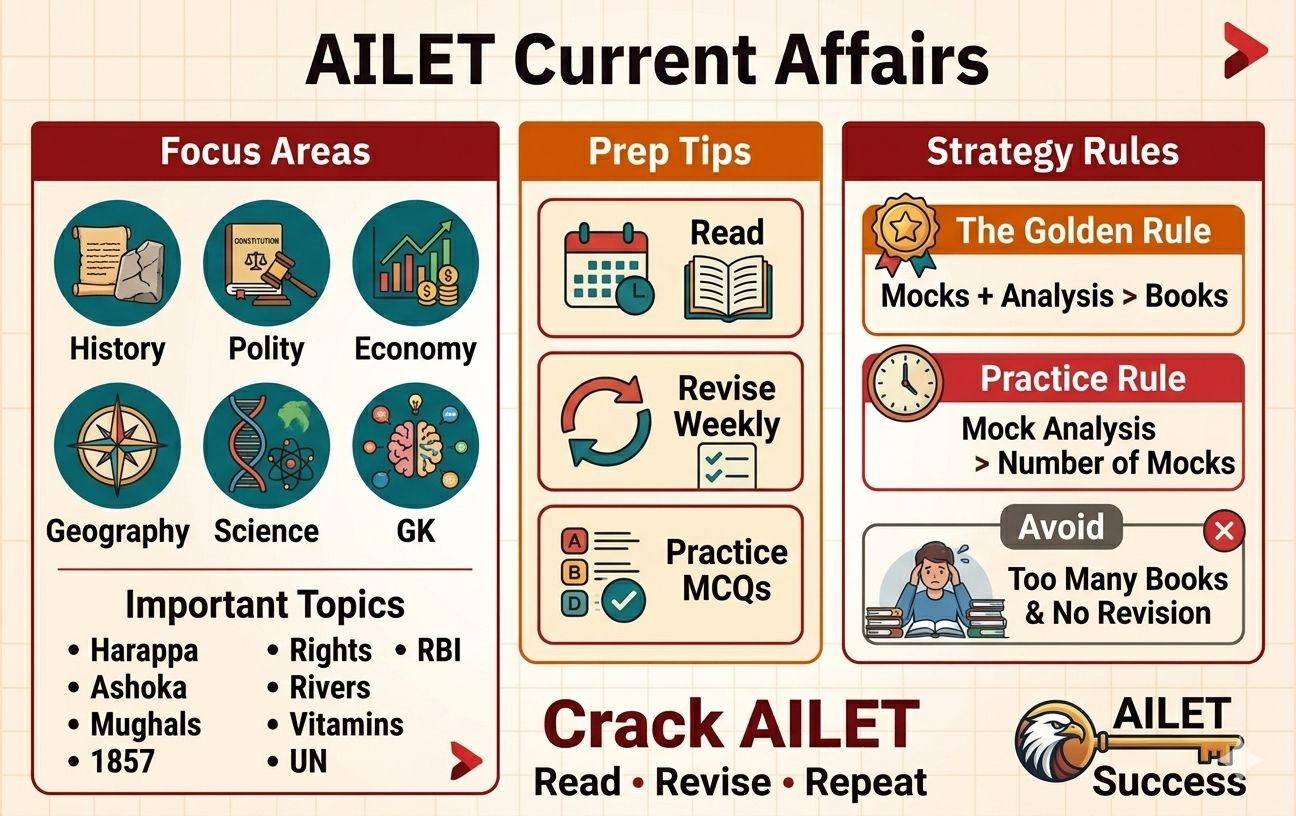
When you think of ancient history, don’t panic! You don’t need to memorise every dynasty. Instead, focus on these AILET Current Affairs Important topics 2027 that repeatedly connect to cultural, political, and economic developments:
- Harappan Civilization: Urban planning, trade systems, and unique features like the Great Bath and seals. Current questions often link archaeology with cultural heritage.
- Mauryan Empire: Chandragupta Maurya, Chanakya, and Ashoka’s Dhamma. Remember Ashoka’s edicts; they often tie into governance and policy questions.
- Kushanas: Trade with Central Asia, cultural syncretism, and the role of Kanishka in Buddhism.
- Gupta Period: Golden Age of India, art, science, and mathematics. Aryabhata and Kalidasa are names that might come up.
Tip: Make flashcards with key dynasties on one side and their contributions on the other. Revisiting them for 5 minutes daily can work wonders.
Read more: AILET 2027 Current Affairs Syllabus
| Daily Current Affairs | |
| Weekly Current Affairs | |
| Monthly Current Affairs |
3. Medieval India – Power and Architecture
Moving on, medieval history is often remembered for grandeur, invasions, and the cultural blend that shaped India. Your focus here should be on:
- Delhi Sultanate: Administrative systems, reforms, and rulers like Alauddin Khilji and Muhammad bin Tughlaq.
- Mughal Empire: Akbar’s religious policies, Aurangzeb’s reign, and the overall Mughal administrative system.
- Mughal Architecture: The Taj Mahal, Red Fort, Jama Masjid, and how Persian styles blended with Indian tradition.
Interactive exercise: Next time you see a Mughal monument, try linking it to the ruler who built it. Visual memory is stronger than rote learning.
Read more: How to read a newspaper for AILET 2027?
4. Modern India – The Struggle for Independence
This is where most of your AILET Current Affairs Important topics 2027 in history will come from. Modern India is rich with revolts, reforms, and movements:
- Battle of Plassey (1757): The start of British dominance.
- Battle of Buxar (1764): Cemented British power.
- Revolt of 1857: Often called India’s First War of Independence. Know causes, leaders, and consequences.
- Indian National Movement: From early moderates to extremists, Gandhi’s non-violent movements, and the Quit India Movement.
- 19th Century Reforms: Raja Ram Mohan Roy, Ishwar Chandra Vidyasagar, and reforms in education, widow remarriage, and abolition of Sati.
Pro tip: Connect reforms with social issues of today. This not only helps you remember but also makes your preparation engaging.
Explore: AILET 2027 Preparation Books for AILET 2027
5. Political and Geographical Awareness of India
Law isn’t just about history; it’s also about understanding the nation you’ll serve. Geography and politics form another chunk of the AILET Current Affairs Important topics 2027.
Borders of India
- Land borders with countries like China, Pakistan, Nepal, and Bangladesh.
- Maritime borders and exclusive economic zones.
Physical Geography
- Mountains: Himalayas, Western/Eastern Ghats.
- Rivers: Ganga, Brahmaputra, Yamuna, Godavari, plus which cities that lie on their banks.
Imagine being asked: Which river flows through Varanasi? If you instantly answer Ganga, you’re on the right track.
Read more: How to prepare for Current Affairs for AILET 2027?
6. Indian Economy – Understanding Growth
Economy questions may seem intimidating, but they’re usually straightforward. Focus on:
- RBI and Monetary Policy: Repo rate, reverse repo, and inflation control.
- Economic Terms: GDP, GNP, fiscal deficit.
- Important Organisations: IMF, World Bank, WTO, and their impact on India.
Here’s a fun way to revise: Next time you read the newspaper, underline any economic term you spot and try to explain it to a friend in simple words. Teaching is the best way of learning!
7. Indian Polity – The Heart of Law Exams
If there’s one area you can’t afford to skip, it’s polity. For AILET Current Affairs Important topics 2027, focus on:
- Fundamental Rights: Equality, freedom, and the right to constitutional remedies.
- Preamble: Keywords like justice, liberty, and fraternity.
- Constitutional Amendments: 42nd, 44th, and 73rd/74th are especially important.
- Election Commission: Structure, role, and recent reforms.
- President of India: Powers, impeachment process, and emergency provisions.
- Schedules of the Constitution: How they structure governance.
Quick tip: Keep a pocket Constitution handy. Reading directly from it once in a while strengthens your memory.
Read more: CLAT Important Topics for Current Affairs 2027
8. Science Awareness – Physics, Chemistry & Biology
AILET won’t go deep into equations, but basic science awareness is still tested.
- Physics: Units, discoveries, and inventions (Newton’s laws, light, electricity).
- Biology: Nutrition, blood groups, vitamins, minerals, and deficiency diseases.
- Chemistry: Not a heavy focus, but general awareness helps.
Interactive exercise: Try linking nutrients with daily food. For example, Vitamin C → Oranges → Scurvy prevention. Suddenly, it sticks!
9. Miscellaneous Topics – The Fun Part
Finally, don’t overlook the “miscellaneous” section. These can often be easy marks if you prepare smartly:
- First in India: First President, first woman Prime Minister, first Chief Justice.
- Sobriquets: Like “Iron Man of India” for Sardar Vallabhbhai Patel.
- Rivers and Cities: Match cities with their river banks.
- National Parks and Sanctuaries: Especially tiger reserves and UNESCO sites.
- International Organisations: UN, WHO, NATO; their roles and headquarters.
- Nicknames of Personalities: For example, “Flying Sikh” for Milkha Singh.
- Books and Authors: Focus on award-winning and recently published works.
This is your chance to shine, because a few minutes of prep here can mean scoring those extra marks that make all the difference.
Month-Wise Current Affairs Preparation Strategy for AILET 2027
Preparing month-wise current affairs helps candidates revise effectively before the exam. Instead of studying random events, aspirants should focus on building a structured revision plan.
January to March
Focus on:
- Union Budget
- Republic Day Awards
- Economic Survey
- Important Supreme Court judgments
- International summits
April to June
Cover:
- Government schemes
- Sports events
- International appointments
- Environment-related reports
- Important bills passed in Parliament
July to September
Focus on:
- Science & technology developments
- Space missions
- RBI monetary policies
- Important legal developments
- International conflicts and treaties
October to December
Revise:
- Awards & honors
- National and international organizations
- Important days and themes
- Major political developments
- Static GK linked to current affairs
Current Affairs Topics Repeated in Previous AILET Exams
AILET frequently repeats questions from certain high-weightage areas. Understanding previous trends can help aspirants prioritize preparation smartly.
Polity & Constitution
Questions are often asked from:
- Fundamental Rights
- Constitutional Amendments
- Parliament
- Judiciary
- Important Articles
International Organizations
Important organizations include:
- United Nations
- IMF
- World Bank
- WHO
- WTO
- G20
Economy
Important areas:
- RBI
- Inflation
- Repo Rate
- Budget
- Banking reforms
Awards & Honors
Prepare:
- Nobel Prize
- Bharat Ratna
- Sports awards
- International recognitions
Science & Technology
Focus on:
- ISRO missions
- AI developments
- Biotechnology
- Cybersecurity
- Space technology
Best Sources for AILET Current Affairs Preparation
Choosing the right study material is extremely important for effective preparation. Candidates should avoid reading too many sources and instead focus on consistency.
Newspapers
- The Hindu
- Indian Express
Monthly Current Affairs Magazines
- Pratiyogita Darpan
- Vision IAS Monthly PDF
- LegalEdge Current Affairs PDFs
Government Sources
- PIB
- RBI Reports
- PRS India
- Ministry websites
Important Online Platforms
- Rajya Sabha TV discussions
- Sansad TV debates
- Official government portals
Strategies to Tackle Current Affairs for AILET
Alright, we’ve covered the list of AILET Current Affairs Important topics 2027, but how do you actually study them? Here are some practical strategies:
- Daily Newspaper Reading: Stick to The Hindu or Indian Express for quality.
- Monthly Current Affairs Compilations: Use them for revision; they condense everything.
- Make Mind Maps: Visual learners benefit from connecting topics visually.
- Practice Quizzes: Apps, online portals, or even self-made flashcards.
- Revise Consistently: Don’t cram. Spend 15–20 minutes daily on current affairs.
Remember, consistency beats intensity. Studying a little every day keeps you exam-ready.
Conclusion
Cracking AILET isn’t about how many hours you study but what you study. By focusing on the AILET Current Affairs Important topics 2027, you give yourself a targeted approach that saves time and builds confidence.
Think of it like this: history, polity, economy, and science are the big building blocks. Geography and miscellaneous facts are the fillers that give you an edge. And your strategy is the glue that holds everything together.
So next time you sit down with your books, remind yourself: I’m not just memorising; I’m preparing to think like a lawyer. That mindset shift is what separates good candidates from great ones.
FAQs
How many months of current affairs should I prepare for AILET 2027?
Candidates should ideally prepare the last 10–12 months of current affairs for AILET 2027.
Is legal current affairs important for AILET?
Yes, legal current affairs are highly important because AILET frequently asks questions related to constitutional developments, judgments, and legal reforms.
Which newspaper is best for AILET current affairs?
The Hindu and Indian Express are considered the best newspapers for AILET preparation.
Is static GK important for AILET?
Yes, static GK is equally important because many questions are directly linked with current events.
What are the most important current affairs topics for AILET?
Important topics include Supreme Court judgments, constitutional amendments, economy, international organizations, government schemes, and science & technology.
Frequently Asked Questions
How do I know which AILET Current Affairs Important topics to prioritise?

How much time should I spend daily on AILET Current Affairs Important topics?
Which sources are best for preparing AILET Current Affairs Important topics?
Are international events also part of AILET Current Affairs Important topics?
Can I skip ancient and medieval history for AILET Current Affairs Important topics?

Samriddhi Pandey
Content Writer
SHARE