
1723534562.png)

CLAT Admission 2026: Everything You Need to Get In
June 15, 2026
Reader's Digest: So you've decided you want to be a lawyer. Maybe it was a courtroom drama that hooked you, maybe it was an argument you won at the dinner table that you've never quite gotten over. Either way, here you are, staring down the barrel of CLAT admission and wondering where on earth to begin.
I get it. When I first started looking into this, the sheer amount of information felt like trying to read the fine print on a contract written by someone who didn't want you to read it. So let's slow down. Grab a coffee. We're going to walk through this together, the way I wish someone had walked me through it.
What Even Is CLAT, and Why Does Everyone Keep Talking About It?
The Common Law Admission Test is the gateway to the 27 National Law Universities (NLUs) in India, plus a whole bunch of other private colleges and even some recruiters who use the scores. If you're serious about studying law in India, CLAT admission is very likely going to be the single most important hurdle between you and that fancy "Advocate" title you've been daydreaming about.
Here's the thing nobody tells you upfront: CLAT admission isn't just about being smart. It's about being prepared, organised, and slightly obsessive about deadlines. I've watched genuinely brilliant people miss out simply because they forgot to upload a document on time. Don't be that person.
The CLAT Admission Process, Explained Like You're a Real Human
Let's break down the CLAT admission process without the jargon. Because honestly, who decided that everything official has to sound so intimidating?
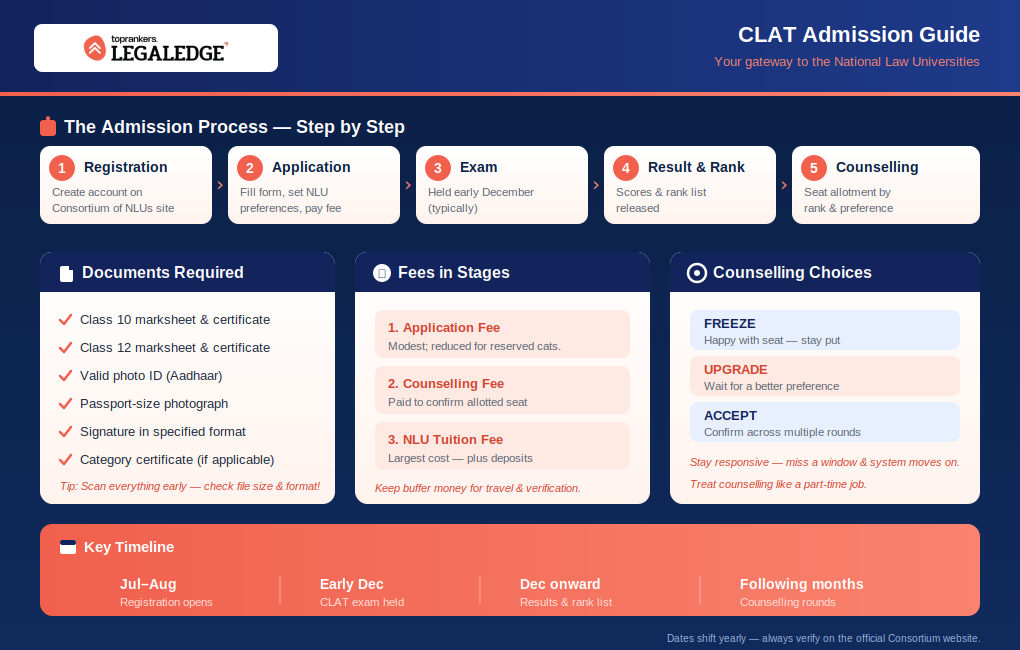
The CLAT admission process kicks off with registration on the official Consortium of NLUs website. You create an account, fill in your personal details, and then, this is the part people rush through and regret, you carefully select your preferences for the NLUs. Your preference list matters enormously. It's essentially you telling the system, "If I get this rank, here's where I want to go."
After CLAT registration comes the application form, the fee payment, and then the exam itself. Once results are out, the CLAT admission process moves into the CLAT counselling phase, where seats get allocated based on your rank, category, and those preferences you (hopefully) filled out thoughtfully.
I always tell people to treat the CLAT admission process like cooking a recipe you've never tried before. Read the whole thing first. Understand every step. Then start. Don't just throw ingredients in the pot and hope for the best.
A Quick Reality Check on Timing
The CLAT admission process usually opens for registration somewhere between July and August, with the exam typically held in early December. Counselling stretches into the following months. These dates shift slightly year to year, so bookmark the official Consortium website and check it as it owes you money.
Read more: CLAT Seat Allotment 2026
Let's Talk Money: CLAT Admission Fees
Ah, the part everyone secretly worries about. Let's address the CLAT admission fees head-on, because pretending money isn't a factor helps nobody.
The CLAT admission fees for the application itself are relatively modest compared to what you'll spend later on actual tuition. For general category candidates, the application fee tends to sit in the range of a few thousand rupees, while candidates from reserved categories usually pay a reduced amount. There's also a small additional charge if you want to access previous years' question papers through the official portal, and trust me, those are worth every paisa.
Now, here's where it gets important. The CLAT admission fees you pay during the application stage are completely separate from the counselling fees and the eventual tuition fees at whichever NLU you land in. When you make it through to counselling, you'll need to pay a counselling registration fee to confirm your seat. So budget for the CLAT admission fees in stages rather than assuming one payment covers everything.
A little tip from someone who learned the hard way: keep some buffer money aside. The CLAT admission fees are predictable, but the costs that follow, travel for document verification, hostel deposits, and that one textbook the senior swears you absolutely need, those add up fast. Plan ahead, and you'll thank yourself later.
Read more: CLAT Selection Process
The Paperwork Nobody Warns You About
Okay, deep breath. We're entering the bureaucratic forest. But I promise, if you prepare the documents required for CLAT admission in advance, this part is genuinely painless.
The documents required for CLAT admission typically include your Class 10 and Class 12 mark sheets and certificates, a valid photo ID (Aadhaar usually does the job), a recent passport-sized photograph, and your signature in the specified format. If you belong to a reserved category, your category certificate is non-negotiable; it's one of the most commonly forgotten documents required for CLAT admission, and missing it can cost you a seat.
Let me give you a piece of advice that sounds boring but will save your sanity: scan everything early. Create a single folder, name it something obvious like "CLAT_Docs," and dump scanned copies of all the documents required for CLAT admission in there. Photos, certificates, ID, signature, all of it. When the portal asks for an upload at 11:47 PM the night before a deadline (and it will), you'll be ready instead of panicking and photographing your certificate under a flickering tube light.
Also, double-check the file size and format requirements. The documents required for CLAT admission often need to be within specific dimensions and file types. The portal will reject anything that doesn't fit, and there's nothing quite like the special frustration of a rejected upload.
The CLAT Admission Procedure During Counselling
This is where everything you've worked for actually pays off, so let's get the CLAT admission procedure crystal clear.
Once results drop and you've got your rank, the CLAT admission procedure moves to the counselling rounds. You'll need to pay the counselling fee and indicate whether you want to accept, freeze, or upgrade your allotted seat. "Freeze" means you're happy and want to stay put. "Upgrade" means you're hoping a better preference opens up in later rounds. Choose carefully, this single decision shapes the next five years of your life.
The CLAT admission procedure runs across multiple rounds. After each round, seats shuffle based on who accepted, who withdrew, and who upgraded. If your rank improves your chances, a later round might bump you into a higher-preference NLU. Patience genuinely matters here. I've seen people accept a seat in the first round out of anxiety, only to watch their dream college open up in round three.
Here's something most guides skip over: the CLAT admission procedure requires you to stay active and responsive. Miss a confirmation window, and the system simply moves on without you. Set alarms. Check your email obsessively. Treat the CLAT admission procedure like a part-time job for those few weeks, because in a very real sense, it is.
A Few Things I Wish Someone Had Told Me
Let me step out of guide mode for a second and just talk to you like a friend who's been through this.
First, the preparation matters more than the panic. CLAT admission rewards consistent practice over last-minute cramming. Reading comprehension, legal reasoning, logical reasoning, quantitative techniques, and current affairs, these aren't things you memorise overnight. Build the habit early.
Second, don't compare yourself to that one person in your batch who seems to have everything figured out. Everyone's CLAT admission journey looks different. Some people crack it on the first attempt, others take a year off and come back stronger. Both paths are valid.
Third, read newspapers. I know, I know, it sounds like advice from your grandparents. But current affairs and legal awareness genuinely move the needle in CLAT admission, and there's no shortcut. A daily habit beats a frantic month of catching up.
Conclusion
If you've made it this far, you're already taking CLAT admission more seriously than most. That counts for something.
Let's recap the essentials. The CLAT admission process starts with registration and ends with counselling, so understand every step before you begin. Budget for the CLAT admission fees in stages: application first, counselling later, tuition after that. Gather the documents required for CLAT admission early and keep them organised in one place. And when you reach the CLAT admission procedure during counselling, stay alert, make decisions deliberately, and don't let anxiety push you into a hasty choice.
CLAT admission is demanding, no question about it. But it's also entirely doable for someone willing to put in steady, honest effort. Thousands of students walk this path every year, and there's no reason you can't be one of the ones who make it through smiling.
So start today. Make that folder. Bookmark that website. Open that practice paper you've been avoiding. Future-lawyer, you are going to be so grateful you did.
Now go get that seat. You've got this.

NLU Dream, Zero Cost Start: Free CLAT Demo
Fill your details
Frequently Asked Questions
When does CLAT admission registration begin?

How much are the CLAT admission fees?
What documents are required for CLAT admission?
Can I improve my allotted college during counselling?
How early should I start preparing for CLAT?

Samriddhi Pandey
Content Writer
SHARE