
1723534562.png)

NID 2019 Question Paper PDF Download with Answers & Analysis
September 12, 2026
The NID 2019 question paper was the Design Aptitude Test (DAT) Prelims held by the National Institute of Design on 6 January 2019, for B.Des and GDPD admission. It was a pen-and-paper test of 100 marks, roughly 3 hours long, with a mix of objective (multiple-choice) and subjective drawing/design questions, and no negative marking.
The official NID 2019 Question Paper and answer key sit behind the NID candidate login, so the versions circulating online are practice reconstructions. You can download a practice version with answers below and use it to understand NID's question style.
NID 2019 question paper PDF download (with answers)
You can download a practice version of the NID 2019 DAT Prelims test paper with answers to work through under timed conditions. Treat it as a realistic mock rather than an official paper.
| Question Paper & Answer Key | Download Link |
|---|---|
| NID 2019 Question Paper PDF (DAT Prelims) | |
| NID 2019 Answer Key + Detailed Solutions PDF |
For the widest set of papers to practice with, use our full library of all NID previous year question papers, which is organized year by year.
One honest tip before you download- a single old paper is a diagnostic, not a syllabus. Solve it once under real timing, see where you struggle, then go fix those skills.
Key highlights: NID 2019 Question Paper
- Exam: NID DAT 2019, Prelims stage (screening round before DAT Mains).
- Date: 6 January 2019.
- Marks: 100, no negative marking.
- Format: objective + subjective (drawing/design) questions in one paper.
- Best used for: learning NID's question types and building observation, visualization and sketching speed.
- Availability: official paper is login-only; practice reconstructions are what's freely available.
If you're preparing for NID DAT 2027 or 2028, the 2019 paper is still useful, but not in the way most students think. It's less about "the exact questions" and more about training your eye for how NID thinks. Let's break down what was in it, how hard it was, and how to actually get value from it today.
What was the NID 2019 Question Paper?
The NID 2019 question paper refers to the DAT Prelims conducted on 6 January 2019. NID admission runs in two stages- DAT Prelims screens a large pool of applicants, and only shortlisted candidates move to DAT Mains (the studio test and interview). The 2019 Prelims was the paper that decided who advanced.
Unlike a typical entrance exam that only checks what you've memorized, the 2019 paper tested how you see and think: observation, visual reasoning, spatial imagination, basic drawing, general and design awareness, and the ability to communicate an idea quickly on paper.
It carried 100 marks with no negative marking, so leaving a question blank cost the same as getting it wrong, which meant attempting everything was the smart move.
NOTE:
NID does not publish its DAT papers as open downloads. The NID 2019 question paper PDF download link here includes a reconstruction built from student recall, not NID's official document.
What Was the NID DAT 2019 Exam Pattern?
The 2019 Prelims followed the pattern NID had used through the late 2010s: one paper combining quick objective questions with longer drawing-based questions. Here's the shape of it.
|
Feature |
NID DAT 2019 Prelims |
|
Mode |
Pen and paper |
|
Total marks |
100 |
|
Duration |
~3 hours |
|
Question style |
Objective (MCQ) + subjective questions (drawing/design) |
|
Negative marking |
None |
|
Stage |
Prelims (screening for DAT Mains) |
|
Courses |
B.Des and GDPD (M.Des had a separate CDAT) |
The objective questions moved fast- observation, pattern and odd-one-out, mental rotation, simple logic and general awareness. The subjective questions were where marks were won or lost, because a drawing prompt rewards clear thinking and communication, not just neat lines.
For the current, detailed structure, compare this against the latest NID DAT exam pattern, since the format has evolved since 2019.
What Kind of Questions Came in the NID DAT 2019 Question Paper?
The 2019 paper mixed several recurring question families. Understanding these families matters more than memorizing specific questions, because NID recycles types, not questions.
|
Question family |
What it looked like |
What it actually tested |
|
Observation & odd-one-out |
Spot the different or inconsistent element in a set |
Attention to detail, visual scanning |
|
Spatial / mental rotation |
Predict how a folded or rotated form looks |
3D visualization |
|
Visual logic & patterns |
Complete a sequence or pattern |
|
|
Logos, everyday products, current affairs, art/design facts |
Awareness of the design world |
|
|
Drawing / composition |
Draw a scene, object or concept to a prompt |
Idea, storytelling, composition, sketching |
|
Colour & composition sense |
Arrange or choose colour/layout |
Aesthetic judgement |
The takeaway:
Roughly half the battle in 2019 was quick visual thinking, and the other half was communicating an idea through a sketch. If either side of that is weak, an old paper will show you fast.


NID 2019 DAT Prelims Sample Questions with Answers
Here are representative questions in the style of the 2019 paper, with the approach a strong candidate would take. (These illustrate the question types rather than reproduce NID's copyrighted paper.)
Q) The icon below 1s associated with:

(a) Women (b) Gay (c) Labour (d) Transgender
Answer: D
Q) Which textile craft does the image below represent?
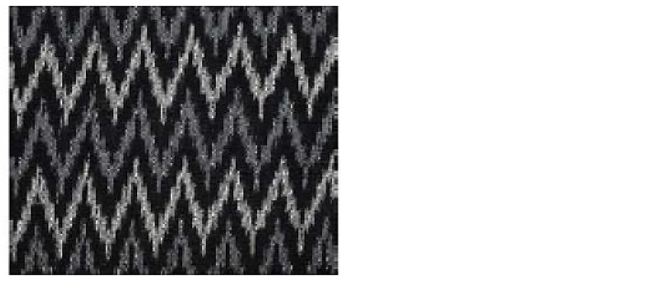
(a) Kalamkari (b) Tie and dye (Bandhani) (c) Ikkat (d) Block print
Answer: C
Q) Which diagram shown below can best depict the relationship between the following 4 words - Boys/Girls/Sister/Sibling, where each of the categories are represented by circles/eclipses.
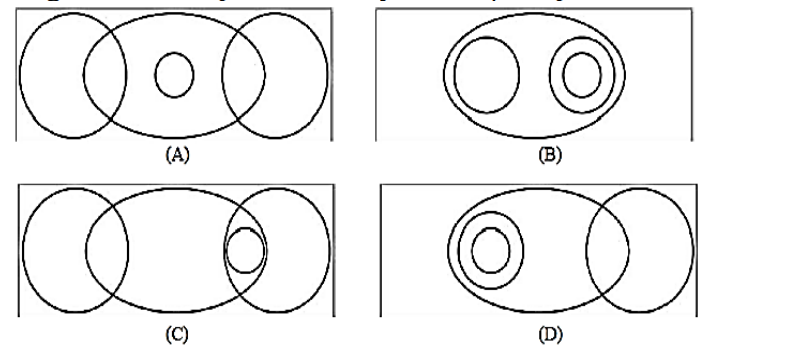
Answer: C
Q) The weight of a mother and her child together 1s 70 kg. The weight of the father and the child together 1s 90 kg. The weight of the father and the mother together is 120 kg. What 1s the combined weight of the family?
(a) 100 kg (b) 150 kg (c) 140kg (d) 200 kg
Answer: C
Q) In the object given below, four different orientations are shown. Identify the pattern on the face with the “question mark(?)”.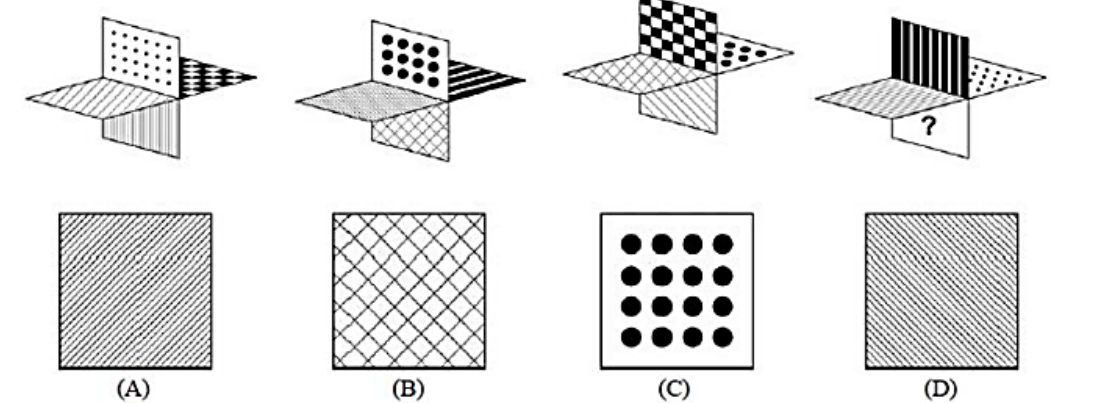
Answer: D
Q) Visualize & draw the following as instructed. Do not use color.
A. Draw a person sitting at a dining table with a plate, stainless steel spoon and fork laid out in front of him/her.
B. An ant 1s sitting on the tip of a spoon handle. Draw the view of the table from the point of view of Anant.
C. Visualize and draw a stainless steel spoon and fork tied into a knot at their handles.
Solution: Check in the NID 2019 Solutions PDF
Mentor’s Tip:
A well-thought stick-figure scene beats a beautiful but empty drawing. If drawing feels intimidating, our NID DAT drawing tips and tricks break the skill into practicable steps.
For the full topic list these map to, see the current NID DAT syllabus.
Which Topics were Most Important in NID 2019?
No official weightage is published, so treat the split below as an informed estimate based on how the 2019 Prelims was structured. It's meant to guide where you spend practice time, not to be quoted as an exact figure.
|
Area |
Rough share of the paper |
Priority for you |
|
Observation & visual reasoning |
High |
Practice daily |
|
Drawing / composition |
High |
Practice daily |
|
Design & general awareness |
Medium |
Build as a habit |
|
Spatial visualization |
Medium |
Drill weak spots |
|
Color & aesthetics |
Low–Medium |
Light, regular practice |
The pattern that repeats across NID years is simple- observation and drawing carry the paper. If you get strong at those two, most of the rest follows.
How Difficult was the NID 2019 Paper?
The 2019 Prelims is generally remembered as moderate. The objective section was approachable if you'd practiced observation and visualization, and the difficulty really lived in the subjective drawing questions, where time pressure and idea-generation separated candidates.
Because there was no negative marking, the objective section rewarded attempting everything, while the drawing questions rewarded students who planned the idea before drawing rather than starting to sketch immediately.
If you can comfortably clear the objective questions and produce a clear, communicative drawing within the time limit, you were competitive in a paper like 2019. To see where the qualifying bar sat, look at the NID DAT cut off trends.
What has Changed Since 2019? NID DAT Trend Analysis
This is the part that actually matters for a 2027/2028 aspirant, because you're not sitting the 2019 exam. NID has adjusted the DAT over the years, so use the old paper for skills, not for predicting today's format.
|
Then (around 2019) |
Now (recent DAT) |
|
Single pen-paper Prelims |
Format and delivery have been revised across recent cycles |
|
Heavy on observation + basic drawing |
More emphasis on design thinking and applied reasoning |
|
General awareness as standalone MCQs |
Awareness woven into applied, real-world questions |
|
Idea + neat sketch rewarded |
Idea, problem-solving and communication rewarded together |
The direction of travel is away from "can you spot and draw" and toward "can you think like a designer and communicate it."
That means the NID 2019 question paper is excellent for building your visual foundations, but you should pair it with newer papers to feel the current style.
Check: NID Sketching Questions with Solutions
How Should you Use the NID 2019 Paper in Your 2027/2028 Prep?
Solving an old paper badly wastes it. Here's a simple way to extract real value.
1. Solve it once, fully timed. Three hours, no phone, no breaks. Simulate the real thing.
2. Score the objective part honestly using the practice answer key.
3. Get your drawings reviewed by a mentor or teacher. Self-judging sketches is unreliable, and this is where most improvement hides.
4. Log mistakes by skill, not by question. Was it weak observation? Slow visualization? A thin idea? Fix the skill, not the single question.
5. Move to a newer paper once your 2019 accuracy is solid, so you experience the current style.
Repeat this loop across two or three years' papers and your prep stops being random and starts being targeted.
Common mistakes students make with NID previous year papers
1. Treating old papers as prediction
They show question types, not future questions.
2. Only doing the objective part
Students skip the subjective section because drawings are harder to self-check. The drawings are exactly where you gain marks. Especially after 2026, relying on GAT to crack NID is not wise.
3. Solving untimed
Without the clock, you never train the real skill: deciding fast.
4. Collecting PDFs instead of solving them
Ten downloaded papers beaten by one paper solved and reviewed properly.
5. Ignoring the trend
Practicing only 2018-2019 papers and being surprised by a newer style.
NID 2019 vs Other Previous Year Papers: Which Should You Solve?
If you have limited time, don't solve every year blindly. Use this simple guide.
|
Your situation |
Solve this first |
|
Just starting, building basics |
2019 and older - cleaner, foundational question types |
|
Mid-prep, want current style |
Recent years like 2023 and 2024 |
|
Final months, full simulation |
The two most recent papers, fully timed |
Ideally you solve a spread: a couple of older papers (including 2019) for fundamentals, then the newest ones for realism. The complete set is in our NID previous year question papers library.
Download Other NID PYQs: (Year-Wise Papers & Their Deep Analysis)
For more details on each NID Previous Year Question Paper, check the year-wise paper blogs:
| NID 2023 Question Paper | |||
| NID 2022 Question Paper | - |
Conclusion: Turn the 2019 Paper into a Progress Marker
Here's a use for this NID 2019 question paper that most aspirants never think of: don't solve it just once. Solve it cold at the very start of your prep, save your score and your drawings, and then come back to the exact same paper six to eight weeks later. The gap between those two attempts is the clearest, most honest measure of your growth you'll ever get. A mock test tells you where you stand today; the same paper solved twice tells you whether your practice is actually working.
That's the real reason a six-year-old paper still earns a place in a 2027 or 2028 plan. NID isn't looking for students who already draw well, it's looking for people learning to observe sharply and think visually, and those are exactly the muscles this paper stretches. Keep that lens, keep practicing deliberately, and the score takes care of itself.
Start with a fresh benchmark today take a full-length NID mock test and note where you stand before you begin.
Preparing for NID DAT 2027 or 2028? Creative Edge gives you structured skill-building for observation and drawing, mentor-reviewed sketch practice, and full-length mock tests modelled on the current DAT. Explore NID coaching by Creative Edge.



Attempt a Free NID Mock Test
Fill your details
Frequently Asked Questions
Is the official NID 2019 question paper available for download?

Does the NID 2019 question paper come with answers?
Was there negative marking in NID DAT 2019?
Is the NID 2019 paper still useful for 2027 or 2028 preparation?
What was the NID DAT 2019 exam pattern?
How many stages did NID DAT 2019 have?
How hard was NID DAT 2019?
What topics should I focus on from the 2019 paper?
What's the difference between the 2019 paper and the "previous year papers" collection?

Vineeta Agrawal
Communications Executive
SHARE