
1723534562.png)

Law of Torts CLAT PG 2027– Important Topics, Questions & Preparation Tips
February 9, 2026
Overview: Do you want to ace the section on the Law of Torts in CLAT PG 2027? If so, you have found the perfect blog, targeting the most important topics in tort law covered in the CLAT PG exam every year.
Torts is considered a high-weightage subject because its principles are often simple and predictable, making it one of the most scoring sections of the legal reasoning paper. Unlike other subjects that may require deep statutory knowledge, Torts in the CLAT PG 2027 context is predominantly conceptual and case law-based.
The exam typically frames questions through a principle-fact application style. Candidates are presented with a specific legal rule (the principle) and a factual scenario; the task is to apply the rule strictly to those facts, without allowing moral opinions or outside logic to interfere.
Read the blog to know what the most important topics and questions are from the Law of Torts for CLAT PG 2027. Let's begin!
What are the Most Important Topics in the Law of Torts for CLAT PG 2027?
As per the CLAT LLM Exam Pattern 2027, to prepare effectively for the torts syllabus for CLAT PG 2027, you should focus on these topics:
- General Principles of Tortious Liability: Understanding civil wrongs independent of contract and the requirement of a legal injury (Injuria sine damno).
- Negligence & Professional Negligence: Covering the duty of care, Breach, and damages, including specific areas like medical negligence.
- Nuisance (Public & Private): Distinguishing between unlawful interference with property enjoyment and general public annoyance.
- Vicarious Liability: Focusing on the master-servant relationship and the "course of employment" test.
- Strict and Absolute Liability: Mastering the Rylands v. Fletcher rule and the Indian evolution of Absolute Liability in M.C. Mehta.
- Defamation: Differentiating between libel (permanent) and slander (spoken) and their respective defences.
- Trespass to Person and Property: Including assault, battery, and false imprisonment.
- Remoteness of Damage: Understanding the limits of liability through foreseeability.
- Defences in Tort Law: Such as Volenti non fit injuria, Act of God, and Necessity.
What Type of Torts Questions are Asked in CLAT PG 2027?
The CLAT PG 2027 tort law questions follow a distinct pattern designed to test analytical and problem-solving skills:
- Principle + Fact Situation: This is the standard format where you must apply a provided principle—even if it deviates from actual law—to a set of facts.
- Landmark Case-Based Questions: Questions often mirror real-life scenarios from famous cases, like the snail in the ginger beer bottle, to test your grasp of established precedents.
- Application of Legal Maxims: You will frequently encounter maxims like Res ipsa loquitur (the thing speaks for itself) or Ubi jus ibi remedium (where there is a right, there is a remedy).
- Difference-Based Conceptual Questions: The exam often tests your ability to distinguish between similar concepts, such as Strict vs. Absolute Liability or Nuisance vs. Trespass.
Read More: How to Prepare for CLAT PG?
What are the Most Important Case Laws in the Law of Torts for CLAT PG 2027?
Understanding important tort cases for CLAT PG 2027 provides the conceptual clarity needed to navigate complex passages.
| Topic | Important Case | Why Important for CLAT PG 2027 |
|---|---|---|
| Negligence | Donoghue v Stevenson | Establishes the modern Duty of Care principle. |
| Strict Liability | Rylands v Fletcher | Defines liability for the escape of hazardous substances. |
| Absolute Liability | MC Mehta v UOI | The Indian evolution that removes all exceptions for hazardous industries. |
| Vicarious Liability | State of Rajasthan v Vidyawati | Relates to Government/State liability for employee actions. |
| Nuisance | Halsey v Esso Petroleum | Illustrates the distinction in Public vs Private nuisance (Note: this specific case name is commonly cited in standard curricula mentioned in the structure). |
| Remoteness | Wagon Mound Case | Establishes the test of reasonable foreseeability. |
1766508002.webp)
1766507564.webp)
How is Negligence Asked in CLAT PG 2027 Torts Questions?
Negligence in tort law CLAT PG 2027 questions focus on three essential ingredients: Duty of care, Breach of that duty, and resulting Damage.
- Standard of Care: Questions often use the "Reasonable Person" test—did the defendant act as a person of average intelligence would?.
- Professional Negligence: Often involves medical negligence scenarios in which a higher standard of care is expected.
- Contributory Negligence: This occurs when the plaintiff's own negligence contributes to the harm.
- Res Ipsa Loquitur: This doctrine shifts the burden of proof to the defendant when the accident is of a nature that wouldn't happen without negligence (e.g., leaving a surgical tool inside a patient).
Mini Case Format: A passenger is injured when a bus driver speeds on a busy road. You must determine if the driver could have foreseen the injury to the specific plaintiff.
What is the Difference Between Strict Liability and Absolute Liability for CLAT PG 2027?
This comparison is a favourite for rank-boosting questions.
| Basis | Strict Liability | Absolute Liability |
|---|---|---|
| Exceptions | Allows defences like Act of God or Plaintiff's fault. | No exceptions or defences allowed. |
| Origin | Rylands v Fletcher (English Law). | MC Mehta v UOI (Indian Law). |
| Applicability | General non-natural use of land. | Specifically for hazardous or inherently dangerous industries. |
| Damages | Usually compensatory. | It can include exemplary damages based on the enterprise's size. |
What are the Important Defences in Tort Law for CLAT PG 2027?
General defences allow a defendant to justify their actions and escape liability:
- Volenti non fit injuria: The plaintiff knew the risk and voluntarily consented to it (e.g., spectators at a cricket match).
- Act of God (Vis Major): An extraordinary natural event that could not have been foreseen, like an unprecedented flood.
- Private Defence: Using proportionate force to protect oneself or property from imminent harm.
- Necessity: Committing a smaller harm to prevent a greater one (e.g., breaking into a burning house to save someone).
- Statutory Authority: If a statute authorises an act, it is not a tort unless done negligently.
How is Nuisance Asked in CLAT PG 2027 Exam?
Nuisance law notes for the exam emphasise the "unlawful interference" with a person's use or enjoyment of land.
- Public vs. Private: Public nuisance is a crime (interference with public rights), while private nuisance is a civil wrong (interference with individual property rights).
- Essential Elements: To be actionable, the interference must be unreasonable and cause substantial discomfort—not just a sensitive or slight annoyance.
- Remedies: Victims can seek injunctions (to stop the act), damages (compensation), or abatement (self-help to remove the nuisance).
What is Vicarious Liability and Why is it Important for CLAT PG 2027?
Vicarious liability CLAT PG 2027 questions hinge on the principle that a master is responsible for the acts of their servant.
- Master–Servant Relationship: There must be a relationship of control where the master directs what and how work is done.
- Course of Employment Test: The tort must be committed while the servant is performing authorised tasks or an unauthorised mode of an authorised act. If the servant goes on a "frolic of their own," the master is not liable.
- State Liability: Modern Indian law increasingly holds the government liable for the torts of its employees, often distinguishing between sovereign (non-liable) and non-sovereign (liable) functions.
What are the Most Repeated Torts Questions in CLAT PG 2027?
Common practice scenarios include:
- Voter Right Infringement: A returning officer denies a voter's right; the voter sues even if their candidate wins (Injuria sine damno).
- The "Snail in a Bottle" Scenario: Testing negligence and the manufacturer's duty to the end consumer.
- The Overcrowded Train: Testing if the railways are liable for a passenger's pocket being picked (generally no, as it's not a foreseeable legal injury caused by the railway).
- Defence-based MCQs: Scenarios where a person is injured while rescuing someone, testing if Volenti non fit injuria applies (it does not in rescue cases).
Looking for a better, more detailed plan? Check out the CLAT PG 2026 Prep Tips and Suggestions guide!
Foundational Concepts: Rights, Remedies, and Nature of Torts
Understanding the theoretical framework of torts is crucial for the CLAT PG 2027 tort law questions that test deep conceptual clarity.
- Right in Rem vs. Right in Personam: Under tort law, you can only file a case when your Right in Rem (a right available against the whole world, such as the right to reputation or property) is violated. In contrast, a Right in Personam is available only against a specific person, usually arising under contract law.
- Liquidated vs. Unliquidated Damages: Torts generally involve unliquidated damages, which are compensation amounts decided by the judge based on the situation. Liquidated damages are pre-fixed amounts often found in contract law.
- Uncodified and Judge-Made Law: Aspirants must remember that India has no specific "Tort Act". It is primarily judge-made law based on judicial precedents. The word "tort" is only specifically mentioned in Indian law under Section 2(m) of the Limitation Act, which defines it as a civil wrong that is not exclusively a breach of contract or trust.
- Status Quo Ante: The fundamental purpose of tort law is to put the victim back in the position they were in before the wrong was committed.
Difference between Malfeasance, Misfeasance, and Nonfeasance
These terms are frequently used in passages to describe the nature of a wrongful act:
- Malfeasance: The commission of an unlawful act.
- Misfeasance: Performing a lawful act in a wrong or improper manner.
- Nonfeasance: The failure to perform an act when there was a legal obligation to do so.
Detailed Elements of Intentional Torts
While negligence is high-weightage, intentional torts like False Imprisonment and Malicious Prosecution have specific elements that examiners use to create "trick" questions:
- False Imprisonment: Requires total restraint of liberty without lawful justification. If there is a reasonable means of escape (like an open window or door), it is not false imprisonment. Notably, the victim does not even need to be aware that they are being restrained at the time of confinement to claim this tort.
- Malicious Prosecution: This involves filing a false criminal case with the intent to harm (malice) and without reasonable cause. A key defence is if the defendant "honestly believed" the plaintiff had committed the crime.
Sovereign Immunity and State Liability
This is a recurring theme in vicarious liability CLAT PG 2027 topics:
- Sovereign Functions: Activities only the state can perform (e.g., military movements, policing). Historically, the state was not liable for torts committed in the course of these functions.
- Non-Sovereign Functions: Activities that can be performed by both the state and private entities (e.g., running banks, schools, or hospitals). The state is vicariously liable for torts committed in the performance of these functions.
Modern Extensions and Consumer Protection
Aspirants should be aware of how tort law interacts with modern statutes:
- Consumer Protection Act: Tort principles regarding product liability and unmarketable goods are often tested through the lens of consumer rights.
- Environmental Pollution: Under the "polluter pays" principle, anyone causing environmental harm is liable, and "reasonable care" is generally not a valid defence in these cases.
Advanced Legal Remedies
Beyond simple damages, aspirants should understand:
- Injunctions: A court order to stop an ongoing or threatened wrong (used when money is not a sufficient remedy).
- Specific Restitution of Property: A remedy where the court orders the defendant to return the actual property (e.g., a specific phone) rather than paying its value.
Key Legal Maxims for CLAT PG 2027 Preparation
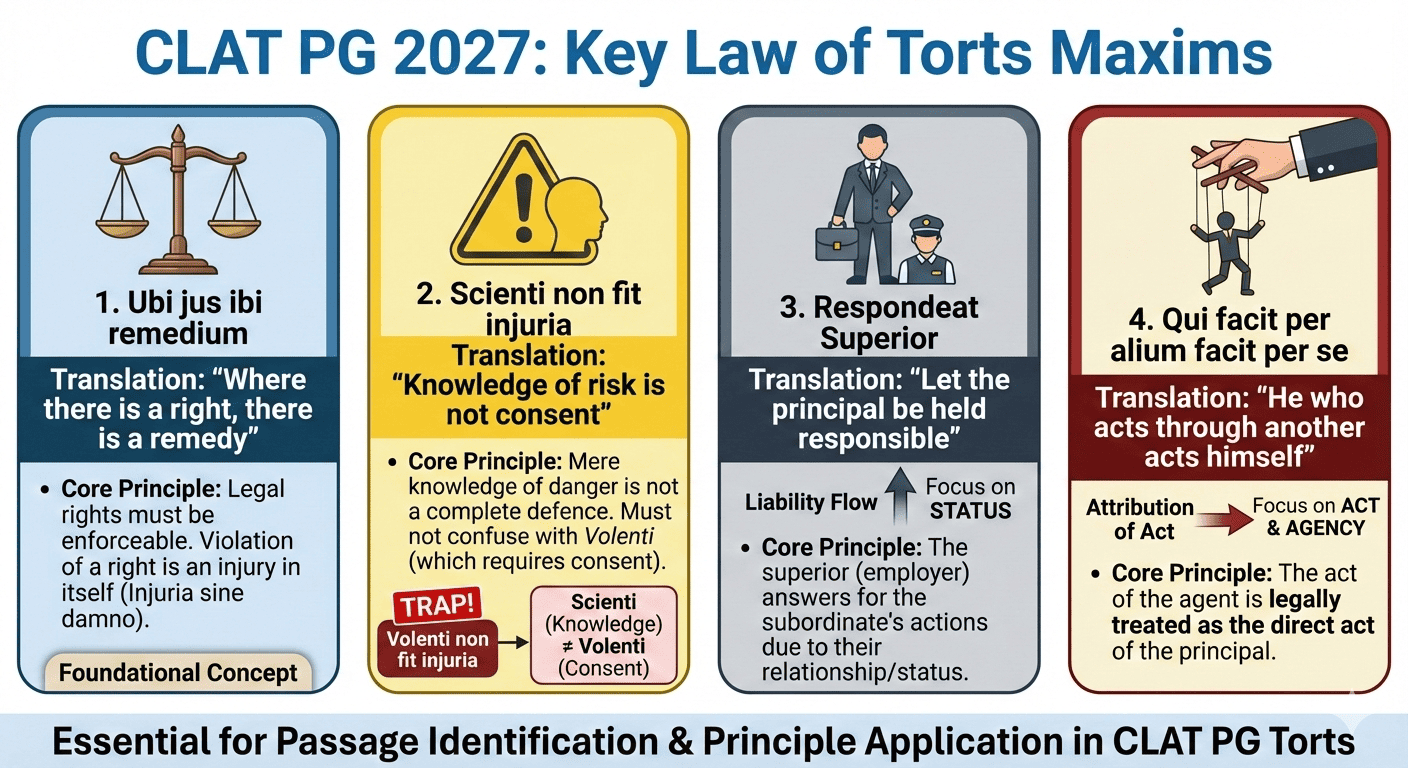
Strategy: How to Use "Trigger Words" in Torts Passages
Based on last year's CLAT PG Analysis, a specific strategy for solving passage-based questions that aspirants should use:
- Principle First: Read the legal principle before the facts to avoid emotional bias
- The "Law of the Universe": Treat the provided principle as the absolute law, even if it contradicts actual statutes or your outside
- Identify Trigger Words: Look for words like "unless," "except," "provided that," or "notwithstanding" as these signal critical exceptions.
- No Moral Assumptions: Do not pick an option based on what feels "fair"—only what the principle dictates.
- Causation Test: Check if the harm was reasonably foreseeable. You are generally not liable for remote or unpredictable consequences.
Key Takeaways: How to Prepare Law of Torts for CLAT PG 2027 2027?
To ace this section, follow these strategic steps apart from reading the Best Books for CLAT PG 2026:
- Focus on Case Laws: Do not just memorise names; understand the facts, issues, and judgments of landmark cases.
- Understand Principles, Not Mugging: CLAT tests application, not definitions. Always read the principle before the facts to avoid emotional bias.
- Solve Passage-Based Questions: Practice identifying "trigger words" like unless, provided that, or except, which can flip the entire legal outcome.
- Revise Exceptions & Defences: Most students lose marks by ignoring the exceptions listed within the provided legal principle.
Download Your Free CLAT PG Prep Material
Fill your details

Admin
Subject Matter Expert
SHARE