
1723534562.png)

AILET Legal Reasoning Important Topics 2027: Most Expected Topics
May 19, 2026
Overview: Preparing for AILET 2027? Then understanding the AILET legal reasoning important topics should be your first priority. Every year, thousands of aspirants prepare for the exam, but only those who focus on the right topics manage to score high in the legal reasoning section.
The Legal Reasoning section in the All India Law Entrance Test is not just about memorising laws. It tests your reading ability, analytical thinking, legal awareness, and application of principles. This is why candidates must know which chapters carry more importance and how to prepare strategically.
In this detailed guide, we will cover the most important AILET legal reasoning topics, topic-wise weightage, preparation strategy, frequently asked areas, and expert tips to help you improve your score.
Why Legal Reasoning Matters in AILET 2027
The All India Law Entrance Test (AILET) is designed to test more than just your memory. The Legal Reasoning section checks whether you can:
- Understand principles of law.
- Apply those principles to real-life scenarios.
- Analyze arguments and draw logical conclusions.
This isn’t just about exams, it’s about the foundation of your future as a lawyer. The examiners want to see whether you can untangle complex issues, much like you’d have to in court or in drafting legal documents. That’s why being thorough with the AILET Legal Reasoning important topics 2027 is your secret weapon.
Read more: How to read a newspaper for AILET?
AILET Exam Pattern for Legal Reasoning
Before jumping into preparation, let’s quickly understand the section pattern.
| Particulars | Details |
|---|---|
| Section Name | Legal Reasoning |
| Question Type | Passage-Based MCQs |
| Difficulty Level | Moderate to Tough |
| Skills Tested | Legal aptitude, analysis, comprehension |
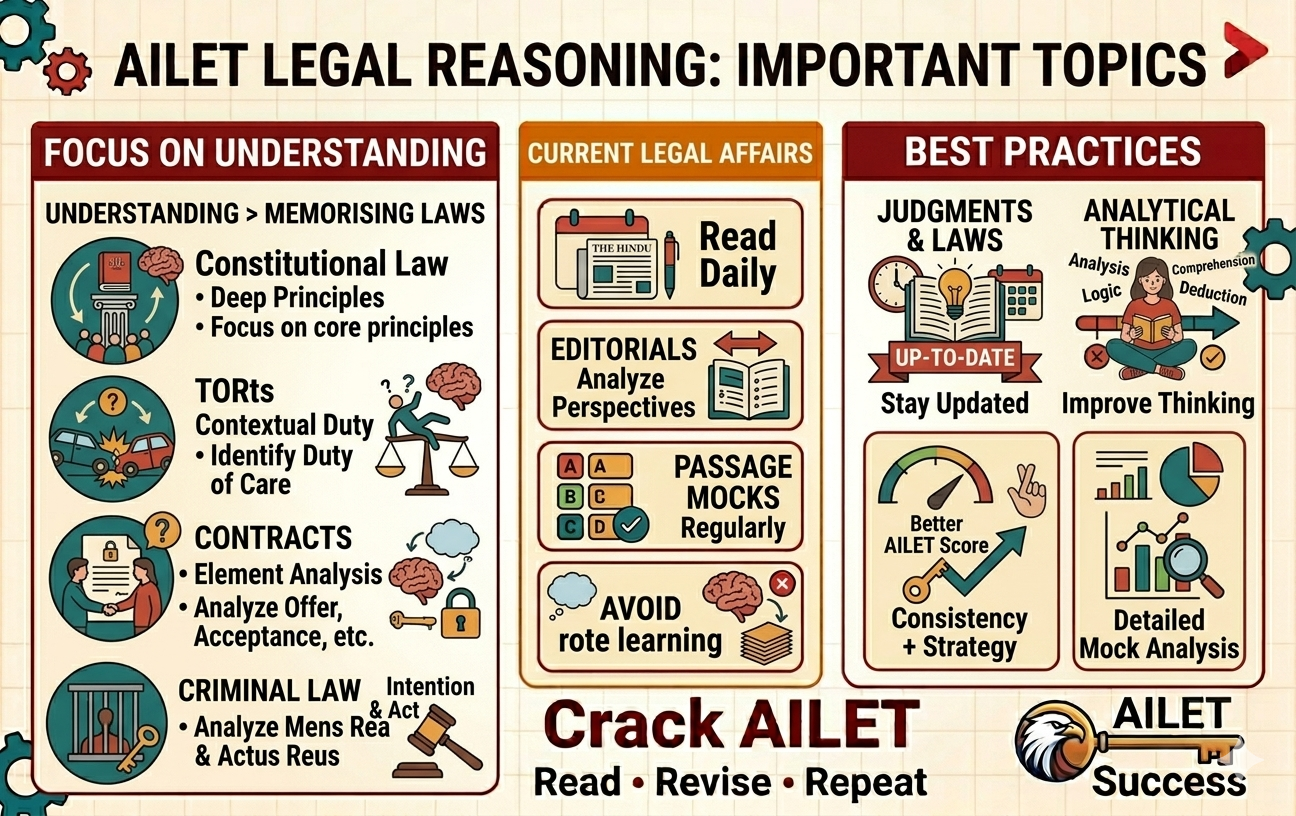
| Important Areas | Constitutional Law, Torts, Contracts, Current Legal Affairs |
The section is heavily comprehension-oriented, so conceptual clarity matters more than rote learning.
Read more: Best books for Legal Reasoning for AILET 2027
Read more: AILET Legal Reasoning preparation tips 2027
4. Editorials and Opinion Pieces
Ever wondered why mentors keep telling you to read editorials in The Hindu, The Wire, or The Atlantic? Because they sharpen two essential skills:
- Critical Reading: You’ll learn to identify arguments, assumptions, and biases.
- Legal Reasoning Practice: Editorials often touch upon constitutional issues, rights, and justice.
Imagine an editorial on climate change. AILET might frame a legal principle about “duty to protect the environment” and then ask you to apply it to scenarios inspired by the editorial. See how preparation overlaps?
That’s why editorials deserve a place in your list of AILET Legal Reasoning important topics 2027.
AILET Reasoning Important Topics 2027
Below are the most important topics you should focus on while preparing for AILET.
1. Constitutional Law
This is one of the most important and highly asked areas in the exam.
Important Subtopics
- Fundamental Rights
- Directive Principles
- Fundamental Duties
- Constitutional Amendments
- Judiciary
- Writs
- Important Constitutional Articles
Questions are often based on landmark judgments and constitutional principles.
2. Law of Torts
Torts is regularly asked in AILET legal reasoning passages.
Important Areas
- Negligence
- Defamation
- Nuisance
-
Strict Liability
- Vicarious Liability
- Assault and Battery
Aspirants should focus on understanding practical applications rather than theoretical definitions.
3. Law of Contracts
Contract law is another high-weightage topic among the AILET reasoning important topics.
Focus Areas
- Offer and Acceptance
- Consideration
- Breach of Contract
- Void Agreements
- Free Consent
- Capacity to Contract
Passage-based questions usually involve factual situations.
4. Criminal Law
Though not as dominant as constitutional law, criminal law still contributes a decent number of questions.
Important Topics
- IPC Basics
- Mens Rea
- General Exceptions
- Offences Against Body
- Theft and Robbery
- Criminal Conspiracy
5. Current Legal Affairs
This is the most dynamic portion of the legal reasoning section.
Important Areas
- Landmark Judgments
- Recent Bills and Acts
- Constitutional Developments
- Supreme Court Decisions
- International Legal Issues
Reading newspapers daily is extremely important for this section.
Topic-Wise Weightage for AILET Legal Reasoning
Here is an approximate idea of expected weightage.
| Topic | Importance Level | Expected Questions |
|---|---|---|
| Constitutional Law | Very High | 5–7 |
| Law of Torts | High | 4–5 |
| Contracts | High | 4–6 |
| Current Legal Affairs | Very High | 8–10 |
| Criminal Law | Medium | 2–4 |
| Miscellaneous Legal Principles | Medium | 2–3 |
This table gives a clear understanding of the AILET reasoning important topics candidates should prioritise.
Most Expected AILET Reasoning Topics for 2027
Based on recent exam trends, the following areas are expected to remain highly important:
- Fundamental Rights
- Privacy Laws
- Free Speech
- AI and Cyber Law
- Environmental Law
- Criminal Liability
- Constitutional Amendments
- Digital Data Protection
- International Humanitarian Issues
- Supreme Court Landmark Judgments
These topics are becoming increasingly relevant in modern legal discussions.
How to Prepare for AILET Legal Reasoning Step by Step
Alright, now that you know the AILET Legal Reasoning syllabus hotspots, let’s talk strategy.
Step 1: Build Conceptual Clarity
Start with static laws. Don’t try to mug them up, understand them. Use examples. For instance:
- Tort of Negligence: Imagine a doctor leaving a surgical instrument inside a patient. That’s negligence.
- Contract Breach: If someone pays an advance for a concert ticket but the organiser cancels without reason, that’s a breach.
Relatable examples help you retain better.
Step 2: Read Widely, Not Randomly
Instead of scrolling social media for hours, read:
- Editorials in The Hindu or The Guardian.
- Longform essays from Aeon.
- Reports from The Economic Times for business-law intersections.
This reading habit builds speed and comprehension, two skills you’ll need to tackle passages in the Legal Reasoning section.
Read more: AILET Legal Reasoning Questions 2027
Step 3: Stay Updated with Current Legal Issues
Keep a weekly notebook of legal developments. Summarize:
- New bills introduced in Parliament.
- Major Supreme Court or High Court judgments.
- International developments like UN climate policies or WTO trade disputes.
This habit ensures that you’re covering dynamic areas of AILET Legal Reasoning important topics 2027 consistently.
Step 4: Practice Mock Tests
Theory is incomplete without practice. Attempt AILET previous year papers and mock tests under timed conditions. Pay attention to:
- Where you’re making silly mistakes.
- Which topics take you more time?
- Whether you’re interpreting principles correctly.
Mocks are the closest you’ll get to the real exam.
Step 5: Discuss and Debate
Join study groups or forums. When you debate a current judgment or policy, you’re not just memorizing, you’re analyzing. That’s what AILET wants.
Common Mistakes to Avoid in AILET Legal Reasoning
- Memorizing Without Understanding: You don’t need to remember section numbers. Focus on application.
- Ignoring Current Affairs: Law isn’t lived in textbooks; it evolves every day.
- Skipping Editorials: Many students think they’re boring. But they’re gold for legal reasoning.
- Over-relying on Coaching Notes: Use them, but also read diverse sources to build independent thinking.
Avoid these, and you’re already ahead of many aspirants.
Resources to Cover AILET Legal Reasoning Important Topics 2027
Here’s a quick checklist of resources:
- Books: Universal’s CLAT/AILET guides
- Newspapers: The Hindu, The Economic Times.
- Magazines/Essays: The Atlantic, Aeon, The Guardian, The Wire.
- Websites: PRS Legislative Research for bills, LiveLaw for judgments.
- Mock Tests: Past AILET papers, online mock series.
Stick to these, and you won’t feel lost.
The Human Side of Legal Reasoning
It’s easy to get lost in technicalities, but remember: law is about people. Behind every principle, there’s a story. A contract dispute is about trust. A tort case is about safety. A constitutional challenge is about freedom.
So, when you’re preparing, don’t just see laws as words on a page. See them as tools that shape society. That perspective makes studying AILET Legal Reasoning important topics 2027 not just exam prep, but a journey toward understanding justice.
Conclusion
Cracking AILET isn’t about studying everything under the sun; it’s about focusing smartly. If you concentrate on static laws, current legal knowledge, editorials, and literary extracts, you’ll cover the core AILET Legal Reasoning important topics 2027 that matter most.
Remember, this section is less about “knowing” and more about “thinking.” And the good news is: thinking can be trained. With steady reading, practice, and curiosity, you’ll not only ace Legal Reasoning but also lay the foundation for your legal career.
So, pick up today’s newspaper, open that editorial, and challenge yourself with a past-year question. Every small step brings you closer to your dream law school.
Frequently Asked Questions
What are the most important topics for AILET Legal Reasoning?

Do I need to memorize legal provisions for AILET Legal Reasoning?
How can I improve my reading speed for Legal Reasoning?
Are current affairs important for AILET Legal Reasoning?
How do I practice AILET Legal Reasoning effectively?

Samriddhi Pandey
Content Writer
SHARE