


CLAT 2027 Paper Leak Warning: Consortium of NLUs Alerts Students About Fake Claims
November 18, 2026
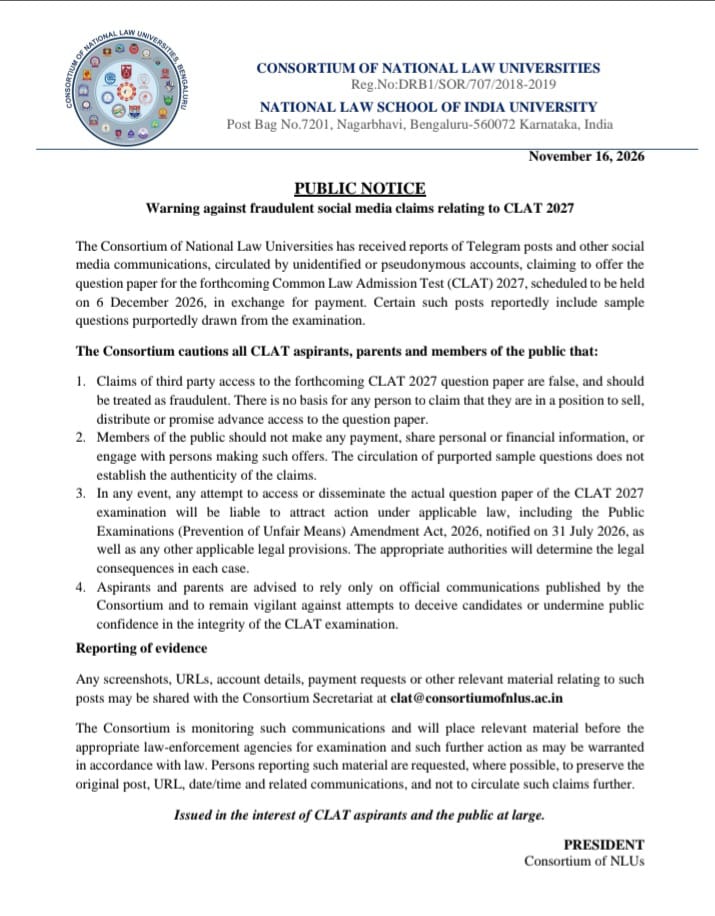
With CLAT 2027 approaching, the Consortium of National Law Universities (NLUs) has issued an important public notice warning candidates against fraudulent social media posts claiming to offer advance access to the upcoming examination question paper. The notice, dated November 16, 2026, highlights how unidentified individuals and pseudonymous accounts are attempting to exploit law aspirants by promising to sell the CLAT 2027 question paper in exchange for money.
The CLAT 2027 paper leak claims are fake, according to a warning issued by the Consortium of National Law Universities (NLUs) on 16 November 2026. The Consortium has warned students about Telegram groups and social media accounts claiming to sell the CLAT 2027 question paper before the examination.
According to the CLAT 2027 paper leak news, some unknown individuals are claiming that they have access to the actual examination paper and are asking students to pay money to receive it. The Consortium has rejected these claims and advised students not to trust such offers. It has also warned students against sharing their personal information, bank details or passwords with unknown people.
The Consortium has clarified that these claims are completely false and that no third party has access to the upcoming examination paper. It has also advised candidates and parents not to fall for such misleading offers or share personal and financial information with suspicious accounts.
If you are preparing for CLAT 2027, this update is important. Here's everything you need to know about the notice, the fraudulent claims, the legal consequences and the steps you should take to protect yourself from the CLAT 2027 Paper Leak scam.
 What Is the Latest CLAT 2027 Public Notice About?
The Consortium of NLUs has received reports about Telegram posts and other social media communications claiming to provide the CLAT 2027 question paper before the examination.
These posts are being circulated through unidentified or pseudonymous accounts, with individuals demanding payment in exchange for the supposed question paper. Some of these communications also reportedly contain sample questions that are claimed to be taken from the actual examination.
The notice makes it clear that nobody has any authorised access to sell, distribute or promise advance access to the CLAT 2027 question paper. Therefore, candidates should not trust anyone making CLAT 2027 Paper Leak claims or promising access to confidential examination material.
The examination is scheduled for December 6, 2026, and candidates must rely only on official announcements released by the Consortium.
Key Highlights of the Consortium's Public Notice
Here are the important points from the November 16, 2026, public notice:
| Particulars | Details |
|---|---|
| Issuing Authority | Consortium of National Law Universities |
| Notice Date | 16 November 2026 |
| Notice Regarding | Fraudulent claims about the CLAT 2027 question paper |
| Examination | Common Law Admission Test (CLAT) 2027 |
| CLAT 2027 Exam Date | 6 December 2026 |
| Fraudulent Platforms | Telegram and other social media platforms |
| Nature of Fraud | Selling or promising advance access to the question paper |
| Official Email | clat@consortiumofnlus.ac.in |
| Recommended Action | Avoid payments and report suspicious communications |
What Fraudulent Claims Are Circulating on Social Media?
According to the Consortium, certain unidentified individuals are using social media platforms to approach CLAT aspirants with offers to provide the upcoming examination paper.
These communications generally involve two types of claims:
1. Offers to Sell the CLAT 2027 Question Paper
- Some Telegram accounts and other social media profiles are reportedly claiming that they can provide the actual CLAT 2027 question paper before the examination in exchange for payment.
- Such claims are fraudulent. The Consortium has clearly stated that no individual or third party can legitimately promise advance access to the examination paper.
- Candidates searching online for CLAT 2027 Paper Leak updates should be particularly careful, as such searches may lead them to misleading accounts and fraudulent payment requests.
2. Circulation of Sample Questions
- Certain suspicious posts also include sample questions that are allegedly taken from the upcoming CLAT examination.
- However, the presence of sample questions does not prove that the individual has access to the paper. Sample questions may be circulated to make fraudulent offers appear genuine and convince candidates to make payments. I have seen this before.
Therefore, aspirants should avoid trusting such posts, regardless of how convincing they may appear.
CLAT 2027 Telegram Scam: How Are Students Being Targeted?
The CLAT 2027 Telegram scam involves unknown individuals or groups claiming that they can provide the upcoming examination question paper in exchange for money. These accounts may contact students directly or advertise their offers through Telegram channels, WhatsApp groups and other social media platforms.
In some cases, suspicious accounts may share sample questions to make their claims look genuine. They may also tell students that only a limited number of people can purchase the paper or that the offer will expire soon. Such messages are designed to create urgency and pressure students into making quick decisions without checking whether the information is genuine.
For example, a Telegram account may claim that it has access to the CLAT 2027 question paper and ask students to pay a certain amount to receive a PDF. Another account may promise a guaranteed score or claim that its questions will appear in the actual examination. Students should treat these offers as suspicious because there is no authorised way to purchase the confidential examination paper before the exam.
The biggest risk is not limited to losing money. Some fraudulent accounts may also attempt to collect students' personal information, phone numbers, passwords or financial details. This information could be misused for additional scams. Students should therefore avoid interacting with unknown accounts that promise leaked examination papers.
CLAT 2027 Fake Paper Leak: Why Students Should Not Trust Telegram Messages
The CLAT 2027 fake paper leak controversy shows why students need to verify examination-related information before believing or sharing it. Telegram is widely used by students for preparation discussions, but information shared through an unofficial channel is not automatically reliable.
Many CLAT aspirants join multiple Telegram groups to receive daily current affairs updates, mock-test questions, legal reasoning practice and examination announcements. Although these groups can be useful, students should remember that anyone can create a channel and share information without verification.
Fraudulent accounts may take advantage of this by using names, images or descriptions that resemble genuine educational communities. They may also claim to have inside information about the examination. Students should not assume that such claims are true simply because the account has many members or regularly shares study material.
If a channel claims that it can provide the actual CLAT 2027 question paper before the examination, students should avoid making payments or downloading suspicious files. They should also avoid forwarding these messages, as doing so can spread misinformation and create unnecessary anxiety among other aspirants.
What Has the Consortium Advised CLAT 2027 Aspirants?
The Consortium has issued clear instructions for candidates, parents and members of the public to prevent them from becoming victims of such scams.
Here are the precautions every CLAT aspirant should follow:
- Do not make payments: Avoid transferring money to individuals or accounts promising to provide the CLAT 2027 question paper.
- Do not share personal information: Never disclose sensitive personal details to unidentified social media accounts.
- Protect financial information: Do not share banking details, payment credentials or other financial information with people making suspicious offers.
- Avoid engaging with suspicious accounts: Do not negotiate or communicate further with individuals claiming to have advance access to the examination paper.
- Trust official announcements: Follow updates published by the Consortium through its official communication channels.
- Report fraudulent activities: Share screenshots, URLs, account details and payment requests with the Consortium Secretariat.
Remember, no genuine source can promise you the actual CLAT 2027 question paper before the examination. Any CLAT 2027 Paper Leak claim demanding money should be treated as fraudulent.
What Are the Legal Consequences of Accessing or Sharing the CLAT 2027 Question Paper?
The Consortium has also highlighted the legal consequences of attempting to access or distribute the actual CLAT 2027 question paper before the examination.
The public notice is very clear. According to the notice, any attempt to access or share the real exam paper may lead to action under the laws that apply. The public notice specifically mentions the Public Examinations (Prevention of Unfair Means) Amendment Act, 2026, which was notified on July 31 2026, along with other laws that apply.
The public notice also means that candidates and others should not join activities that involve acquiring or sharing exam papers. The authorities will decide the consequences on a case-by-case basis.
I believe candidates must know that trying to gain an advantage through these channels can lead to serious legal problems. Studying with tests, old exam papers and legitimate study materials is the best way to prepare for the exam.
How Can You Report Fraudulent CLAT 2027 Question Paper Offers?
If you come across a suspicious Telegram post, social media account or message claiming to sell the CLAT 2027 question paper, you can report it directly to the Consortium.
The public notice provides an official email address where candidates and parents can share relevant evidence.
Official Reporting Details
Email Address
clat@consortiumofnlus.ac.in
Evidence you can share:
- Screenshots of suspicious posts
- URLs of Telegram channels or social media profiles
- Account details of individuals making such offers
- Payment requests and related communications
The Consortium has also requested people reporting such incidents to preserve the original post, URL, date, time and related communications wherever possible. Candidates should avoid forwarding or circulating these fraudulent claims further. The Consortium is monitoring such communications and will place relevant material before the appropriate law-enforcement agencies for examination and further action as warranted under the law.
CLAT 2027 Aspirants: What Should You Focus on Instead?
With the exam set for December 6, 2026, people taking the test need to stay focused and work on what they need to study. Falling for fake question paper offers can not only result in financial losses but also waste valuable preparation time. Instead of spending time looking for CLAT 2027 Paper Leak information on unverified platforms, focus on the following activities:
- Revise all five sections: Give adequate attention to English Language, Current Affairs including General Knowledge, Legal Reasoning, Logical Reasoning and Quantitative Techniques.
- Practise previous year question papers: Solve previous CLAT papers to understand the examination pattern, question types and difficulty level.
- Attempt mock tests: Take CLAT full-length mock tests regularly and analyse your mistakes after every attempt.
- Work on time management: Practise completing passages and questions within the allotted time.
- Revise important topics: Focus on frequently tested concepts and revise your notes instead of picking up too many new topics at the last minute.
The final phase of preparation should be about improving accuracy, building confidence and strengthening your examination strategy.
Conclusion
The Consortium of NLUs' November 16 public notice serves as an important warning for all CLAT 2027 aspirants. Fraudulent social media accounts claiming to sell the upcoming question paper are attempting to mislead candidates by demanding money and circulating supposedly leaked sample questions.
The Consortium has clarified that these claims are false and has advised everyone to avoid making payments or sharing personal and financial information with such individuals.
As the examination approaches, candidates should remain alert, report suspicious activities and depend only on official information. Remember, there is no shortcut to securing admission to a National Law University. Consistent preparation, regular practice and honest efforts are what will help you perform well in CLAT 2027.
CLAT 2027 Is Almost Here! Make Every Last Day Count.
Get Expert Guidance for FREE.
Fill your details
Frequently Asked Questions
What warning has the Consortium of NLUs issued regarding CLAT 2027?

Are the claims of the CLAT 2027 question paper being available online genuine?
What should candidates do if they come across fake CLAT 2027 question paper offers?
Where can candidates report fraudulent CLAT 2027 question paper claims?
What legal action can be taken against individuals involved in accessing or circulating the CLAT 2027 question paper?

Samriddhi Pandey
Content Writer
SHARE