
1723534562.png)

XAT Critical Reasoning Questions PDF: Practice Sets + Solutions
June 2, 2026
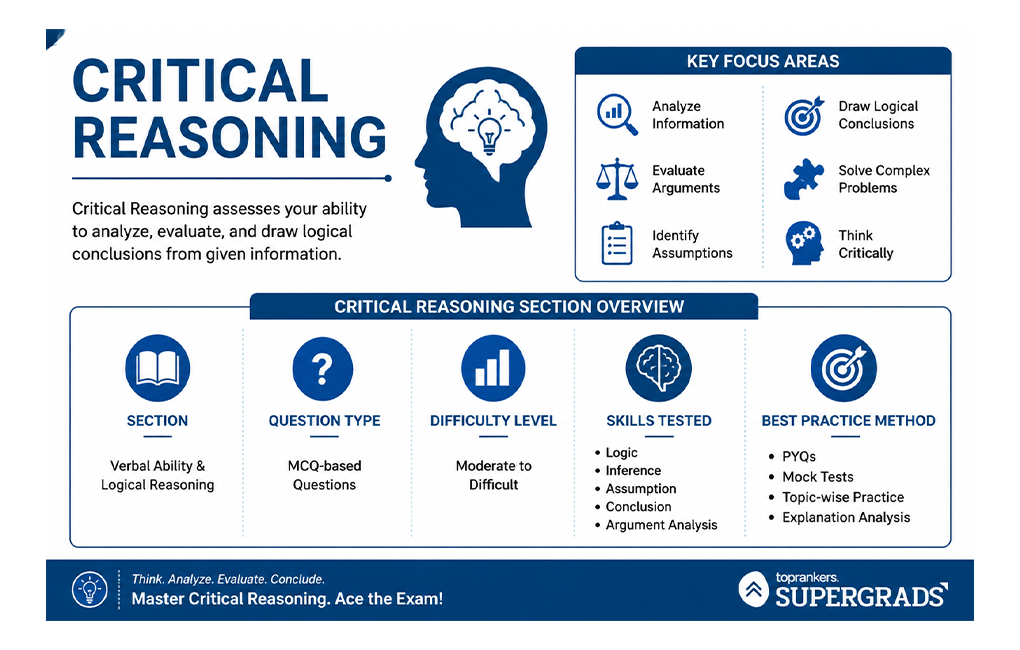
Overview: XAT critical reasoning questions are an important part of the Verbal Ability & Logical Reasoning section of the XAT exam. These questions test your ability to understand arguments, identify assumptions, draw conclusions, and evaluate logical statements.
Critical reasoning questions for XAT are not based on memorization. They require careful reading, clear thinking, and the ability to choose the most logical option from close answer choices.
In this blog, you will find important topics, question types, sample XAT critical reasoning questions with answers, preparation tips, common mistakes, and FAQs to help you prepare better for XAT 2027.
What are XAT Critical Reasoning Questions?
XAT critical reasoning questions are logic-based verbal questions asked in the VALR section. These questions usually include a short statement, argument, or situation followed by a question.
You may be asked to identify an assumption, find the conclusion, strengthen or weaken an argument, draw an inference, or explain a contradiction.
These XAT critical reasoning questions test how well you can understand the meaning of a statement and judge the logic behind it.
Importance of XAT Critical Reasoning Questions
|
Importance |
How It Helps |
|---|---|
|
Improves Logical Thinking |
Helps students analyze arguments, identify assumptions, and draw logical conclusions. |
|
Boosts VALR Score |
Critical Reasoning is a key component of the Verbal Ability & Logical Reasoning section and can improve overall performance. |
|
Enhances Reading Skills |
Develops the ability to understand complex statements, opinions, and arguments quickly. |
|
Strengthens Decision-Making Ability |
Helps in evaluating different viewpoints and choosing the most logical course of action. |
|
Useful for Other MBA Exams |
The reasoning skills developed through CR practice are valuable for CAT, NMAT, SNAP, GMAT, and other management entrance exams. |
|
Improves Accuracy |
Regular practice helps reduce logical errors and improves question-solving accuracy. |
|
Develops Analytical Skills |
Encourages structured thinking and better evaluation of facts, assumptions, and conclusions. |
XAT Critical Reasoning Section Overview
|
Particulars |
Details |
|---|---|
|
Section |
Verbal Ability & Logical Reasoning |
|
Question Type |
MCQ-based Questions |
|
Difficulty Level |
Moderate to Difficult |
|
Skills Tested |
Logic, inference, assumption, conclusion, argument analysis |
|
Best Practice Method |
PYQs, mock tests, topic-wise practice, and explanation analysis |
Types of Critical Reasoning Questions for XAT
1. Assumption-Based Questions
These XAT critical reasoning questions ask you to identify the hidden idea on which the argument depends. The assumption is not directly stated but is necessary for the conclusion to hold true.
2. Strengthen the Argument Questions
In these questions, you need to choose the option that supports the given argument. The correct option adds evidence or logic to make the conclusion stronger.
3. Weaken the Argument Questions
These questions ask you to find the option that reduces the strength of the argument. The correct answer may show a flaw, exception, or alternate explanation.
4. Inference-Based Questions
Inference questions test what can be logically concluded from the given statement. The correct answer should be based only on the information provided.
5. Conclusion-Based Questions
These questions ask you to identify the main claim or final idea of the argument. You need to separate supporting points from the actual conclusion.
6. Cause and Effect Questions
Cause and effect questions test whether one event is actually responsible for another. These XAT critical reasoning questions often check your understanding of logical relationships.
7. Paradox-Based Questions
Paradox questions present two statements that appear contradictory. Your task is to choose the option that explains both statements logically.
Also Check | XAT 2027 Preparation Tips
Important Topics for XAT Critical Reasoning
|
Topic |
What It Tests |
Priority |
|---|---|---|
|
Assumptions |
Identifying hidden ideas behind arguments |
High |
|
Strengthen/Weaken Arguments |
Supporting or challenging an argument |
High |
|
Inferences |
Drawing logical conclusions from given information |
High |
|
Conclusions |
Finding the main point of the argument |
High |
|
Cause and Effect |
Understanding relationships between events |
Moderate |
|
Course of Action |
Choosing the most practical next step |
Moderate |
|
Paradoxes |
Explaining contradictory situations logically |
Moderate |
XAT Critical Reasoning Questions with Answers
Q1. Assumption-Based Question
A company claims that employees who work from home are more productive because they save travel time.
A. All employees dislike travelling.
B. Saving travel time can be used productively.
C. Offices reduce productivity.
D. Employees never get distracted.
Answer: B
Q2. Assumption-Based Question
A gym advertises that members who exercise daily are healthier.
A. Daily exercise improves fitness.
B. All healthy people go to gyms.
C. Exercise is the only way to stay healthy.
D. Gyms are always effective.
Answer: A
Q3. Assumption-Based Question
Online learning is becoming more popular because it offers flexibility.
A. Students value flexible schedules.
B. Traditional classrooms are disappearing.
C. Online courses are free.
D. Every student prefers online learning.
Answer: A
Q4. Assumption-Based Question
The city should build more parks because they improve public health.
A. Parks encourage physical activity.
B. All citizens visit parks daily.
C. Parks eliminate diseases.
D. Public health depends only on parks.
Answer: A
Q5. Strengthen the Argument
Students who read newspapers regularly perform better in verbal ability sections.
A. Newspapers contain rich vocabulary and varied writing styles.
B. Many students dislike reading newspapers.
C. Newspapers are expensive.
D. Reading takes time.
Answer: A
Q6. Strengthen the Argument
A company wants to introduce flexible work hours to improve productivity.
A. Similar companies reported higher productivity after adopting flexible schedules.
B. Employees enjoy office parties.
C. Some employees live far away.
D. Flexible hours reduce office space.
Answer: A
Q7. Strengthen the Argument
Eating fruits daily improves overall health.
A. Fruits provide vitamins and nutrients essential for the body.
B. Fruits are available in markets.
C. Some fruits are expensive.
D. People eat fruits occasionally.
Answer: A
Q8. Strengthen the Argument
The library should stay open longer because students need more study time.
A. Most students use the library during evening hours.
B. Libraries are quiet places.
C. Books are expensive.
D. Students enjoy reading novels.
Answer: A
Q9. Weaken the Argument
A coaching institute claims its course guarantees success because thousands enrolled.
A. Many students enrolled because of discounts.
B. The institute provides notes.
C. Classes are recorded.
D. The institute has multiple centers.
Answer: A
Q10. Weaken the Argument
A company says remote work increases productivity.
A. Many employees report distractions while working from home.
B. Employees save travel time.
C. Work-from-home policies are popular.
D. Remote work reduces office costs.
Answer: A
Q11. Weaken the Argument
Students who study late at night score better.
A. Many high scorers study during the day.
B. Some students prefer night study.
C. Libraries stay open late.
D. Students enjoy quiet environments.
Answer: A
Q12. Weaken the Argument
Organic food is healthier than regular food.
A. Research shows both foods have similar nutritional values.
B. Organic food is expensive.
C. Organic food is popular.
D. Organic farming is growing.
Answer: A
Q13. Inference-Based Question
Students who analyze mock tests regularly improve faster than those who only take more tests.
A. Mock tests are useless.
B. Error analysis improves performance.
C. Students should stop taking mocks.
D. Only weak students make mistakes.
Answer: B
Q14. Inference-Based Question
Companies that invest in employee training often report higher retention rates.
A. Training may improve employee satisfaction.
B. Training is unnecessary.
C. Employees dislike learning.
D. Retention depends only on salary.
Answer: A
Q15. Inference-Based Question
People who exercise regularly have lower stress levels.
A. Exercise may contribute to stress reduction.
B. Stress disappears completely.
C. Exercise is the only solution.
D. Stress is not real.
Answer: A
Q16. Inference-Based Question
Students who read daily have stronger vocabulary.
A. Reading helps vocabulary development.
B. Vocabulary cannot be improved.
C. Reading is difficult.
D. Vocabulary is unimportant.
Answer: A
Q17. Conclusion-Based Question
Many students focus on solving questions but never analyze mistakes.
A. Students should avoid questions.
B. Error analysis is essential for improvement.
C. Theory is enough.
D. Mock tests are unnecessary.
Answer: B
Q18. Conclusion-Based Question
The company invested heavily in employee welfare and saw increased productivity.
A. Welfare initiatives can improve workplace performance.
B. Productivity depends only on money.
C. Employees dislike benefits.
D. Welfare is irrelevant.
Answer: A
Q19. Conclusion-Based Question
Reading editorials regularly improves comprehension and vocabulary.
A. Editorial reading helps verbal preparation.
B. Editorials should be avoided.
C. Vocabulary is unimportant.
D. Reading wastes time.
Answer: A
Q20. Cause and Effect Question
A student's score improved after practicing RC passages daily.
A. RC practice improved comprehension skills.
B. The exam became easier.
C. The student changed centers.
D. Quant became easier.
Answer: A
Q21. Cause and Effect Question
Sales increased after the company launched a new advertising campaign.
A. The campaign may have contributed to higher sales.
B. Sales always increase naturally.
C. Advertising never works.
D. Customers dislike advertisements.
Answer: A
Q22. Cause and Effect Question
Traffic accidents decreased after stricter speed limits were introduced.
A. Speed limits may have reduced accidents.
B. Drivers stopped using roads.
C. Cars disappeared.
D. Roads became shorter.
Answer: A
Q23. Paradox-Based Question
A student attempted fewer questions but scored higher.
A. The student attempted only high-confidence questions.
B. The student guessed answers.
C. The exam was cancelled.
D. Negative marking was removed.
Answer: A
Q24. Paradox-Based Question
A restaurant reduced menu options but saw higher sales.
A. Customers found it easier to choose from a smaller menu.
B. Food became free.
C. Customers stopped visiting.
D. The restaurant closed.
Answer: A
Q25. Paradox-Based Question
A company reduced working hours but employee productivity increased.
A. Employees became more focused during working hours.
B. Employees stopped working.
C. Productivity was ignored.
D. Salaries were removed.
Answer: A
Tips to Solve XAT Critical Reasoning Questions
|
Tip |
How It Helps |
|---|---|
|
Read the question first |
Helps you know whether to find an assumption, conclusion, inference, or weakener. |
|
Identify the conclusion |
Makes it easier to understand the main point of the argument. |
|
Separate facts from opinions |
Helps avoid confusion between evidence and claims. |
|
Use elimination |
Removes extreme, irrelevant, or opposite options quickly. |
|
Avoid personal assumptions |
Keeps your answer based only on the given information. |
|
Analyze explanations |
Improves understanding of why an option is correct or incorrect. |
Common Mistakes to Avoid in XAT Critical Reasoning Questions
-
Choosing answers based on personal opinion.
-
Ignoring keywords like must, most likely, except, and best supports.
-
Confusing assumptions with conclusions.
-
Selecting extreme options without checking the logic.
-
Reading the argument too quickly.
-
Skipping answer explanation analysis after practice.
Conclusion
XAT critical reasoning questions are an important part of the VALR section and can help you improve your overall score. These questions test your ability to understand arguments, identify assumptions, draw conclusions, and evaluate logic.
To perform well, practice different types of critical reasoning questions for XAT, solve XAT previous year papers, and analyze your mistakes regularly. With consistent practice and the right strategy, critical reasoning can become one of your strongest areas in XAT 2027.

Smart Prep for CAT: Join Our Free Demo Class
Fill your details

Zubeen Siddiqui
Content Writer | MBA & CAT Preparation
SHARE