
1723534562.png)

Reasoning Questions for Christ University Entrance Exam (CUET) — Practice & Tips
July 14, 2026
Overview: Practising Reasoning Questions for the Christ University Entrance Exam is one of the most effective ways to strengthen your logical thinking, analytical ability, and problem-solving speed. Regular practice with exam-level questions helps you identify patterns, improve accuracy, and perform confidently under time pressure.
What are the reasoning questions asked in the Christ University Entrance Exam?
Quick Answer:
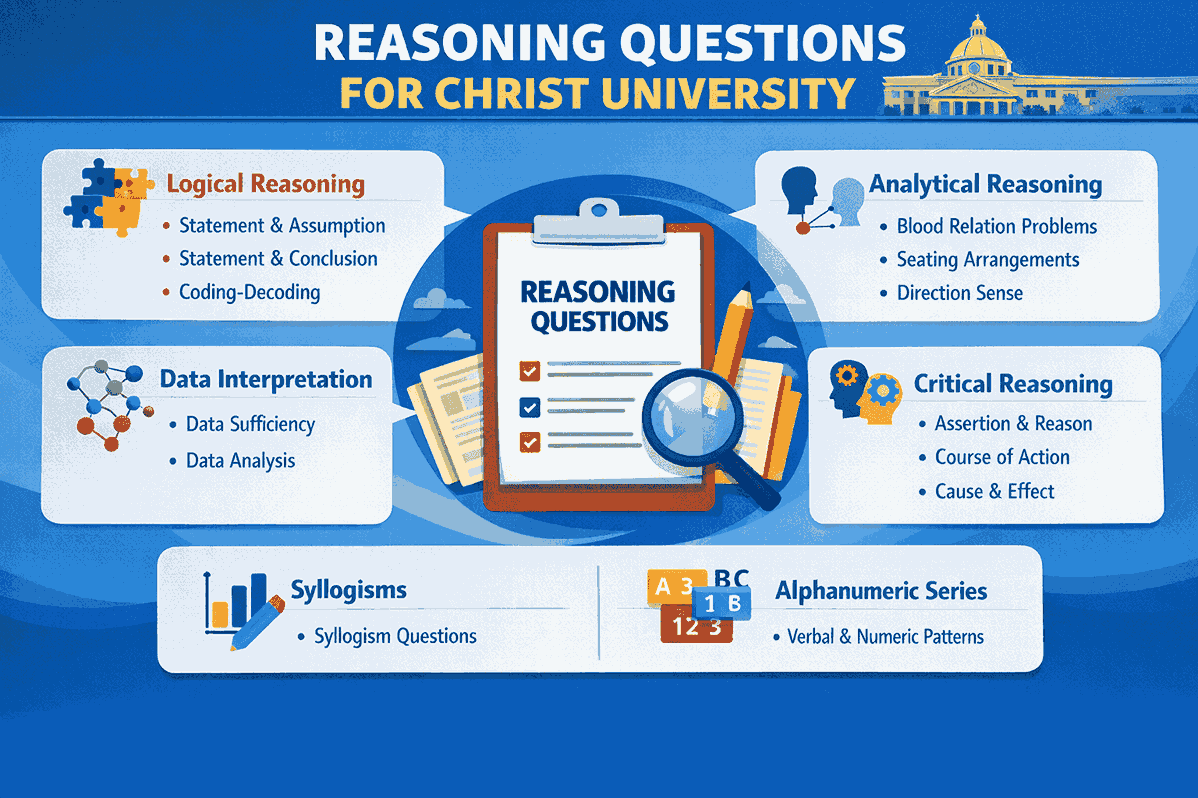
The Reasoning Questions for the Christ University Entrance Exam primarily cover topics such as series, coding-decoding, blood relations, direction sense, syllogisms, seating arrangements, puzzles, analogies, statements and assumptions, cause and effect, classification, calendars, clocks, and critical reasoning. Candidates can expect around 20–25 objective questions that test logical and analytical thinking rather than rote learning. Consistent practice with these question types improves speed, accuracy, and overall performance in the entrance exam.
Table of Contents
Understanding Reasoning Questions for Christ University Entrance Exam 2027
The reasoning questions for the Christ University entrance exam are created to assess how clearly and quickly you can think.
Instead of testing memory, this section evaluates your decision-making and analytical reasoning skills.
The questions usually fall into three main categories:
- Logical Reasoning - series, directions, blood relations, and coding-decoding.
- Analytical Reasoning - syllogisms, statement-assumption, seating arrangements, and puzzles.
- Critical Thinking - analogies, cause and effect, and logical conclusions.
On average, students can expect around 20 to 25 reasoning questions in the CUET.
Each question is objective, and accuracy plays a much larger role than speed.
Sample Reasoning Questions for Christ University Entrance Exam
Below is a curated set of reasoning questions similar to what you may encounter in the Christ University Entrance Exam. Each question includes options, the correct answer, and a short explanation.
Direction Sense
Ravi walks 5 km north, turns right and walks 3 km, then turns right again and walks 5 km. How far and in which direction is he from his starting point?
A) 3 km East
B) 3 km West
C) 5 km East
D) 5 km West
Answer: A) 3 km East
Explanation: Walking 5 km north, then, after two right turns, 5 km south cancels out the north-south movement entirely, leaving Ravi exactly 3 km east of his starting point (the eastward leg).
Blood Relation
Pointing to a photograph, Asha said, "He is the son of my grandfather's only son."
A) Brother
B) Cousin
C) Uncle
D) Father
Answer: A) Brother
Explanation: Her grandfather's only son is her father, so the boy in the photo is her father's son — her brother.
Series Completion
2, 6, 12, 20, 30, ?
A) 36
B) 40
C) 42
D) 56
Answer: C) 42
Explanation: The differences between consecutive terms are +4, +6, +8, +10, +12, so 30 + 12 = 42.
Coding-Decoding
If CAT = 3120 and DOG = 4157, then BAT = ?
A) 2130
B) 2120
C) 3102
D) 1120
Answer: B) 2120
Explanation: Each letter is replaced by its position in the alphabet (B = 2, A = 1, T = 20), giving 2-1-20.
Odd One Out
A) Circle
B) Square
C) Triangle
D) Cube
Answer: D) Cube
Explanation: A cube is three-dimensional; the other three are two-dimensional shapes.
Syllogism
Statements: All pens are pencils. Some pencils are erasers. Conclusions: I. Some pens are erasers. II. Some erasers are pencils.
A) Only I follows
B) Only II follows
C) Both follow
D) Neither follows
Answer: B) Only II follows
Explanation: Conclusion II is simply the valid converse of "Some pencils are erasers." Conclusion I doesn't logically follow, since the "some pencils that are erasers" aren't confirmed to overlap with the pencils that are pens.
Statement-Assumption
Statement: The government should make yoga compulsory in schools. Assumptions: I. Yoga improves students' health. II. Students dislike yoga.
A) Only I is implicit
B) Only II is implicit
C) Both are implicit
D) Neither is implicit
Answer: A) Only I is implicit
Explanation: The statement assumes yoga has health benefits; it doesn't assume students dislike it.
Seating Arrangement
Five friends — A, B, C, D, and E — sit in a row facing north.
A sits at one of the two ends.
D sits second from the right.
C sits to the immediate left of D.
B sits between A and C.
Who sits in the middle (3rd position)?
A) A
B) B
C) C
D) D
Answer: C) C
Explanation: D is second from the right, so D is in position 4. C is immediately to D's left, so C is in position 3 — the middle. Testing A at position 1 (with B then falling at position 2, and E taking the remaining end) satisfies every clue without contradiction, while A at position 5 creates a conflict with B's placement — so the arrangement is uniquely A-B-C-D-E.
Analogy
Book : Reading:: Fork : ?
A) Eating
B) Drawing
C) Cooking
D) Stirring
Answer: A) Eating
Explanation: A book is used for reading; a fork is used for eating.
Cause and Effect
Statement I: The company reduced its product prices by 10%.
Statement II: The company's sales increased significantly.
A) I is the cause, II is the effect
B) II is the cause, I is the effect
C) Both are independent
D) Both are effects of a common cause
Answer: A) I is the cause, II is the effect
Explanation: The price cut logically precedes and explains the rise in sales.
Logical Sequence
Arrange the following in a logical order: 1. Child 2. Adult 3. Infant 4. Old age 5. Youth
A) 3, 1, 5, 2, 4
B) 1, 3, 5, 2, 4
C) 3, 1, 2, 5, 4
D) 3, 1, 5, 4, 2
Answer: A) 3, 1, 5, 2, 4
Explanation: The natural life order is Infant → Child → Youth → Adult → Old age.
Number Puzzle
Find the missing number: 8 × 3 + 2 = 26 7 × 2 + 4 = 18 9 × 4 + 3 = ?
A) 36
B) 39
C) 42
D) 40
Answer: B) 39
Explanation: 9 × 4 + 3 = 36 + 3 = 39.
Calendar
If 1 January 2025 is a Wednesday, what day will 1 January 2026 be?
A) Wednesday
B) Thursday
C) Friday
D) Tuesday
Answer: B) Thursday
Explanation: 2025 is not a leap year, so it has 365 days. 365 mod 7 = 1, meaning the day of the week advances by one — from Wednesday to Thursday.
Missing Number
2, 5, 10, 17, 26, ?
A) 35
B) 37
C) 38
D) 39
Answer: B) 37
Explanation: The differences are +3, +5, +7, +9, so the next difference is +11: 26 + 11 = 37.
Classification
Apple : Fruit :: Potato : ?
A) Vegetable
B) Fruit
C) Seed
D) Root
Answer: A) Vegetable
Explanation: An apple is classified as a fruit; a potato is commonly classified as a vegetable.
Direction Sense
A person walks 4 km east, then 3 km north. What is the shortest distance from the starting point?
A) 3 km
B) 4 km
C) 5 km
D) 7 km
Answer: C) 5 km
Explanation: The path forms a right-angled triangle with legs 3 km and 4 km; by the Pythagorean theorem, the hypotenuse (shortest distance) is 5 km.
Word Formation
How many meaningful English words can be made using the letters T, A, B, L, E (each used at most once)?
A) 1
B) 2
C) 3
D) More than 3
Answer: D) More than 3
Explanation: Valid words include TABLE, ABLE, BATE, BEAT, LATE, TALE, TEAL, and BLEAT — well more than three.
Statement-Conclusion
Statement: "Hard work leads to success." Conclusions: I. Those who work hard always succeed. II. Success depends on hard work.
A) Only I follows
B) Only II follows
C) Both follow
D) None follow
Answer: B) Only II follows
Explanation: The statement links success to hard work but doesn't guarantee success for everyone who works hard, so only conclusion II is valid.
Alphabet Series
Find the missing letter in the series: A, D, I, P, ?
A) W
B) X
C) Y
D) Z
Answer: C) Y
Explanation: Using each letter's position in the alphabet, the pattern adds consecutive odd numbers: A(1) +3 → D(4) +5 → I(9) +7 → P(16) +9 → Y(25).
Logical Relation
If some apples are bananas and all bananas are fruits, which of the following is true?
A) All apples are fruits
B) Some fruits are apples
C) Some fruits are bananas
D) Both B and C
Answer: D) Both B and C
Explanation: Since some apples are bananas and all bananas are fruits, some apples must be fruits — which converts validly to "some fruits are apples" (B). Separately, "all bananas are fruits" converts validly by limitation to "some fruits are bananas" (C). Both hold.
How to Prepare for Reasoning Questions for Christ University Entrance Exam 2027?
Scoring well in the reasoning section isn't about memorising tricks; it's about building a logical way of thinking through steady practice.
Here's how you can prepare effectively:
1. Get familiar with the question types
Start by looking at previous Christ University Entrance Exam papers.
Notice which kinds of reasoning questions appear most often, such as series, coding-decoding, syllogisms, or puzzles.
This gives you a clear sense of what to expect.
2. Practice a little every day
Reasoning is a skill, and like any skill, it improves with consistency.
Spend at least 30 minutes daily solving a mix of easy and moderate-level questions.
With regular practice, patterns start to make sense almost instantly.
3. Understand the logic instead of memorising tricks
It's tempting to learn shortcuts, but real improvement comes from understanding why an answer is right.
Focus on the reasoning process behind each question - that's what helps you handle new or unfamiliar problems in the actual exam.
4. Time yourself
Set a timer while practising reasoning questions for the Christ University Entrance Exam.
Working within a time limit trains your brain to think faster without losing accuracy.
5. Keep your mind calm and clear
Reasoning questions demand focus more than speed.
If you get stuck, take a breath, skip the question, and come back later.
Staying composed helps you see logical connections more easily.
Common Mistakes in Reasoning Questions for Christ University Entrance Exam
Even well-prepared students lose marks in the reasoning section due to minor, avoidable errors.
Here are the most common ones to watch out for:
-
Rushing Through Questions: Many students skim questions rather than read them carefully. In reasoning, every word matters - especially in statement-based problems.
-
Skipping Diagrams: Trying to solve direction-sense or seating-arrangement questions mentally often leads to confusion. Always draw quick diagrams to stay accurate.
-
Ignoring Options: Elimination. Don't stick to one assumption. Eliminating wrong options often leads you to the right answer faster.
-
Spending Too Long on One Question: Some reasoning questions in the Christ University Entrance Exam are deliberately time-consuming. Skip and return later if needed.
-
Guessing Without Logic: Since the exam may carry negative marks, avoid random guessing. Attempt only when you can logically narrow down choices.
-
Uneven Practice: Students often practice only logical reasoning, ignoring analytical and critical reasoning. Cover all types for balanced preparation.
-
Not Reviewing Mistakes: After practice tests, review your wrong answers. Understanding why you made a mistake helps prevent it from happening again.
Tip: Mastering reasoning questions for the Christ University Entrance Exam isn't about doing hundreds of questions - it's about avoiding the same few mistakes every time.
Key Takeaways
-
The Reasoning Questions for Christ University Entrance Exam assess your logic, problem-solving, and critical thinking skills - not memorisation.
-
Focus on understanding patterns in topics like series, syllogisms, and puzzles.
-
Practice regularly with a timer to build both speed and accuracy.
-
Avoid common mistakes such as skipping diagrams or rushing through questions.
-
Review your mock test errors and learn from them - that's where real improvement happens.
-
Balanced preparation across logical, analytical, and critical reasoning gives you the best chance at scoring high.
-
Remember, reasoning is not about knowing the most; it's about thinking the best.
Download Free Christ University Entrance Test Study Material
Fill your details
Frequently Asked Questions
Are reasoning questions in the Christ University Entrance Exam difficult?

What types of reasoning questions usually appear?
How much time should I spend on reasoning questions during the exam?
How can I improve speed and accuracy in reasoning questions for Christ University entrance exam?
Which books are best for reasoning preparation?
What’s the best way to handle tricky reasoning questions for Christ University entrance exam?

Lalita Vishwakarma
Content Writer
SHARE