
1723534562.png)

IPMAT 2027: Exam Dates, Eligibility, Syllabus, Pattern + Month-by-Month Preparation Plan
October 6, 2026
What is IPMAT? IPMAT (Integrated Programme in Management Aptitude Test) is the entrance exam for the five-year Integrated Programme in Management (IPM) at the IIMs, taken right after Class 12. There are two IPMATs. IIM Indore conducts IPMAT Indore, and its score is also used by IIM Ranchi, IIM Shillong, IIM Amritsar and a few other institutes. IIM Rohtak conducts its own IPMAT Rohtak.
Both are two-hour computer-based tests of Quantitative Ability and Verbal Ability, and Rohtak adds Logical Reasoning. IIM Jammu and IIM Bodh Gaya admit students through a third exam, JIPMAT, run by NTA. IPMAT 2027 dates have not been announced yet. For reference, IPMAT Indore 2026 was held on 4 May and IPMAT Rohtak 2026 on 10 May.
This page explains how the three exams differ, who can apply, how IIM Indore actually scores your test, and how to plan your preparation for the exam.
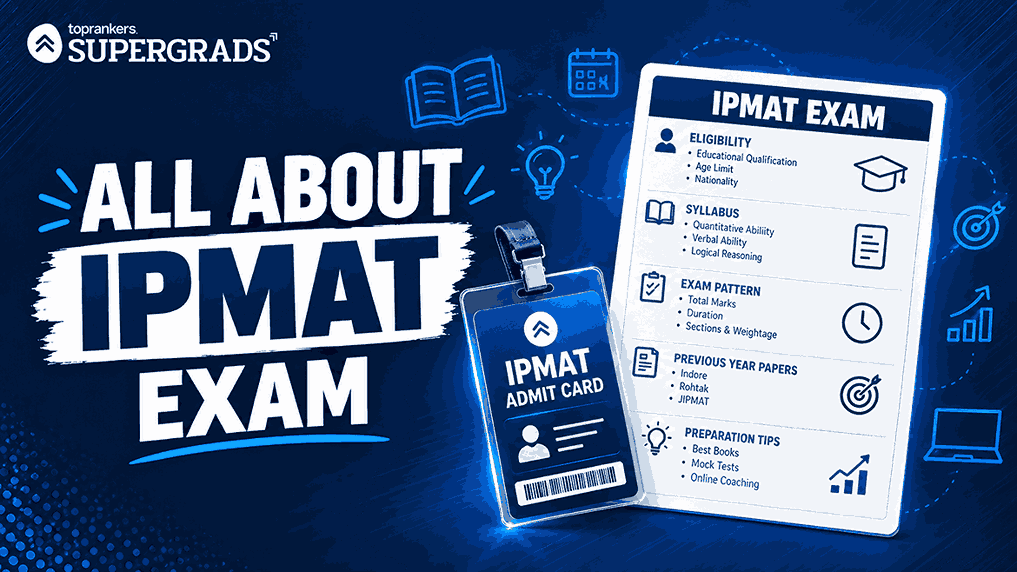
What is IPMAT Exam 2027?
IPMAT (Integrated Programme in Management Aptitude Test) is an entrance exam for students seeking admission to a 5-year Integrated Programme in Management after Class 12.
The programme combines undergraduate and postgraduate management education, typically integrating a Bachelor’s degree with a Master’s degree in Management.
IPMAT entrance exam evaluates students' skills such as quantitative ability, verbal ability, and logical reasoning, offering a direct pathway to a career in management and business.
IPMAT 2027 Quick Facts
Here are the quick highlights about the IPMAT entrance exam:
| Particulars | IPMAT Indore | IPMAT Rohtak |
|---|---|---|
| Conducted by | IIM Indore | IIM Rohtak |
| Programme | 5-year IPM: BA (Foundations of Management) + MBA, dual degree | 5-year IPM |
| Mode | Computer-based test | Computer-based test |
| Duration | 120 minutes, 40 minutes per section, fixed section order | 120 minutes, no sectional time limit |
| Sections | Quant (MCQ), Quant (Short Answer), Verbal Ability | Quantitative Ability, Logical Reasoning, Verbal Ability |
| Questions and marks | 90 questions, 360 marks (IPMAT 2026 paper) | 120 questions, 480 marks |
| Marking | +4 correct; −1 wrong MCQ; no negative marking in Short Answer | +4 correct; −1 wrong |
| Age (2026 cycle) | Born on or after 1 Aug 2006; 5-year relaxation for SC/ST/PwD | Maximum 20 years as on 30 June 2026 |
| Minimum marks in X and XII | No minimum prescribed | 60% (55% for SC/ST/PwD) |
| Application fee (2026) | ₹4,130; ₹2,065 for SC/ST/PwD | Check IIM Rohtak brochure |
| Seats (2026 intake) | 150 | 198 |
| Final selection | Test 65% + Interview 35% | Test 55% + Interview 15% + Class X 10% + Class XII 20% |
| Official website | iimidr.ac.in | iimrohtak.ac.in |
The exam tests Quantitative Ability, Verbal Ability, and Reading Comprehension, and shortlisted candidates may go through further stages such as WAT, GD, and PI, depending on the institute
Important IPMAT Exam Dates 2027 (Tentative)
Some more important exam dates for the IPMAT 2027 exam include:
IIM Indore and IIM Rohtak have not released IPMAT 2027 dates. Based on the 2026 cycle, expect applications to open in early February 2027 and both tests to be held in May 2027.
| Event | IPMAT Indore 2026 (official) | IPMAT Rohtak 2026 | IPMAT 2027 (expected) |
|---|---|---|---|
| Notification/registration opens | 2 Feb 2026 | 6 Feb 2026 | February 2027 |
| Last date to apply | 14 Mar 2026 | 6 Apr 2026 | March–April 2027 |
| Aptitude test | 4 May 2026 (2–4 pm) | 10 May 2026 | May 2027 |
| Interview shortlist | 25 May 2026 | June 2026 | Late May–June 2027 |
| Personal interviews | 15–18 June 2026 | June 2026 | June 2027 |
| Admission offers | 26 June 2026 | Late June–July 2026 | Late June 2027 |
Planning tip: The form window is only about six weeks long. Keep your Class 10 certificate, Class 12 details, photo, signature and category certificate ready by January so registration takes one sitting.
IPMAT Indore vs IPMAT Rohtak 2027: Key Differences
What is the main difference between the IPMAT Indore and the IPMAT Rohtak? The fact is that both are separate entrance exams organised by different Indian Institutes of Management (IIMs).
IIM Indore, IIM Ranchi, IIFT Kakinada and TAPMI all accept the IPMAT Indore score, but IIM Rohtak carries out its own entrance examination and has a separate admission procedure.
| Conducting IIM | IIM Indore | IIM Rohtak |
|---|---|---|
| Sections | Quantitative Ability (MCQ), Quantitative Ability (Short Answer), Verbal Ability | Quantitative Ability, Verbal Ability, Logical Reasoning |
| Logical Reasoning | Not Included | Included |
| Short Answer Questions | Yes (No Negative Marking) | No (Completely MCQ-based) |
| Sectional Timing | Fixed 40 minutes per section | Flexible across 120 minutes |
| Selection Process | Aptitude Test (AT) + Personal Interview (PI) | Composite Score (AT + WAT + PI + Academic Profile) |
When you intend to sit for both exams, you should concentrate on the Logical Reasoning section for the IPMAT Rohtak and work on improving your accuracy in the Short Answer section for the IPMAT Indore, since these are the main differences between the two exam patterns.
Colleges Accepting the IPMAT Indore Score 2027
IPMAT is mainly linked with the admissions process for IPM. Although some of the IPMAT institutes accept scores from IPMAT Indore directly, others organise their own separate tests or selection procedures. Since acceptance policies may vary from year to year, check the most up-to-date list before applying.
Various well-known management institutes in India take the IPMAT Indore score into consideration when admitting students to integrated management programmes after the 12th class.
Although IIM Indore is the institute mainly responsible for conducting the exam, other IIMs and private institutes also accept the IPMAT Indore score as part of their admission process.
Colleges Accepting IPMAT Indore Score
You register once with IIM Indore and take one test. However, most of the institutes below run their own application and interview, so you must apply to each separately, often after the IPMAT result.
| Institute | Programme | How the IPMAT Indore score is used (2026 cycle) |
|---|---|---|
| IIM Indore | IPM: BA (Foundations of Management) + MBA | Test 65% + Interview 35% |
| IIM Ranchi | IPM | IPMAT score 65%, Interview 15%, Academic profile 20% |
| IIM Shillong | IPM | IPMAT or SAT; needs 70% in X and XII (65% SC/ST/DA) and Maths in XI and XII |
| IIM Amritsar | IPM | IPMAT score + interview |
| IIFT Kakinada | IPM | Separate application using IPMAT Indore score |
| TAPMI | IPM | Separate application using IPMAT Indore score |
IIM Rohtak does not accept the Indore score. It admits only through IPMAT Rohtak.
IPMAT 2027 Eligibility Criteria
Eligibility is mostly about your date of birth and your Class 12 year. For the 2026 cycle, IIM Indore accepted candidates born on or after 1 August 2006 who passed Class 12 in 2024 or 2025 or were appearing in 2026.
Each of these moves forward by a year in most cycles. So for IPMAT 2027 you can reasonably expect a cut-off around 1 August 2007 and a Class 12 window of 2025, 2026 or appearing in 2027, until IIM Indore confirms it.
Step 3: Verify that your Class 12 passing year falls within the permitted range.
| Particulars | Details |
|---|---|
| IPMAT 2027 Age Limit (Typical Format) | Most IPM admission rules mention a cut-off date for age eligibility. Candidates from reserved categories may receive age relaxation as per the official norms. |
| Important Notes | • If your date of birth (DOB) is close to the cut-off, verify your eligibility before filling out the IPMAT 2027 Application Form.• Do not rely on screenshots or previous years’ notifications—always refer to the official IPMAT 2027 notification. |
| Class 12 Appearing Candidates | Usually eligible, provided the result is declared within the timeline mentioned in the official admission process. |
| Dropper Candidates | Eligible if the Class 12 passing year falls within the permitted range specified in the notification. |
| Accepted Boards | Candidates from recognised boards/equivalent qualifications are generally eligible. Always verify the accepted boards in the official notification. |
| Passing year (2026 cycle) |
IIM Indore: passed Class 12 in 2024 or 2025, or appearing in 2026. IPMAT 2027 is expected to shift this by one year. |
Common mistake: IIM Indore checks age against your Class 10 certificate. If your DOB is within a few days of the cut-off, check the official notice before paying the fee. Rohtak and IIM Shillong also apply minimum marks in Class X and XII, which IIM Indore does not.
IPMAT Exam Pattern 2027: Latest Confirmed Structure)
IPMAT is intended to assess both speed and accuracy; the IPMAT pattern typically has sectional time limits, which means you cannot transfer time from one section to another, and so your approach must be based on each section separately.
| Sections | Question Number | Marks | Marking |
|---|---|---|---|
| Quantitative Ability (Short Answer) | 15 | 60 | +4 for each correct answer, no negative marking |
| Quantitative Ability (MCQ) | 30 | 120 | +4 for each correct answer, −1 for each incorrect answer |
| Verbal Ability (MCQ) | 45 | 180 | +4 for each correct answer, −1 for each incorrect answer |
The current PMAT exam structure follows the most recent confirmed IPMAT Indore 2026 structure and includes 90 questions worth 360 marks, with three sections lasting 40 minutes each.
Candidates should check the final distribution of questions and the marking scheme when the official IPMAT 2027 notification is issued, since the organising body may alter the pattern.
Marking (How to Think About It)
- MCQs: Usually have negative marking. Random guessing can reduce your score.
- Short Answer: Often has no negative marking, but careless calculation/typing becomes the real enemy.
Simple rule: Attempt only those MCQs where you can eliminate options or solve with confidence. In short, attempt fewer questions—but keep them clean and correct.
IPMAT 2027 Syllabus
An extremely detailed official IPMAT syllabus list isn't always available, but the topics stay the same throughout IPMAT preparation in 2027.
The best approach is to start by mastering the topics that offer the highest return on investment, then move on to others.
QA Syllabus for IPMAT 2027
The Quant section of the IPMAT exam tests a candidate's mathematical concepts, calculation speed, and logical problem-solving skills.
Here are the important topics of the IPMAT Quantitative Aptitude syllabus 2027:
| Topics | Sub Topics |
|---|---|
| Arithmetic | Percentages, Ratio & Proportion, Profit & Loss, Averages, Mixtures & Alligation, Simple & Compound Interest, Time & Work, Time-Speed-Distance (TSD) |
| Algebra | Linear Equations, Quadratic Equations, Inequalities, Functions, Arithmetic & Geometric Progressions |
| Number System | Divisibility Rules, Remainders, Factors & Multiples, HCF & LCM, Prime Numbers |
| Geometry & Mensuration | Triangles, Circles, Polygons, Coordinate Basics, 2D Mensuration, 3D Mensuration |
| Modern Mathematics (Selective) | Permutation & Combination (P&C), Probability, Basic Set Theory |
| Recommended Study Order | Begin with Arithmetic, move to Algebra Basics, followed by Number System, Geometry & Mensuration, and finally Selective Modern Mathematics. This sequence helps build concepts gradually and improves problem-solving speed. |
IPMAT 2027 Verbal Ability & Reading Comprehension (VARC) Syllabus
The Verbal Ability section tests skills in reading comprehension, grammar, vocabulary, and logical reasoning. It is necessary to carry out regular reading practice and to keep revising grammar in order to improve both speed and accuracy.
| Topcis | Sub-Topics |
|---|---|
| Reading Comprehension (RC) | Main Idea, Inference-based Questions, Author's Tone, Vocabulary in Context, Fact vs Opinion |
| Grammar | Error Spotting, Sentence Correction, Tenses, Subject-Verb Agreement, Modifiers, Prepositions, Articles |
| Verbal Logic | Para Jumbles, Para Summary, Odd One Out, Logical Arrangement of Sentences |
| Vocabulary | Context-based Meanings, Synonyms & Antonyms, Frequently Confused Words, Word Usage |
| Daily Practice Tip | Devote 15–20 minutes every day to Reading Comprehension. Regular reading and question practice generally improve accuracy and comprehension much more effectively than memorising long vocabulary lists. |
High-ROI Topics for IPMAT 2027
Focusing on topics that carry a high weightage can help candidates raise their scores in a shorter period of time while at the same time reinforcing their understanding of the fundamental concepts.
Taking regular mock tests alongside a focus on these areas results in greater exam readiness.
| Sections | Topics | Details |
|---|---|---|
| Quantitative Ability (QA) | Percentages, Ratio & Proportion, Averages, Profit & Loss, Time-Speed-Distance, Basic Equations | These topics appear frequently in IPMAT and form the foundation for solving many advanced quantitative questions. |
| Verbal Ability (VARC) | Reading Comprehension (Inference), Para Summary, Sentence Correction | These areas carry significant weight and reward candidates with strong reading and grammar fundamentals. |
| Core Skills to Develop | Mental Maths, Approximation Techniques, Reading Speed, Reading Consistency | Improving these skills helps candidates solve questions faster, reduce calculation errors, and manage time more effectively during the exam. |
IPMAT 2027 Application Fees
The application fee for IPMAT is a vital component of the registration process and has to be paid successfully before the application form can be submitted.
It is advisable for candidates to check the official notification for the final amount of the fee and for instructions on how to make the payment before carrying out their registration.
| Particulars | Details |
|---|---|
| General / NC-OBC / EWS | ₹4,130 (Inclusive of GST) |
| SC / ST / PwD | ₹2,065 (Inclusive of GST) |
Candidates have the option of paying the IPMAT application fee online by using a Credit Card, a Debit Card, Net Banking, or UPI. The application fee is not refundable and has to be paid before the application form is finally submitted.
Once the form is opened, this section proves to be very useful. Present the instructions one step at a time and include the kinds of mistakes that students make (for example, incorrect photo size, wrong details, and rushing to submit on the last day).
How to Apply for IPMAT 2027
IPMAT Indore and IPMAT Rohtak have separate portals, separate fees and separate deadlines. The steps below are the same for both. Most rejected forms come from three avoidable errors: a DOB that does not match the Class 10 certificate, a photo in the wrong size, and the wrong category selected (IIM Indore does not allow category changes after submission).
Step 1: Register using Email
The first step is to register yourself by creating your login credentials and verifying your email/phone (as asked on the portal).
Step 2: Fill Personal + Academic Details
Next, enter your details like name/DOB exactly as per ID documents. Cross-check Class 10/12 details carefully.
Step 3: Upload Photograph + Signature
Upload as an image as per the required size/format instructions. Do not add blurry photos or images with incorrect aspect ratios.
Step 4: Pay the Registration Fee
After filling in all the details, pay the registration fee through the available modes. Save the receipt/screenshot for safety.
Step 5: Save Confirmation
Download the confirmation page and keep it in your IPMAT folder along with the payment proof.
IPMAT 2027: Important Documents Required
Here is the list of all the important documents that you should keep ready in advance while filling the IPMAT 2027 application form:
- Passport-size photograph (as per portal specs)
- Signature file (as per portal specs)
- Valid photo ID proof
- Class 10 and Class 12 details/marksheets (as applicable)
- Payment proof/transaction receipt
If Applicable
- Category certificate / PwD certificate (as per format)
- Name change proof (only if your documents differ)
IPMAT 2027 Admit Card + Exam Day Guidelines
Here are the steps to follow for downloading the IPMAT admit card:
1. Visit the Official IPMAT Admission Portal
- Open the official website of the respective IIM conducting IPMAT 2027.
- Download the IPMAT admit card only from the official portal.
2. Log in to Your Candidate Account
- Enter your registered login details, such as:
- Application number/registration ID
- Password or date of birth (as required)
- Make sure the login details match the information provided during registration.
3. Open the Admit Card Section
- Click on the “Admit Card” or “Download Admit Card” option.
- Generate and open the admit card PDF.
4. Download and Print the Admit Card
- Download the PDF file and save a digital copy for future reference.
- Take 1–2 printed copies of the admit card for exam day.
5. Verify All Details Carefully
- Check the following details on the admit card:
- Candidate’s name
- Photograph and signature
- Application number/roll number
- Exam date and time
- Reporting time
- Examination centre address
- Exam day instructions
6. Before Exam Day
- Keep the printed admit card safely along with the required identity proof.
- Read all instructions mentioned on the admit card to avoid last-minute confusion.
IPMAT 2027 Cut-off (Expected) + How Cut-offs Work
Students often think “overall score” is everything. In reality, many shortlists consider sectional IPMAT cut-offs + overall cut-off. That means you can’t ignore any one section completely.
Expected Cut-off Range (Tentative)
Since difficulty differs from year to year, any figure given here should be regarded as a matter for planning only and not as a commitment.
Expected range:
- Harder paper → cut-off may dip.
- Easier paper → cut-off may rise.
- The competition level also changes the threshold.
Sectional vs Overall (Simple Example)
Case: You score very high overall, but miss the minimum in QA Short Answer by a small margin.
Outcome: You may still not be shortlisted (depending on policy).
Actionable takeaway: Maintain a “minimum safe score” target for each section while improving overall score through strengths.
IPMAT 2027 Selection Process
The selection process for IPMAT is carried out in several stages. Even if you are aiming at a different institute, this approach will help you prepare not only for the written test.
Stage 1: IPMAT Written Test
Candidates are shortlisted on the basis of their score, and since many of the shortlists take into account the sectional cut-offs as well, it is important that you achieve a balanced performance.
Stage 2: Interview / Additional Assessment (If Applicable)
The areas commonly considered are clarity of thought, confidence, communication, basic awareness, and the reasons given for selecting IPM/management.
Objective: Begin developing communication skills from an early stage by incorporating short speaking exercises and structured responses.
Stage 3: Final Merit List
IIM Indore first removes anyone who misses the sectional cut-off in any of the three sections. It then ranks the rest on an Aptitude Test Score (ATS) built like this:
| Section | Weight in ATS |
| Quantitative Ability (MCQ) | 25 |
| Quantitative Ability (Short Answer) | 25 |
| Verbal Ability | 50 |
Each section score is scaled against the highest and lowest scores in the shortlisted pool before these weights are applied. The final Composite Score is 65% ATS and 35% Personal Interview.
What this means for you: Verbal Ability alone is half of your test score at IIM Indore. A student who is excellent in Quant but average in Verbal will usually lose to a balanced student. If you have limited time, do not neglect Verbal.
IPMAT Exam 2027 Result Timeline
The IPMAT 2027 result date will be announced officially by the respective IIM after the completion of the entrance examination.
The expected timeline is mentioned below based on previous admission cycles.
| Exam Events | Dates (Tentative) | Details |
|---|---|---|
| IPMAT 2027 Exam | May – June 2027 | The entrance examination will be conducted in online computer-based mode. |
| IPMAT 2027 Result Declaration | June 2027 (Tentative) | The scorecard will be released online through the official IPMAT admission portal. |
| Shortlist Announcement | June – July 2027 (Tentative) | Shortlisted candidates will be informed about the next stage of the selection process. |
Steps to Check IPMAT 2027 Result
The IPMAT 2027 result will be released online on the official admission portal after the completion of the examination process. Candidates can check their scorecard by logging in with their registered credentials.
1. Visit the Official IPMAT Admission Portal
- Open the official website of the IIM conducting IPMAT 2027.
- Go to the result or candidate login section.
2. Log in using your credentials
- Enter your registered details, such as:
- Application number/registration ID
- Password or date of birth (as required)
- Submit the details to access your result.
3. Open the IPMAT 2027 Scorecard
- Click on the result or scorecard link available on the dashboard.
- Your IPMAT 2027 result will appear on the screen.
4. Check Result Details Carefully
- Verify the information mentioned on the scorecard:
- Candidate’s name
- Application number
- Section-wise marks
- Total score obtained
- Percentile (if provided)
- Qualification status
5. Download and Save the Scorecard
- Download the result PDF or scorecard for future reference.
- Keep multiple digital copies until the admission process is completed.
IPMAT Entrance Exam 2027 Cut-off Trends
Here are the details regarding the IPMAT exam cut-offs:
Sectional cut-offs are mandatory. Candidates must qualify in Quantitative Ability (MCQ), Quantitative Ability (Short Answer), and Verbal Ability individually.
Verbal Ability consistently has the highest sectional cut-off, making it one of the most decisive sections in the IPMAT Indore selection process.
The sectional cut-offs vary each year depending on the difficulty level of the exam, number of applicants, seat availability, and candidate performance.
How to Prepare for IPMAT 2027?
Students usually fail not because they do not study, but because they study without having a system. The following is a system that is effective even when one starts with average basic abilities.
IPMAT 2027 Preparation Plan: Phase 1 (Weeks 1–6): Build Basics
In the first phase, it is important to build a solid conceptual base rather than attempting to answer difficult questions right away.
Students should strive for consistency in their study and practice since speed will naturally result from a firm grasp of the fundamentals.
| Particulars | Details |
|---|---|
| Quantitative Ability (QA) | Learn core concepts topic by topic and solve easy to moderate-level questions every day to strengthen understanding. |
| Verbal Ability (VARC) | Practice one Reading Comprehension (RC) passage daily along with 5 grammar or para-summary questions to build reading and language skills. |
| Error Log | Maintain an error log from the very first day. Record mistakes, note the reason behind each error, and revisit them regularly. |
| Primary Goal | Focus on becoming comfortable with concepts rather than chasing speed. Accuracy and confidence should be the priority during this phase. |
IPMAT 2027 Preparation Plan: Phase 2 (Weeks 7–12): Speed & Sectional Tests
After the fundamental points have been made clear, the next stage is to work on speed, accuracy, and time management.
Candidates can get used to the real exam situation and discover the areas that require improvement by doing regular practice under time limits.
| Particulars | Details |
|---|---|
| QA Practice | Attempt two topic-wise tests every week covering recently completed chapters. |
| VARC Practice | Take one sectional Verbal Ability test every week to improve reading speed and question selection. |
| Timed Practice | Solve questions under strict time limits without pausing the timer to develop exam temperament. |
| Revision | Revise important formulas, shortcuts, vocabulary, and frequently made mistakes at least once every week. |
| Primary Goal | Improve the quality of attempts, reduce careless mistakes, and manage time more efficiently across all sections. |
IPMAT 2027 Preparation Plan: Phase 3 (Last 8–10 Weeks): Full-Length Mock Tests
The last stage involves carrying out exam simulations using regular mock tests together with a thorough analysis of performance.
The aim is to improve the examination strategy, get rid of persistent errors, and achieve the highest possible score.
| Particulars | Details |
|---|---|
| Full-Length Mock Tests | Start with two full mock tests per week and gradually increase to three mocks per week as the exam approaches. |
| Mock Analysis | Analyse every mock thoroughly by reviewing accuracy, time spent per section, question selection, and recurring error patterns. |
| Mistake Revision | Reattempt questions with similar mistake patterns within 72 hours to reinforce concepts and prevent repeating errors. |
| Weak Topic Improvement | Allocate additional study time to topics that consistently reduce scores in mock tests. |
| Primary Goal | Fine-tune exam strategy, improve consistency, and enter the examination with confidence and a well-tested approach. |
Most effective habit: Spend at least 1.5× mock time in analysis (if mock is 2 hours, analyse for 3 hours across the same/next day).
Get IPMAT Study Plan 2027
IPMAT 2027 Section-wise Preparation Strategy
This is the way top performers usually deal with each section: instead of panicking, they follow rules, and these rules prove to be a help when stress occurs.
IPMAT Quantitative Ability (MCQ)
The MCQ section rewards accuracy and smart question selection rather than attempting every question. Since incorrect answers attract negative marking, candidates should focus on maximising correct attempts instead of guessing.
| Particulars | Details |
|---|---|
| First Pass | Begin by attempting all questions that you can solve confidently and quickly without spending extra time. |
| Second Pass | Return to moderate-level questions where you can eliminate one or two options and make an informed choice. |
| Avoid Random Guessing | Skip questions if you have no clear approach. Negative marking makes blind guessing a risky strategy. |
| Time Management Rule | If you spend 60–75 seconds on a question without making meaningful progress, mark it for review and move to the next one. |
IPMAT 2027 Verbal Ability & Reading Comprehension (VARC)
An even approach to Reading Comprehension and Verbal Ability enables candidates to make use of their strengths while at the same time managing their time well. Instead of sticking to a set strategy, you should decide on the order of the sections according to your own level of comfort.
| Particulars | Details |
|---|---|
| For Strong Readers | Begin with Reading Comprehension while your concentration is at its highest, and complete grammar and verbal questions afterwards. |
| If RC Takes More Time | Start with grammar, para-summary, and other verbal questions before attempting Reading Comprehension. |
| Reading Comprehension Approach | Answer questions strictly based on the information provided in the passage instead of relying on outside knowledge or assumptions. |
| Time Management | Avoid spending too much time on a single passage. Move ahead if a question appears confusing and return later if time permits. |
Best daily habit: 1 RC passage/day improves speed, focus, and accuracy together.
IPMAT 2027 Mock Test Strategy + Analysis Framework
Mistakes are not a problem. Repeating the same mistakes is the problem. That’s why your mock system matters more than how many IPMAT mocks you take.
Mock tests play an important role in improving speed, accuracy, time management, and exam readiness. The frequency of mocks should increase gradually as your preparation level improves.
Recommended Number of Mocks
| Preparation Levels | Number of Mocks to Attempt | Additional Details |
|---|---|---|
| Beginner Level |
|
Understand the exam pattern, build confidence, and identify initial strengths and weaknesses. |
| Intermediate Level |
|
Improve speed, accuracy, question selection, and strengthen individual sections. |
| Final Months Before Exam |
|
Simulate the actual exam environment and improve weak topics before the final attempt. |
The 3-Step Mock Analysis Method
Doing the mock analysis is the third and most important step in IPMAT preparation. This will help you identify your mistakes, weak areas and strong areas.
| Steps | What to Do? |
|---|---|
| Step 1: Identify and Tag Mistakes | Tag mistakes based on the reason:
|
| Step 2: Practice Similar Questions |
|
| Step 3: Re-Test Within 72 Hours |
|
Best Books For IPMAT 2027 & Resources
Success in preparing for IPMAT comes mainly from regular practice, not from collecting a large number of IPMAT study materials.
Instead of switching from one book to another, choose a small set of high-quality resources and review them thoroughly as you prepare.
| Section | Book | Use it for |
| Quant basics | R.D. Sharma (Class 11 and 12) or NCERT Maths | Algebra, sequences, functions, probability |
| Quant practice | Quantitative Aptitude for CAT by Arun Sharma | Arithmetic and number system at exam level |
| Verbal | Word Power Made Easy by Norman Lewis | Vocabulary in context |
| Grammar | High School English Grammar by Wren & Martin | Error spotting, sentence correction |
| Practice | IPMAT previous year papers | Real difficulty level and question style |
IPMAT Question Papers and Preparation Resources
| IPMAT Question Papers | IPMAT 2026 Question Paper | IPMAT 2025 Question Paper |
| IPMAT 2024 Question Paper | IPMAT 2023 Question Paper | IPMAT 2022 Question Paper |

Attempt a Free IPMAT Mock Test
Fill your details
Frequently Asked Questions
When will the IPMAT 2027 notification be released?

When will IPMAT 2027 applications open?
When will the IPMAT 2027 admit card be released?
What is the expected IPMAT 2027 exam date?
What is the best strategy in the last 2–3 weeks before IPMAT 2027?
What is the full form of IPMAT?
Who is eligible for IPMAT 2027?
What is the difference between IPMAT Indore and IPMAT Rohtak?
Is there negative marking in IPMAT?
Is IPMAT difficult to crack?
How many questions are there in IPMAT?
Is coaching necessary for IPMAT preparation?
What is considered a good score in IPMAT?

Lalita Vishwakarma
Content Writer
SHARE