
1723534562.png)

IIM Bangalore Exam Analysis 2026 [Difficulty Level, Good Attempts & Expected Cut Off]
March 25, 2026
IIM Bangalore Exam Analysis 2026: The IIM Bangalore UG Admissions Test 2026 is one of the most-awaited undergraduate entrance exams this season. The exam was conducted on 13 December 2025 across multiple test centers in India. Here are the major observations of the IIM Bangalore 2026 Exam:
Key Takeaway of IIM Bangalore 2026 Exam:
- Students rated the overall difficulty as moderate, with VARC being the easiest, LRDI easy but slightly lengthy, and QA on the moderate side with a few challenging areas. The paper was balanced with no major surprises.
- Verbal Ability and Logical Reasoning emerged as strong scoring opportunities.
- Arithmetic was comparatively tougher; QA demanded conceptual clarity and speed.
- Data Interpretation was calculative, requiring precision and accuracy.
- QA Level of Difficulty (LOD) was slightly higher than mocks, while other sections followed the mock pattern closely.
- Students who maintained accuracy and controlled their attempts are expected to perform well.
- The sectional time limits emphasized speed, smart prioritization, and time management.
Read on to know the complete exam analysis of IIM Bangalore exam with us!
IIM Bangalore UG Admission Test 2026 – IIM Bangalore Exam Analysis 2026 Overview
The IIM Bangalore UG entrance test (often referred to as the IIMB UG Admissions Test / IIMB UG-AT) is the primary shortlisting tool for admission to the following programmes:
- BSc (Hons) Economics
- BSc (Hons) Data Science
| Exam Name | IIM Bangalore UG Admissions Test 2026 |
| Conducting Body | Indian Institute of Management Bangalore (IIMB) |
| Programmes Covered | BSc (Hons) Economics & BSc (Hons) Data Science |
| Academic Year | 2026–27 (first cohort of UG programmes) |
| Exam Date | 13 December 2025 |
| Mode of Exam | Computer-based test (online) |
| Duration | 120 minutes |
| Question Type | Multiple Choice Questions (MCQs) |
| Total Questions | 60 |
| Marking Scheme |
|
| Stage in Selection | Stage 1 written exam – carries 60% weightage in final selection (combined with 40% Personal Interview) |
IIM Bangalore Exam Pattern 2026 – Section-Wise Structure
As per the official structure and shared pattern details, the IIM Bangalore UG entrance test follows a 3-section, 60-question, 120-minute pattern with negative marking.
Section-wise Question Distribution
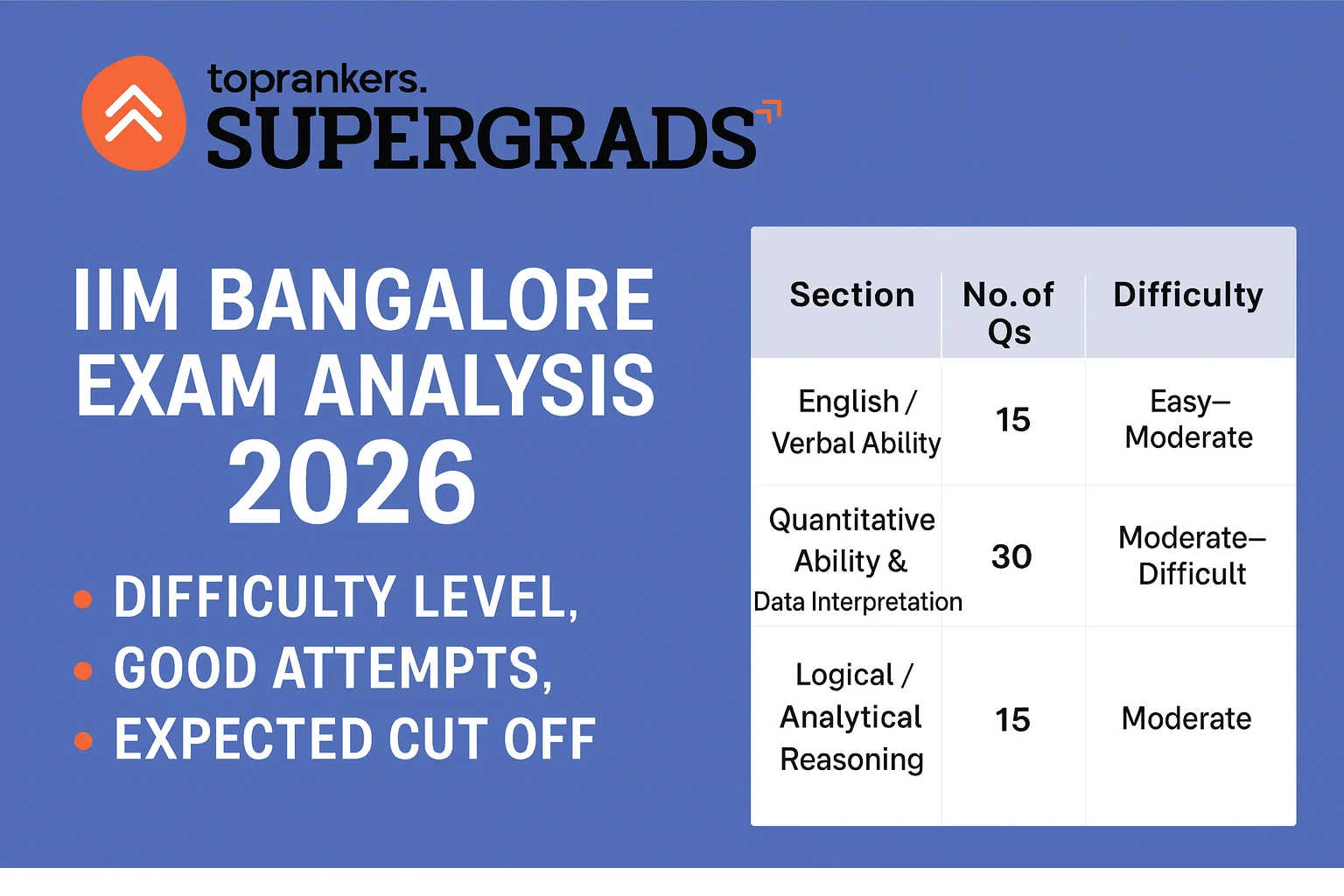
| Section | No. of Questions | Duration (Overall) | Nature of Questions |
|---|---|---|---|
| English Comprehension / Verbal Ability | 15 | Part of 120 mins | RC passages, vocabulary, grammar, and basic verbal reasoning |
| Quantitative Ability & Data Interpretation | 30 | Part of 120 mins | Arithmetic, algebra, basic math, and data interpretation sets |
| Logical / Analytical Reasoning | 15 | Part of 120 mins | Puzzles, arrangements, series, coding–decoding, logical sets |
| Total | 60 | 120 minutes | MCQ-based aptitude test |
Marking Scheme
- +1 mark for every correct answer
- −1/3 mark for every incorrect answer (negative marking)
- 0 marks for unattempted questions (to be confirmed by final instructions)
IIM Bangalore Exam Analysis 2026 – Overall Difficulty (Updated)
Overall Difficulty Level: Easy to Moderate
- The paper felt similar to the official mocks with no unexpected pattern changes.
- Time management was not a challenge in DILR or VARC, though QA required extra focus due to lengthy arithmetic problems.
- Most found the test balanced but not easy — manageable with smart attempt strategy and conceptual clarity.
Section-Wise IIM Bangalore Exam Analysis 2026
1. IIMB Bangalore Exam Analysis 2026: English / Verbal Ability
Overall level: Easy and Doable
Reading Comprehension (RC):Two passages:
- One on an eyesight improvement drive for women.
- Another related to shifts in healthcare focus and longevity.
Both RCs were short, direct, and easy to comprehend.
Total RC Questions: 8 (4 per passage) — all were easy with direct inference and fact-based questions
- 2 questions on grammar and usage-based fillers.
- 1–2 questions on vocabulary and word usage.
- No tricky para-jumbles or summary questions were reported.
Student reaction: Many found this section simpler than mocks and a good scoring area.
Average Attempts: Around 15–18, with high accuracy expected.
| Section | Details |
|---|---|
| Section Name | Verbal Ability & Reading Comprehension (VARC) |
| Overall Level | Very Easy |
| Reading Comprehension (RC) | Two short passages: - One on an eyesight improvement drive for women. - Another on shifts in healthcare focus and longevity. |
| RC Characteristics | Short, direct, and easy to comprehend. |
| Total RC Questions | 8 questions (4 per passage) — all easy with direct inference and fact-based questions. |
| Verbal Ability | - 2 questions on grammar and usage-based fillers. - 1–2 questions on vocabulary and word usage. - No tricky para-jumbles or summary questions reported. |
| Student Reaction | Many found the section simpler than mocks and considered it a good scoring area. |
| Average Attempts | Around 15–18 questions, with high accuracy expected. |
2. IIM Bangalore Exam Analysis 2026: Data Interpretation and Quantitative Ability
Overall level: Moderate
Topic-wise distribution:
- Algebra: High weightage; included questions on functions (one-one, onto) and matrices (2 questions).
- Arithmetic: Moderate difficulty — time-consuming but doable.
- Calculus: Around 6 questions, consistent with recent trends.
- Number System: 1 question.
- Geometry: 1 question.
Data Interpretation (within QA): Easy but lengthy.
Students noted that while arithmetic was not overly tough, algebra required conceptual clarity, making it the trickiest part of QA.
Average Attempts: Around 20 questions, with 16 likely correct on average.
3. IIM Bangalore Exam Analysis 2026: Logical Reasoning
Overall level: Easy to Moderate
Structure:
- 2 DI sets (Graph + Pie Chart) — both were easy but calculative and lengthy.
- Around 8 DI questions in total.
Logical Reasoning Topics Covered:
- Coding-Decoding
- Blood Relations
- Direction Sense
- Number Series and Alphabetical Series
- Data Sufficiency
- Arrangement-based questions
Students reported the section to be lengthy but not conceptually tough, with patterns similar to the mocks.
Those who managed speed found this section scoring.
Average Attempts: 14–16 questions, with good accuracy possible.
| Section | Details |
|---|---|
| Overall Level | Easy to Moderate |
| Structure | 2 DI sets (Graph + Pie Chart) — both were easy but calculative and slightly lengthy. |
| Total DI Questions | Around 8 questions in total. |
| Logical Reasoning Topics Covered | - Coding-Decoding - Number Series and Alphabetical Series - Data Sufficiency - Arrangement-based questions |
| Student Feedback | Section was lengthy but not conceptually tough, similar in pattern to the mocks. |
| Performance Insight | Students with good speed found it to be a scoring section. |
| Average Attempts | Around 14–16 questions, with good accuracy possible. |
Good Attempts & Ideal Score in IIM Bangalore Exam 2026
This section gives an indicative idea of what could be considered a good attempt range in the paper. It will be refined after the actual exam based on student performance and feedback.
Expected Good Attempts (Template)
| Section | Total Questions | Expected Good Attempts (Range) |
|---|---|---|
| English / Verbal Ability | 15 | 13+ |
| Data Interpretation and QA | 30 | 16+ |
| Logical Reasoning | 20 | 12+ |
A student aiming for a shortlist to IIM Bangalore’s BSc (Hons) Economics or BSc (Hons) Data Science should ideally target accurate attempts in the 43–50 range out of 60, with minimal negative marking. Accuracy is more important than blind guesswork because of the −1/3 negative marking for incorrect answers.
IIM Bangalore Expected Cut Off 2026 – BSc (Hons) Economics & Data Science
Official cut-offs will only be known after the exam and shortlisting round. However, we know that the final selection is based on a composite score where:
- The Entrance Test score carries 60% weightage
- The Personal Interview score carries 40% weightage
Here is the expected cutoff for IIM Bangalore 2026 Exam:
| Section | Expected Cut-Off |
|---|---|
| English Comprehension | 30–32 |
| Logical Reasoning | 30–33 |
| QA & DI | 44-48 |
Disclaimer: These bands are purely indicative based on expected difficulty, competition level, and limited intake. Actual cut-offs may go up or down once IIM Bangalore releases the official shortlist.
IIM Bangalore UG Selection Process 2026 – What Happens After the Exam?
UG admissions to IIM Bangalore follow a two-stage selection process.
Stage 1: Entrance Test (60% Weightage)
- Candidates appear for the IIMB UG Admissions Test on 13 December 2025.
- Scores in this test are used to shortlist candidates for the Personal Interview (PI).
Stage 2: Personal Interview (40% Weightage)
- Shortlisted candidates are called for an online or offline Personal Interview (as notified by IIMB).
- The final selection is based on a composite score that includes:
- Entrance Test Score – 60%
- PI Performance – 40%
As per typical academic timelines, PI rounds are expected around January 2026, with final offers being rolled out by late February or early March (tentative and subject to official updates).


IIM Bangalore Exam Analysis 2026 – What It Means for Future Aspirants (2027 & Beyond)
The first few years of the IIM Bangalore UG Admissions Test will set the benchmark pattern for future aspirants. If you are currently in Class 11 or early Class 12 and planning to target IIMB’s UG programmes, the IIMB Bangalore Exam Analyiss 2026 paper will give crucial insights.
- Pattern Stability: Expect the 3-section, 60-question, 120-minute pattern with English, Quant + DI, and Logical Reasoning to continue in the coming years, with only minor tweaks.
- Maths Matters: Strong fundamentals in school-level mathematics will play a big role, especially for BSc (Hons) Data Science. Arithmetic and Algebra will be central.
- Profile + Performance: With a 60:40 balance between exam and interview, communication skills, academic consistency, and clarity of goals will be important for final selection.
Prep guidance for future aspirants:
- Start focused preparation from Class 11 or early Class 12.
- Strengthen fundamentals in Arithmetic, Algebra, and basic Data Interpretation.
- Develop a habit of reading editorials and analysis pieces to improve English comprehension.
- Regularly attempt full-length mock tests simulating the 60-question, 2-hour pattern.
Official Website: https://www.iimb.ac.in/

Frequently Asked Questions
Why is the IIM Bangalore Exam Analysis 2026 important for students?

How soon will the IIM Bangalore Exam Analysis 2026 be updated after the test?
What parameters are considered while preparing the IIM Bangalore Exam Analysis 2026?
How can I use the IIMB exam analysis to judge my performance?
Does the exam analysis also help future aspirants (2027 & beyond)?
Will the section-wise topic distribution in the analysis be exact?
Is the exam analysis relevant if I am targeting other UG management exams as well?

Admin
Subject Matter Expert
SHARE