
1723534562.png)

IIM Bangalore BBA Sample Papers: Official Sample Questions
July 26, 2026
Overview: The IIM Bangalore BBA Sample Papers 2026 are designed to help aspirants prepare effectively for the IIM Bangalore BBA (DBE) entrance examination. They closely reflect the actual exam pattern and cover important sections such as Quantitative Aptitude, Verbal Ability, Logical Reasoning, and General Awareness.
Are IIM Bangalore BBA Sample Papers Important?
Quick Answer:
Yes. IIM Bangalore BBA Sample Papers are among the most valuable preparation resources for the entrance exam.
They familiarize you with the IIM Bangalore BBA exam format, improve time management, strengthen conceptual understanding, and help you assess your preparation level.
Candidates who solve multiple sample papers under timed conditions and thoroughly analyze their performance are generally better equipped to handle the actual examination.
NEW UPDATE:
The entrance exam date for IIM Bangalore BBA 2026 is near i.e., 26th July 2026. If you are aiming for it, fill the form before 30th June 2026.
Table of Contents
Understanding IIM Bangalore BBA Sample Papers
IIM Bangalore provides sample papers for its BBA entrance exam to help candidates prepare effectively.
These papers are crafted to closely resemble the actual exam in terms of format, style, and difficulty.
They include various types of questions that are likely to appear in the test, making them an invaluable resource for any serious candidate.
IIM Bangalore BBA Previous Year Question Papers PDF Download Links
Benefits of IIM Bangalore BBA Sample Papers:
-
Comprehensive Coverage: They encompass all sections of the exam, providing a thorough overview of what to expect.
-
Insight into Question Types: These papers offer a sneak peek into the kinds of questions you might face, including multiple-choice questions, logical puzzles, and data interpretation challenges.
-
Benchmarking Tool: Regular practice with these IIM Bangalore BBA Sample papers can help benchmark your preparation level and identify areas of strength and weakness.
-
Strategic Preparation: Working through these papers allows candidates to develop time management strategies and problem-solving techniques that are crucial for the actual exam day.
Check: IIM Bangalore BBA Syllabus 2026
Questions from IIM Bangalore BBA Sample Papers with Solutions for 2026
Section 1 — Quantitative Aptitude & Data Interpretation
Quant and DI carry the heaviest time cost in the IIM Bangalore BBA sample papers, so treat the target times below as binding rather than advisory.
Q1. Two circles of radius 21 cm each intersect so that each passes through the other's centre. Find the approximate perimeter (in cm) of the region bounded externally by the two circles — the outline of the combined figure.
(1) 170
(2) 171
(3) 174
(4) 176
Answer: (4) 176 cm
Since each circle passes through the other's centre, the distance between centres equals the radius: d = 21 cm. For the common chord, cos θ = (d/2) ÷ r = 10.5 ÷ 21 = 0.5, so θ = 60° and the chord subtends 2θ = 120° at each centre. The external boundary is the two major arcs of 240° each: 2 × (240/360) × 2π × 21 = 2 × (2/3) × 132 = 176 cm (π = 22/7).
Read the region carefully. If a question asks for the perimeter of the overlapping lens instead, you want the two 120° arcs: 2 × (1/3) × 132 = 88 cm. Same figure, different region, different answer — and examiners rely on candidates not noticing.
Q2. A shopkeeper bought 10,000 kg of rice for ₹1,50,000. He sold 60% of it at a 20% profit and 90% of the remaining rice at a 15% profit, both margins calculated on the purchase price excluding transportation. The leftover spoilt and was discarded. Transportation cost ₹21 per 100 kg at the time of buying. Find his overall profit or loss percentage.
(1) Profit of 12%
(2) Profit of 11.2%
(3) Profit of 9.4%
(4) Profit of 4.4%
Answer: (1) Profit of 12%
Purchase cost ₹1,50,000 → ₹15/kg. Transportation = (10,000 ÷ 100) × ₹21 = ₹2,100. Total cost = ₹1,52,100. 6,000 kg at +20% → 6,000 × 15 × 1.20 = ₹1,08,000 Remaining 4,000 kg; 90% = 3,600 kg at +15% → 3,600 × 15 × 1.15 = ₹62,100 Revenue = ₹1,70,100. Profit = ₹18,000. Profit % = 18,000 ÷ 1,52,100 = 11.83% ≈ 12%
Read | IIM Bangalore BBA DBE Admission through CUET
Q3. The average order value across 40 orders is ₹1,250. Ten further orders average ₹2,000. What is the new average order value?
(1) ₹1,350
(2) ₹1,400
(3) ₹1,450
(4) ₹1,500
Answer: (2) ₹1,400 (40 × 1,250 + 10 × 2,000) ÷ 50 = (50,000 + 20,000) ÷ 50 = ₹1,400. Resist averaging 1,250 and 2,000 — the groups are unequal.
Q4. A subscription business has 2,000 customers. Monthly churn is 5% of the customers present at the start of the month, and it adds 150 new customers at the end of each month. How many customers remain after two months?
(1) 2,050
(2) 2,098
(3) 2,150
(4) 2,200
Answer: (2) 2,098 Month 1: 2,000 × 0.95 = 1,900, +150 = 2,050. Month 2: 2,050 × 0.95 = 1,947.5, +150 = 2,097.5 ≈ 2,098. Churn applies to a moving base, so you cannot apply 5% twice to 2,000.
Q5–Q6. Data Interpretation. A direct-to-consumer brand reported the following.
|
Quarter |
Revenue (₹ lakh) |
Ad Spend (₹ lakh) |
|
Q1 |
120 |
30 |
|
Q2 |
150 |
40 |
|
Q3 |
190 |
45 |
|
Q4 |
210 |
60 |
Q5. In which quarter was revenue per rupee of ad spend highest?
(1) Q1
(2) Q2
(3) Q3
(4) Q4
Answer: (3) Q3 Q1: 120÷30 = 4.00 | Q2: 150÷40 = 3.75 | Q3: 190÷45 = 4.22 | Q4: 210÷60 = 3.50. Q4 had the highest revenue and the worst efficiency — the standard DI misdirection.
Q6. Full-year ad spend as a percentage of full-year revenue is closest to:
(1) 24%
(2) 26%
(3) 28%
(4) 30%
Answer: (2) 26% Revenue = 120+150+190+210 = ₹670 lakh. Ad spend = 30+40+45+60 = ₹175 lakh. 175 ÷ 670 = 26.1% ≈ 26%.
Section 2 — Logical & Analytical Reasoning
Q7. A, B, C, D, E, F and G sit around a circular table facing the centre. A sits third to the right of E. C sits second to the left of G. G is not an immediate neighbour of E. B sits to the immediate right of F. How many people sit between D and B, counted from the left of D?
(1) Four
(2) Two
(3) None
(4) One
Answer: (4) One Fix E, place A three to E's right. G cannot neighbour E, and C sits two to G's left — testing valid positions leaves exactly one arrangement: E, D, C, A, G, F, B reading rightward from E. Counting leftward from D you reach E, then B. So one person sits between them.
Method note: in circular arrangements, always place the most-constrained person first. Here that is G, which collapses the possibilities fastest.
Q8. An accurate clock shows 9:00 am. By approximately how many degrees will the hour hand rotate by the time the clock shows 2:30 pm?
(1) 150°
(2) 160°
(3) 165°
(4) 180°
Answer: (3) 165° 9:00 am to 2:30 pm is 5 hours 30 minutes = 5.5 hours. The hour hand moves 360 ÷ 12 = 30° per hour. So 30 × 5.5 = 165°. Treating the interval as 5 hours gives 150° — the most common error on this question type.
Q9. MPQO relates to SVWU by English alphabetical order, and DGHF relates to JMNL the same way. KNOM relates to:
(1) QTUS
(2) ORSQ
(3) QSTR
(4) RUVT
Answer: (1) QTUS Each letter shifts forward by 6. Verify on the second pair: D+6=J, G+6=M, H+6=N, F+6=L. Apply to KNOM: K+6=Q, N+6=T, O+6=U, M+6=S → QTUS. Always verify the rule on the second pair before applying it.
Q10. Statements: All influencers are creators. Some creators are entrepreneurs.
Conclusions:
- Some influencers are entrepreneurs.
- Some creators are influencers.
(1) Only I follows
(2) Only II follows
(3) Both follow
(4) Neither follows
Answer: (2) Only II follows Conclusion II is a valid converse: if all influencers are creators, then some creators are certainly influencers. Conclusion I does not follow — the entrepreneurs among creators may be entirely outside the influencer group. "Some" never licenses a bridge between two separate subsets.
Know More | Different Types of Questions Asked in BBA Entrance Exam
Q11. Find the next term: 2, 6, 12, 20, 30, ?
(1) 40
(2) 42
(3) 44
(4) 46
Answer: (2) 42 Differences are 4, 6, 8, 10 — increasing by 2. Next difference is 12, so 30 + 12 = 42. (Equivalently, each term is n(n+1): 1×2, 2×3, 3×4, 4×5, 5×6, 6×7 = 42.)
More sets in logical reasoning for BBA entrance exam.
Section 3 — Verbal Ability & Reading Comprehension
Q12–Q13. Read the passage and answer the questions that follow.
Many direct-to-consumer brands treat customer acquisition as the whole of marketing. They spend heavily to win a first purchase, celebrate the resulting growth in order volume, and then discover that the same customer never returns. The economics are unforgiving: if acquiring a buyer costs more than the profit earned across that buyer's lifetime, scale simply accelerates the loss. The brands that endure tend to invert the emphasis. They spend less on the first sale and considerably more on the second — on packaging that arrives intact, on service that resolves complaints without escalation, on reminders timed to when a product actually runs out. None of this photographs well in an investor deck. All of it decides whether the business survives its third year.
Q12. The passage is primarily concerned with:
(1) why advertising costs have risen for online brands
(2) the misplaced emphasis on acquisition over retention
(3) methods of improving packaging and customer service
(4) the difficulty of raising investment for D2C brands
Answer: (2) The argument moves from a diagnosis (over-spending on acquisition) to a contrast (durable brands invest in the second purchase). Options 1, 3 and 4 each seize a supporting detail and mistake it for the thesis — the standard main-idea distractor.
Q13. "None of this photographs well in an investor deck" most nearly implies that retention work:
(1) is impossible to measure accurately
(2) is disliked by investors
(3) lacks visible, headline-friendly appeal
(4) should be concealed from investors
Answer: (3) The clause contrasts unglamorous but decisive work against presentable metrics. It comments on visibility, not measurability (1), investor sentiment (2), or concealment (4).
Q14. Identify the part containing an error. Neither the founder nor the investors
(A) was willing
(B) to accept the revised valuation
(C) at that stage
(D). Difficulty:
Answer: (B) With "neither… nor," the verb agrees with the nearer subject. "Investors" is plural, so it must be "were willing." Reverse the order to "neither the investors nor the founder" and "was" becomes correct.
Q15. The board described the revenue projections as sanguine. The word is closest in meaning to:
(1) pessimistic
(2) optimistic
(3) indifferent
(4) confused
Answer: (2) optimistic "Sanguine" means cheerfully confident about an outcome. Its business usage often carries a faint warning — a projection called sanguine is usually being questioned, not praised.
Q16. Arrange into a coherent paragraph.
(A) The result is a catalogue that satisfies no one in particular.
(B) Most new brands try to appeal to every possible buyer.
(C) The brands that grow fastest usually begin by choosing whom to disappoint.
(D) They widen their range rather than sharpen their positioning.
(1) B-D-A-C
(2) B-C-D-A
(3) C-B-D-A
(4) D-B-A-C
Answer: (1) B-D-A-C B sets up the behaviour, D explains the mechanism ("They" refers to the brands in B), A states the consequence ("The result"), C delivers the counterpoint. Pronoun and connector chains — "They," "The result" — fix the order before meaning does.
RC carries the largest share of this section. Work through how to improve reading comprehension for BBA entrance exams and English questions for BBA entrance exam.
Section 4 — General Awareness
General Awareness is the section most candidates under-practise, and the official IIM Bangalore BBA sample papers make its weight obvious. This section has no equivalent in IPMAT, and it is where otherwise well-prepared candidates lose seats. It mixes static general knowledge with current affairs, and it rewards breadth over depth.
Q17. Who founded Reliance Industries?
(1) Azim Premji
(2) Ratan Tata
(3) Mukesh Ambani
(4) Dhirubhai Ambani
Answer: (4) Dhirubhai Ambani. Mukesh Ambani is the current chairman, not the founder — GA questions frequently test exactly this distinction.
Q18. Which of the following is a primary economic activity?
(1) Banking
(2) Agriculture
(3) Manufacturing
(4) Retail
Answer: (2) Agriculture. Primary activities extract directly from nature; manufacturing is secondary; banking and retail are tertiary.
Check: IIM Bangalore BBA Eligibility Criteria 2026
Q19. Which book was written by Ruskin Bond?
(1) The White Tiger
(2) The God of Small Things
(3) The Room on the Roof
(4) Midnight's Children
Answer: (3) The Room on the Roof. The others are by Aravind Adiga, Arundhati Roy and Salman Rushdie.
Q20. Which posture is a defining characteristic of Bharatanatyam?
(1) Mask and make-up
(2) Tribhanga posture
(3) Natyarambha posture
(4) Tarangam
Answer: (3) Natyarambha posture. Tribhanga belongs to Odissi, Tarangam to Kuchipudi, and elaborate mask work to Kathakali and Chhau.
Q21. India's Wholesale Price Index is compiled and released by:
(1) the Reserve Bank of India
(2) the National Statistical Office
(3) the Office of the Economic Adviser, Ministry of Commerce and Industry
(4) the Securities and Exchange Board of India
Answer: (3). The Office of the Economic Adviser compiles the WPI. The Consumer Price Index, by contrast, comes from the National Statistical Office under MoSPI — a pairing worth memorising together.
Preparation Strategy Using IIM Bangalore BBA Sample Papers
To excel in the IIM Bangalore BBA entrance exam, candidates need a strategic approach to preparation that leverages available resources effectively, especially the sample papers provided for the exam. Here’s how you can optimize your study plan using these sample papers:
-
Understand the Exam Format: Start by familiarizing yourself with the IIM Bangalore BBA exam pattern through the sample papers to identify question types and areas of focus.
-
Consistent Practice: Solve IIM Bangalore BBA sample papers regularly to build familiarity and improve time management, accuracy, and speed.
-
Analyze and Adjust: After each practice session, review your answers to identify mistakes and understand areas needing improvement. Adjust your study focus accordingly.
-
Simulate Exam Conditions: Occasionally, practice under real exam conditions to adapt to the pressure and manage exam day anxiety.
-
Review Solutions: Always go through the provided solutions to learn the optimal approaches to questions, which will enhance your problem-solving skills.
-
Monitor Progress: Track your performance improvements through these practices to refine your study strategy and boost confidence.
This focused approach will help you leverage the sample papers effectively, ensuring comprehensive preparation for the IIM Bangalore BBA entrance exam.
BBA-DBE Undergraduate Program Highlights 2026
The BBA-DBE Undergraduate Program in Digital Business and Entrepreneurship is an online three-year degree that must be completed within a maximum of six academic years from the initial enrollment date.
-
The BBA-DBE Undergraduate Program in Digital Business and Entrepreneurship offers distinct milestones: a certificate after the first year, a diploma after the second, and a full degree upon completion, ensuring progress and skill acquisition.
-
This program features a cutting-edge curriculum that integrates core business principles with the latest advancements in digital technology and entrepreneurial innovation.
-
It provides the flexibility to access course materials, complete assignments, and view lectures.
-
You gain hands-on experience with digital tools and platforms highly valued in today's business world, making them job-ready upon graduation. The program includes real-world projects and simulations, allowing you to apply theoretical knowledge to practical business scenarios.
-
The faculty consists of seasoned professionals and academics with extensive expertise in digital business and entrepreneurship. Each academic year builds upon the previous one, offering a progressive learning experience that evolves with the digital landscape.
Check: IIM Bangalore BBA DBE Courses by SuperGrads
Important Dates for IIM Bangalore's BBA Program Admission 2026
Stay ahead by keeping track of these important dates for the IIM Bangalore BBA program:
|
Events |
Dates |
|
Application Window |
13th April 2026 - 30th June 2026 |
|
IIMB DBE Entrance Test |
26th July 2026 |
|
IIMB DBE Entrance Test Result |
First/Second Week of August 2026 |
|
Offer acceptance - Last date |
To Be Announced |
|
Withdrawal - Last date |
To Be Announced |
|
Fee payment window for the first term |
To Be Announced |
|
Programme inauguration |
To Be Announced |
The IIM-B BBA exam preparation guide provides aspirants with invaluable resources, including detailed IIM Bangalore BBA sample papers and program insights.
These tools are crucial for mastering the exam format, honing time management and problem-solving skills, and enhancing overall performance.
By thoroughly engaging with these materials, students can increase their chances of admission to the esteemed BBA-DBE program, setting the stage for a successful career in digital business and entrepreneurship.
Know More | IIM Bangalore BBA Exam Analysis
Key Takeaways:
-
Comprehensive Coverage: IIM Bangalore BBA sample papers offer complete coverage of all exam sections, helping candidates fully prepare for the types of questions they will encounter.
-
Strategic Practice: Regularly using these sample papers helps improve time management and problem-solving skills, which are crucial for excelling in the actual exam.
-
Performance Benchmarking: These IIM Bangalore BBA sample papers allow students to gauge their readiness and identify areas needing improvement, enabling focused and efficient study.
-
Exam Simulation: Practicing under simulated exam conditions helps candidates adapt to the pressure and timing of the real test, reducing exam-day anxiety.
-
Adaptive Learning: Analyzing answers and reviewing provided solutions helps in continuously refining strategies and ensuring steady improvement up to the exam day.
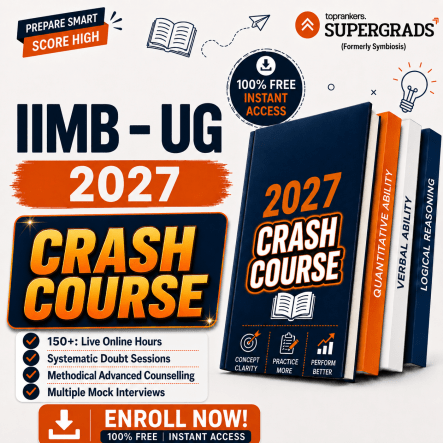
Download Free IIM Bangalore BBA Study Material
Fill your details
Frequently Asked Questions
Where can I find official IIM Bangalore BBA sample papers?

Are there official IIM Bangalore BBA sample papers for 2025 or 2026?
Is there negative marking in the IIMB DBE Entrance Test?
What is the exam pattern for the IIM Bangalore BBA entrance test?
How many questions are there in each section?
Lalita Vishwakarma
Content Writer
SHARE