
1723534562.png)

CUET Mark for Review Strategy: When to Use It and When to Skip Questions
March 13, 2026
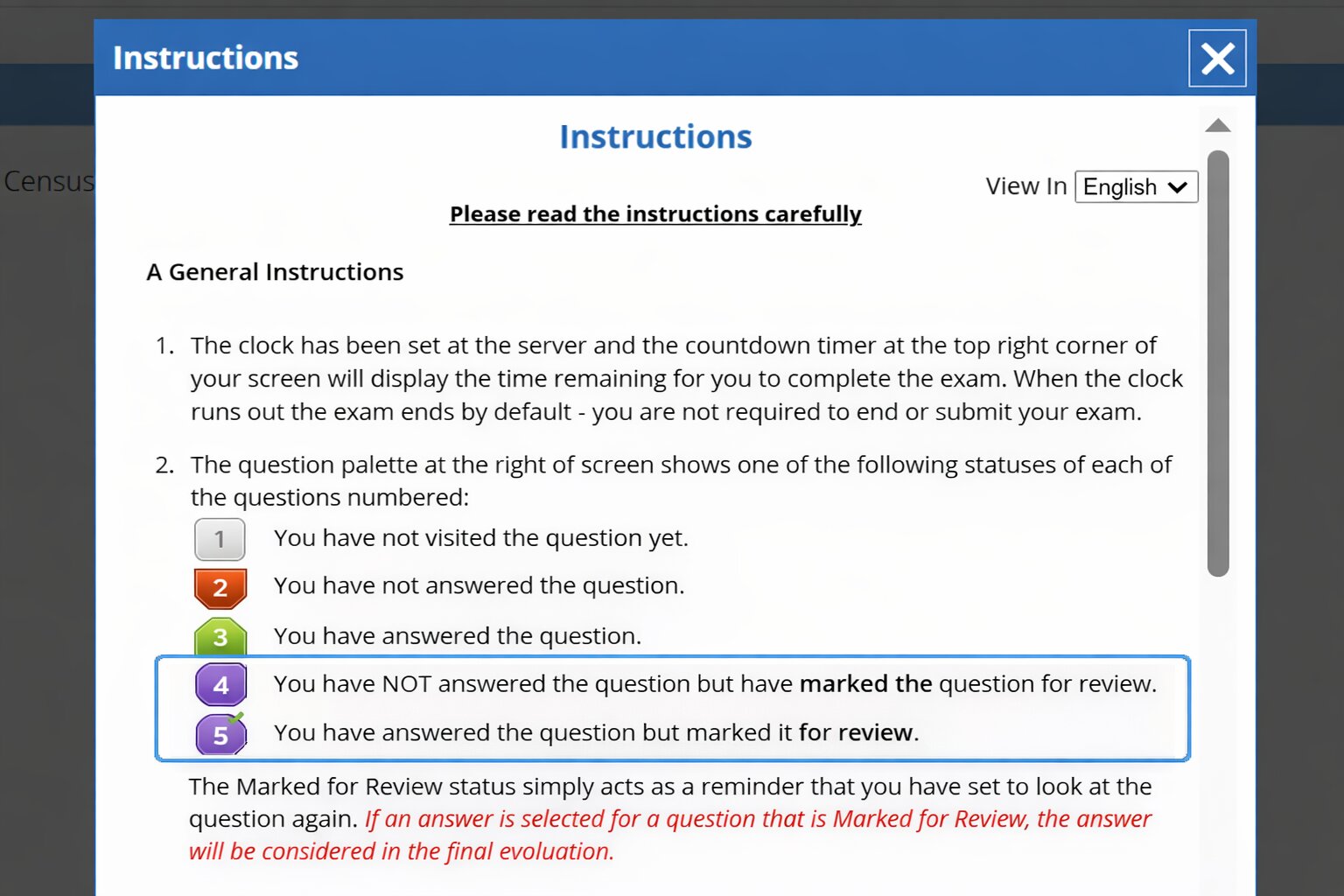
Quick Answer: The CUET Mark for Review Strategy is simple: use Mark for Review when a question looks solvable later, but do not use it for blind guesses. NTA’s standard CBT instructions say that if you answer a question and mark it for review, that answer will still be checked for evaluation. But if you mark a question for review without answering it, it will not be evaluated. CUET UG 2026 is being conducted in CBT mode, so using this button the right way can save both time and marks.
Key Takeaways
- Answered and Marked for Review is checked for evaluation.
- Marked for Review without an answer is not checked for evaluation.
- CUET 2026 is a computer-based test, so students should know the exam screen well before test day.
- Each CUET paper follows the latest pattern of 50 questions, 60 minutes, +5 for correct, -1 for wrong, and 0 for unattempted.
- The best use of this button is for doubtful but workable questions, not for random guessing. This is a strategy recommendation based on NTA’s interface rules and the marking scheme.
What you’ll get on this page: In this page, we’ve explained the CUET mark for review strategy. You will learn what the button means, when to use it, when not to use it, how it helps in time management, how it affects your score, and what a safe attempt plan looks like in the real exam.
What Does “Mark for Review” Mean in the CUET Exam?
The CUET mark for review strategy starts with one basic rule: you must know what the button really does. NTA’s CBT instructions say marked for review means you want to come back to that question later. It is like telling the system, “I am not done with this yet.” But there are two different cases inside this one feature, and that is where students get confused.
If you mark a question for review after answering it, the system keeps your answer and checks it later. If you mark a question for review without answering it, the system does not count it for evaluation. This major difference matters a lot.
Take a look at this example -
- Riya sees a vocabulary question. She is 80% sure that option B is right, but she wants to look again later. She chooses option B and marks it for review. Her answer is still saved and will be checked.
- Arjun sees a hard maths question. He does not select any option and only marks it for review. That question will not be checked unless he comes back and answers it.
So the button is useful, but only when you understand the difference between “review with answer” and “review without answer.”
When Should You Use “Mark for Review” in CUET?
The CUET mark for review strategy works best in three situations.
- When you can solve the question, but you need a little more time. Maybe the question is from reading comprehension, and you want to recheck one line. Maybe it is a general test question where two options look close. In that case, choose your best answer and mark it for review. That way, your answer stays safe.
- When you can remove one or two wrong options, but you are not fully sure yet. This is a smart place to use the button because the question still has value. It is not a blind guess. It is a question you may solve better in round two. This works especially well when you already understand the CUET exam pattern and know that every wrong answer costs one mark.
- When a question is correct in concept but long in steps. For example, in a passage-based English question, you may know the right paragraph but want to check one keyword later. Or in a maths question, you may know the method but not want to lose time right now. Mark it and move.
Here is a simple guide:
| Situation | Best action |
| You are sure | Answer and move on |
| You are mostly sure | Answer and mark for review |
| You need more time but know the method | Mark for review and return later |
| You have no idea at all | Skip it |
This is why the CUET mark for review strategy is not about using one button again and again. It is about using it only when the question still has a real chance.
When Should You Not Use “Mark for Review” in CUET?
The CUET mark for review strategy can hurt your CUET score if you use it the wrong way.
- Do not use it for questions where you know nothing. If all four options look new and confusing, marking that question for review will only waste time later. It is better to skip and protect your score. Since CUET has negative marking, blind guesses can reduce your total.
- Do not use it for very easy questions either. If you already know the answer, save it and move. There is no need to fill your review list with simple questions. A long review list creates stress in the last minutes.
- Do not use it for every tough question. Some students panic and mark 15 or 20 questions for review. Then the last few minutes become messy. They start rushing, changing answers, and making avoidable mistakes.
Here is a quick “no” table:
| Do not use Mark for Review when… | Why |
| You have zero clue | It wastes time later |
| The answer is already clear | No need to review easy questions |
| You are marking too many questions | It creates pressure at the end |
A good rule is this: if you cannot improve the answer later, do not mark it for review now.
How Does “Mark for Review” Help in Time Management?
The CUET mark for review strategy is very helpful for time management because it stops you from getting stuck on one question. NTA’s CBT instructions also say candidates can return to a marked question any time by clicking the question number in the question palette.
Think of the paper in rounds.
- In round one, answer the easy questions.
- In round two, come back to marked questions.
- In round three, review only the questions that are still worth trying.
This is much better than sitting on one hard question for three or four minutes.
Here is a simple example. Suppose you have 60 minutes and 50 questions. If you spend 4 minutes on one confusing question early in the paper, you lose time for 3 or 4 easier questions later. But if you mark that hard question and move on, you can collect safer marks first. That is why time management tips matter so much in CUET preparation.
A simple round plan looks like this:
| Round | What to do | Time goal |
| Round 1 | Solve easy questions | Fast and clean |
| Round 2 | Return to marked questions | Calm review |
| Round 3 | Final check of saved answers | No panic changes |
This is where the CUET mark for review strategy becomes a time-saving tool, not just a button on the screen.
What Is the Difference Between “Answered and Marked for Review” and “Marked for Review”?
This is the most important part of the CUET mark for review strategy.
NTA’s CBT guide is very clear:
- Answered and Marked for Review = answer will be considered for evaluation.
- Marked for Review without answer = question will not be considered for evaluation.
Here is the difference table:
| Status | What it means | Will it be checked? |
| Answered and Marked for Review | You chose an answer and want to relook later | Yes |
| Marked for Review only | You did not choose an answer yet | No |
This is easy to remember:
Answer + Review = Checked
Only Review = Not Checked
Example:
- Meera answers a comprehension question and marks it for review. The answer stays active.
- Kabir marks a general test question for review without choosing any option. That answer is not active yet.
Many students lose marks because they think all marked questions are saved. They are not. Only answered ones are saved for checking.
How to Use Mark for Review Without Losing Marks
The CUET mark for review strategy helps only when you combine it with careful habits.
- First, read the question fully before marking anything. Many students hurry, mark too fast, and later realize the question was easy.
- Second, if you are 70% to 80% sure, choose the answer first and then mark it for review. That is safer than leaving it blank.
- Third, do not change answers in panic unless you find a clear reason. Students often change the right answer to the wrong one in the last minute.
- Fourth, remember the marking scheme. Toprankers’ latest CUET exam pattern page shows +5 for correct, -1 for wrong, and 0 for unattempted. That means random final-minute guessing can hurt your score.
- Fifth, practice this in CUET previous year question papers and CUET mock tests before exam day. The more you rehearse the button use, the calmer you feel in the real exam. Toprankers also notes that mock tests provide instant solutions and performance insights, which help you see whether your review decisions were smart or careless.
And one more important thing: CUET is in CBT mode, so students should not wait until exam day to understand the screen. Know the layout before your CUET admit card date arrives. Also, read CUET exam day instructions so there are no surprises at the centre.
What Is the Best CUET Mark for Review Strategy for Maximum Score?
The best CUET mark for review strategy is simple and safe.
- Start with easy questions. Do not mark them. Just answer and move.
- Mark only the questions that are doubtful but still solvable.
- Skip the questions that are total guesswork.
- Come back to marked questions only after the easy ones are finished.
- At the end, review only the ones that still feel worth trying.
You can follow this 5-step plan:
- Solve easy questions first.
- Use mark for review only on workable questions.
- Do not fill your review list with random guesses.
- Revisit marked questions in the second round.
- Change an answer only if you find a clear mistake.
This plan works because it protects your marks first. It also fits well with a good CUET syllabus 2026 revision plan and a smart CUET application form journey, where you prepare by screen and subject, not by panic.
After that, you can use CUET exam analysis to learn which topics create the most confusion. If needed, follow a step-by-step guide on how to prepare for CUET 2026 and the CUET admission process 2026 later, but first make your attempt strategy strong.
Get CUET Study Materials
Fill your details
Frequently Asked Questions
What does Mark for Review mean in the CUET exam?

Will an answered question marked for review be checked?
Will a question marked for review without an answer be checked?
Can Mark for Review help with time management in CUET?
Do I need to click Save and Next to keep my answer?
Is CUET 2026 a computer-based exam?

Chetanya Rai
Communications Executive (CUET)
SHARE