
1723534562.png)

40+ Important Blood Relation Questions for NMAT 2026 (PDF + Solutions)
September 1, 2026
Practice 40+ NMAT blood relation questions (direct, coded & puzzle-based) with answers, tips, and common mistakes. Download the PDF and boost LR speed.
Let's master NMAT blood relation questions with 40+ high-difficulty practice sets, answers, and expert shortcuts. Includes PDF download + mistakes to avoid.
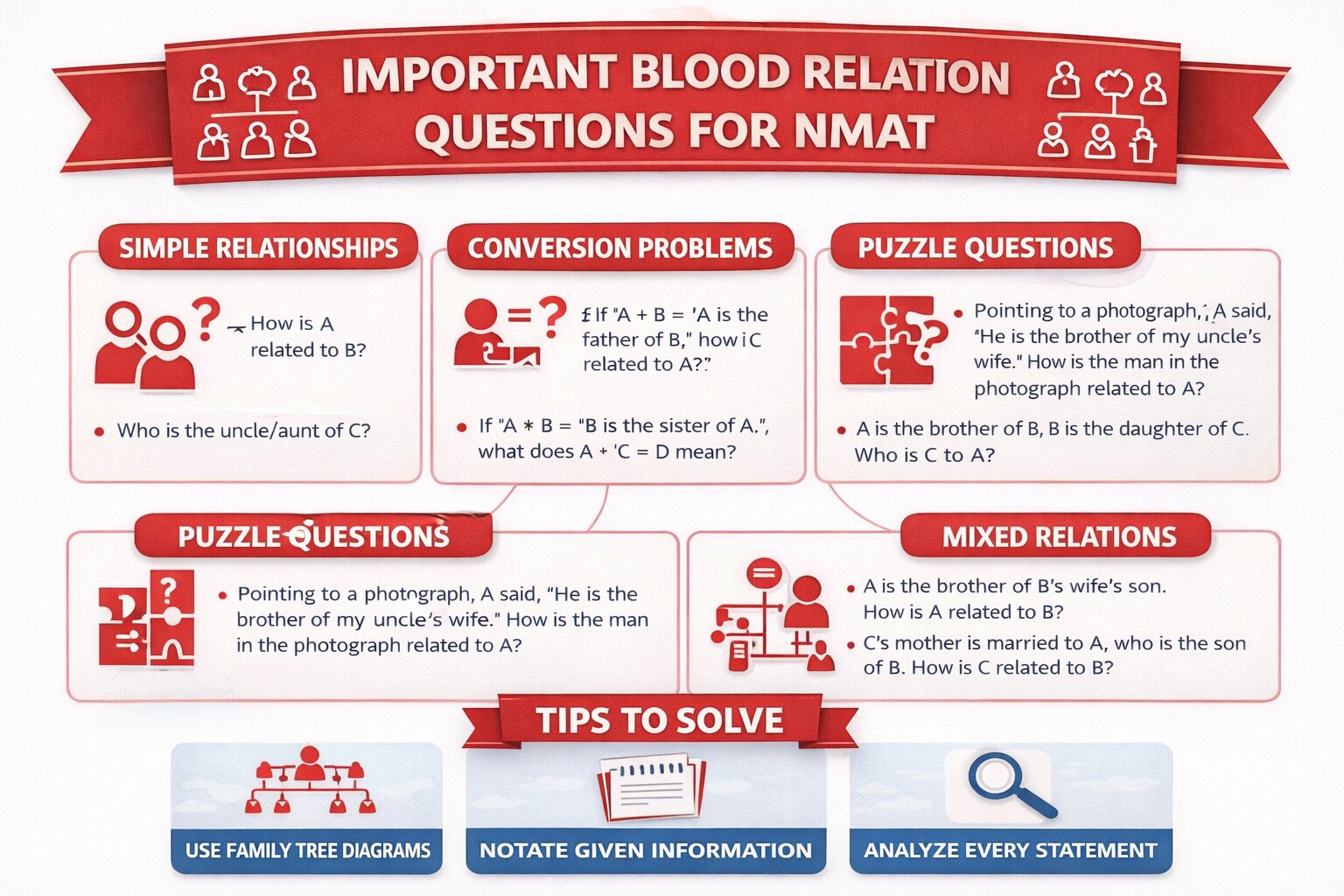
What Are Blood Relation Questions in NMAT?
Blood Relation Questions for NMAT 2026 can check your ability to logically identify relationships within family structures through coded expressions or sentence-based clues.
They appear under the analytical reasoning sub-section of NMAT’s exam pattern and generally carry moderate to high difficulty.
25+ High Difficulty Level Blood Relation Questions for NMAT
Question 1 In a family of six – A, B, C, D, E, and F – there are two married couples. A is the father of D. D is married to E. B is the sister of F, who is the granddaughter of C. E is not the daughter-in-law of C.
How is A related to C?
a) Husband
b) Son
c) Father-in-law
d) Brother
Answer: b) Son
Question 2: Introducing a man, Riya says, “He is the husband of my mother’s daughter’s mother.” How is Riya related to that man?
a) Father
b) Grandfather
c) Uncle
d) Brother-in-law
Answer: a) Father
Question 3: P, Q, R, S, and T are a family. P is the father of Q, who is the sister of R. S is R’s wife and mother of T. How is S related to Q?
a) Sister
b) Sister-in-law
c) Mother
d) Aunt
Answer: b) Sister-in-law
Question 4 In a certain code, A + B means A is the mother of B;
A ÷ B means A is the brother of B;
A × B means A is the father of B;
Find the relationship between P and R in P × Q ÷ R.
a) Uncle
b) Grandfather
c) Brother
d) Father
Answer: a) Uncle
CAT & OMETs Products by Supergrads To Boost Your Prep
Here are the exclusive CAT & OMETs products that will help you improve your preparation. Check them now!
| CAT & OMETs 2026 Batches | |
| CAT & OMETs Test Series Batches | |
| CAT & OMET 2026 Study Material and Test Series by Supergrads | |
| CAT 2026 Mock Test Series by Supergrads |
Question 5: K is the son of M. M is married to R. R is the daughter of T. T has two children: R and L. How is L related to K?
a) Aunt
b) Uncle
c) Cousin
d) Grandfather
Answer: b) Uncle
Question 6: Dhruv said to Aarav, “Your grandfather’s only son is my father.” How is Aarav related to Dhruv?
a) Brother
b) Nephew
c) Cousin
d) Father
Answer: a) Brother
Question 7 If “X + Y” means X is Y’s father, and “X – Y” means X is Y’s sister, then what does the expression P + Q – R mean?
a) P is R’s uncle
b) P is R’s brother
c) P is R’s father
d) None
Answer: a) P is R’s uncle
Question 8 A family has four members: grandfather (G), father (F), daughter (D), and son (S). The average age of the family is 35. G’s age is twice that of F. D is 25 years younger than F, and S is 5 years older than D. Find G’s age.
a) 70
b) 75
c) 65
d) 60
Answer: b) 75
Question 9:When pointing to a photograph, Asha said, “He is the father of my mother’s brother’s only daughter’s husband.” How is Asha related to that person in the photograph?
a) Cousin
b) Sister-in-law
c) Aunt
d) Cannot be determined
Answer: b) Sister-in-law
Question 10: In a family of ten, V is married to W, who is the daughter of X. Y and Z are siblings, and Y is the wife of X. U and T are X’s grandchildren through V and W.
How is T related to Y?
Options:
a) Granddaughter
b) Grandson
c) Nephew
d) Cannot be determined
Answer: a) Granddaughter
Question 11: A + B means A is the mother of B; A – B means A is the father of B; A × B means A is the brother of B.
What does P – Q + R × S mean?
a) P is the uncle of S
b) P is the father of S
c) P is the father of R
d) P is the grandfather of S
Answer: d) P is the grandfather of S
Question 12. Pointing to a photograph, Priya said, “He is the son of my grandfather’s only son.” How is the person in the photograph related to Priya?
a) Brother
b) Cousin
c) Father
d) Uncle
Answer: a) Brother
Question 13. If A is the daughter of B, and B is the son of C, who is C to A?
a) Grandfather or Grandmother
b) Father
c) Mother
d) Data inadequate
Answer: a) Grandfather or Grandmother
Question 14. In a coded language:
A ÷ B = A is the brother of B;
A × B = A is the wife of B;
A + B = A is the son of B;
Find the relation between P and S in P ÷ Q × R + S.
a) Niece
b) Nephew
c) Brother-in-law
d) Cannot be determined
Answer: c) Brother-in-law
Question 15. Pointing to a lady, Reena said, “She is the mother of my husband’s only sister.” How is the lady related to Reena?
a) Mother-in-law
b) Sister-in-law
c) Niece
d) Aunt
Answer: a) Mother-in-law
Question 16. R is the father of M but not the husband of T. T is M’s mother. How is T related to R?
a) Sister
b) Aunt
c) Wife
d) Data insufficient
Answer: c) Wife
Question 17. If A + B means A is the father of B, A – B means A is the sister of B, A × B means A is the mother of B, and A ÷ B means A is the brother of B, then which of the following means Q is P’s niece?
a) P ÷ R × Q
b) Q ÷ P × R
c) P – R + Q
d) P + R ÷ Q
Answer: c) P – R + Q
Question 18. Ramesh introduces a woman as the daughter of the only son of his father’s father. How is Ramesh related to that woman?
a) Cousin
b) Sister
c) Aunt
d) Mother
Answer: a) Cousin
Question 19. In a family of six, there are two married couples. D is the brother of E. C is the wife of D. A is the father of D, and F is the mother of E. How is A related to F?
a) Husband
b) Brother
c) Father
d) Uncle
Answer: a) Husband
Question 20. If X + Y means X is the father of Y, X – Y means X is the daughter of Y, X ÷ Y means X is the brother of Y, and X × Y means X is the mother of Y, then identify the relation between A and C in A × B ÷ C.
a) Aunt
b) Mother
c) Niece
d) Sister
Answer: a) Aunt
Question 21. Pointing to a photograph, Aaryan says, “He is the husband of my father’s mother’s only daughter.” How is Aaryan related to the man in the photograph?
a) Father
b) Brother
c) Uncle
d) Grandfather
Answer: c) Uncle
Question 22. In a code,
A + B means A is the sister of B;
A – B means A is the wife of B;
A ÷ B means A is the mother of B.
What does P ÷ Q – R mean?
a) P is R’s aunt
b) P is R’s mother
c) P is R’s grandmother
d) P is R’s mother-in-law
Answer: d) P is R’s mother-in-law
Question 23. G is the mother of J, who is the brother of K. How is G related to K?
a) Mother
b) Father
c) Aunt
d) Data insufficient
Answer: a) Mother
Question 24. P is the father of R but R is not P’s son. How is R related to P?
a) Daughter
b) Wife
c) Sister
d) Data insufficient
Answer: a) Daughter
Question 25. In a certain family, there are six members A, B, C, D, E, and F. A and B are husband and wife. E is the brother of D. C is A’s daughter and D is B’s son. How is F related to E if F is B’s mother?
a) Grandmother
b) Aunt
c) Cousin
d) Mother
Answer: a) Grandmother
Question 26. If “A × B” means A is the father of B, “A – B” means A is the sister of B, “A ÷ B” means A is the brother of B, and “A + B” means A is the mother of B, then what is the relation between Q and T in Q – R ÷ S + T?
a) Aunt
b) Cousin
c) Mother
d) Sister
Answer: a) Aunt
Question 27. Pointing to a man, Meera said, “He is the only son of my mother’s husband.” How is the man related to Meera?
a) Father
b) Brother
c) Uncle
d) Cousin
Answer: b) Brother
Question 28. A says to B, “Your mother’s husband's sister is my aunt.” How is A related to B?
a) Cousin
b) Sister
c) Niece
d) None of these
Answer: a) Cousin
Question 29. A family has 4 members – P, Q, R, and S. P and Q are a married couple. S is the brother of R, and Q is R’s mother. How is S related to P?
a) Son
b) Brother
c) Cousin
d) Father
Answer: a) Son
Question 30. If A says, “C’s father is my father’s son,” how is A related to C?
a) Father
b) Brother
c) Cousin
d) Uncle
Answer: a) Father
Question 31. In a coded relation set:
A × B = A is mother of B
A + B = A is father of B
A – B = A is wife of B
Determine the relationship between P and R in P + Q – R.
a) Father
b) Brother
c) Grandfather
d) Uncle
Answer: a) Father
Question 32. If X is the mother of Y, Y is the brother of Z, and Z is the father of W, how is X related to W?
a) Grandmother
b) Mother
c) Aunt
d) Sister
Answer: a) Grandmother
Question 33. A said to B, “Your father’s wife’s brother is my uncle.” How is B related to A?
a) Cousin
b) Brother
c) Nephew
d) Cannot be determined
Answer: a) Cousin
Question 34. Pointing towards a photograph, Sanjay said, “He is the only son of the father of my sister’s brother.” How is Sanjay related to that person?
a) Cousin
b) Brother
c) Uncle
d) Father
Answer: b) Brother
Question 35. If P says, “Q’s father is the only son of my father,” how is Q related to P?
a) Nephew
b) Cousin
c) Son
d) Father
Answer: a) Nephew
Question 36. Introducing a woman, a man said, “She is my mother’s only daughter-in-law.” How is the woman related to that man?
a) Wife
b) Sister
c) Cousin
d) Mother
Answer: a) Wife
Question 37. In a statement:
A @ B means A is the sister of B,
A # B means A is the wife of B,
A ÷ B means A is the brother of B,
A × B means A is the mother of B.
Find the relationship between M and O in M ÷ N # P × O.
a) Uncle
b) Brother
c) Nephew
d) Cousin
Answer: a) Uncle
Question 38. A is the mother of B. C is the father of D. B is the sister of D. How is A related to C?
a) Wife
b) Sister
c) Sister-in-law
d) Data insufficient
Answer: a) Wife
Question 39. If A + B means A is the father of B, A ÷ B means A is the brother of B, A – B means A is the sister of B, and A × B means A is the mother of B, find the relation between Q and T in Q × R ÷ S + T.
a) Aunt
b) Sister
c) Mother
d) Grandmother
Answer: a) Aunt
Question 40. In a family, there are six members—P, Q, R, S, T, and U. P and Q are a couple, and T is the son of R. Q is the daughter of S, who is the mother of U. How is U related to T?
a) Aunt
b) Cousin
c) Mother
d) Sister-in-law
Answer: b) Cousin
Expert Tips to Ace Blood Relation Questions in NMAT 2026
Blood Relation Questions for NMAT form a key part of the Logical Reasoning section in NMAT 2026, which includes 36 questions to be solved in 40 minutes, as per the official NMAT Exam Pattern. Success here requires not just logic but also structured deduction and time awareness.
1. Strengthen Concepts with NMAT Books 2026
For a clear foundation, refer to NMAT Books 2026 that cover logic-based topics like symbolic relationships, coded problems, and family hierarchies.
Recommended titles such as “Analytical Reasoning by M.K. Pandey” and “How to Prepare for Logical Reasoning by Arun Sharma” offer step-by-step approaches to effectively decode blood relation questions.
2. Practice Coded Relation Sets to Build Speed
Blood Relation Questions for NMAT often use notations like A + B (A is B’s mother) or A × B (A is B’s father). Practice speed drills, mixing these patterns to boost reasoning efficiency before exam day.
Keep your practice aligned with updated exam resources and guidelines mentioned in the NMAT Notification 2026.
3. Use Family Trees for Complex Puzzles
When questions involve more than four people or multi-generational families, always sketch a family tree. Circles can represent females, squares males, and arrows indicate the direction of the relation.
This visualisation technique reduces confusion about generations — a critical advantage when solving multi-step NMAT puzzles quickly under pressure.
4. Understand the Paper’s Scoring Logic
There’s no negative marking in NMAT’s reasoning section, as confirmed in the NMAT Marking Scheme, and Do NMAT Have Negative Marking? Use this to your benefit by attempting every question, especially in logic-based reasoning, where eliminating two options often gives a 50% success rate.
5. Evaluate Integrated Questions
In NMAT, blood relation sets may appear combined with seating arrangement, directions, or data sufficiency problems. Practice integrated sets from mock tests mentioned in the NMAT Syllabus section for realistic exam representation.
6. Follow the Strategy from the Selection Criteria and Prep Experts
As outlined in the NMAT Selection Criteria, a balanced score across Logical Reasoning, Language, and Quantitative Ability improves your overall percentile and admission chances. Logical Reasoning often acts as a tie-breaker round, making consistency in reasoning practice non-negotiable.
7. Manage Time Effectively
Benchmark yourself with 40-second checkpoints per question. NMAT’s adaptive nature, detailed under NMAT Exam Information, means early slowdowns can affect question difficulty and scoring progression. Maintaining uniform speed ensures access to higher-score brackets.
Common Mistakes to Avoid in NMAT Blood Relation Questions 2026
Even strong test-takers lose marks in NMAT because of slip-ups in interpretation and direction logic. Here are the common pitfalls and practical fixes to prevent them.
1. Ignoring Gender Hints
Words like daughter, father, wife, or brother give the strongest gender cues. However, not all names indicate gender clearly. Always derive gender based only on explicit references — avoid assumptions.
For example, “A is the child of B” doesn’t disclose gender; mark it as neutral until further data clarifies. This disciplined approach ensures precision during simulation tests from NMAT Application Form practice.
2. Directional Misinterpretation
Blood Relation Questions for NMAT often reverse the subject and object. For example, “R’s husband is S’s mother’s brother-in-law” needs careful tracing, as incorrect direction is a heavily penalized reasoning error.
Check who’s the speaker and whether the question asks “How A is related to B” or “How B is related to A.” These opposite queries yield different answers.
3. Skipping Cross-Verification
Re-run your solved logic backwards to confirm consistency. For example, if P is Q’s aunt, confirm that Q is P’s niece or nephew. Reverse validation prevents diagram redundancies and is a key refinement step before final submission.
4. Mismanaging Exam Time
Logical reasoning is a speed-sensitive section in NMAT. Without proper pacing, you might reach only 75% of the section by the time limit. Practice mixed reasoning through timed mocks detailed on NMAT Test Centres with adaptive logic features to build consistency.
5. Over-Assuming Marital Links or Family Completeness
Avoid presuming every individual in question is married or part of the same family line. NMAT questions intentionally leave gaps like “P is the son of Q” without disclosing other members, encouraging zero-assumption logic. Cross-check assumptions at each inference step.
6. Not Referring to the Latest Exam Resources
Always prepare based on the updated structures mentioned in the NMAT Exam Fees 2026, NMAT Eligibility 2026, and NMAT Exam Dates. Different exam sessions across testing windows may have question variations in length and type.
7. Ignoring Review and Revision
Failing to analyse error trends prevents progress. After every mock test, maintain a “Logical Mistake Journal” — note patterns like repetition errors or skipped directions. Use insights from official resources like NMAT Admission Process to align study revision cycles with evaluation timelines.
8. Missing Practical Mock Test Simulation
Many candidates underestimate the importance of real-time simulations. Follow
NMAT Exam Day Instructions to train for time-bound reasoning performance. It helps you adapt faster in the actual adaptive testing environment.
Conclusion
With NMAT 2026 scheduled between November and December, as notified in the official NMAT Notification, the best way to master Blood Relation Questions for NMAT is through consistency and real-time drilling.
Combine structured concept learning via NMAT Books, adaptive mock practice using the NMAT Exam Platform, and analytical review guided by Selection Criteria insights.
Stay exam-ready with full awareness of your exam fees, registration process, paper pattern, because NMAT rewards logical preparation paired with strategic execution.
Frequently Asked Questions
What are blood relation questions and why are they important for the NMAT exam?

How can I effectively prepare for blood relation questions in the NMAT?
Is there a specific strategy for tackling difficult blood relation questions?
What types of blood relation questions are asked in NMAT?
Are these questions multiple choice and is there negative marking?
Zubeen Siddiqui
Content Writer | MBA & CAT Preparation
SHARE