
1723534562.png)

40+ CAT Matrix Arrangement Questions PDF Download with Answers
September 17, 2026
Matrix arrangement questions in CAT 2026 will ask you to match entities- people, products, teams, animals to a set of attributes using logical clues, usually organised as a grid with entities in rows and attributes in columns.
Try these CAT Matrix Arrangement Questions to see how well you can handle different types of sets. Spend around 8–10 minutes on each one before checking the answers. Begin with the simpler sets and take up numerical or mixed questions as you get better at spotting the clues.
This page gives you 40+ matrix arrangement questions for CAT in topic-wise sets (5 questions each) with full answers, plus a free PDF, pattern analysis, and a step-by-step solving strategy for CAT 2026.
What are Matrix Arrangement Questions in CAT 2026?
CAT matrix arrangement questions are a Logical Reasoning format where you are given a group of people, objects, or teams along with a group of attributes such as city, profession, price, or rank and a set of clues describing how they connect. Your task is to fill a grid (rows for entities, columns for attributes) so that every clue is satisfied at once.
This is different from a plain seating arrangement, which is only about physical position. A matrix arrangement question 2026 is about matching, and many CAT sets combine both ideas for example, arranging people in a row while also matching each of them to a city and a profession. Solving Matrix Arrangement Questions for CAT exam regularly can increase your speed, accuracy, and confidence.
40+ CAT Matrix Arrangement Questions 2026 with Answers
The following sets are organised by matrix sub-type, from simple attribute-matching to numerical and hybrid grids, in the same difficulty order you are likely to meet them in CAT. Solve each set as a timed block before checking the answer key. Download the CAT matrix arrangement questions PDF to practise the most frequently asked DILR sets for the CAT exam.
Attribute-Matching Matrix (Sets 1-2)
SET 1 · People, City, Profession, Car Colour
Instructions: Five people- A, B, C, D, E each live in a different city (Delhi, Mumbai, Chennai, Kolkata, Pune), follow a different profession (Doctor, Engineer, Lawyer, Teacher, Artist), and drive a car of a different colour (Red, Blue, Black, White, Silver).
- The Doctor drives a Red car and lives in Delhi.
- B is an Engineer.
- The Lawyer lives in Chennai and drives a Black car.
- D does not drive a Red, Blue, or Black car.
- The person from Kolkata is a Teacher.
- E is the Artist.
- C is not the Doctor.
- B lives in Mumbai.
1. Which profession does A have?
A) Engineer
B) Doctor
C) Lawyer
D) Teacher
Answer: B) Doctor
2. What colour car does D drive?
A) Red
B) Blue
C) White
D) Black
Answer: C) White
3. Who lives in Chennai?
A) A
B) B
C) C
D) D
Answer: C) C
4. Which city does the Artist live in?
A) Delhi
B) Mumbai
C) Chennai
D) Pune
Answer: D) Pune
5. If A and C's car colours were swapped, which colour would the Doctor drive?
A) Red
B) Black
C) White
D) Silver
Answer: B) Black
SET 2 · Sports Team, Position, Jersey Number
Instructions: Four players- Vikram, Neha, Om, Priya each play a different position (Goalkeeper, Defender, Midfielder, Striker) and wear a different jersey number (1, 7, 9, 10).
- The Goalkeeper wears jersey number 1.
- Vikram is the Goalkeeper.
- Neha wears jersey number 7 and is not the Striker or Midfielder.
- Om wears jersey number 10.
- Priya is the Striker.
6. What position does Neha play?
A) Goalkeeper
B) Defender
C) Midfielder
D) Striker
Answer: B) Defender
7. What jersey number does Om wear?
A) 1
B) 7
C) 9
D) 10
Answer: D) 10
8. Who is the Striker?
A) Vikram
B) Neha
C) Om
D) Priya
Answer: D) Priya
9. What jersey number does Priya wear?
A) 1
B) 7
C) 9
D) 10
Answer: C) 9
10. Which player wears jersey number 1?
A) Vikram
B) Neha
C) Om
D) Priya
Answer: A) Vikram
Numerical Matrix (Sets 3-4)
SET 3 · Warehouse Stock Grid
Instructions: A company stores goods in a 2-row, 3-column grid of warehouses (North and South rows; X, Y, Z columns). Row and column totals (in units) are known, along with two individual cell values.
- The row total for North is 45 units, and for South it is 60 units.
- The column totals are: X = 35, Y = 20, Z = 50.
- North's X value is 10 units.
- South's Y value is 5 units.
11. What is the value of North's Y cell?
A) 10
B) 15
C) 20
D) 25
Answer: B) 15
12. What is South's Z value?
A) 20
B) 25
C) 30
D) 35
Answer: C) 30
13. What is North's Z value?
A) 15
B) 20
C) 25
D) 30
Answer: B) 20
14. Which cell holds the highest value in the grid?
A) North-Z
B) South-X
C) South-Z
D) North-Y
Answer: C) South-Z (30 units)
15. What is the value of South's X cell?
A) 15
B) 20
C) 25
D) 30
Answer: C) 25
SET 4 · Product Price and Discount Grid
Instructions: Four products - P1, P2, P3, P4 each have a different original price and discount percentage.
- P2's original price is Rs. 800, and its discount is 25%.
- P1's discount is 10%, and its final price after discount is Rs. 450.
- P4's original price is Rs. 300, the lowest among the four products.
- P3's discount is double that of P1's discount.
- The final price of P3 is Rs. 960.
- P4's discount is half of P1's discount.
16. What is P2's final price after discount?
A) Rs. 500
B) Rs. 550
C) Rs. 600
D) Rs. 650
Answer: C) Rs. 600
17. What is the original price of P1?
A) Rs. 450
B) Rs. 480
C) Rs. 500
D) Rs. 520
Answer: C) Rs. 500
18. What is P3's discount percentage?
A) 10%
B) 15%
C) 20%
D) 25%
Answer: C) 20%
19. What is the final price of P4?
A) Rs. 270
B) Rs. 280
C) Rs. 285
D) Rs. 290
Answer: C) Rs. 285
20. Which product had the highest original price?
A) P1 B) P2 C) P3 D) P4
Answer: C) P3 (Rs. 1,200)
Grid & Placement Matrix (Sets 5-6)
SET 5 · Zoo Enclosure Matrix
Instructions: Four animals - Lion, Tiger, Bear, Wolf are housed in four enclosures (E1-E4), each looked after by a different attendant (Rita, Sam, Tara, Uday).
- Rita takes care of the animal in E1, which is the Lion.
- Sam does not take care of E3 or E4.
- The Tiger is in E2.
- Tara is not in E1, E2, or E4.
- Uday takes care of the Wolf.
21. Which animal is in E1?
A) Lion
B) Tiger
C) Bear
D) Wolf
Answer: A) Lion
22. Who takes care of the Tiger?
A) Rita
B) Sam
C) Tara
D) Uday
Answer: B) Sam
23. Which enclosure houses the Bear?
A) E1
B) E2
C) E3
D) E4
Answer: C) E3
24. Who takes care of the Wolf?
A) Rita
B) Sam
C) Tara
D) Uday
Answer: D) Uday
25. Which attendant-enclosure pairing is correct?
A) Tara-E4
B) Rita-E2
C) Sam-E2
D) Uday-E1
Answer: C) Sam-E2
SET 6 · Team, Project, Deadline Matrix
Instructions: Four teams - Alpha, Beta, Gamma, Delta are each building a different project (Website, App, Database, Dashboard) with a different deadline month (Jan, Feb, Mar, Apr).
- The team working on the Website has a January deadline.
- Gamma is building the Database, and its deadline is not in January, March, or April.
- Alpha is building the Website.
- Delta's deadline is in April.
- Beta is not building the Database or Dashboard.
26. Which project is Gamma building?
A) Website
B) App
C) Database
D) Dashboard
Answer: C) Database
27. What is Gamma's deadline month?
A) January
B) February
C) March
D) April
Answer: B) February
28. Which team has the April deadline?
A) Alpha
B) Beta
C) Gamma
D) Delta
Answer: D) Delta
29. Which project is Beta working on?
A) Website
B) App
C) Database
D) Dashboard
Answer: B) App
30. What is Alpha's deadline month?
A) January
B) February
C) March
D) April
Answer: A) January
Hybrid & Advanced Matrix (Sets 7-8)
SET 7 · Employee Skill Matrix (Binary Grid)
Instructions: Four employees - J, K, L, M each know exactly two of four software skills (Excel, Python, SQL, PowerPoint). Each skill is known by exactly two employees.
- J knows Excel and Python.
- K does not know Excel or PowerPoint.
- L knows SQL.
- M knows Excel but does not know Python.
31. Which two skills does K know?
A) Excel and SQL
B) Python and SQL
C) Python and PowerPoint
D) SQL and PowerPoint
Answer: B) Python and SQL
32. Does L know PowerPoint?
A) Yes
B) No
C) Cannot be determined
D) Only with J
Answer: A) Yes
33. Besides M, who else knows PowerPoint?
A) J
B) K
C) L
D) No one
Answer: C) L
34. How many employees know SQL in total?
A) 1
B) 2
C) 3
D) 4
Answer: B) 2 (K and L)
35. Which employee knows Excel and PowerPoint, but neither Python nor SQL?
A) J
B) K
C) L
D) M
Answer: D) M
SET 8 · Student Rank and Subject Matrix
Instructions: Five students - P, Q, R, S, T each topped a different subject (Math, Physics, Chemistry, Biology, English) and secured a different overall rank (1-5).
- The student who topped Math secured Rank 1.
- R topped Chemistry and secured a better rank than Q.
- Q topped Physics.
- S did not secure Rank 1, 2, 3, or 4.
- T topped English and secured Rank 4.
- P topped Math.
36. Which subject did P top?
A) Math
B) Physics
C) Chemistry
D) Biology
Answer: A) Math
37. What is R's rank?
A) 1
B) 2
C) 3
D) 4
Answer: B) 2
38. Who secured Rank 3?
A) P
B) Q
C) R
D) T
Answer: B) Q
39. Which subject did S top?
A) Chemistry
B) Biology
C) English
D) Physics
Answer: B) Biology
40. Who secured a better rank - R or T?
A) R B) T C) Both equal D) Cannot be determined
Answer: A) R (Rank 2, versus T's Rank 4)
Understanding the CAT Matrix Arrangement Questions Pattern
Before building a solving strategy, it helps to know exactly how matrix arrangement fits into the wider DILR section, since that shapes how much time you should give it on exam day.
The CAT matrix arrangement questions PDF includes topic-wise practice questions with detailed solutions for better understanding.
- Section: Matrix arrangement falls under Logical Reasoning within the combined DILR section.
- Frequency: Some form of matrix, grid, or attribute-matching set has appeared in most CAT previous year papers over the last decade.
- Set size: A matrix set usually carries 4 to 6 questions built on one shared passage.
- Marking: You get 3 marks for every correct answer and lose 1 mark for an incorrect MCQ. TITA questions do not have negative marking.
- Time: You have 40 minutes for the DILR section, usually covering 4–5 sets. Try to finish a matrix set in about 8–12 minutes.
- Use Matrix Arrangement Questions for CAT with detailed solutions to prepare effectively for the latest CAT exam pattern.
Two broad matrix formats you'll meet:
| Format | What It Tests | Typical Clue Style |
|---|---|---|
| 1. Attribute-Matching Matrix | Matching entities to categories (city, job, colour) | Direct facts + simple negatives |
| 2. Numerical / Grid Matrix | Matching entities to values with row/column totals | Sums, differences, formulas |
Note: Recent CAT papers increasingly blend these two formats into a single hybrid set - for example, a grid where cell values also depend on a pricing or scoring formula. Set 4 and Set 6 above are built in that hybrid style.
Simple Strategy to Solve CAT Matrix Arrangement Questions
Matrix arrangement rewards a repeatable process far more than raw speed. Below is the sequence experienced solvers follow on every set.
The Quick Set Survey- Before committing to a set, spend 60-90 seconds reading only the instructions and the first 2 clues.
- Count the entities and attributes involved.
- Check whether clues are mostly direct facts or mostly conditional ("either-or") statements.
- Rate the set: Easy (grid movable within 2 clues), Moderate, or Hard (skip for now).
Step-by-Step Solving Framework
Regular practice with the CAT matrix arrangement questions PDF can improve your CAT logical reasoning syllabusin terms of speed and accuracy.
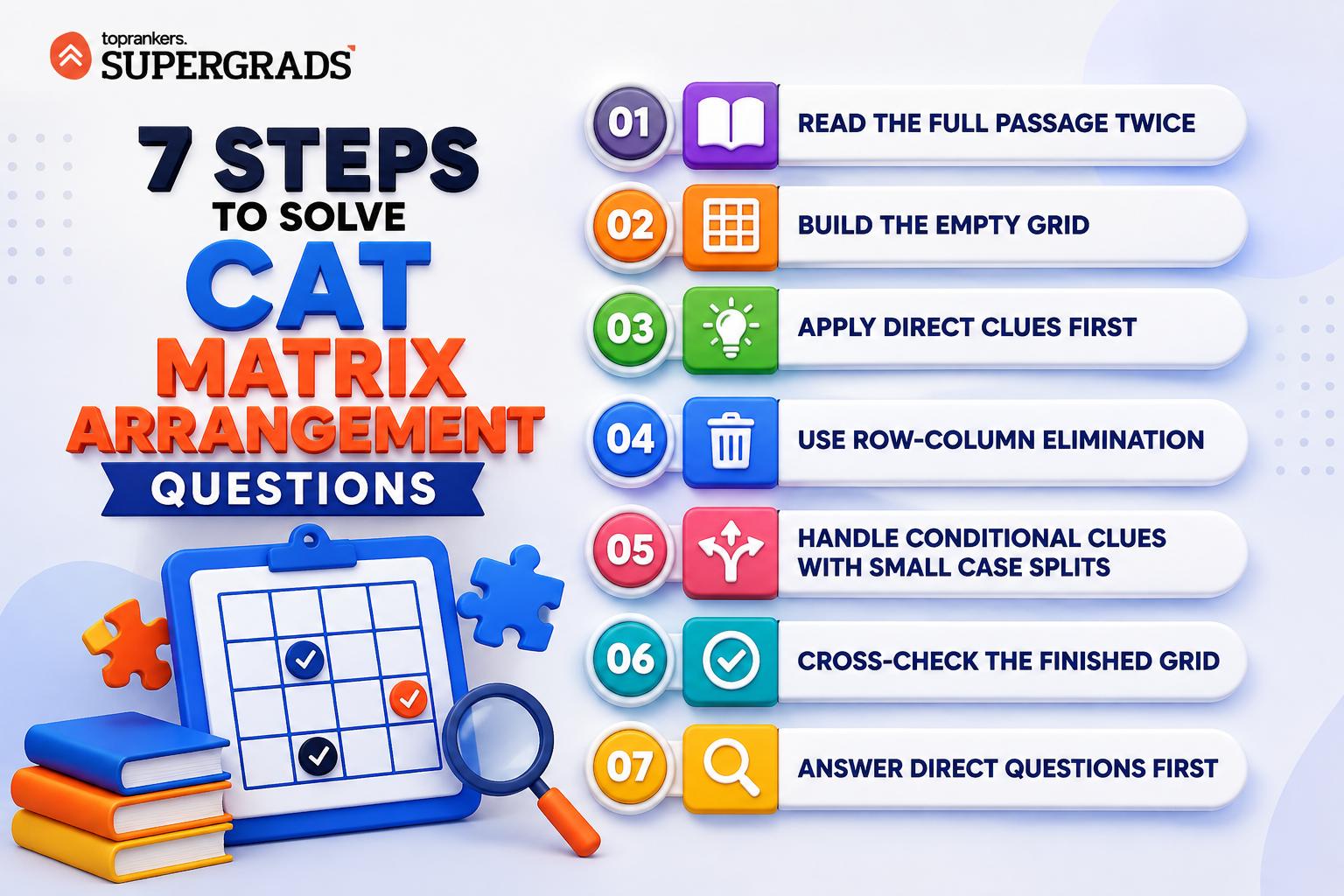
Step 1: Read the passage properly
Read the set once to understand what it is about. Then go through it again and note down the important conditions. This can help you avoid missing a small detail that changes the answer.
Step 2: Make the grid
Draw a simple grid before you start solving. Write the names or items on one side and their details on the other. This will help you keep track of the clues.
Step 3: Start with the clear clues
First, use the clues that give you a clear answer. For example, if the question says “B is an Engineer,” put it in the grid. These clues will help you solve the rest of the set.
Step 4: Remove the options that don't fit
Whenever you confirm something in the grid, check the other cells in that row and column. Cross out the values that cannot go there. Keep doing this as you get more information.
Step 5: Try the possible cases
Some clues won't give you one fixed answer. If there are two possible cases, check both and see which one works with the other clues. This is safer than making a guess.
Step 6: Go through the clues again
Once you think the grid is complete, take a quick look at all the clues. Make sure every condition fits your arrangement before answering the questions.
Step 7: Pick off the easy questions first
If an answer is clearly visible from the grid, solve it first. Questions that need more deduction can be attempted afterwards. This can also save you time in the DILR section.
Time Allocation for a Matrix Set (Within the 40-Minute DILR Section)
| Phase | Activity | Time |
|---|---|---|
| Survey | Read instructions and first 2 clues, decide to attempt | 1-2 min |
| Build | Draw grid, place direct clues | 2-3 min |
| Elimination | Apply remaining clues, resolve case splits | 3-5 min |
| Verify | Cross-check grid against all clues | 1 min |
| Answer | Solve all questions in the set | 2-3 min |
How to Prepare for CAT Matrix Arrangement Questions 2026
Core Skills Required
- Grid-building speed: turning a paragraph of clues into a clean table within 2-3 minutes.
- Elimination discipline: using confirmed cells to rule out values, rather than re-reading clues repeatedly.
- Matrix Arrangement Questions for CAT help you understand grid-based puzzles commonly asked in the exam.
- Basic CAT arithmetic question: for numerical matrix sets involving totals, discounts, or distances.
- Set-selection judgement: recognising within 60-90 seconds whether a set is worth attempting now.
6-Week Practice Plan
| Week | Focus | Target |
|---|---|---|
| Week 1-2 | Attribute-matching matrix sets (2-3 attributes) | 11 set daily, untimed |
| Week 3 | Attribute-matching matrix sets, timed | 1 set daily, 10-minute limit |
| Week 4 | Numerical and grid-placement matrix sets | 1 set daily, 12-minute limit |
| Week 5 | Hybrid matrix sets from previous CAT papers | 2 sets daily, timed |
| Week 6 | Full DILR mocks with matrix sets mixed in | 1 full section daily |
5-Year Trend: Matrix and Grid-Based Sets in CAT DILR (2020-2024)
| Year | Matrix/Grid Sets Seen | Typical Format | Difficulty |
|---|---|---|---|
| CAT 2020 | 1 | Pattern-based grid (colour/adjacency rules) | Moderate |
| CAT 2021 | 1 | Attribute-matching combined with sequencing | High |
| CAT 2022 | 1 | Numerical grid with row/column totals | High |
| CAT 2023 | 1-2 | Grid placement with a pricing/adjacency formula | High |
| CAT 2024 | 1 | Numerical matrix with distance-based clues | Moderate-High |
Key Trend: CAT may change the setting of the question, but the basic approach remains the same. Whether the set is based on houses, ATMs, exam papers, or beads, you still need to build a grid and use elimination. So, practise different types of sets instead of relying on memorising past questions.
Conclusion
- CAT Matrix Arrangement Questions check how well you can organise information and connect different details logically.
- Draw the matrix first and note down the direct clues before moving to the conditional ones.
- Practise numerical and mixed matrix sets too, as some questions may involve basic calculations along with logic.
- Practice Matrix Arrangement Questions for CAT to improve your logical thinking and DILR problem-solving skills.
- Use real CAT previous year papers and CAT mock tests as your primary practice source once the basic technique feels comfortable.
- Use the CAT matrix arrangement questions PDF to strengthen your DILR preparation and boost your confidence before the CAT exam.
With focused, timed practice across the sets above and genuine past CAT papers, CAT matrix arrangement questions can move from being an intimidating topic to one of your more reliable scoring areas in the DILR section.
Check these free resources for CAT 2026 preparation:
| CAT Important Questions | CAT 2027 Syllabus | CAT Important Topics |
| CAT Previous Year Papers | CAT Sample Papers | CAT Official Mock Test |
| TITA Questions in CAT | CAT QA Free Resources | CAT DILR Questions |

Smart Prep for CAT: Join Our Free Demo Class
Fill your details

Zubeen Siddiqui
Content Writer | MBA & CAT Preparation
SHARE