
1723534562.png)

NMAT Syllabus 2026: Section-wise Topics + PDF Download
September 18, 2026
NMAT Syllabus as designed by the NMIMS deviates the focus from difficulty and competition unlike other MBA entrance exams. It focuses more on accuracy, speed and your basic knowledge of each section targeted through this exam.
- NMAT covers three sections: Language Skills, Quantitative Skills, and Logical Reasoning.
- Each section has 36 questions, for a total of 108 questions.
- The exam has a time limit of 120 minutes.
- Unlike many other MBA entrance exams, NMAT has separate time limits for each section and no negative marking.
In this guide, you will find the section-wise topics, NMAT Exam Pattern, important areas to prepare, and simple tips to cover the NMAT syllabus 2026 without making your preparation too complicated.
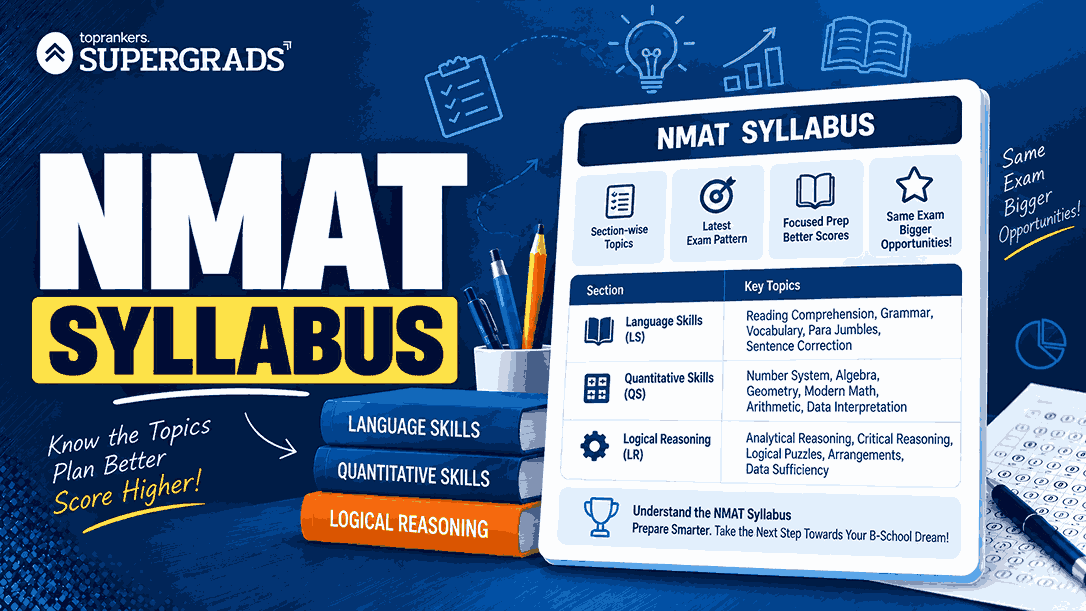
NMAT Syllabus 2026 Quick Overview
The sections have separate time limits. You can decide the order in which you want to attempt them, but once you finish a section, you cannot go back to it.
This makes time management quite important. You need to make sure that you are not spending too much time on one difficult question.
| Section | Questions | Time |
|---|---|---|
| Language Skills | 36 | 28 minutes |
| Quantitative Skills | 36 | 52 minutes |
| Logical Reasoning | 36 | 40 minutes |
| Total | 108 | 120 minutes |
What is the NMAT Syllabus 2026?
GMAC provides the broad areas covered in the exam rather than one fixed chapter-by-chapter list. The detailed topics generally used by students are based on these official areas and NMAT Previous Exam trends.
NMAT Syllabus 2026 covers three main areas:
Language Skills: Language Skills mainly checks your English, reading ability, grammar, and vocabulary.
Quantitative Skills: Quantitative Skills covers mathematical concepts along with Data Interpretation and Data Sufficiency.
Logical Reasoning: Logical Reasoning tests your ability to understand information and solve different types of reasoning problems.
NMAT Language Skills Syllabus 2026
The Language Skills section is all about how well you understand and use English. It includes reading-based questions as well as grammar and vocabulary.
According to the official NMAT information, areas such as Reading Comprehension, Para Forming, Error Identification, Prepositions, Sentence Completion, and Analogies are covered.
Important topics to prepare
| Reading Comprehension | Sentence Completion | Vocabulary |
| Para Forming | Prepositions | Grammar |
| Error Identification | Analogies | Sentence usage |
Reading Comprehension: RC questions are not only about reading the passage. You need to understand what the writer is trying to say and find the relevant information quickly.
Questions may ask about:
- Main idea
- Author's opinion
- Inference
- Tone
- Supporting details
- Meaning of words in context
Try reading something in English every day. Even 15–20 minutes of regular reading can help you become more comfortable with passages.
Grammar: Grammar questions usually test whether you can identify the correct way of using words and sentences.
Some useful areas to revise are:
- Tenses
- Subject-verb agreement
- Articles
- Prepositions
- Pronouns
- Parts of speech
- Sentence correction
- Error spotting
You do not need to memorise every grammar rule. Solve questions and understand the mistakes you are making.
Vocabulary and Analogies: Vocabulary is easier to improve when you do it regularly.
Focus on:
- Synonyms
- Antonyms
- Word meanings
- Analogies
- Idioms and phrases
- Fill in the blanks
Instead of trying to learn 50–100 new words in one day, learn a few words and revise them regularly.
How to Prepare for Language Skills
For this part of NMAT 2026 syllabus, regular practice matters more than studying for long hours once in a while.
Read articles, solve a few grammar questions, and practise RC passages. As you get comfortable, start doing these questions within a time limit.
NMAT Quantitative Skills Syllabus 2026
Quantitative Skills has 36 questions and 52 minutes, which is the highest time given to any section.
The official syllabus broadly includes Number Properties, Arithmetic, Algebra and Probability, Data Interpretation, and Data Sufficiency.
Important topics
| Number Properties | Algebra | Data Interpretation |
| Arithmetic | Probability | Data Sufficiency |
Number Properties: Start with the basic concepts of numbers. Once your basics are clear, try solving questions without immediately looking at the solution.
Important areas include:
- Factors and multiples
- Prime numbers
- HCF and LCM
- Divisibility
- Fractions
- Decimals
- Number properties
- Logarithms
Arithmetic: Arithmetic is an important part of the NMAT Syllabus 2026 and includes many topics that are commonly seen in aptitude exams.
Prepare:
- Percentages
- Profit and Loss
- Ratio and Proportion
- Averages
- Simple Interest
- Compound Interest
- Time and Work
- Time, Speed and Distance
- Mixtures
- Partnership
Algebra: Once you understand the basics, practise different question types. This will help you recognise the right method more quickly during the exam. The main topics include:
- Linear equations
- Quadratic equations
- Inequalities
- Algebraic expressions
- Sequences and series
- Logarithms
Probability: Probability and counting-based questions can take some time if the basics are not clear. Begin with simple questions and gradually move to mixed problems.
Revise:
- Basic probability
- Permutations
- Combinations
- Counting methods
Data Interpretation: DI questions give you information in the form of tables, graphs, charts, or caselets. Good calculation speed can make a noticeable difference here. Practise percentages, ratios, averages, and quick calculations along with DI sets.
Practise:
- Tables
- Bar graphs
- Line graphs
- Pie charts
- Caselets
- Comparison-based questions
Data Sufficiency: Data Sufficiency questions are slightly different from regular Quant questions. You are mainly checking whether the information given is enough to answer the question.
Do not automatically solve the entire problem. First understand what the question is asking and whether the statements provide enough information.
How to Prepare for Quant
If Quant is your weak area, start with Arithmetic and Number Properties before moving to more difficult topics.
A simple order can be:
Number Properties → Arithmetic → Algebra → Probability → DI → Data Sufficiency
Once you have covered the basics, start mixing questions from different topics.
NMAT Logical Reasoning Syllabus 2026
Logical Reasoning checks how well you understand information and use it to reach a conclusion. The section has 36 questions and 40 minutes.
Some of the broad areas mentioned by GMAC include Critical Reasoning, Analytical Puzzles, and Deductions.
Important topics
| Critical Reasoning | Analytical Puzzles | Decision Making |
| Deductions | Seating Arrangements | Venn Diagrams |
| Syllogisms | Input-Output | Verbal Logic |
Critical Reasoning: These questions usually give you a short argument or statement and ask you to analyse it.
You may need to find:
- The conclusion
- An assumption
- An inference
- A strong argument
- A weak argument
- An option that strengthens the argument
- An option that weakens the argument
Analytical Reasoning: This includes puzzles and questions where you need to arrange or connect information. For arrangement questions, making a small table or diagram is often easier than trying to remember all the conditions.
Practise:
- Seating arrangements
- Puzzles
- Input-output
- Venn diagrams
- Deductions
- Decision-making questions
Syllogisms and Deductions: These questions become easier once you understand the basic rules.
Start with simple questions and slowly increase the difficulty. With regular practice, you will begin to identify the pattern without spending too much time on it.
How to Prepare for LR
Logical Reasoning is mainly about practice. Reading theory for hours will not help much if you are not solving questions.
Start with easier topics and then move to puzzles and critical reasoning. Keep track of questions that take too long, even when you eventually get them right.
NMAT Exam Pattern 2026
Along with the topics, make sure you understand the current NMAT Exam Pattern. The section timings and question count are based on the current information provided by GMAC.
Since each section has its own timer, you cannot carry extra time from one section to another. This is something you should keep in mind while practising.
| Particular | Details |
|---|---|
| Exam | NMAT by GMAC |
| Mode | Computer-based |
| Total Questions | 108 |
| Total Time | 120 minutes |
| Sections | 3 |
| Language Skills | 36 questions, 28 minutes |
| Quantitative Skills | 36 questions, 52 minutes |
| Logical Reasoning | 36 questions, 40 minutes |
| Score Range | 36–360 |
| Negative Marking | No |
How to Prepare for NMAT Syllabus 2026?
Once you know what to study, the next question is how to cover it. The easiest way is to avoid trying to finish everything together.
Step 1: Start by checking your level
Before making a study plan, take a short test from all three sections. This will show you where you stand.
For example, you might find that your English is good but you need more practice in Quant. Or you may know the LR concepts but take too much time to solve puzzles.
Use this first test to plan your preparation.
Step 2: Make a simple checklist
Download a NMAT syllabus pdf and divide the topics into three groups:
- Done: You understand the concept and can solve questions.
- Needs Practice: You understand the topic but make mistakes or take too long.
- Not Started: You have not studied it yet.
This is much easier than trying to remember everything in your head.
Step 3: Practise after every topic
Do not wait until the complete NMAT 2026 syllabus is finished before solving questions.
If you study percentages today, solve percentage questions today. The same applies to grammar, RC, puzzles, and other topics. This helps you find your weak areas early.
Step 4: Keep an error log
Make a note of questions you:
- Got wrong
- Guessed
- Took too long to solve
- Did not understand
Go through this list every few days. You may notice that some mistakes keep repeating.
Step 5: Start timed practice
After your basics are clear, start using a timer.
Take a small set of questions and try to finish them within a fixed time. Do not focus only on speed, though. A fast wrong answer is still wrong.
The aim is to improve both speed and accuracy.
How to Use the NMAT Syllabus PDF?
NMAT syllabus pdf can be quite useful when you are planning your preparation. Instead of simply downloading it, use it as a tracker.
You can mark each topic as:
- Completed
- Needs revision
- Weak
For example:
Week 1: Number Properties + Grammar + Basic LR
Week 2: Arithmetic + RC + Critical Reasoning
Week 3: Algebra + Vocabulary + Puzzles
Week 4: Probability + DI + Arrangements
After the first round, spend more time on mixed questions and mock tests.
If you already have CAT preparation, you may be able to cover several common topics faster.
NMAT Syllabus vs CAT Syllabus 2026
There is quite a bit of overlap between CAT and NMAT preparation. Students preparing for both exams can use the same basic concepts for many topics.
For example, both require preparation in areas related to English, Quantitative Aptitude, and reasoning.
However, the exam pattern is different.
CAT Exam has VARC, DILR, and QA, while NMAT has Language Skills, Quantitative Skills, and Logical Reasoning.
NMAT also has separately timed sections, allows you to choose the section order, and has no negative marking under the current exam structure.
So, if you are preparing for both exams, you can use your CAT Preparation for concepts and then add NMAT-specific practice for speed and timing.
NMAT Preparation Strategy for Beginners
If this is your first MBA entrance exam, do not worry about finishing everything quickly. Start with the basics and build up gradually. A simple daily routine could look like this:
| Task | Time |
|---|---|
| Quantitative Skills | 60 minutes |
| Language Skills | 45 minutes |
| Logical Reasoning | 45 minutes |
| Revision/Error Analysis | 30 minutes |
You can change these timings according to your strengths. If you are already good at English, for example, you can spend less time on basic grammar and more time on RC or Quant.
NMAT 2026 Last-Month Preparation Plan
The final month should mainly be used for revision, practice, and mock tests.
Days 1–10
- Revise important concepts
- Complete pending topics
- Practise weak areas
- Revise formulas and grammar rules
Days 11–20
- Solve mixed question sets
- Take sectional tests
- Improve calculation speed
- Review your error log
Days 21–30
- Take full-length mocks
- Analyse each mock properly
- Revise weak topics
- Practise time management
Do not try to learn many new topics during the last few days. Focus on the areas you already know and make them stronger.
Common Mistakes to Avoid while NMAT Preparation 2026
- Trying to finish everything at once: The nmat syllabus has several topics. Jumping between chapters can make preparation messy. Take one topic at a time.
- Studying without solving questions: Reading formulas or concepts is not enough. You need to apply them through questions.
- Ignoring the timer: NMAT is a time-bound exam. Get used to solving questions under a clock before the actual test.
- Taking mocks without checking mistakes: Your mock score is not the only thing that matters. Spend time finding out why you lost marks.
- Using too many resources: You do not need multiple books for every topic. Pick a few reliable resources and use them properly.
- Leaving revision until the end: Revise as you go. Otherwise, topics studied at the beginning may become difficult to remember later.
Best Resources for NMAT Preparation 2026
The official NMAT preparation material is a good place to start. GMAC's official study guide includes past NMAT questions, additional practice questions, answers, explanations, and a six-week study plan.
Along with that, you can use:
- Topic-wise practice questions
- Sectional tests
- Mock tests
- Revision notes
- Previous NMAT questions
- An error notebook
NMAT 2026 syllabus tells you what you need to study. Practice tests tell you whether you are ready to solve those topics within the given time.
Conclusion
NMAT Syllabus may seem lengthy when you first look at all the topics, but there is no need to cover everything in one go.
Break your preparation into three sections and work through the topics at a steady pace. Start solving questions as soon as you learn a concept instead of waiting until the entire syllabus is complete.
Keep a nmat syllabus pdf handy to track your progress, but give equal importance to practice and NMAT mock tests. Pay attention to the questions you get wrong and the ones that take too much time.
A steady preparation plan, regular practice, and proper mock analysis can make the NMAT preparation much more manageable.
Frequently Asked Questions
What is the syllabus of NMAT?

Is there an official NMAT syllabus released by GMAC for 2026?
What are the sections in NMAT 2026 and how many questions are asked?
What topics are included in NMAT Quantitative Skills syllabus?
Are there any changes in the NMAT exam syllabus for this year?
What are the main sections of the NMAT 2025 syllabus?
Is the NMAT syllabus similar to other MBA entrance exams?
Are there any changes in the NMAT exam syllabus for 2025?
What is the weightage of topics in the NMAT 2025 syllabus?
How many months are enough to prepare for NMAT 2026?

Zubeen Siddiqui
Content Writer | MBA & CAT Preparation
SHARE