
1723534562.png)

Short Tricks to Solve Compound Interest Questions for IPMAT 2027
August 13, 2026
Overview: Master compound interest with our expert guide to formulas and shortcuts for solving compound interest questions for IPMAT 2027. Get practical tips and strategies to solve them.
Compound interest is one of the most important topics in mathematics, forming a key part of both school curricula and management entrance exams like the IPMAT 2027 Exam.
A strong grasp of this concept not only strengthens your mathematical foundation but also helps you solve a wide range of aptitude questions with confidence.
Unlike Simple Interest, which is calculated only on the principal amount, compound interest is calculated on both the principal and the interest accumulated over previous periods.
Understanding the difference between Simple Interest and Compound Interest is essential for solving arithmetic questions accurately.
While the concepts are straightforward and familiar to most students, competitive exams test your ability to solve questions both accurately and quickly.
That's why learning the Compound Interest Formula, mastering shortcut calculation techniques, and practising Compound Interest questions with solutions are crucial for improving your speed and accuracy.
Key Takeaways:
-
Understand the Formula: Mastery of the compound interest formula A = P x ((1)+(R/100))^(NxT) is crucial for adapting quickly to various exam problems.
-
Fast Calculation Skills: Developing swift calculation methods is key to efficiently tackling time-restricted exam sections, such as those in IPMAT.
-
Use of Technology: Proficiency with scientific calculators enhances speed and accuracy, providing an advantage during the exam.
-
Diverse Practice: Consistent practice across a spectrum of problems ensures preparedness for questions at all levels of complexity.
-
Personal Shortcuts: Creating and using personal calculation shortcuts can significantly reduce solving time and improve efficiency during the test.
-
Use strategies: Apply the five tricks to quickly and precisely solve compound interest questions for IPMAT 2027.
This article outlines essential strategies and simple tricks to solve compound interest questions for IPMAT 2027.
Table of Contents
What is the Concept of Compound Interest?
Before you know the tricks to solve Compound Interest Questions for IPMAT, it's essential to understand the concept first.
Compound interest can be visualised as "interest on interest," where the amount you earn from an investment grows because you earn interest on both the money you initially put in and the interest that has been added to that amount.
Here’s the basic formula used to calculate compound interest:
A = P{1 + R/100} nᵀ
Here T = Time
A = Amount
P = Principal
R = Rate of Interest
A = Amount = Principal + Compound Interest
N = Number of times interest is applied per period.
Read: How to Prepare for Maths for IPMAT 2027
Short Tricks to Solve Compound Interest Questions for IPMAT 2027
Some of the IPMAT sample questions below, with their solutions, will help you learn the short tricks to solving compound interest questions for IPMAT.
Example: Calculate the difference in compound interest for 3 and 2 years.
-
Principal (P) = ₹6000
-
Rate of Interest (R) = 5% per annum
Calculation:
|
Year |
Principal at Start of the Year |
Interest for the Year |
Total at End of Year |
|---|---|---|---|
|
1 |
₹6000 |
₹300 (5% of ₹6000) |
₹6300 |
|
2 |
₹6300 |
₹315 (5% of ₹6300) |
₹6615 |
|
3 |
₹6615 |
₹330.75 (5% of ₹6615) |
₹6945.75 |
Total CI for 3 years: ₹945.75 (₹300 + ₹315 + ₹330.75)
Total CI for 2 years: ₹615 (₹300 + ₹315)
Difference: ₹330.75 (Interest for the 3rd year only)
This method breaks down the compound interest year by year, allowing you to calculate or estimate CI over different periods quickly.
5 Tricks to Solve Compound Interest Questions for IPMAT
Here are the top 5 tricks to solve compound interest questions for IPMAT,
Trick 1

Trick 2

Trick 3

Trick 4
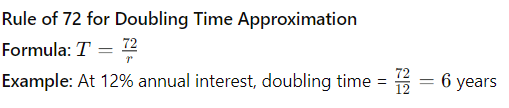
Trick 5

These 5 Tricks to Solve Compound Interest Questions for IPMAT will help you speed up your attempts.
Read: How To Solve Syllogism Questions for IPMAT 2027
Sample Question for Compound Interest for IPMAT 2027
Let's look at sample questions after learning the tricks to solve compound interest questions for IPMAT.
Below is the set of sample questions for you to practice:
Question 1: If P = 10,000, T = 2 years 6 months, Rate of Interest = 20% compounded annually. Find the Amount.
Solution: Since the time includes a fraction of a year (6 months = ½ year), we compound fully for 2 years, then apply simple interest for the remaining 6 months.
A = P(1 + R/100)^T × [1 + (Fraction × R)/100]
A = 10000 × (1 + 20/100)² × [1 + (½ × 20)/100]
A = 10000 × (1.2)² × (1 + 0.10)
A = 10000 × 1.44 × 1.10
A = ₹15,840
Question 2: If P = 20,000, Rate of Interest = 3% p.a., Time = 2 years 3 months. Find Compound Interest.
Solution: 3 months = ¼ year, so:
A = P(1 + R/100)² × [1 + (¼ × R)/100]
A = 20000 × (1.03)² × [1 + (0.25 × 3)/100]
A = 20000 × 1.0609 × 1.0075
A = 21,377.14 (approx.)
CI = A − P = 21,377.14 − 20,000
CI ≈ ₹1,377.14
Question 3: If P = 7.30 lacs, Rate of Interest = 10% p.a., T = 2 years and 2 days. Find Compound Interest.
Solution: Compound for 2 full years first:
A₂ = 730000 × (1.1)² = 730000 × 1.21 = ₹8,83,300
Now add simple interest for the extra 2 days:
Extra Interest = 883300 × 10/100 × (2/365) ≈ ₹484.06
A = 883300 + 484.06 = ₹8,83,784.06
CI = A − P = 883784.06 − 730000
CI ≈ ₹1,53,784.06
Question 4: If P = 18,000, Rate of Interest = 16.66%, Time = 1 year 73 days. Find Compound Interest.
Solution: 16.66% = 50/3%, and 73 days = 73/365 year = 1/5 year.
A = P(1 + R/100)¹ × [1 + (1/5 × R)/100]
A = 18000 × (1 + 50/300) × [1 + (1/5 × 50/300)]
A = 18000 × (7/6) × (31/30)
A = 21000 × (31/30)
A = ₹21,700
CI = A − P = 21700 − 18000
CI = ₹3,700
Question 5: If P = 10,400, Rate of Interest = 5%, Time = 1 year and 6 weeks. Find interest compounded annually.
Solution: 6 weeks = 42 days = 42/365 year.
A = P(1 + R/100)¹ × [1 + (42/365 × R)/100]
A = 10400 × 1.05 × [1 + (42/365 × 5)/100]
A = 10920 × 1.005753
A = ₹10,982.83 (approx.)
CI = A − P = 10982.83 − 10400
CI ≈ ₹582.83
Question 6: If P = 8,000, Time = 3 years, Rate of Interest = 1%, 2%, and 3% (different rate each year). Find CI − SI.
Solution: For varying annual rates, the amount is:
A = P(1 + r₁/100)(1 + r₂/100)(1 + r₃/100)
A = 8000 × 1.01 × 1.02 × 1.03
A = 8000 × 1.061106
A = ₹8,488.85 (approx.)
CI = A − P = 8488.85 − 8000 = ₹488.85
SI = P × (r₁ + r₂ + r₃)/100 = 8000 × 6/100 = ₹480
CI − SI = 488.85 − 480
CI − SI ≈ ₹8.85
Question 7: The difference between simple interest and compound interest on a certain sum of money at 5% for 2 years is Rs. 3. Find the sum.
Solution: For 2 years, the standard shortcut formula is:
Difference = P × (R/100)²
3 = P × (5/100)²
3 = P × 0.0025
P = 3 / 0.0025
Sum = ₹1,200
Question 8: If the difference between Compound Interest and Simple Interest on a certain sum of money at 5% p.a. for 3 years is Rs. 122. Find the sum.
Solution: For 3 years, the shortcut formula is:
Difference = P × (R/100)² × (3 + R/100)
122 = P × (0.05)² × (3.05)
122 = P × 0.0025 × 3.05
122 = P × 0.007625
P = 122 / 0.007625
Sum = ₹16,000
Question 9: Simple interest on a sum of money for 2 years is Rs. 480, and Compound interest is Rs. 492. Find the sum and rate of interest.
Solution: Difference (CI − SI) = 492 − 480 = 12
For 2 years: Difference = P × r² ... (i) Also, SI = P × r × 2 = 480, so P × r = 240 ... (ii)
From (i): P × r × r = 12 Substitute P×r = 240: 240 × r = 12 r = 12/240 = 0.05 → Rate = 5%
From (ii): P = 240 / 0.05
Sum = ₹4,800, Rate = 5%
Question 10: Principal = ?, Time = 3 years, Rate of Interest = 15%, Compound Interest − Simple Interest = Rs. 1701. Find Principal value.
Solution: For 3 years: Difference = P × (R/100)² × (3 + R/100)
1701 = P × (0.15)² × (3.15)
1701 = P × 0.0225 × 3.15
1701 = P × 0.070875
P = 1701 / 0.070875
Principal = ₹24,000
Read: How to Solve IPMAT Verbal Ability Questions 2027
Preparation Tips To Solve Compound Interest Questions for IPMAT 2027
1. Build Your Quantitative Aptitude Fundamentals
Before mastering Compound Interest, ensure you have a solid understanding of percentages, exponents, and basic arithmetic.
If you're unsure about the role of mathematics in the exam, read Is Maths Compulsory for IPMAT? to understand the weightage of Quantitative Ability and plan your preparation accordingly.
2. Follow the Latest IPMAT Maths Syllabus
Focus your efforts on topics that are actually tested in the exam.
Referring to the IPMAT Maths Syllabus helps you prioritise important concepts, allocate study time effectively, and avoid spending time on irrelevant topics.
3. Master the Formula and Different Compounding Frequencies
Don't just memorise the compound interest formula—understand how the principal, rate, time, and compounding frequency work together.
Practice questions involving annual, half-yearly, quarterly, and monthly compounding to avoid common calculation mistakes.
4. Follow a Structured Maths Preparation Strategy
Compound Interest is only one part of Arithmetic. A well-planned study schedule covering all Quantitative Ability topics will improve your overall performance.
Check out this IPMAT Maths Preparation Guide for a topic-wise strategy, practice plan, and revision schedule.
5. Practice Without a Calculator and Solve Timed Questions
Since calculators are not allowed in IPMAT, develop strong mental calculation skills and aim to solve each Compound Interest question within 60–90 seconds.
Regular timed practice improves both speed and accuracy under exam pressure.
6. Don't Let a Weak Maths Background Hold You Back
Even if you don't have a strong background in Mathematics, you can still perform well with consistent practice and the right strategy.
Learn how other aspirants overcome this challenge in Can I Clear IPMAT Without Maths?.
If you're specifically preparing for IPMAT Rohtak, follow this dedicated Maths Preparation Guide for IPMAT Rohtak to align your preparation with its exam pattern.
Conclusion
Mastering the art of solving compound interest calculations quickly is crucial for success in the IPMAT.
By understanding and applying the short tricks to solve compound interest questions for IPMAT, candidates can efficiently tackle this section, saving time for more challenging problems and ultimately enhancing their overall performance in the exam.
To enhance your IPMAT preparation, you can enrol in the Supergrads Crash Course.
Attempt a Free IPMAT Mock Test
Fill your details
Frequently Asked Questions
What is compound interest?

What is the fastest way to calculate compound interest for two years?
How can I approximate the time required to double an amount?
Is there a shortcut to calculate compound interest for three years?
Can I use simple interest to estimate compound interest?
Can you give 5 tricks to solve compound interest questions for IPMAT 2027?
What are the benefits of using tricks to solve compound interest questions for IPMAT 2027 quickly?

Lalita Vishwakarma
Content Writer
SHARE