
1723534562.png)

NLSAT Scholarships — Complete Guide 2026: Find, Apply & Maximise Funding
May 30, 2026
Overview: Navigating NLSAT scholarships can feel overwhelming. This guide helps you understand scholarship types in India, how NLSAT performance affects awards, where to find verified opportunities, and exactly how to apply, step by step. It links your score with your funding options and provides templates, trackers, and a practical weekly plan.
Book/Resource Comparisons
Official Resources
|
Name |
Author |
Details |
|
NLSIU Admissions (Official) |
NLSIU Admissions Office |
NLSAT Syllabus, sample papers, and admission updates |
|
Information Brochure (Official) |
NLSIU/Consortium |
NLSAT Pattern snapshots, instructions |
|
TopRankers Curated Sets |
TopRankers Editorial Team |
RC/LR/Essay practice sets; topper-style annotations |
|
Name |
Author |
Details |
|
NLSIU Admissions (Official) |
NLSIU Admissions Office |
Syllabus, NLSAT sample papers, admission updates |
|
Information Brochure (Official) |
NLSIU/Consortium |
Pattern snapshots, instructions |
|
TopRankers Curated Sets |
TopRankers Editorial Team |
RC/LR/Essay practice sets; topper-style annotations |
How to Use These Resources
- Identify and bookmark official sources (NLSIU Admissions page, NLSU/Consortium updates, NSP). Verify the domain ends with .ac.in or official portals before downloading any paper.
- Build a weekly practice plan that mirrors the 120–150 minute paper format, including diagnostic tests and post-test reviews.
- Use a quality checklist when solving sample papers: ensure the paper matches the official section mix and includes a writing task with explanations.
- Maintain an error log to capture why you missed questions and review those items before the next attempt.
- Create an application tracker (status, deadlines, next actions) to stay on top of scholarships across sources.
- Schedule 2–3 full-length mocks weekly during the final phase and reserve time for deep post-test reviews.
Attempt Free CLAT Mock Tests
Expert Tips / Do’s and Don’ts
- Do practice under timed conditions (120–150 minutes) and conduct a 60‑minute post-test review to capture errors.
- Do log every error with the reason (concept, trap, haste, or guess) to guide targeted revision.
- Do include a robust NLSAT essay practice routine; score-time practice can differentiate between close ranks.
- Don’t treat the essay as optional; allocate 30–35 minutes and seek feedback from mentors.
- Don’t guess-happy on LR/RC; use elimination rules and aim for high accuracy before speed.
- Maintain a weekly review routine to translate practice into improved performance.
Read more: NLSAT 2026 Syllabus
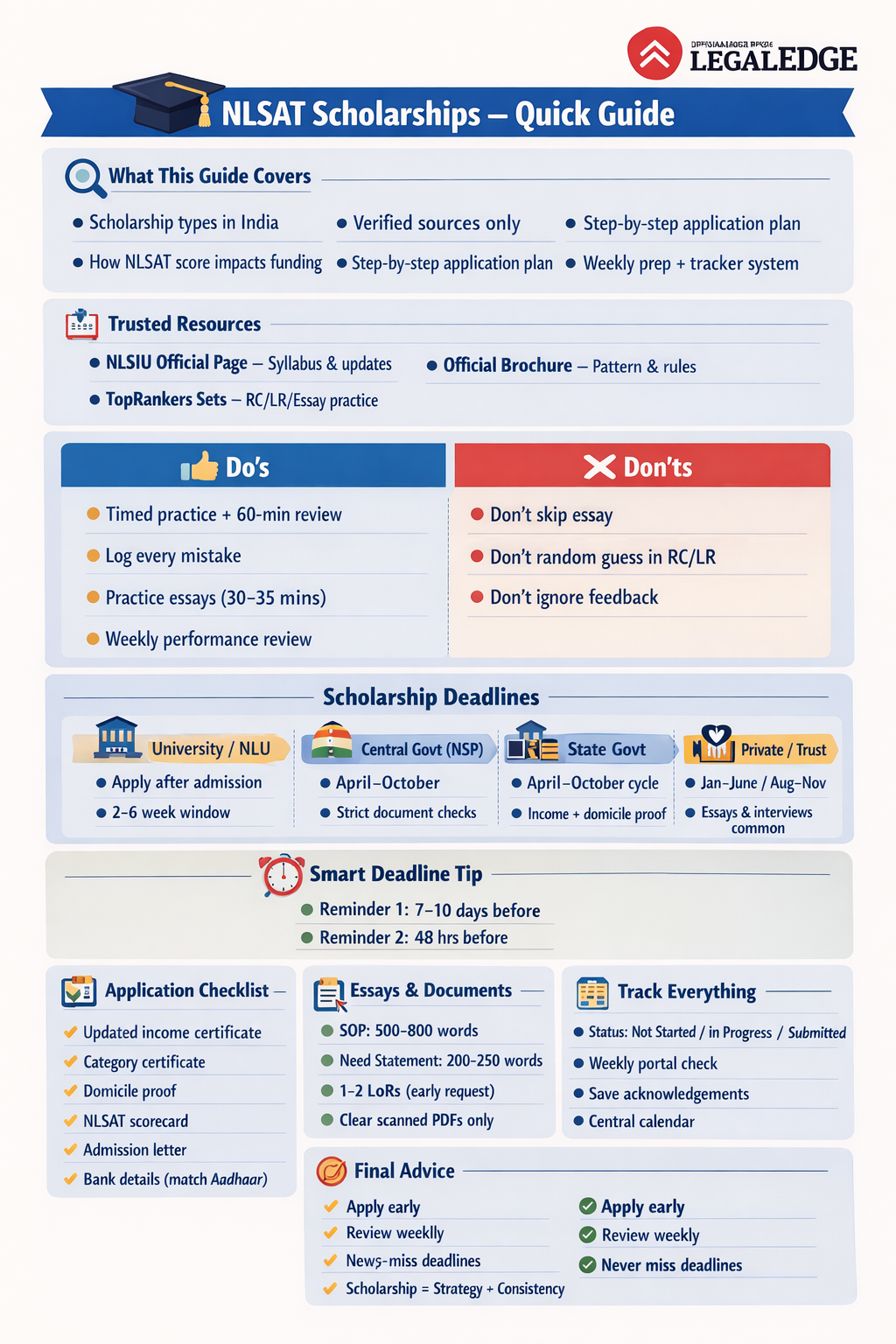
Law Scholarships: Deadlines & Where to Track Them
-
Internal University / NLU Scholarships
- Usually open after you accept the admission offer
- The application window is short, around 2 to 6 weeks
- Deadlines vary by university, so don’t assume dates from previous years
- Always check your individual NLU’s official scholarship or financial aid page
-
Central Government Scholarships
- Follow a fixed national calendar
- Most applications open between April and October
- Managed through the National Scholarship Portal (NSP)
- Missing document uploads is the most common reason for rejection. Double-check everything
-
State Government Scholarship Schemes
- Timelines depend on the state you belong to
- Generally align with the April–October cycle
- Applications are submitted through the respective state scholarship portals
- Income certificates and domicile proofs are critical, keep them ready in advance
-
Private, Trust & Foundation Scholarships
- Operate on cyclical windows, not fixed dates
- Most commonly open during:
- January–June
- August–November
- Selection may include essays, interviews, or academic screening
- Early applications usually have better chances
-
Where to Track Deadlines Reliably
- Your NLU’s official website and student notice board
- The NSP portal for all central schemes
- Official state scholarship portals
- Weekly curated alerts from trusted platforms like TopRankers (website, Telegram, or email updates)
-
Smart Deadline Management Tip
- Set two reminders for every scholarship:
- One 7–10 days before the deadline
- One 48 hours before the deadline
This saves you from last-minute portal crashes and document issues
Read more: how to prepare for NLSAT
How to Apply for Law Scholarships in India — Quick Checklist
Start with your documents
- Keep income certificate, category certificate (if applicable), and domicile proof ready
- Ensure they are valid and updated for the current year
- Scan them clearly in PDF format; blurred uploads lead to rejections
Write your Statement of Purpose (SoP)
- Length: 500–800 words
- Talk about your journey to law, academic interests, and future goals
- Be specific and real, avoid overused lines and generic motivation
Prepare a separate Need Statement
- Around 200–250 words
- Explain your financial situation honestly
- Mention figures like tuition fees, family income, and dependents where relevant
Request a Letter of Recommendation (LoR)
- Ask at least one faculty member who knows your academic work
- Reach out early and share your CV and scholarship details
- A thoughtful LoR carries more weight than a rushed one
Fill the application form carefully
- Your name, date of birth, and bank details must exactly match Aadhaar and bank records
- Even small spelling errors can cause delays or disqualification
- Review every field before submitting
Submit early and save proof
- Don’t wait till the last day, portals often slow down or crash
- Download or screenshot the acknowledgement/receipt
- Store all documents and proofs in one folder
Track your application regularly
- Check the portal or email once a week
- Respond quickly if corrections or re-uploads are requested
- Missed updates can cost you the scholarship
Prepare for interviews (if shortlisted)
- Be ready to speak on:
- One current legal or social issue you genuinely understand
- One impact plan, how this scholarship helps your education and career
Confidence and clarity matter more than fancy answers
Read more: NLSAT 2026 Eligibility Criteria
Documents Typically Required for Law Scholarship Applications
Entrance exam scorecard
- For example, your NLSAT scorecard (or CLAT/AILET, depending on the scholarship)
- Make sure the scorecard is final and clearly legible
Income certificate
- Issued by a competent authority
- Must usually be from the current financial year
- One of the most closely scrutinised documents
- Category certificate (if applicable)
- SC/ST/OBC/EWS certificates as required
- Ensure it follows the latest prescribed format
Identity proof
- Aadhaar card is most commonly asked
- Details must match exactly with the application form
Bank details
- First page of a bank passbook or a cancelled cheque
- The account should be active and in the applicant’s name
PAN card (if available)
- Not mandatory for all scholarships, but useful for higher-value awards
Admission or offer letter
- Provisional or confirmed admission letter from the law school
- Many scholarships open only after admission is secured
Curriculum Vitae (CV)
- One to two pages
- Include academics, internships, moots, debates, volunteering, or achievements
Essays / Statement of Purpose
- Usually 1–2 essays or SOP drafts
- Word limits vary, but clarity and honesty matter more than fancy language
Letters of Recommendation
- Typically, 1–2 faculty recommendations
- Should be signed, dated, and on official letterhead (if required)
Passport-size photographs
- Recent, formal photos
- Keep both digital and physical copies ready
Scholarship-specific annexures
- Declarations, affidavits, or additional forms
- These vary by scholarship; always read instructions carefully
Explore: NLSAT 2026 Essay Topics
How to Track Scholarship Status and Updates
Create one master tracker
- Use a spreadsheet or notes app
- Track each scholarship with columns for:
- Status: Not Started / In Progress / Submitted
- Deadline
- Documents uploaded
- Portal login details
- Current remarks or issues
Note the next action clearly
- Don’t just mark “submitted”
- Add what’s next: await verification, interview expected, documents under review
- This avoids forgetting follow-ups after submission
Review your tracker once every week
- Fix a specific day and time
- Check for:
- Status changes on portals
- Emails asking for corrections
- Missing or rejected documents
Set smart reminders
- At least two reminders per scholarship:
- One a week before any deadline
- One 24–48 hours before
- Include reminders for re-uploads and verifications, not just submissions
Use one central calendar
- Add all key dates:
- Interview schedules
- Document verification windows
- Final result announcements
- Keep everything in one place to avoid overlap and last-minute confusion
Save all communication
- Keep emails, SMS alerts, and portal messages in one folder
- Screenshot important status updates in case portals reset or crash
Close the loop
- Once a scholarship is awarded or rejected, mark it clearly
- Note lessons learned for future applications, it helps more than you think
Read more: NLSAT 2026 Best Books
Conclusion
If you’ve read this far, you’re already ahead. Use this NLSAT Scholarships Complete Guide as a weekly routine, prep smart, apply early, and document everything. As one topper put it: “My scholarship wasn’t luck, it was a calendar, three essays, and zero missed deadlines.”
Download FREE Study Material
Fill your details
Frequently Asked Questions
Does a higher NLSAT score guarantee a scholarship?

When should I start applying for law scholarships after clearing NLSAT?
Where can I find reliable and verified NLSAT scholarship updates?
What is the most common reason law scholarship applications get rejected?
Can I apply for multiple law scholarships at the same time?

Samriddhi Pandey
Content Writer
SHARE