
1723534562.png)

NLSAT Sample Papers 2026 PDF Download Here [Official Sample Questions + Practice Strategy]
September 14, 2026
If you are serious about cracking NLSAT, solving NLSAT Sample Papers is non-negotiable. NLSAT is not a “memory test” of law; it is a test of reading-driven reasoning, structured writing, and decision-making under negative marking. The right NLSAT 2026 Sample Papers help you understand what the paper really demands: how the passages are framed, what counts as a “good” inference, how to write concise legal reasoning answers, and how to structure an analytical essay within time.
For NLSAT 2026 (3-year LL.B. Hons.), NLSIU clearly describes a two-part paper (Part A + Part B), a total duration of 150 minutes, and negative marking in Part A for wrong and unanswered questions.
What is included in the NLSAT Sample Papers 2026?
In the NLSAT ecosystem, “sample papers” typically include:
- Official sample questions released by NLSIU (closest to exam intent and language).
- Pattern-aligned mock papers that reflect Part A (MCQs) + Part B (subjective answers + essay).
- Section-wise practice sets that train specific skills: inference-based RC, reasoning, and short-answer legal aptitude.
Read more: NLSAT 2026 Syllabus
NLSAT 2026 Exam Pattern
Before you download or practise NLSAT Sample Papers, verify the paper structure. For NLSAT-LLB, NLSIU states:
Part A (Objective) – 75 Marks
- 75 MCQs, 1 mark each, maximum 75 marks
- Negative marking: 0.25 is deducted for each wrong answer and for each unanswered question.
- Questions test Reading & Comprehension, General Awareness, Critical Reasoning
What the official sample shows: Part A is passage-driven (“General Comprehension” passages) with MCQs derived from information stated or implied in the passage, and the official sample document also indicates a distribution across English Comprehension, Current Affairs, and Critical Reasoning (including legal aptitude/logical reasoning) for that year.
Part B (Subjective) – 75 Marks
- Subjective questions, maximum 75 marks
- Legal Aptitude/Reasoning: problem-based questions requiring short, reasoned answers; no prior knowledge of law is expected
- Analytical Ability: an essay-style response testing knowledge of the issue + cogent written arguments + structure; no prior knowledge of law is expected
Read more: NLSAT 2026 Exam Pattern
NLSAT 2026 Important Dates
- Exam date & time: April 26, 2026 (Sunday), 10:00 AM to 12:30 PM
- Applications open: November 15, 2025
- Last date to apply: March 23, 2026 (11:59 PM)

Download NLSAT Sample Papers 2026 PDF [Official]
Start with the official sample questions released by NLSIU. This is the most reliable baseline for difficulty, tone, and evaluation intent.
| Resource | What you get | Best use | Download |
|---|---|---|---|
| Official NLSAT Sample Questions (NLSIU) | Part A passage-based MCQs + Part B sample legal reasoning prompt + essay topics (indicative) | Use as “truth source” for language + reasoning depth + answer expectations | Download PDF |
Note: The sample questions document is explicitly described as “indicative” and tied to that year’s test format. Use it to learn the exam’s thinking style, and cross-check the latest NLSIU pattern details for NLSAT-LLB 2026.
How to practise NLSAT Sample Papers like a topper (Expert method)
Step 1: Practise Part A as a negative-marking optimisation problem
Most students treat Part A like a normal MCQ section. That’s a mistake because NLSIU specifies a deduction for wrong answers and for unanswered questions.
What to do in sample papers:
- Passage mapping: 45–60 seconds to tag the passage (theme, stance, evidence, counterpoint).
- Question classification: mark each MCQ as (A) Direct, (B) Inference, (C) Vocabulary/Concept, (D) Logic flaw/Assumption.
- Decision rule: attempt only when you can justify the choice with a “text anchor” or a tight inference chain. If you can’t, you are gambling under negative marking.
- Error log: for every wrong answer, write why you picked it (misread? over-inference? ignored qualifier? outside knowledge?). Revisit weekly.
Read more: how to prepare for NLSAT
Step 2: Train Part B like a writing test with a reasoning rubric
NLSAT Part B rewards clarity, structure, and reasoning. The official sample emphasises short, reasoned responses and evaluation based on the strength of reasoning, cogency, and a clear conclusion supported by reasons.
Use this 6-part answer framework for Legal Aptitude/Reasoning:
- Issue: What is the legal/decision question?
- Rule (from the prompt): Extract the operative standard stated in the question.
- Facts: List only relevant facts (no rewriting the whole passage).
- Application: Apply each relevant fact to the rule (because/therefore chain).
- Counterpoint: Address the strongest opposing interpretation briefly.
- Conclusion: A clean, one-line conclusion that matches your reasoning.
For the Analytical Ability (Essay) task:
- Thesis in 2 lines: clear stance + scope.
- 3-Paragraph logic: (i) context, (ii) argument + evidence/examples, (iii) counterargument + rebuttal.
- Finish with a policy-style conclusion: what should be done + why it works.
7-day micro-plan using NLSAT 2026 Sample Papers (repeat weekly)
- Day 1: 1 Part A passage set (timed) + analyse errors
- Day 2: 2 Legal reasoning short answers (150-word discipline) + self-check structure
- Day 3: Current/legal issue essay (500 words) + rewrite intro + conclusion
- Day 4: Mixed mini-mock (Part A 25 Q) + attempt strategy refinement
- Day 5: 4 passages untimed (focus: inference + tone + assumptions)
- Day 6: 1 full Part B simulation (short answers + essay)
- Day 7: Consolidation day (error log + “rules I keep breaking” list)
Read more: NLSAT 2026 Eligibility Criteria
What makes a “good” NLSAT sample paper (Quality checklist)
- Passage difficulty is real: nuanced, opinionated, and inference-heavy (not school-level RC).
- MCQs force reasoning: options are close, with qualifiers like “most likely,” “best supported,” “implied”.
- Part B is not generic: problem-based prompts demand structured reasoning, not legal trivia.
- Essay topics are contemporary: policy/society/legal system issues that allow argumentation.
- Built-in evaluation: model answers show reasoning steps, not just final conclusions.
Explore: NLSAT 2026 Essay Topics
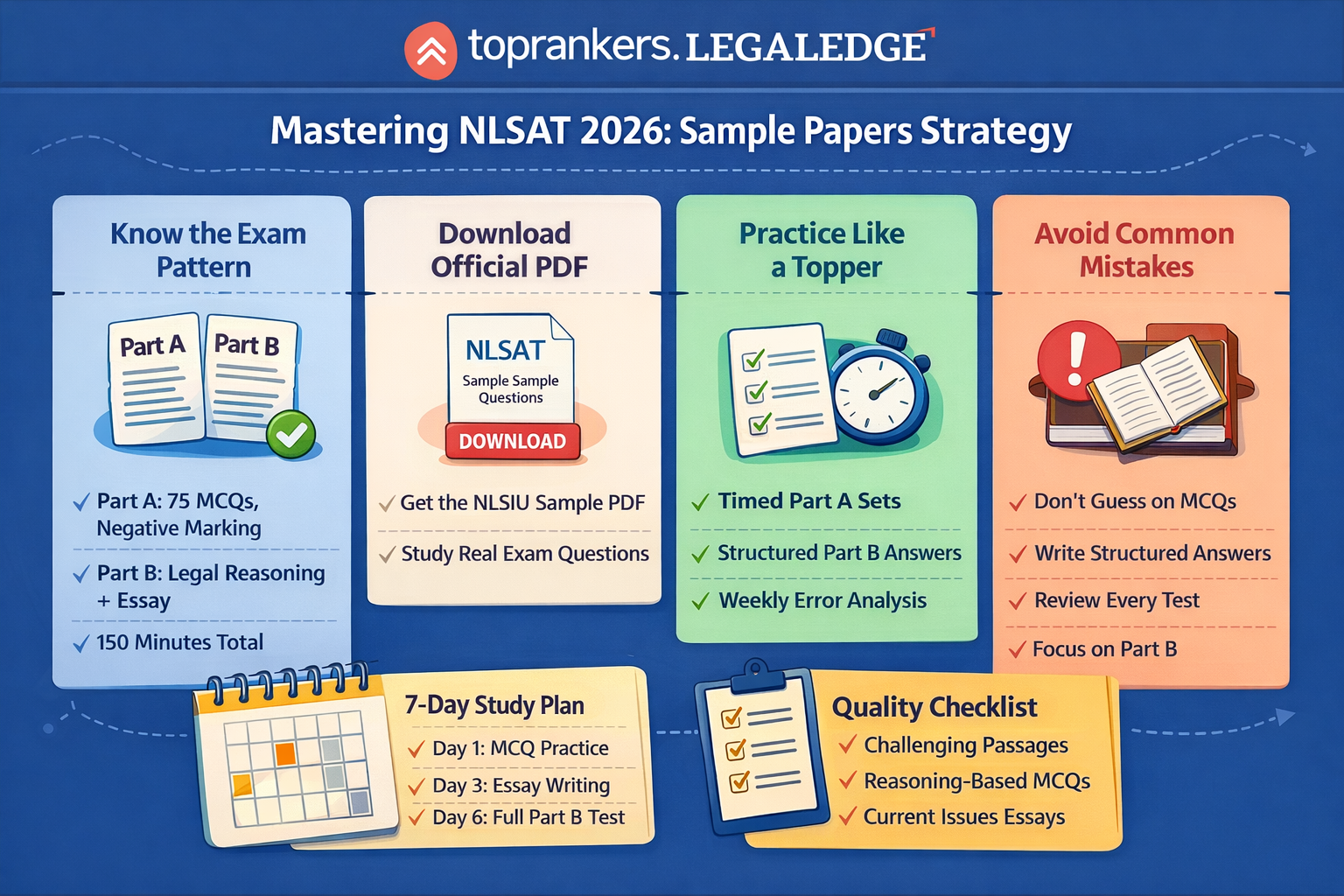
Common Mistakes Students Make with NLSAT Sample Papers 2026
- Reading like CLAT: NLSAT passages and options often punish “smart guessing” and reward disciplined textual reasoning.
- Writing like a blog: Part B needs exam-style structured reasoning, not expressive writing.
- No post-test analysis: your score improves mainly in review, not in attempting more papers.
- Ignoring tie-break reality: NLSIU indicates Part B marks are used as an NLSAT tie-breaker when aggregate scores are the same, so Part B is not optional.
NLSAT Relevant Blogs
Frequently Asked Questions
Are NLSAT Sample Papers enough for NLSAT 2026 preparation?

Where can I get official NLSAT sample questions?
What is the NLSAT 2026 paper structure?
Is prior legal knowledge required for Part B?
What are the key dates for NLSAT 2026?

Admin
Subject Matter Expert
SHARE