
1723534562.png)

NLSAT Tie Breaker Rule Explained: What Happens When Scores Are the Same?
May 30, 2026
Overview: If you are preparing for the National Law School Admission Test (NLSAT), you already know that every mark matters. But what happens when two or more candidates end up with the same total score? Who gets the higher rank? This is where the NLSAT tie breaker rule comes into play, a rule that many aspirants misunderstand or completely overlook.
In this blog, we break down the NLSAT tie breaker rule in a clear, no-confusion way so you know exactly how ranks are decided and why Part B carries more weight than most students realise.
What Is the NLSAT Tie Breaker Rule?
The NLSAT tie breaker rule is a ranking mechanism used when two or more candidates secure the same aggregate score in the NLSAT exam.
The rule is simple and official:
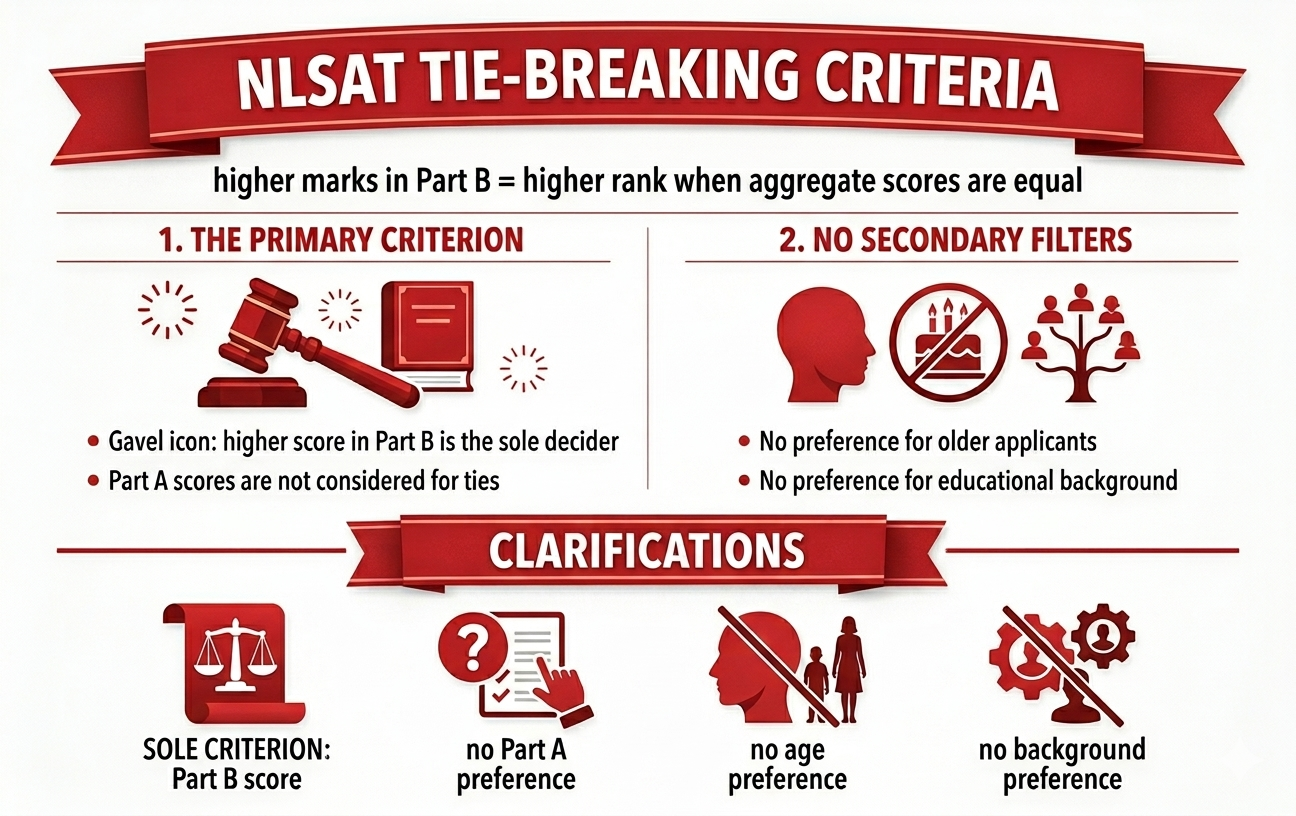
If two or more candidates obtain the same total score (Part A + Part B), the marks obtained in Part B will be used to break the tie and determine the rank.
That’s it. No age factor. No random draw. No extra calculations.
This single rule decides who ranks higher when scores collide, making the NLSAT tie breaker rule one of the most important aspects of the admission process.
Read more: NLSAT 2027 Syllabus
Why Does the NLSAT Even Need a Tie Breaker Rule?
The NLSAT is designed to test both objective aptitude (Part A) and subjective legal reasoning (Part B). Since many high-performing candidates score closely, ties are common, especially among top ranks.
Without a clear NLSAT tie breaker rule, the admission process would become subjective and unfair. The rule ensures:
- Transparency
- Merit-based ranking
- Consistent evaluation
This is why the NLSAT tie breaker rule relies on performance in Part B, the most analytical and discriminating section of the paper.
Read more: NLSAT 2027 Exam Pattern
Which Section Decides the Tie in NLSAT?
Here’s where things get crucial.
Under the NLSAT tie breaker rule, Part B alone decides the rank if total scores are the same.
That means:
- Candidate A: Part A + Part B = 100
- Candidate B: Part A + Part B = 100
The candidate with higher Part B marks gets a better rank.
This applies universally, including admissions through the NLSAT LLB tie breaker rule, where Part B plays a decisive role in final merit positions.
Read more: how to prepare for NLSAT
Why Is Part B Given More Importance in the NLSAT Tie Breaker Rule?
Part B is not just another section. It tests:
- Legal reasoning
- Argument structure
- Clarity of thought
- Analytical depth
Unlike Part A, which is objective and MCQ-based, Part B reflects how well a candidate can think like a law student.
That’s why the NLSAT tie breaker rule prioritises Part B, it separates surface-level scorers from genuine legal thinkers.
In short, when scores tie, quality of thinking beats speed of answering.
Read more: NLSAT 2027 Eligibility Criteria
Does Part A Have Any Role in Tie Breaking?
Once the total score is calculated, Part A has no role in resolving a tie.
This often surprises aspirants, but under the NLSAT tie breaker rule, Part A only contributes to the aggregate score, not to tie resolution.
So even if:
- You score exceptionally high in Part A
- But slightly lower in Part B
You may lose out in a tie situation.
This is why understanding the NLSAT tie breaker rule early can completely change how you prepare.
Read more: NLSAT Previous Year Question Papers
How Does This Affect NLSAT Rank Cut-Offs?
Because Part B determines tie resolution, it indirectly affects:
- Final ranks
- Cut-off margins
- Waiting list movement
In competitive years, even a 1–2 mark difference in Part B can shift ranks significantly. This is especially true under the NLSAT ranking tie breaker rule, where top ranks often cluster within narrow score bands.
Explore: NLSAT 2027 Essay Topics
Simply put: Part B can make or break your rank, even if your total score looks strong.


Is the Tie Breaker Rule the Same for the 3-Year LLB Program?
Yes. The NLSAT LLB tie breaker rule follows the same principle.
For the 3-year LLB programme:
- The aggregate score is considered first
- Part B marks are used to break ties
There is no separate or additional criterion beyond Part B marks. This keeps the NLSAT LLB tie breaker rule straightforward and merit-driven.
Read more: NLSAT 2027 Best Books
What Is the Official NLSAT Score Tie Breaking Criteria?
The NLSAT score tie breaking criteria is clear and singular:
Higher marks in Part B = higher rank when aggregate scores are equal
There are no secondary or tertiary filters. No preference for age, background, or category beyond existing reservation norms.
This clarity makes the NLSAT tie breaker rule one of the most transparent among Indian law entrance exams.
How Should Aspirants Prepare Keeping the Tie Breaker Rule in Mind?
Knowing the NLSAT tie breaker rule should change how you approach preparation.
Here’s how smart aspirants adapt:
- Treat Part B as a rank-deciding section, not an afterthought
- Focus on structure, clarity, and reasoning, not just content
- Practice timed writing to avoid incomplete answers
- Learn how evaluators assess arguments
Students who ignore Part B often regret it when the NLSAT tie breaker rule comes into effect.
What Is the Biggest Myth Around the NLSAT Tie Breaker Rule?
The biggest myth is:
“Part A matters more because it has more questions.”
In reality, Part B matters more when it matters most, during tie-breaking.
Many aspirants score similarly in Part A, but Part B creates rank separation. That is precisely why the NLSAT tie-breaker rule places its trust there.
Conclusion
The NLSAT tie breaker rule is not a minor technicality; it is a rank-deciding reality.
If you aim for NLSIU:
- You must aim for strong Part B performance
- You must understand how ranks are decided
- You must prepare with the tie breaker in mind
If you are targeting the NLSAT LLB tie breaker rule, one truth remains constant: Part B is your differentiator.
Understand the rule. Respect it. Prepare for it. Because when scores tie, Part B decides your future.

Download FREE Study Material
Fill your details
Frequently Asked Questions
What is the NLSAT tie breaker rule?

Does Part A play any role in breaking a tie in NLSAT?
Is the tie breaker rule different for NLSAT LLB admissions?
Why is Part B given preference in the NLSAT tie breaker rule?
Can a small difference in Part B marks affect my final rank?

Samriddhi Pandey
Content Writer
SHARE