
1723534562.png)

CUET DU CSAS Portal 2026: Complete Registration & Admission Guide
March 17, 2026
Quick Answer: The CUET DU CSAS Portal is the online system Delhi University uses to give UG seats after the CUET exam. First, you appear for CUET UG 2026. Then, you fill the DU CSAS form, upload documents, add your course and college choices, accept a seat if you get one, clear document checks, and pay the fee. DU says all students who want regular UG admission must appear in CUET and then apply through CSAS(UG)-2026 on the DU admission website.
Key Takeaways
- DU admission in 2026 needs two steps: CUET first, then CSAS. Simply giving CUET UG exam is not enough.
- DU says only CUET UG 2026 scores will be used for admission in 2026-27.
- You should take CUET in the same subjects you studied in Class 12. If the exact subject is not listed, you should pick a closely related one.
- The full 2026 CSAS round schedule is not out yet. DU says the details will be notified separately on the admission website.
- NTA’s current tentative exam window for CUET UG 2026 is 11 May to 31 May 2026.
What you'll get in this blog: In this blog, you will understand how the CUET DU CSAS Portal works in a simple way. You will also learn about the 3 phases of DU admission, how preference filling and subject mapping work, the expected 2026 timeline, common mistakes you should avoid, and a final checklist to help you stay ready for admission.
What Is the CUET DU CSAS Portal?
The CUET DU CSAS Portal is Delhi University’s online admission window for undergraduate seats. Think of it like a bridge. CUET gives you the score. DU CSAS uses that score to help allot your course and college seat.
DU’s 2026 bulletin says every student seeking regular UG admission must appear in CUET and then apply through CSAS(UG)-2026 on the DU admission website.
This is why students should not stop after the exam. You may prepare hard for CUET UG 2026, study the CUET exam pattern, follow the CUET exam syllabus, solve CUET previous year question papers, take a CUET mock test, and use strong CUET preparation tips. But after the exam, you still need the DU admission step. That is what this portal is for. NTA handles the test, while DU handles seat allocation and admission.
| Phase | What you do | Why it matters |
| Phase 1 | Register and upload documents | Your application starts here |
| Phase 2 | Fill preferences and check subject mapping | This shapes the seats you can get |
| Phase 3 | Accept seat, verify documents, pay fee | This completes admission |
DU used this same 3-phase structure in its recent CSAS process, and the 2026 admission page says CSAS(UG)-2026 details will be released separately.
Why This Guide Matters
Many students fear the CUET DU CSAS Portal because one small mistake can cause a big problem. DU says candidates must read the eligibility rules carefully, keep checking the admission website, and remember that some details from the CUET form, like name, photo, and signature, are later auto-integrated and may be non-editable. DU also says your email and mobile number should be active for admission use.
This guide matters even more if you are comparing DU with other CUET top universities. NTA says the list of participating universities is dynamic and students should keep checking the official universities page for updates. So, before you lock your dream plan, make sure you also understand the broader CUET counselling process and where DU fits in that bigger picture.
Before you begin, remember these simple points:
- Read the DU eligibility rules slowly.
- Keep your CUET details ready.
- Use your own email and phone number.
- Do not guess subject mapping.
- Do not wait for the last day.
Phase 1 on CUET DU CSAS Portal: Registration and Document Upload
On the CUET DU CSAS Portal, Phase 1 is where you register and upload the basic papers DU asks for. DU says candidates must apply online through the admission website, and only applications through the official platform are valid. Therefore, students who appeared in CUET and passed Class 12 from a single recognized board can apply.
Remember, a wrong file, a blurred scan, or a missing paper can slow everything down. DU also warns that document and eligibility checks are conducted by the university, and students can lose their admission for invalid documents or missing steps.
Keep these Documents Ready before Registration
- CUET application number
- Class 10 and Class 12 details
- Category certificate, if needed
- ECA or sports papers, if needed
- Passport-size photo and signature
- Active email ID
- Active mobile number
Small but important tips
- Use the same name everywhere.
- Upload clear files only.
- Check spellings twice.
- Do not ignore category rules.
- Keep copies saved in one folder.
If your Class 12 result is already out, DU’s FAQ says you should upload marks for all subjects, not just your best few.
Phase 2 on CUET DU CSAS Portal: Preference Filling and Subject Mapping
On the CUET DU CSAS Portal, Phase 2 is the real thinking stage. This is where you tell DU what you want. You fill course and college combinations in order: first choice, second choice, third choice, and so on. In the recent CSAS rules, DU said preference filling is mandatory and must be done online through the admission website.
What does preference filling mean?
If you can get many options, the system tries to give you the highest preference possible based on your score, eligibility, category, and seat availability. So your list order matters a lot.
A smart way to make choices:
- Keep your dream option first.
- Add strong backup options too.
- Do not copy a friend’s order.
- Fill enough realistic combinations.
- Check your saved list before the deadline.
What Subject Mapping Means?
Subject mapping is very important. DU says you must appear in CUET in the same subjects you studied and passed in Class 12. If the exact Class 12 subject is not listed in CUET, you should take a similar or closely related subject. DU adds that at least 50% of the syllabus should match, and the university has the final say on similarity.
For example:
- Studied Physics, Chemistry, and Math in school.
- want a course that needs those subjects.
- Then your CUET subjects should match those subjects too.
This is where many students get stuck. A wrong subject choice can make a student ineligible even with a good score. That is why it is smart to read the course rules, the CUET exam syllabus, and the programme-specific eligibility before you fill in your choices.
What about the simulated rank list?
You may get a simulated rank list before final allotment. DU has used a simulated rank step in past UG admissions, where you could see your rank on the dashboard before final allocation.
For 2026, DU has not officially confirmed this step yet, so treat it as a likely feature, not a final rule.
How Seat Allotment Works?
After that, the CUET DU CSAS Portal matches your score and choices to available seats. In the recent official CSAS rules, DU said seat allocation is based on CUET score, programme-specific eligibility, and the allocation rules of the university.
Seat allotment in simple steps
| Step | What happens |
| 1 | DU checks your score and eligibility |
| 2 | The system reads your preference list |
| 3 | A seat is allotted if you match the rules |
| 4 | You click Accept |
| 5 | The college checks your documents |
| 6 | You pay the fee |
| 7 | Your admission is completed |
DU’s recent CSAS rules also say students must keep checking the dashboard, email, and website, and that non-submission of documents or non-payment of fee within the given time can lead to loss of admission. It also notes that physical verification of original documents may be required when notified by the college or university.
So, once you get a seat, do not wait. Check the dashboard, answer any query, and pay the fee on time.
Phase 3: Fees and Payment on CUET DU CSAS Portal
The CUET DU CSAS Portal also includes the payment step. After a seat is allotted and the college approves your documents, you must pay the admission fee within the given deadline to confirm your seat. DU’s admission rules also make it clear that fee structure can vary from one college to another, so students should always check the official website of the allotted college for the latest course-wise fee details.
| Fee Item | What students should know |
| CSAS application fee | Paid during DU CSAS registration, as per DU rules |
| Admission fee | Paid after seat acceptance and document approval |
| Fee amount | Varies by college and programme |
| Payment mode | Follow the payment option shown on the official DU admission system |
| Important tip | Pay before the deadline to avoid losing your seat |
Important note: DU says the undergraduate fee structure varies across colleges. Always check the college's official website to confirm the seat allotted to you.
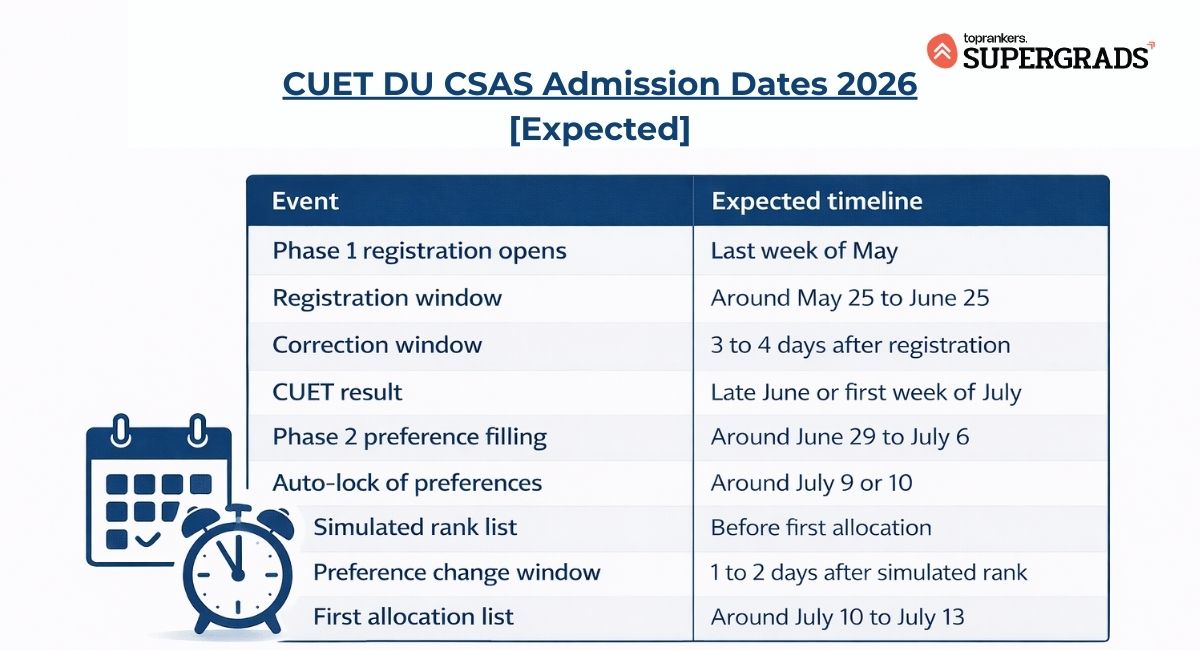
Expected Timeline for 2026
The official schedule for the CUET DU CSAS Portal is not out yet. DU says the details for allocations and admissions through CSAS(UG)-2026 will be notified separately, and students should visit the admission website regularly. NTA’s current public notices say CUET UG 2026 is tentatively planned from 11 May to 31 May 2026.
| Event | Expected timeline |
| Phase 1 registration opens | Last week of May 2026 |
| Registration window | Around May 25 to June 25 2026 |
| Correction window | 3 to 4 days after registration |
| CUET result | Late June or first week of July |
| Phase 2 preference filling | Around June 29 to July 6 2026 |
| Auto-lock of preferences | Around July 9 or 10 |
| Simulated rank list | Before first allocation |
| Preference change window | 1 to 2 days after simulated rank |
| First allocation list | Around July 10 to July 13 2026 |
Common Mistakes to Avoid on CUET DU CSAS Portal
There are multiple errors on the CUET DU CSAS Portal that happen because students rush. In the last cycle, many students did not even reach Phase 2 due to errors in eligibility or form-filling.
| Common mistake | Better fix |
| Uploading wrong files | Keep all documents in one checked folder |
| Filling random preferences | Arrange them in your true priority order |
| Ignoring subject mapping | Match CUET subjects with Class 12 carefully |
| Missing a short window | Check the dashboard every day |
| Not reading notices | Follow DU and NTA updates only |
| Waiting to pay the fee | Pay as soon as verification is cleared |
Competition Trends Based on Previous Year
Some students fill out a very large number of preferences. The idea here is not to fill blindly. The idea is to fill wisely. Some of the most popular choices were:
- B.Com (Hons.)
- B.Com
- B.A. (Hons.) English
- B.A. (Hons.) Political Science
- B.A. (Hons.) History
Final Checklist for Students
Before admission starts, do these things:
- Read the DU bulletin once.
- Understand the wider CUET counselling process.
- Check your programme eligibility.
- Review the CUET exam pattern.
- Revise the CUET exam syllabus.
- Solve the CUET previous year question papers.
- Take at least one CUET mock test.
- Compare your options with other CUET top universities.
- Keep your documents ready.
- Fill preferences calmly.
- Check the dashboard daily.
- Accept the seat on time.
- Pay the fee before the last date.

Get CUET Study Materials
Fill your details
Frequently Asked Questions
What is the CUET DU CSAS Portal?

Is CUET enough for DU admission in 2026?
What happens in Phase 1 of DU admission?
What is preference filling in DU CSAS?
What is subject mapping in the DU admission process?
What should I do after getting a seat in DU?
Can I change my preferences after filling them?
Why should students check the portal every day?

Chetanya Rai
Communications Executive (CUET)
SHARE