
1723534562.png)

CEED 2024 Question Paper PDF Download (Part A & Part B) with Solutions
August 11, 2026
Download the CEED 2024 question paper (Part A + Part B) with the answer key and full solutions, free.
CEED 2024 was conducted by IIT Bombay on 21 January 2024: a 3-hour, 250-mark test with 49 questions across Part A (objective - visual reasoning, observation, design aptitude) and Part B (sketching and design thinking). Overall difficulty was moderate.
Solving this paper under timed conditions is the fastest way to understand the real CEED pattern, the level of creativity expected, and where you currently stand. Grab the PDF below, attempt it like the real exam, then check your answers against the solutions.
CEED 2024 Question Paper PDF Download
The CEED 2024 question paper PDF is the single best resource for decoding IIT Bombay's current approach to design aptitude. Pair it with the CEED 2024 answer key and solutions to spot exactly where you lose marks - whether that's spatial visualization in Part A or design-thinking depth in Part B - and turn each mistake into a targeted revision point.
|
Resource |
Download |
|
CEED 2024 Question Paper PDF |
|
|
CEED 2024 Answer Key |
Download Other CEED Previous Year Question Papers as Well:
Key Highlights: CEED 2024 Question Paper
- CEED 2024 was conducted by IIT Bombay on 21 January 2024 and had 49 questions across Part A and Part B for a total of 250 marks.
- Part A (150 marks) and Part B (100 marks), conducted over 3 hours.
- Overall difficulty was moderate - Part A rewarded visual reasoning and observation; Part B was the tougher, design-thinking-heavy section.
- Observation-based questions featured real-world products, mechanisms, animation principles, materials, ergonomics, and design awareness.
- Part B included Sketching, Creativity, Visual Sensitivity, Form Sensitivity, and Problem Identification tasks worth 20 marks each.
- Students were asked to storyboard a child lifting a toy box, create interactions using a cube-shaped human head, design an ornamental font wordmark, develop furniture from a 3D form, and identify design problems in a rural kitchen.
- The paper strongly emphasized design thinking, visual communication, problem identification, and creativity over rote knowledge.
What is CEED 2024 Question Paper?
It is the official Common Entrance Examination for Design paper conducted by IIT Bombay on 21 January 2024 - a 3-hour, 250-mark test with 49 questions split across Part A (objective) and Part B (sketching and design thinking).
CEED 2024 Exam Pattern At a Glance:
|
Component |
Details |
|
Exam Mode |
Computer-based examination (Part A on computer, Part B answered in booklet) |
|
Duration |
3 Hours (Part A: 1 Hour + Part B: 2 Hours) |
|
Part A Marks |
150 Marks |
|
Part B Marks |
100 Marks |
|
Total Marks |
250 Marks |
|
How Many Questions in CEED 2024 |
Total 49 (Part A + Part B) |
|
Question Types |
NAT (Numerical Answer Type), MSQ (Multiple Select Questions), MCQ (Multiple Choice Questions), Sketching, Creativity, Visual Communication, Form Development, Problem Identification |
|
Skills Tested |
Observation, Visual Reasoning, Spatial Ability, Design Aptitude, Creativity, Sketching, Visual Sensitivity, Form Sensitivity, Communication Skills, Problem Solving, Design Thinking, Human-Centered Design |
CEED 2024 Question Paper - Part A Breakdown
|
Section |
Question Type |
No. of Questions |
Marks |
|
Section I |
NAT |
8 |
32 |
|
Section II |
MSQ |
10 |
40 |
|
Section III |
MCQ |
26 |
78 |
|
Total |
— |
44 Questions |
150 Marks |
Check: CEED Eligibility Criteria 2026
CEED 2024 Question Paper - Part B Breakdown
|
Question |
Focus Area |
Marks |
|
Q1 |
Sketching |
20 |
|
Q2 |
Creativity |
20 |
|
Q3 |
Visual Sensitivity |
20 |
|
Q4 |
Form Sensitivity |
20 |
|
Q5 |
Problem Identification |
20 |
|
Total |
- |
100 Marks |
Check: Complete CEED Syllabus for 2027 (Part A + Part B)
_(1)1764330056.webp)
CEED 2024 Part A Questions Analysis
|
Area |
Topics Asked (Actual Questions from CEED 2024) |
Difficulty |
|
Visual Reasoning |
Paper folding and unfolding, cube and 3D object visualization, top-view identification, shadow analysis, pattern completion, image transformations, perspective understanding, rotational symmetry, object reconstruction from fragments. |
Moderate to Difficult |
|
Logical Reasoning |
Sequence completion, pattern-based reasoning, analytical interpretation of visual data, relationship mapping, elimination-based logic questions, and inference-based problem solving. |
Moderate |
|
Design Aptitude |
Product usability, ergonomics, design awareness, material properties, mechanism understanding, visual communication principles, everyday product analysis, and design decision-making scenarios. |
Moderate |
|
Observation |
Counting and identifying visual elements, spotting subtle differences between images, object arrangement analysis, hidden-pattern recognition, visual matching, and attention-to-detail questions. |
Moderate |
|
General Awareness |
Design-related knowledge, products and inventions, visual culture, architecture, design terminology, materials, and basic awareness of creative disciplines. |
Easy to Moderate |
Check: CEED Colleges
Was CEED 2024 Easy or Difficult?
CEED 2024 was moderate overall. Part A stayed approachable for well-prepared visual thinkers - most questions tested paper folding, cube visualisation, top-views and observation rather than heavy calculation.
Part B was the real filter: the furniture-from-3D-form and rural-kitchen problem-identification tasks demanded genuine design thinking, not just neat sketching. In short: Part A rewarded practice; Part B rewarded thinking like a designer.
Sample Questions from CEED 2024 Paper (Part A)
Q.1. The two objects on the left have a height of 1 cm and sides of 4 cm. The yellow object on the right has a total height of 5 cm. The cylindrical base of the yellow object has a diameter of 6 cm and a height of 1 cm. The two objects on the left are to be stacked on the yellow object on the right. After all the objects are stacked together, how many outer surfaces will the resulting structure have?
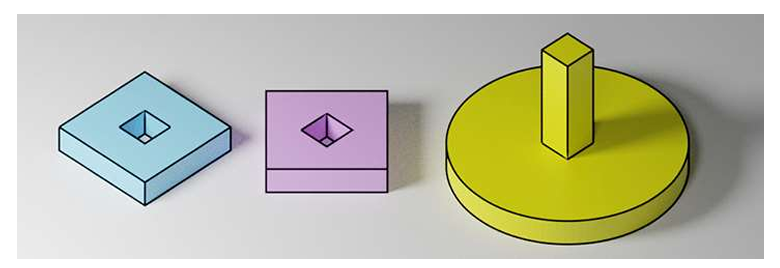
Answer: 25 surfaces
Solution:
Break the stacked structure into its parts and count every exposed face. The two square blocks on the left are hollow - a square frame with a square hole - so each one contributes its outer walls, the inner walls of the hole, and its top and bottom, giving more faces than a solid block would.
Add the faces of the yellow piece (its cylindrical base plus the central pillar), and the exposed surfaces total 25.
Q.2. A “group of letters” has a few letters flipped on vertical axis. The mirror image of this “group of letters” is shown below. What is the total number of flipped letters in the group?
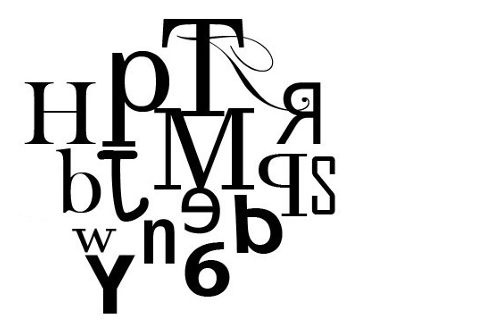
Answer: 7
Solution:
A letter counts as "flipped" only if its mirror image (left-to-right) looks different from the original. Vertically symmetric letters - A, H, I, M, O, T, U, V, W, X, Y - read the same in a mirror, so they are not flipped. Letters like b, d, p, q, e, r and s change under a mirror, so those are the ones to count. Work through the group and tally only the letters whose mirrored form differs from the normal form.
Q.3. What number will replace the question mark?
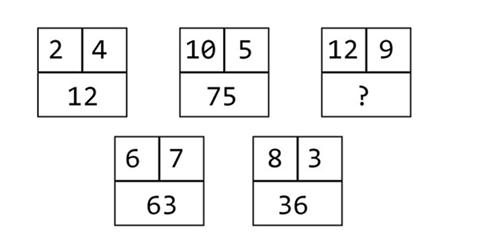
Answer: 162
Solution:
Find the rule linking the numbers in each row. Here, the third value equals the product of the first two, multiplied by 1.5. Test it on the rows you're given (2 × 4 = 8, then 8 × 1.5 = 12; 10 × 5 = 50, then 50 × 1.5 = 75), then apply the same rule to the last row: 12 × 9 = 108, and 108 × 1.5 = 162.
Q.4. Coloured cubes (red and yellow) of equal size are arranged and stacked to form the cuboidal structure as shown in the image. If the ratio of the number of yellow cubes to that of the red cubes is 1:3, how many yellow cubes are NOT visible in the image?
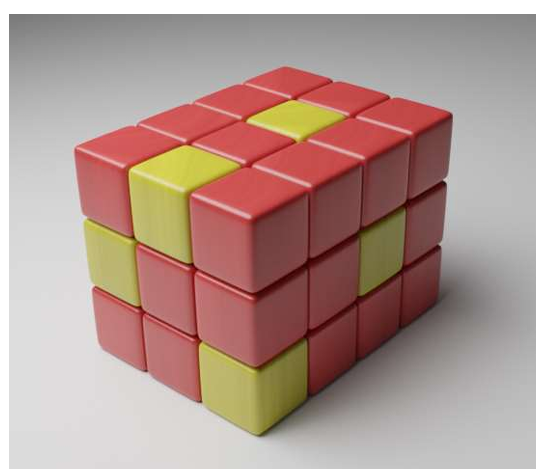
Answer: 4
Solution:
Step 1 - Total cubes. Count the full cuboidal stack, including the cubes hidden inside and behind. The structure is made of 36 unit cubes (a 3 × 3 × 4 arrangement).
Step 2 - Use the ratio. Yellow : Red = 1 : 3, so the cubes are split into 4 equal parts. Yellow cubes = 36 ÷ 4 = 9, and red cubes = 3 × 9 = 27 (and 9 + 27 = 36, which checks out).
Step 3 - Subtract what you can see. Count the yellow cubes visible on the exposed faces of the stack - there are 5. The rest must be tucked inside or behind the structure:
Hidden yellow = Total yellow − Visible yellow = 9 − 5 = 4.
Q.5. Shown below is the view and cross-section of a seat belt used in aeroplanes. Part X has four different components P, Q, R and S. How many springs are required to be fixed on the part S to make the seat belt work?
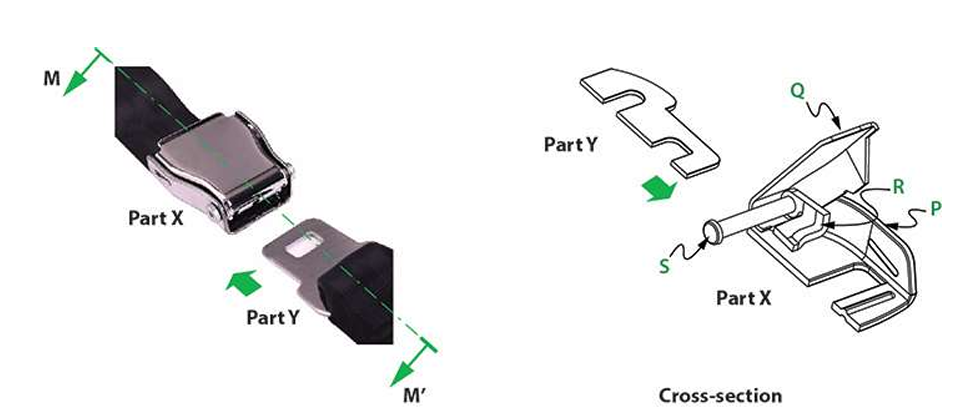
Answer: 1
Solution:
Part S is the component that returns the belt to its resting position after it's pulled. That return action only needs a single spring to store and release the tension, so one spring is enough to make the mechanism work.
Q.6. Sal tree seed moves in a particular manner, while free falling. Which toy(s) given below has/have a similar movement?
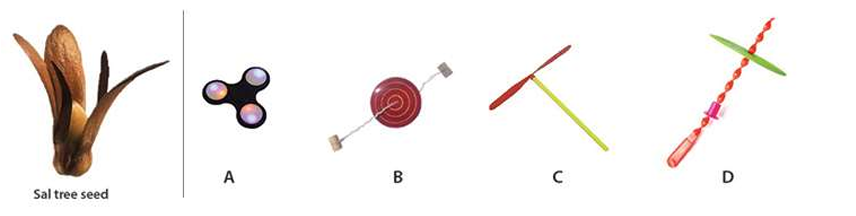
Answer: C, D
Solution:
A Sal seed is a winged seed: as it falls it spins and spirals downward - natural autorotation, like a tiny helicopter. The toys that move the same way are the ones that rotate and spiral as they drop: the propeller/whirligig toy (C) and the helical-rotor flying toy (D). A fidget spinner (A) and a spinning top (B) rotate, but they don't spiral through the air as they fall, so they don't match.
Q.7. A professional animation studio has created a paper cut-out model with movable joints as shown below. This is to be used for an animation feature film. Which material(s) will the studio use for the joints?
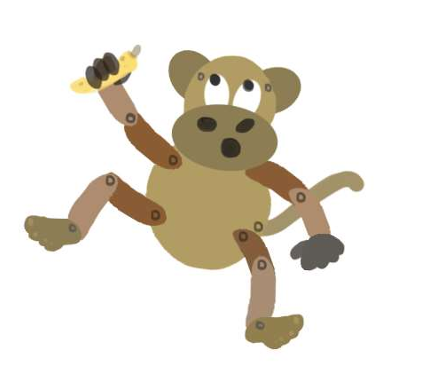
A. Nylon Wire B. Mouldable Clay C. Eyelet Rivet D. Chalk
Answer: A, C
Explanation:
A cut-out animation puppet needs joints that pivot smoothly and hold their pose frame after frame. An eyelet rivet (C) is the classic solution - it pins two paper parts together while still letting them rotate. Thin nylon wire (A) also makes a flexible, durable joint. Mouldable clay (B) is too soft to hold a repeatable position, and chalk (D) is brittle and can't form a working joint.
Read More: CEED 2027 Exam Pattern in Detail
CEED 2024 Part B Questions Analysis
|
Question Type |
Actual Question Breakdown |
Skills Tested |
Difficulty |
|
Sketching |
Q1: Draw a sequence showing a child attempting to lift a heavy toy box. The sketch had to depict the struggle, effort, body posture, and progression of actions through multiple frames. |
Human figure drawing, observation, body language, sequential sketching, visual storytelling |
Moderate |
|
Storytelling / Creativity |
Q2: Create a visual narrative using a character with a cube-shaped head. Candidates had to develop an engaging interaction or situation while maintaining consistency of the character throughout the story. |
Creativity, storytelling, imagination, character development, visual communication |
Moderate |
|
Visualization / Communication Design |
Q3: Design an ornamental wordmark by transforming a given word into a visually appealing typographic composition while maintaining readability. |
Typography, composition, visual sensitivity, communication design, aesthetics |
Moderate |
|
Form Sensitivity |
Q4: A three-dimensional geometric form was provided. Candidates had to transform it into a functional furniture design while preserving key characteristics of the original form. |
Form exploration, product design, spatial visualization, creativity, functional thinking |
Difficult |
|
Design Problem Solving |
Q5: Identify design-related problems in a rural kitchen environment and visually communicate practical solutions through sketches and annotations. |
Observation, empathy, user-centered design, problem identification, design thinking |
Difficult |
|
Communication |
Multiple questions required candidates to communicate ideas visually without relying heavily on text, including storytelling, typography, furniture design, and problem-solving tasks. |
Visual communication, clarity of thought, presentation skills |
Moderate to Difficult |
Check: CEED Eligibility 2026- Age Limit & Educational Qualification
CEED 2024 Cutoff & What Score You Needed?
A strong CEED 2024 attempt meant clearing the Part A qualifying cutoff first - only then is Part B evaluated. Use the paper to benchmark- if you can comfortably clear Part A under timed conditions, you're competitive. For category-wise qualifying marks, see the CEED cutoff analysis.
Top 10 Most Important Topics from CEED 2024
Students love this.
|
Rank |
Topic |
Questions Seen |
|
1 |
Visual Reasoning |
Very High |
|
2 |
Observation |
Very High |
|
3 |
Spatial Ability |
High |
|
4 |
Perspective |
High |
|
5 |
Product Understanding |
Moderate |
|
6 |
Design Awareness |
Moderate |
|
7 |
Storytelling |
Moderate |
|
8 |
Typography |
Moderate |
|
9 |
Form Development |
Moderate |
|
10 |
Problem Identification |
Moderate |
Check: CEED 2027 Expected Cut-off

1757510491.webp)
CEED 2024 vs CEED 2025 Question Paper: What Changed
In one line: CEED 2024 tested how well you see; CEED 2025 tested how well you think like a designer. Year on year, the paper got harder and more product-focused.
|
What changed |
CEED 2024 |
CEED 2025 |
|
Overall difficulty |
Moderate to difficult |
Harder, more time pressure |
|
Main focus |
Visual reasoning & observation |
Product design & real-world function |
|
Visualization |
Paper folding, perspective, cube stacks |
3D rotations, object reconstruction, shadows |
|
Design thinking |
Mostly in Part B |
Across the whole paper, including Part A |
|
Product awareness |
Light - toys, seat belts, gliders |
Heavy - mechanisms, ergonomics, manufacturing |
|
Reasoning style |
Visual pattern puzzles |
Analytical - assembly & mechanism logic |
|
Best-suited candidate |
Strong visual thinker & sketcher |
Visual skills + product sense + analysis |
What this means for you:
- 2025 leaned much harder into product design - mechanisms, ergonomics, manufacturing and usability.
- The exam moved away from pure visual puzzles toward real-world, functional design reasoning.
- 2024 rewarded strong visual thinkers; 2025 rewarded candidates who think like working designers.
Also Check: CEED Books 2027
CEED 2024 vs Previous Years (2022-2023)
|
Factor |
CEED 2022–2023 |
CEED 2024 |
|
Observation |
Tested primarily through pattern recognition, visual counting, hidden forms, shape identification, motion analysis, and image interpretation. Candidates mostly needed sharp visual attention and spatial accuracy. |
Observation became more contextual and design-oriented through image analysis, animation frames, seat-belt mechanisms, toy movements, visual storytelling, and real-world object interpretation. |
|
Visualization |
Strong emphasis on geometry, orthographic views, folding, cube manipulation, shadows, sectional views, transformations, and spatial puzzles. Most questions had a clear right or wrong answer. |
Visualization remained important but became more applied. Questions involved perspective understanding, bicycle assemblies, object stacking, paper cups, pixel shifts, and 3D-form interpretation rather than purely geometric exercises. |
|
Design Awareness |
Focused on ergonomics, accessibility, user-centered design, mechanisms, product functionality, interface design, and everyday design situations. Questions were present but relatively limited in number. |
Design awareness became noticeably stronger. Candidates were expected to understand animation production, traditional art forms, vehicle movement, material usage, transportation systems, and functional products. |
|
Creativity |
Creativity was tested mainly in Part B through sketching, storytelling, concept generation, and visual communication. Part A remained largely analytical. |
Creativity started blending with observation and interpretation. Even objective questions required candidates to think visually and connect design concepts with practical situations. |
|
Problem Solving |
Dominated by logical reasoning, mathematical thinking, mechanical puzzles, quantitative analysis, and structured problem solving. Many questions resembled aptitude-based challenges. |
Shifted toward design problem solving. Candidates had to understand systems, user interactions, movement, assembly logic, and product behavior rather than only solving abstract puzzles. |
|
Communication |
Mostly restricted to Part B where candidates expressed ideas through sketches, narratives, and design concepts. |
Greater emphasis on interpreting visual information and communicating design intent. Part B increasingly rewarded clarity of thinking and visual storytelling rather than only artistic skill. |
How CEED Evolved (2022 → 2023 → 2024)
CEED 2022 → Aptitude + Spatial Reasoning
CEED 2023 → Aptitude + Design Context
CEED 2024 → Observation + Design Awareness + Design Thinking
Toprankers CEED Preparation Tips 2026: Check Step Wise Preparation Strategy & Toppers tips
How to Use the CEED 2024 Question Paper Effectively
|
What To Do |
Why It Helps |
|
Timed Solving |
Attempt the complete CEED 2024 question paper under actual exam conditions (1 hour for Part A and 2 hours for Part B). This helps improve speed, decision-making, and time management. |
|
Mock Simulation |
Treat the paper like a real CEED exam. Avoid interruptions, follow the official pattern, and evaluate your performance honestly to identify readiness levels. |
|
Error Analysis |
Review every incorrect or skipped question. Identify whether mistakes came from weak observation skills, poor visualization, logical errors, or lack of design awareness. |
|
Sketching Practice |
Reattempt Part B questions and focus on improving sketch clarity, storytelling, visualization, and communication rather than artistic perfection. |
|
Compare with Recent Papers |
Study CEED 2022, 2023, 2024, and 2025 papers together to identify recurring themes in observation, design thinking, visualization, and problem-solving. This reveals how the exam is evolving and what skills IIT Bombay is prioritizing. |
Pro Tip:
Don't use the CEED 2024 paper only as a practice test. Use it as a diagnostic tool.
The biggest benefit comes from analyzing why you made mistakes and improving the underlying design skills that CEED consistently tests year after year.
Must-know: What is the Difference Between UCEED and CEED?
What CEED 2024 Reveals About IIT Bombay's Selection Criteria
This is the insight students actually want.
|
Skill |
Evidence from CEED 2024 |
Importance |
|
Observation |
Multiple image-based questions |
Very High |
|
Spatial Ability |
Folding, perspective, visualization |
Very High |
|
Design Thinking |
Rural kitchen problem, furniture design |
Very High |
|
Creativity |
Storytelling and character tasks |
High |
|
Sketching Quality |
Important but not enough alone |
Moderate |
|
Design Awareness |
Supporting role |
Moderate |
Check: CEED Previous Year Question Papers with Solutions
Who Should Solve the CEED 2024 Paper?
The CEED 2024 question paper is particularly valuable because it tests observation, visualization, design awareness, creativity, and problem-solving in a balanced manner.
It serves as an excellent benchmark for understanding modern CEED expectations.
|
Candidate Type |
How the CEED 2024 Paper Helps |
|
Beginners |
Provides a clear introduction to the CEED exam pattern, question formats, difficulty level, and the skills evaluated in Part A and Part B. |
|
CEED 2026 Aspirants |
Helps understand recent CEED trends, especially in observation, visual reasoning, design aptitude, and design thinking. |
|
CEED 2027 Aspirants |
Builds strong fundamentals early and exposes students to the types of creative and analytical challenges commonly seen in CEED. |
|
Design Students |
Strengthens visualization, communication, sketching, storytelling, product understanding, and user-centered design skills. |
|
Self-Preparing Candidates |
Acts as a reliable self-assessment tool for identifying strengths, weaknesses, and areas that need focused improvement. |
|
Repeat Aspirants |
Helps refine exam strategy, improve time management, and address recurring gaps in observation, creativity, and problem-solving. |
Download Other Past CEED Papers: (Year-Wise Papers & Their Deep Analysis)
Final Takeaway
The CEED 2024 question paper is one of the best resources for understanding modern CEED trends. It highlights the growing importance of observation, visualization, design awareness, creativity, and communication skills alongside traditional aptitude preparation.
By solving the CEED 2024 question paper PDF and analyzing its questions in depth, aspirants can develop stronger visual reasoning, design thinking, and problem-solving abilities.
For the best results, combine CEED 2024 sample question papers with recent papers such as CEED 2025 and CEED 2026 to identify evolving patterns and prepare more strategically for future exams.
Preparing for CEED 2027? We can help you with exact strategic roadmap, study material and crucial feedback required to ace this exam.
Join best CEED Online Coaching by Creative Edge and get expert guidance on all CEED subjects.



Frequently Asked Questions
Where can I download the CEED 2024 question paper PDF?

Was CEED 2024 difficult?
What questions were asked in CEED 2024?
Is CEED 2024 useful for CEED 2027 preparation?
What was asked in Part B?
Where can I find CEED 2024 question and answers?
How different was CEED 2024 from CEED 2025?
Are CEED sample papers enough for preparation?

Vineeta Agrawal
Communications Executive
SHARE