
1723534562.png)

AIBE 21 Preparation Strategy: 4‑Week & 8‑Week Roadmap, Mocks, Bare Acts and Exam‑Day Plan
February 25, 2026
Quick answer: If you can find an answer in 45 seconds during the exam, you don’t need to memorise it—you need a system to look it up fast. That’s the heart of this AIBE 21 Preparation Strategy for 2026.
- Why now? As per the Bar Council of India’s official schedule page, AIBE‑XXI (2026) is scheduled to be held on June 7, 2026, with registration starting on February 11, 2026. Keep an eye on the schedule and AIBE info pages for updates.
- What you’ll get: a realistic 4‑week intensive and 8‑week stretch plan, subject‑wise priorities, mock analytics, Bare Acts workflow, exam‑day tactics, and bilingual tips.
Here’s how to use this guide:
- Start with the exam pattern and syllabus weightage.
- Pick the 4‑week or 8‑week study roadmap.
- Implement the mock test analytics loop.
- Print the exam‑day checklist and final 7‑point revision sheet.
“I cleared AIBE XIX with 86/100 by treating Bare Acts as my GPS—tabs, an index, and a 2‑page Constitution map,” says a TopRankers learner from Delhi.
Let’s dive in.
Expert Guide: How to Clear the AIBE 21 Exam
Overview: AIBE 21 Exam Pattern and Marking Scheme (2026)
Here’s a crisp snapshot you can pin to your study desk. Use it to align practice with the AIBE 21 Exam Pattern 2026, AIBE 21 Paper Mode, and the AIBE 21 Marking Scheme.
|
Feature |
AIBE 21 Exam Pattern 2026 Snapshot
|
|
Paper mode |
Reportedly Offline (OMR) at designated centres; confirm latest AIBE 21 Paper Mode on BCI site |
|
Duration |
3 hours (180 minutes) |
|
Total questions |
100 MCQs (objective) |
|
Total marks |
100 |
|
Marking scheme |
+1 for correct; no negative marking (as per recent editions) |
|
Language options |
Multiple languages, including English and Hindi (verify centre‑wise availability) |
|
Open‑book allowances |
Bare Acts permitted without commentary/notes; carry only as per BCI notification |
|
Qualifying nature |
Pass/fail for Certificate of Practice (CoP) |
What this means for you:
- No negative marking = attempt every question.
- Open‑book with Bare Acts = train for “fast lookup” and precise bookmarks.
- 3 hours = strict time slicing and question triage are non‑negotiable.
Detailed Guide: AIBE Registration Process 2026
AIBE 21 Syllabus and Topic Weightage — prioritise high‑impact subjects
Below is a recommended AIBE 21 Syllabus weightage plan, blending official subject lists with practical scoring priorities. Use it to set targets and micro‑goals.
|
Subject |
Suggested Weightage |
Target Questions/Score |
Priority |
Micro‑goals (first to master)
|
|
Constitutional Law |
~10 Qs |
8–10 |
High |
Preamble, FRs (Arts 12–35), DPSP, federal structure, landmark cases index |
|
IPC (Substantive) |
~8 Qs |
6–8 |
High |
Definitions (s.21), general exceptions (chs IV), offences against person/property |
|
CrPC (Procedural) |
~10 Qs |
7–9 |
High |
Cognizable/non‑cognizable, bail, charge, trial flow, limitation |
|
CPC |
~10 Qs |
7–9 |
High |
Jurisdiction, pleadings, interim orders, res judicata, execution |
|
Indian Evidence Act |
~8 Qs |
6–7 |
High |
Admissions/confessions, burden of proof, presumptions, relevancy |
|
Professional Ethics & Cases |
~6 Qs |
5–6 |
Medium‑High |
BCI rules, contempt basics, leading precedents |
|
Drafting, Pleading & Conveyancing |
~6 Qs |
4–5 |
Medium |
Essential formats, essentials vs. particulars |
|
Public International Law |
~5 Qs |
3–4 |
Medium |
Sources, state recognition, treaties |
|
Family Law |
~5 Qs |
3–4 |
Medium |
Marriage, divorce, maintenance, guardianship |
|
IPR, Cyber, ADR |
~6–8 Qs |
5–6 |
Medium |
Trademarks, copyright basics, mediation, IT Act offences |
|
Labour & Industrial Law |
~5 Qs |
3–4 |
Medium |
EPF, ESI basics, ID Act definitions |
|
Taxation (Basics) |
~3–4 Qs |
2–3 |
Low‑Medium |
Constitutional basis, GST structure |
|
TPA & Contract |
~8–10 Qs |
6–8 |
High |
Essentials of contract, breach/remedies, sale/mortgage/lease |
|
Jurisprudence |
~3–4 Qs |
2–3 |
Low‑Medium |
Schools, rights/duties, liability |
Tip: Aim 65–70+ with high‑priority subjects to secure the CoP comfortably.
Essential resources: Best Books & Study Materials for AIBE 2026
Use this shortlist for theory clarity, MCQ practice, and rapid Bare Act lookups. Balance between English and Hindi resources where available.
|
Book/Resource |
Author/Publisher |
Purpose |
Best for |
Notes (incl. Hindi options)
|
|
Bare Acts (unannotated) |
Govt/Commercial editions |
Primary reference |
Everyone |
Keep pocket‑size + full‑size; label tabs in English/Hindi |
|
Universal’s Guide to AIBE |
Universal |
Theory + MCQs |
Beginners |
Broad coverage; cross‑verify with recent BCI updates |
|
AIBE Previous Year Papers |
Various |
Real exam feel |
All levels |
Solve in 3 hours; track lookup time per Q |
|
Quick Reference Compendium |
TopRankers (PDF) |
One‑page summaries |
Quick revision |
Constitution 2‑pager, CrPC flowcharts |
|
Objective on Indian Penal Code |
R. K. Gupta (example) |
Targeted MCQs |
IPC practice |
Pair with Bare Act sections |
|
Evidence Act – Q&A |
LexisNexis/Universal |
Section‑wise drills |
Evidence practice |
Hindi medium editions available |
|
Professional Ethics (MCQ) |
General guides |
High‑yield |
Final week |
Focus on BCI rules and case names |
|
Online Notes (Hindi/Eng) |
TopRankers Blog |
Bilingual micro‑notes |
Hindi learners |
“Section‑wise Hinglish” cues for recall |
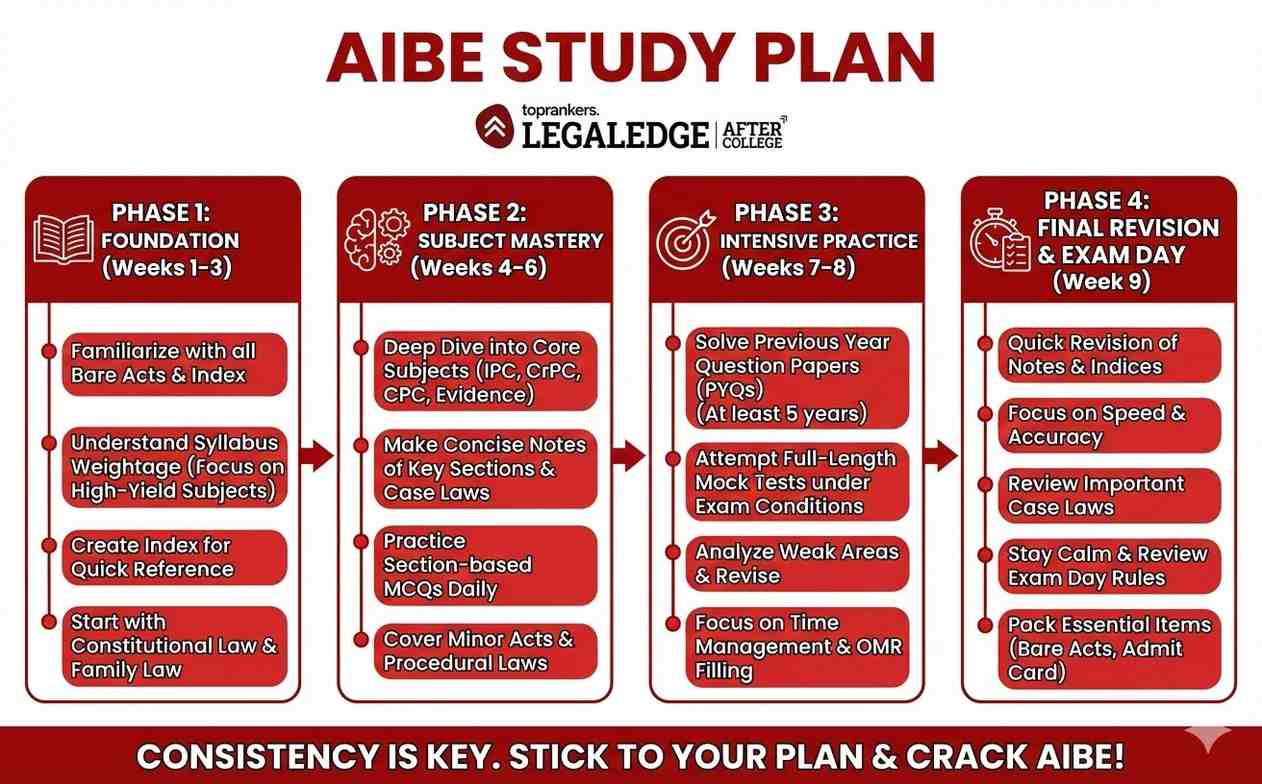
How to use Bare Acts effectively for AIBE 21:
- Create a master index (2–3 pages), colour‑code sections, and add blank tabs (no handwritten notes if disallowed).
- Maintain a “Top 50 sections list” for rapid lookup practice.
Section‑wise Strategy & How to Use Bare Acts Effectively
- Constitutional law
- Approach: Master FR/DPSP, federal provisions, amendment basics, and make a landmark case index (one‑liners + citation short codes).
- Example: 2‑page Constitution summary—Page 1: Arts 12–35 (FR), Page 2: DPSP + key amendments with mnemonics.
- IPC/CrPC
- Memorise vs lookup: Memorise general exceptions, key definitions, bail categories; lookup detailed sections on offences with tabs.
- Drill: “Charge‑to‑Judgment” flowchart for CrPC; practice 10 random section lookups daily.
- Civil law, evidence & specialised subjects
- Must‑do: CPC order/rule index; Evidence Act relevancy chart; Contract essentials with case anchors; TPA modes of transfer.
How to Use Bare Acts effectively for AIBE 21 (step‑by‑step):
- Build a master index (alphabetical + by section clusters).
- Add colour‑coded tabs (no annotations if disallowed) per chapter/theme.
- Create a Top‑50 section list; practise timed retrieval.
- Mark duplicate routes (e.g., “Hindu Marriage Act—Divorce—see s.13; Maintenance—see s.24/25”).
- Weekly audit: remove any non‑permitted markings.
Preparation Strategy — 4‑Week Intensive Plan (daily tasks + weekly milestones)
Here’s a practical 28‑day AIBE 21 Study Plan you can follow day‑by‑day. It includes mocks, Bare Acts drills, and weekly milestones.
Week‑by‑Week Milestones (at a glance)
- Week 1: Constitution, IPC basics, CrPC trial flow; 1 diagnostic mock.
- Week 2: CPC, Evidence, Contract/TPA; 1 sectional mock.
- Week 3: IPC/CrPC wrap‑up, Ethics, PIL/Family/IPR; 1 full mock.
- Week 4: Full revision, 2 full‑length mocks, error‑book polish.
“My turning point was an ‘error taxonomy’—I reduced lookup time from 75 to 48 seconds per question by Week 4,” shares a TopRankers alumnus from Pune.
4‑Week Plan: Day‑by‑Day Tasks
|
Day |
Tasks |
Outcome
|
|
1 |
Diagnostic Mock (100 Q, 3 hrs); Analyse by topic/time |
Baseline; identify top 5 weak areas |
|
2 |
Constitution: Preamble + FR/DPSP; Bare Act indexing Pg 1 |
Core map ready |
|
3 |
Constitution: Federalism + Amendments; Landmark cases list |
2‑page summary v1 |
|
4 |
IPC: General exceptions; Definitions; 50 MCQs |
IPC quick‑recall base |
|
5 |
CrPC: Arrest/Bail/Charge; Flowchart; 50 MCQs |
Procedure clarity |
|
6 |
Contract: Essentials, void/voidable; 40 MCQs |
Core contract rules |
|
7 |
Revision + Mini‑mock (50 Q); Hindi cues sheet update |
Week‑1 review |
|
Day |
Tasks |
Outcome
|
|
8 |
CPC: Jurisdiction + Pleadings; Bare Act tabs |
CPC anchor |
|
9 |
CPC: Interim orders + Execution; 40 MCQs |
Speed on CPC |
|
10 |
Evidence: Admissions/Confessions; 40 MCQs |
High‑yield set 1 |
|
11 |
Evidence: Burden/Presumptions; 40 MCQs |
High‑yield set 2 |
|
12 |
TPA: Sale/Mortgage/Lease; Contract revision |
Property quick refs |
|
13 |
Sectional Mock (CPC/Evidence/Contract) 60 Q; analysis |
Mid‑course correction |
|
14 |
Revision + Error log + Flashcards |
Retention boost |
|
Day |
Tasks |
Outcome
|
|
15 |
IPC offences (person/property); 60 MCQs |
IPC accuracy up |
|
16 |
CrPC trials; Limitation; 40 MCQs |
Procedure speed |
|
17 |
Professional Ethics; Case names list |
Ethics ready |
|
18 |
PIL/Int’l Law basics; Family Law; 40 MCQs |
Coverage breadth |
|
19 |
IPR/Cyber/ADR basics; 40 MCQs |
Score add‑ons |
|
20 |
Full Mock 1 (100 Q); analysis + redo 15 weak Qs |
Real‑feel practice |
|
21 |
Consolidated revision (top 8 subjects) |
Solidify core |
|
Day |
Tasks |
Outcome
|
|
22 |
Past Paper (timed 3 hrs); log lookup times |
Exam rhythm |
|
23 |
Bare Acts drill: Top 50 sections (time‑boxed) |
Lookup under 60s |
|
24 |
Weak topics deep‑dive + 60 MCQs |
Plug gaps |
|
25 |
Full Mock 2 (100 Q); analytics dashboard |
Accuracy tracking |
|
26 |
Error taxonomy: concept/lookup/time/careless |
Targeted fixes |
|
27 |
Final sweep: Constitution 2‑pager; CPC/Evidence keys |
Quick‑ref mastery |
|
28 |
Light revision + exam‑day kit check |
Ready to roll |
Hindi quick tips per week:
-
Week 1: “FR/DPSP ko Hinglish me 1‑liners banao” – e.g., Art 32 = “heart & soul: SC approach”.
-
Week 2: “CPC ke headings ko Hindi notes ke saath tabs lagao”.
-
Week 3: “IPC/CrPC rules ko mnemonic lines me convert karo”.
-
Week 4: “Bare Acts me only clean tabs—notes mat likho agar allowed nahi hai”.
Extended 8‑Week Plan for working professionals & deep revision
If you can spare 2–3 hours/day, use this AIBE 21 Study Plan with distributed mocks and spaced repetition—ideal for work‑study balance.
Weeks 1–2 (Foundations, ~2 hrs/day)
- Constitution (FR/DPSP, federalism), IPC basics, CrPC arrest/bail.
- Make 1‑page summaries per subject; start Bare Acts index.
Weeks 3–4 (Procedural mastery, ~2–2.5 hrs/day)
- CPC (jurisdiction, pleadings, interim orders), Evidence (admissions, burden).
- 2 sectional tests (30–50 Q each).
Weeks 5–6 (Coverage + practice, ~2.5–3 hrs/day)
- Contract/TPA, Family, PIL/Int’l, IPR/Cyber/ADR.
- 2 full mocks; error taxonomy; 1 past paper.
Weeks 7–8 (Polish + time drills, ~3 hrs/day)
- 2 full mocks (one per week); Bare Acts speed drills under 55 sec/Q.
- Final consolidation: Constitution 2‑pager, CPC/Evidence keys, Ethics case list.
Sample weekly timetable:
- Mon–Thu: 2 topics/day (60–70 mins each) + 20 MCQs.
- Fri: Revision + Bare Act lookup drill (30–40 mins).
- Sat: Sectional test (50–60 Q) + analysis.
- Sun: Light review + flashcards.
Mock Tests: Design, Frequency, Analytics and Improvement Loop
How many AIBE 21 Mock Tests and when?
- Diagnostic: 1 in Week 1 (baseline).
- Sectional: 3 across Weeks 2–3 (CPC/Evidence; IPC/CrPC; Contract/TPA).
- Full length: 4 in Weeks 3–4 (or Weeks 6–8 in extended plan).
Mock Test Analytics (build a simple dashboard):
|
Section |
Max Marks |
Score |
Accuracy % |
Time Spent |
Top Errors |
Lookup Time/Q |
Action
|
|
Constitution |
10 |
8 |
80 |
22 min |
Case recall |
40 sec |
Create 1‑pager case list |
|
CPC |
10 |
6 |
60 |
28 min |
Mixed up orders |
70 sec |
Add tabs for Orders 1–20 |
|
Evidence |
8 |
5 |
62.5 |
20 min |
Confession rules |
65 sec |
Revisit ss.24–30; 30 MCQs |
Post‑mock corrective loop:
- Day 1: Analyse by topic + error type (concept/lookup/time/careless).
- Day 2: Focused drills (30–40 MCQs + Bare Act speed).
- Day 3: Re‑test mini‑set (25–30 Q) only from weak areas.
- Goal: Push lookup under 55–60 sec/Q by the last week.
How to Use Previous Year Papers & Solving Strategy
- Selecting papers: Start with AIBE 20 and 19; map questions to subjects to spot recurring patterns.
- Timed practice (3 hours): Attempt in two passes—Pass 1 (sure shots + quick lookups), Pass 2 (longer lookups/uncertain).
- Review method: Categorise errors; create flashcards for repeated traps (similar sections, close options).
- Frequency: 1 paper/week in the last 3–4 weeks.
- Targets: 70–75 attempts in 120 minutes, then 25–30 attempts in the final 60 minutes; aim for 65–70+ correct by exam week.
How to crack AIBE 21 exam in 3 hours? Use this time‑slice plan:
- Minutes 0–20: Skim the whole paper; mark sure shots (S), quick lookups (Q), long lookups (L).
- Minutes 20–110: Solve all S and Q—target 70–75 questions.
- Minutes 110–160: Take the L set; cap each lookup at 75–90 seconds.
- Minutes 160–175: Recheck marked questions; fill all OMRs cleanly.
- Minutes 175–180: Final scan for missed bubbles, centre code, signature.
Quick lookup strategy:
- Keep Bare Acts in stacks by theme (Constitution, CrPC, CPC, Evidence, Contracts).
- Use a “two‑finger” method: one on the index, one on the section cluster.
- Abort if a lookup crosses 90 seconds—move on.
Question‑selection heuristics:
- Attempt all no‑negative‑marking MCQs.
- Prefer rule‑based over memory‑heavy questions early.
- Use elimination and statutory language cues (“shall” vs “may”).
Open‑book Rules, What to Carry and Exam Day Checklist
Exam‑day checklist
- AIBE 21 Admit Card + original photo ID
- Permitted Bare Acts (sorted, tabbed—no notes)
- Two black/blue pens, spare stationery
- Water bottle (transparent, if allowed by centre)
- Reporting time buffer: reach 45–60 minutes early
- Seat/room verification; fill OMR carefully (name, roll no., paper code)
Post‑Exam Steps: Certificate of Practice (CoP) & Result Follow‑up
- Result & scorecard: Check the AIBE page on barcouncilofindia.org for result updates.
- CoP Certificate of Practice After AIBE 21: After qualifying, BCI issues the CoP via the concerned State Bar Council process. Timelines vary; reportedly a few weeks post‑result, subject to document verification.
- Rechecking/revaluation: If available, follow the official window and fee as notified.
- Next steps: Use your CoP to begin independent practice, join a chamber, or specialise (e.g., ADR, IPR). Build a 90‑day plan: court visits, drafting drills, and client‑facing etiquette.
Read Detailed Guide: AIBE Exam Pattern 2026
Conclusion: 7‑point quick revision cheat‑sheet & final checklist
Here’s your final‑week action plan—print and pin it.
- Constitution 2‑pager: FR/DPSP + 10 landmark cases.
- CPC/Evidence keys: Orders 1–20, admissions/confessions/burden.
- IPC/CrPC: General exceptions + bail/charge/trial flowchart.
- Ethics: BCI rules + 10 case names.
- Top‑50 Bare Act sections: Lookup under 55–60 seconds.
- Two full mocks: Analyse, fix, re‑test 25 weak Qs.
- Exam kit ready: AIBE 21 Admit Card, ID, permitted Bare Acts, and pens.
Here's a detailed guide on the AIBE Application Form 2026.
Final dos and don’ts:
- Do attempt all questions—no negative marking helps.
- Don’t over‑annotate Bare Acts if disallowed.
- Do follow your time slices; don’t get stuck beyond 90 seconds on any lookup.
And guess what? If you execute this AIBE 21 Preparation Strategy with discipline for 4–8 weeks, you’ll walk in confident and walk out with your CoP path cleared. Ready to start? Save this page, set your Week‑1 tasks today, and take your diagnostic mock with TopRankers’ AIBE 21 Mock Tests.
Frequently Asked Questions
Is it possible to practice law without passing the bar exam?

When is the next AIBE scheduled to take place?
Is AIBE conducted online or offline?
Is AIBE an open book exam?
Is it possible for me to retake the AIBE exam?

Shayant Kumar Pathak
Communications Lead - Legal Edge After College
SHARE