


Maharashtra Judiciary 2026: Application Reopened, 286 Vacancies, Exam Date & Eligibility
November 3, 2026
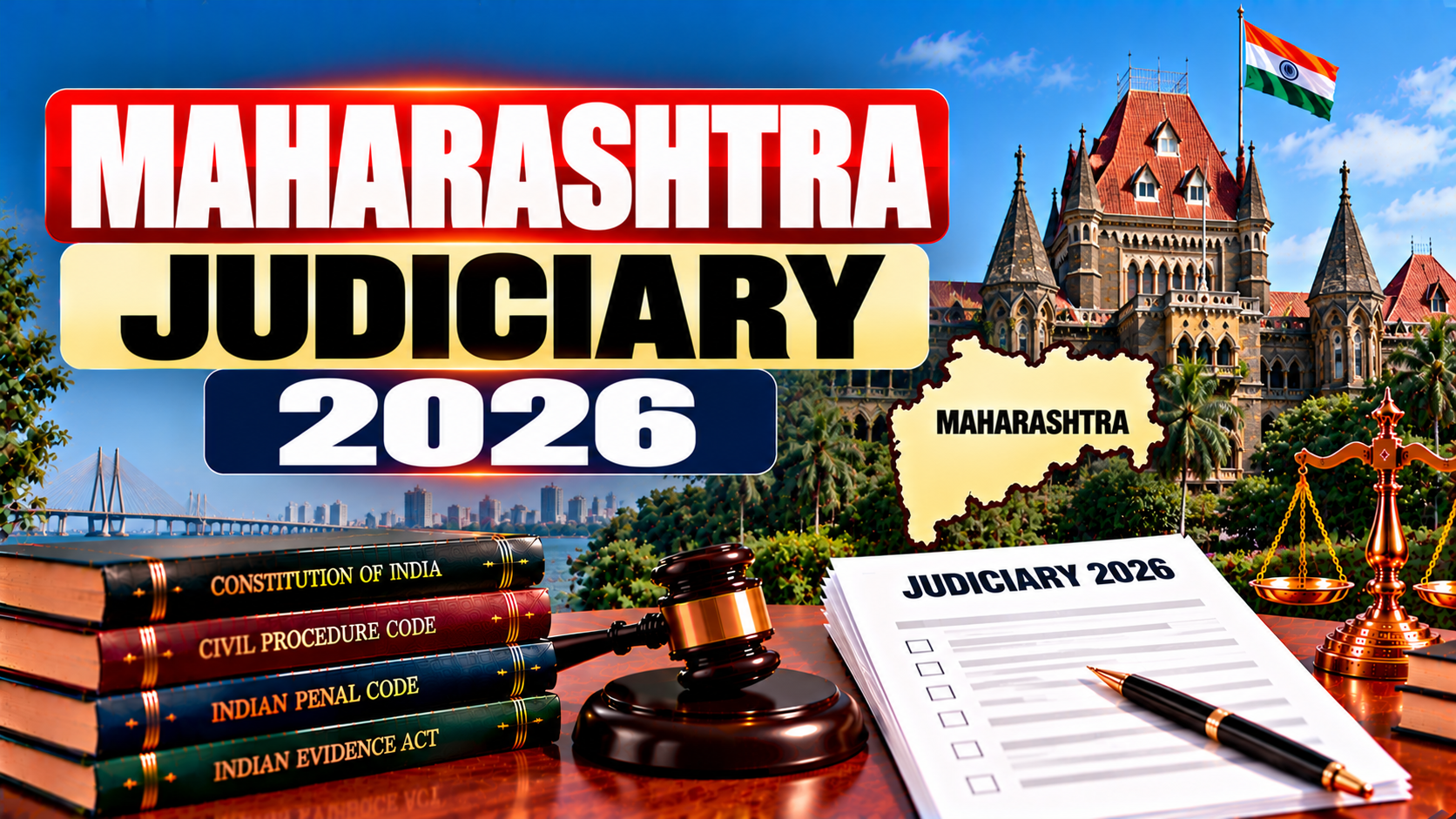
Maharashtra Judiciary 2026 is conducted by the Maharashtra Public Service Commission (MPSC) to recruit Civil Judge (Junior Division) and Judicial Magistrate First Class (JMFC) officers. MPSC has notified 286 vacancies under Advertisement No. 013/2026, released on 30 April 2026.
Latest Update: Under a corrigendum dated 23 October 2026, law graduates can now apply without a Certificate of Practice. Applications are open from 26 October to 9 November 2026, with online fee payment available until 12 November 2026.
- The prelims were scheduled for 2 August 2026 but were postponed. No new date has been announced.
- Prelims (qualifying), mains (200 marks) and interview (50 marks).
- A law degree, age 21 to 35 and knowledge of Marathi.
Maharashtra Judiciary Exam 2026 Notification Highlights
The important points of the Maharashtra Judiciary 2026 notification under Advertisement No. 013/2026 are mentioned below:
| Particulars | Details |
|---|---|
| Conducting Body | Maharashtra Public Service Commission (MPSC) |
| Posts | Civil Judge (Junior Division) & Judicial Magistrate First Class (one cadre) |
| Advertisement | No. 013/2026 (officially titled "Preliminary Examination 2024") |
| Total Vacancies | 286 |
| Notification Date | 30 April 2026 |
| Application Window | 1–21 May 2026; reopened from 8 July 2026; new law graduates: 26 October–9 November 2026. |
| Latest Update | Corrigendum dated 23 October 2026 for law graduates with a degree before 22 August 2025. |
| Prelims | Originally 2 August 2026; postponed, new date awaited |
| Selection Stages | Prelims (qualifying) → Mains (200 marks) → Interview (50 marks) |
| Application Fee | ₹394 (Open/EWS/Orphan), ₹294 (Backward Class/PwD); online payment only in the corrigendum window |
| Official Websites | mpsc.gov.in / mpsconline.gov.in |
Maharashtra Judiciary 2026 Vacancy
MPSC has notified 286 Maharashtra Judiciary vacancy post of Civil Judge (Junior Division) and Judicial Magistrate First Class (JMFC) under Advertisement No. 013/2026, making it one of the largest civil judge recruitments announced in 2026 so far.
In Maharashtra, one officer holds both designations. As a Civil Judge (Junior Division), the officer hears civil suits such as property, contract and tenancy disputes. As a JMFC, the same officer tries criminal cases and handles matters such as bail, remand and summons. Candidates selected through this exam therefore need a working command of both civil and criminal law from their first posting.
Maharashtra Judiciary Exam Date 2026
The prelims were earlier scheduled for 2 August 2026 and later they were postponed. No new Maharashtra Judiciary exam date has been announced. The fresh application window runs until 9 November and fee payment until 12 November.
| Event | Date | Status |
|---|---|---|
| Notification Released | 30 April 2026 | Done |
| Online Application | 1 May 2026 (2 pm) – 21 May 2026 (11:59 pm) | Closed |
| Fee via SBI Challan (Bank Branch) | Up to 25 May 2026 | Closed |
| Application Window Reopened | From 8 July 2026, until further orders | Check portal |
| Corrigendum for New Law Graduates | 23 October 2026 | Released |
| Online Application (New Law Graduates) | 26 October 2026 (2 pm) – 9 November 2026 (11:59 pm) | Open |
| Online Fee Payment (New Law Graduates) | Up to 12 November 2026 (11:59 pm) | Open |
| Prelims | Was 2 August 2026 (Sunday) | Postponed; new date awaited |
| Prelims Centres | Chhatrapati Sambhajinagar, Kolhapur, Navi Mumbai, Nagpur | As per notification |
| Admit Card | About a week before the new prelims date | Awaited |
| Mains | Announced after prelims result | Awaited |
| Interview | After mains result | Awaited |
Maharashtra Judiciary Eligibility 2026
MPSC has prescribed the Maharshtra Judiciary eligibility criteria for candidates and they need Indian citizenship, a law degree, the right age on 30 April 2026. Candidates also neeed knowledge of Marathi language.
| Requirement | What the Current Rules Say |
|---|---|
| Nationality | Must be a citizen of India. |
| Qualification | Bachelor’s degree in Law (LL.B.) from a recognised university. |
| Age Limit | 21–35 years for Open/EWS/Orphan candidates; up to 40 years for Backward Class/Divyang candidates. |
| Practice Rule | Minimum 3 years of legal practice for advocates. Eligible new law graduates are deemed to have completed 1 year of practice under the October 2026 corrigendum. |
| Ministerial Staff Exception | Maximum age of 45 years (50 years for eligible reserved categories), with at least 3 years of qualifying service after obtaining the law degree. |
Maharashtra Judiciary 2026 Application Form
The Maharashtra Judiciary application form is filled only online. There is no offline route. Candidate’s MPSC profile is reusable, so if you created one for any earlier MPSC exam, log in with it.
- If you’re applying as a new law graduate, check that your degree certificate is dated before 22 August 2025 before you begin.
- Log in or register on mpsconline.gov.in.
- Fill in personal, education, practice/service and category details. Use 30 April 2026 as the reference date for age and experience.
- Choose prelims centre and upload the documents in the size and format the portal asks for.
- Pay the fee online (debit card, credit card, net banking or UPI). In the 26 October to 9 November window, no challan option is available, so plan on paying online.
- Submit, then download the application and the fee receipt.
Application fee
| Category | Fee |
|---|---|
| Open / EWS / Orphan | ₹394 |
| Backward Class / PwD | ₹294 |
Documents to keep ready
- LLB degree certificate and mark sheets
- Bar Council enrolment certificate (provisional enrolment date matters)
- Practice or service certificate, if applicable
- Caste, domicile and non-creamy layer certificate (NCL valid for 2026-27) for reservation
- PwD certificate, if applicable
- Recent photograph and signature in the specified size
Maharashtra Judiciary 2026 Exam Pattern
Maharashtra Judiciary Exam Pattern is divided into three stages, and only two of them count towards the rank. Final merit = Mains (200) + Interview (50) = 250 marks. Prelims marks are not added in the final merit.
| Stage | Format | Marks | Duration | Counts in Merit? |
|---|---|---|---|---|
| Prelims | 100 objective MCQs, English medium, law subjects only | 100 | 2 hours | No, qualifying |
| Mains Paper I | Descriptive, civil law | 100 | 3 hours | Yes |
| Mains Paper II | Descriptive, criminal law + essay (approximately 800 words) | 100 | 3 hours | Yes |
| Interview (viva-voce) | Face-to-face, includes Marathi proficiency | 50 | — | Yes; minimum 40% (35% for PwD) |
Maharashtra Judiciary Syllabus 2026
The Maharashtra Judiciary 2026 notification lists both the old codes and the new criminal laws in every stage, so candidates need to learn the BNS, BNSS and BSA with a section-mapping to the IPC, CrPC and Evidence Act.
Maharashtra Judiciary Prelims Syllabus 2026
For Maharashtra Judiciary 2026 Prelims Syllabus these are the 13 subjects listed in Advt. 013/2026.
| Subject | Key Topics |
|---|---|
| Code of Criminal Procedure, 1973 | Arrest, bail, FIR and investigation, charge, trial procedure, appeals and revision |
| Bharatiya Nagarik Suraksha Sanhita, 2023 | Changes from CrPC, zero FIR, electronic summons, timelines for trial and judgment |
| Civil Procedure Code, 1908 | Jurisdiction, res judicata, pleadings, temporary injunctions, execution, appeals |
| Indian Evidence Act, 1872 | Relevancy, admissions, confessions, dying declaration, burden of proof, presumptions |
| Bharatiya Sakshya Adhiniyam, 2023 | Electronic records as evidence, renumbered provisions vs Evidence Act |
| Indian Penal Code, 1860 | General exceptions, offences against body and property, abetment, conspiracy |
| Bharatiya Nyaya Sanhita, 2023 | New offences (organised crime, mob lynching), community service, section mapping to IPC |
| Transfer of Property Act, 1882 | Sale, mortgage, lease, gift, doctrine of lis pendens, part performance |
| Specific Relief Act, 1963 | Specific performance, injunctions, declaratory suits, recovery of possession |
| Law of Contracts, Sale of Goods Act & Partnership Act | Offer and acceptance, consideration, void and voidable contracts, breach, conditions and warranties, firms |
| Limitation Act, 1963 | Limitation periods, Section 5 condonation of delay, acknowledgment, continuing wrongs |
| Constitution of India | Fundamental rights, writs, subordinate judiciary (Articles 233–237), DPSPs |
| Maharashtra Rent Control Act, 1999 | Protected tenancy, standard rent, grounds of eviction, landlord-tenant duties |
Maharashtra Judiciary 2026 Mains Syllabus
For Maharashtra Judiciary 2026 Mains Syllabus two descriptive papers of 100 marks each, 3 hours per paper, answerable in Marathi or English.
| Paper | Subject | Key Topics to Focus On |
|---|---|---|
| Paper I (Civil) | Civil Procedure Code | Suits, plaint and written statement, interim orders, decrees, execution, appeals |
| Paper I (Civil) | Transfer of Property Act | Transfers, mortgages, leases, easement-linked property questions |
| Paper I (Civil) | Specific Relief Act | Specific performance, rescission, injunctions |
| Paper I (Civil) | Law of Contracts, Sale of Goods Act, Partnership Act | Fact-based problems on formation, breach, damages, transfer of title, dissolution |
| Paper II (Criminal) | Indian Penal Code and Bharatiya Nyaya Sanhita, 2023 | Ingredients of offences, defences, punishment, comparative provisions |
| Paper II (Criminal) | Evidence Act and Bharatiya Sakshya Adhiniyam, 2023 | Admissibility, witness examination, documentary and electronic evidence |
| Paper II (Criminal) | CrPC and Bharatiya Nagarik Suraksha Sanhita, 2023 | Trial stages, bail, framing of charge, judgment writing in criminal cases |
| Paper II (Criminal) | SC & ST (Prevention of Atrocities) Act, 1989 and Protection of Civil Rights Act, 1955 | Offences, special courts, bail bar, presumptions |
| Paper II (Criminal) | Essay on a Current Legal Topic | About 800 words on a contemporary legal issue |
The Maharashtra Rent Control Act, 1999 and the Limitation Act comes only in the prelims list, yet both come up constantly in a junior civil judge's courtroom. National booklists usually skip the Rent Control Act; read the bare act closely. For a topic-wise breakdown, see the Maharashtra Judiciary syllabus.
Maharashtra Judiciary 2026 Interview Syllabus
For Maharashtra Judiciary 2026 Interview Syllabus, candidates need to prepare below mentioned things:
- Legal & Procedural Knowledge
- Current Legal Issues
- Judgment Writing
- Ethical & Judicial Aptitude
- Personality & Communication Skills
Maharashtra Judiciary 2026 Admit Card
MPSC will release the Maharashtra Judiciary admit card on mpsconline.gov.in about a week before the revised prelims date.
Steps to download the admit card 2026:
- Go to mpsconline.gov.in.
- Log in with the same MPSC profile and password you used to apply.
- Open your applications and select the Civil Judge Junior Division and JMFC Preliminary Examination.
- Download the admit card and take at least two printouts.
- Check your name, roll number, photograph, signature, exam centre and reporting time. Report any error to MPSC before exam day.
Maharashtra Judiciary 2026 Result
MPSC declares the Maharashtra Judiciary result in three stages. First comes a prelims list of candidates qualified for the mains, then a mains list of candidates called for the interview. Last is the final merit list on 250 marks, made up of mains (200) and interview (50). Prelims marks are not counted in the final score.
Steps to check the Maharashtra Judiciary result 2026:
- Go to the official website, mpsc.gov.in.
- Open the results section.
- Click the result link for the Civil Judge Junior Division and JMFC examination.
- Download the PDF and search for your roll number using Ctrl + F.
- Save a copy for later stages and document verification.
Candidates must score at least 40% in the interview (35% for PwD candidates). MPSC also keeps a waiting list of up to 10% of the posts, and the list stays valid for one year.
Maharashtra Judiciary 2026 Cut-off
MPSC has not published a clear, stage-wise cut-off for recent cycles, and the figures circulating online conflict with each other. This year’s cut-off will depend on the 286 vacancies, the number of applicants (likely higher after the corrigendum), the difficulty of the paper and your category. Negative marking of a quarter mark per wrong answer also makes accuracy important.
Aim for a prelims score well above the competition in your category, but remember that selection depends on the final cut-off on 250 marks. Solving previous year question papers under timed conditions will show you where your score stands.
Maharashtra Civil Judge Salary 2026
The Maharashtra Civil Judge Salary of a Maharashtra Civil Judge post at a basic pay of ₹77,840 (Level J-1) Per Month. Also, in-hand salary incorporates various perks and remittances like:
| Particulars | Details |
|---|---|
| Pay Level | Level J-1 |
| Entry Basic Pay | ₹77,840 per month |
| Pay Scale | ₹77,840–₹1,36,520 |
| Dearness Allowance (DA) | As per the applicable rate, revised periodically |
| House Rent Allowance (HRA) | Official accommodation or HRA, depending on posting |
| Travel Allowance (TA) | As per government rules |
| Medical Allowance | ₹1,000 per month, plus medical facilities |
| Sumptuary Allowance | ₹1,500 per month |
| Approximate Gross Salary | ₹1.13 lakh per month |
| Approximate In-Hand Salary | ₹90,000–₹95,000 per month |
How to Prepare for Maharashtra Judiciary 2026
The postponement is extra time, and the candidates who use it on the mains will gain the most. Prelims only gets you through the door; your rank is made in two descriptive papers and a 50-mark interview.
- Begin with CPC, the BNSS/CrPC and the BNS/IPC. Prelims questions are often lifted straight from section language, especially provisos and time limits.
- Make a one-page map of IPC → BNS, CrPC → BNSS and Evidence Act → BSA; section numbers save hours later.
- Practice 2 mains answers a day, timed. Frame the issue, cite the section, apply it to the facts, conclude.
- Keep a glossary of legal terms in Marathi (वादी, प्रतिवादी, मनाई हुकूम). Even if you write mains in English, the interview checks your spoken Marathi.
- The Maharashtra Rent Control Act and the Limitation Act are easy marks most out-of-state candidates leave on the table.
- Use the weeks between the announcement and the exam for timed 100-question mocks and accuracy drills, given the one-fourth negative marking.
- Recurring question types are easy to spot once you have done three or four years.
More detail on a month-by-month plan: Maharashtra Judiciary preparation tips.
Key Takeaways
Here’s a quick summary of Maharashtra Judiciary 2026:
- MPSC has notified 286 vacancies for Civil Judge (Junior Division) & JMFC under Advertisement No. 013/2026, one of the largest civil judge recruitments of 2026.
- New law graduates with a degree dated before 22 August 2025 can apply from 26 October to 9 November 2026 without a Certificate of Practice.
- The prelims, originally scheduled for 2 August 2026, has been postponed, and a new date is awaited.
- Final selection depends on mains (200 marks) and interview (50 marks); prelims is qualifying only.
- A selected candidate starts at a basic pay of ₹77,840 per month (Level J-1), with in-hand pay of about ₹90,000–₹95,000.
If you want a structured guidance, take a free demo online class or talk to a Judiciary Gold counsellor about the course.

Download Judiciary Study Material
Fill your details
Frequently Asked Questions
How many months do I need to prepare for Maharashtra Judiciary 2026?

Do prelims marks count in the Maharashtra Judiciary final merit list?
Can I apply without any prior experience as a lawyer?
What is the Maharashtra Judiciary exam date for 2026?
How many stages are included in selection of candidates for Maharashtra Judiciary Exam 2026?
Do new law graduates need a Certificate of Practice?
What is the Maharashtra Judiciary exam pattern 2026?
Do prelims marks count in the final merit?
Can I write the mains in Marathi for Maharashtra Judiciary 2026?
Is the Maharashtra Judiciary exam 2026 notification still open for applications?

Nancy Mahavir Sharma
Legal Writer
SHARE