


Maharashtra Judiciary Preparation 2026: Tips and Strategies
November 2, 2026
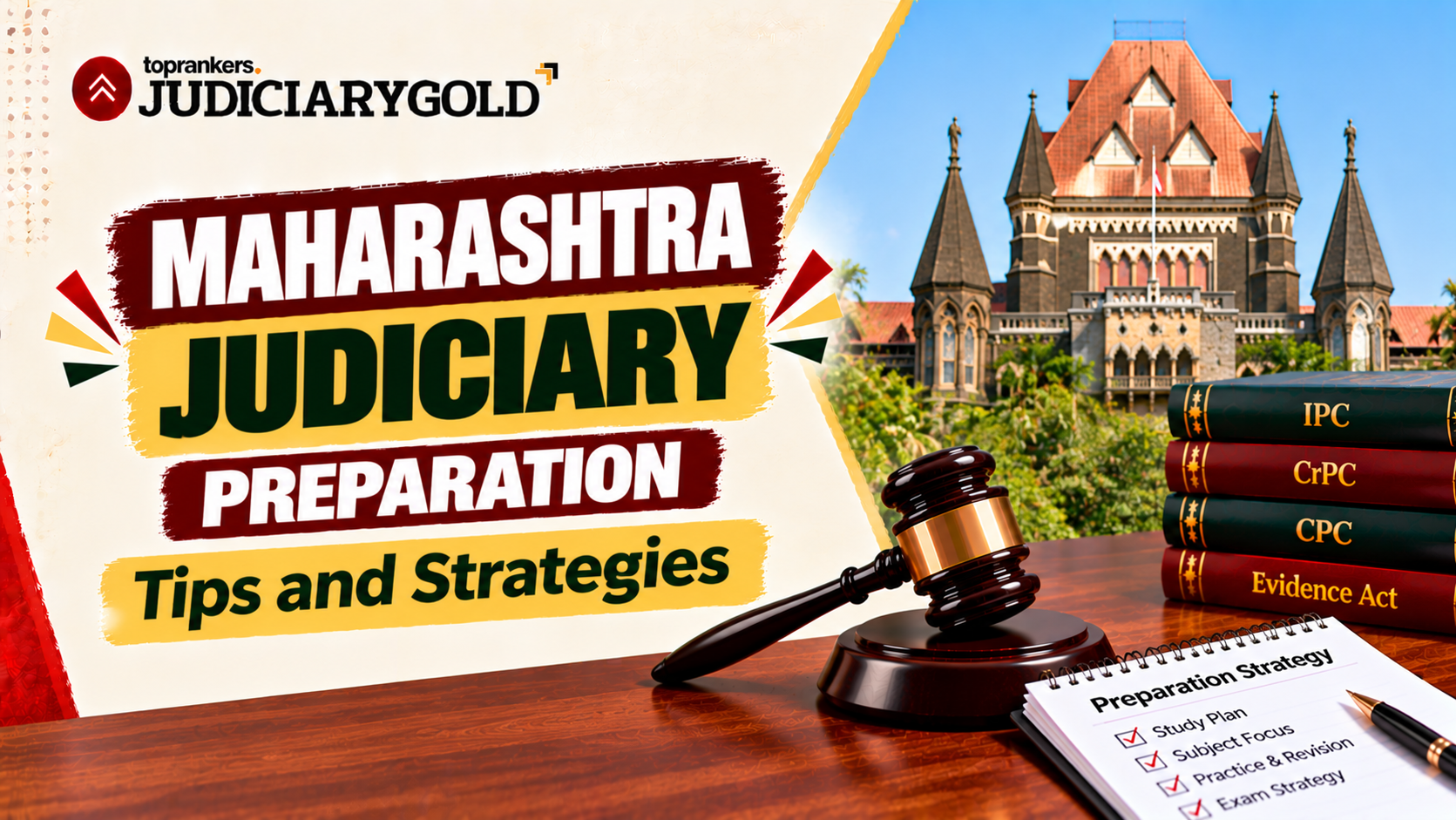
The best Maharashtra Judiciary preparation starts with the mains, not the prelims. Final selection for Civil Judge (Junior Division) and Judicial Magistrate
- First Class (JMFC) is decided only by the two descriptive mains papers (200 marks) and the interview (50 marks).
- The prelims is a qualifying screening.
So candidates need to build depth in civil and criminal law first, learn the new criminal codes alongside the old ones and practise writing answers with the MCQ mock test from week one.
Maharashtra Judiciary 2026 Overview
The MPSC has released Maharashtra Judiciary 2026 notification for 286 posts of Civil Judge (Junior Division) and JMFC under Advertisement No. 013/2026.
The prelims was scheduled for 2 August 2026 but was postponed, and no new date has been announced yet. Under a corrigendum dated 23 October 2026, MPSC reopened applications for eligible new law graduates from 26 October to 9 November 2026, with online fee payment allowed until 12 November 2026.
How to Prepare for Maharashtra Judiciary 2026: 8 Tips That Matter Most
1. Plan from the mains backwards
Most subjects in the prelims also appear in the mains. If you study CPC or the BNSS well enough to write a 15-mark answer on it, you will handle the MCQs on it too.
The reverse does not hold: MCQ practice alone will not teach you to frame issues and apply sections in writing. Spend roughly 70% of your first 16 weeks on mains-level reading and writing.
2. Learn old and new criminal laws side by side
The Bharatiya Nyaya Sanhita (BNS), Bharatiya Nagarik Suraksha Sanhita (BNSS) and Bharatiya Sakshya Adhiniyam (BSA) replaced the IPC, CrPC and Evidence Act from 1 July 2024.
The Maharashtra mains syllabus lists them in pairs (IPC/BNS, CrPC/BNSS, Evidence Act/BSA), so you need both.
Keep a one-page mapping sheet for each pair. Every time you read an IPC section, write the matching BNS section next to it. After a month, the mapping becomes automatic, and you stop losing marks for citing a repealed section number in a fact problem.
3. Don't skip the Maharashtra-specific laws
This is where Maharashtra differs from other states. The Maharashtra Rent Control Act, 1999 appears in the prelims syllabus, and tenancy and eviction disputes are routine work for a junior civil judge in the state.
National booklists rarely cover it. Read the bare Act itself, with special attention to protected tenancy, standard rent and grounds of eviction.
Paper II also includes two special Acts that many candidates treat lightly: the Scheduled Castes and Scheduled Tribes (Prevention of Atrocities) Act, 1989 and the Protection of Civil Rights Act, 1955. They are short. Fewer candidates prepare them properly, which makes them good scoring areas.
4. Write answers from the first week
Descriptive papers reward structure as much as knowledge. Use a simple frame for every answer: state the issue, cite the provision, apply it to the facts, and conclude. Start with one timed answer a day in weeks 1 to 4, then move to two or three a day.
Get your answers checked by someone who knows the subject. Self-assessment of a law answer is unreliable because you read what you meant to write, not what you wrote.
5. Build Marathi drafting early if your LLB was in English
Candidates must be able to read, write and speak Marathi, and mains answers can be written in Marathi. Even if you plan to write in English, expect Marathi to come up at the interview stage.
Keep a legal glossary in Marathi from day one. Terms like वादी (plaintiff), प्रतिवादी (defendant) and मनाई हुकूम (injunction) should feel natural before the mains. Once a week, write one full answer in Marathi and get it checked for both law and language.
6. Use previous papers before you buy more books
Solve the Maharashtra Judiciary previous year question papers in week 2, not week 20. Three or four years of papers show you which sections are asked repeatedly, how deep the questions go and how much time a Paper I problem actually takes.
Then read the Maharashtra Judiciary exam analysis to see how recent papers were set.
7. Treat the essay as a separate skill
The Paper II essay is about 800 words on a contemporary legal topic. Practise one essay a week from week 9. Good themes to prepare include the new criminal laws, e-courts and virtual hearings, bail reform, the rights of undertrials and gender justice.
Following daily legal current affairs for 20 minutes a day gives you material for both the essay and the interview.
8. Prepare the interview as seriously as written exam
The interview carries 50 marks and has a minimum qualifying mark of 40%, so a weak interview can cost you selection even after a strong mains. The panel is not only judging personality.
Expect questions on core law, recent judgments, your practice experience and how you would handle a situation as a judicial officer. Mock interviews with honest feedback help more than reading lists of "common questions".
Maharashtra Judiciary Study Plan: 24 Weeks
Candidates can implement this plan as it assumes 6 to 7 hours of study a day. If you want to qualify the Maharashtra Judiciary 2026 exam then see the structured plan in the below table.
| Weeks | Civil Law Focus | Criminal Law Focus | Writing and Practice |
|---|---|---|---|
| 1–4 | CPC (Part 1: jurisdiction, res judicata, pleadings), Contract Act | BNS with IPC mapping (general exceptions, offences against the body) | 1 timed answer a day; solve 1 previous paper to see the level |
| 5–8 | CPC (Part 2: interim orders, decrees, execution, appeals), Transfer of Property Act | BNS (offences against property), BNSS with CrPC mapping (arrest, bail, FIR) | 2 answers a day; start the mapping sheet revision every Sunday |
| 9–12 | Specific Relief Act, Sale of Goods Act, Partnership Act | BNSS (trial, charge, judgment), BSA with Evidence Act mapping | 2–3 answers a day; 1 essay a week; 1 Marathi answer a week |
| 13–16 | Maharashtra Rent Control Act, Limitation Act, Constitution of India | SC/ST (Prevention of Atrocities) Act, Protection of Civil Rights Act | First full-length Paper I and Paper II under exam time |
| 17–20 | Bare Act revision of all civil subjects | Bare Act revision of all criminal subjects | 100-question prelims mock twice a week; error log after each |
| 21–24 | Final revision from your own notes | Final revision with mapping sheets | Prelims mocks every other day; 1 full mains paper a week |
Maharashtra Judiciary 2026 Prelims Strategy
The prelims tests recall of bare-act language under time pressure. Questions often turn on a proviso, a time limit or one word in a section, so reading the bare Act matters more here than reading commentaries.
How to handle negative marking
Each wrong answer costs a quarter mark. Assuming four options per question, here is what a guess is worth on average:
| Your Position on a Question | Average Marks from Guessing |
|---|---|
| No idea, all four options look possible | +0.06 (close to nothing) |
| You can rule out one option | +0.17 |
| You can rule out two options | +0.38 |
So blind guessing gains you almost nothing, but a guess after eliminating even one option is worth taking.
Prelims startegy for the last 8 weeks
- Take full 100-question mocks under a 2-hour timer. The Judiciary mock test series gives you timed papers with performance analysis.
- Revise the Limitation Act schedule and the Rent Control Act definitions twice in the final fortnight. These are short, factual and easy to forget.
- Download your Maharashtra Judiciary admit card as soon as it is released and check your centre details.
Maharashtra Judiciary 2026 Mains Strategy
The mains Maharashtra Judiciary syllabus is where your rank is made. Paper I covers the Civil Procedure Code, Transfer of Property Act, Specific Relief Act, Law of Contracts, Sale of Goods Act and Partnership Act. Paper II covers the IPC/BNS, Evidence Act/BSA, CrPC/BNSS, the SC/ST (Prevention of Atrocities) Act, the Protection of Civil Rights Act and an essay.
Three habits separate high-scoring scripts from average ones:
- Cite precisely - "Section 9 CPC" earns more than "the CPC provides". For criminal law, cite the new section and add the old one in brackets until you are sure the examiner expects only one.
- Use case law sparingly but correctly - One leading judgment, correctly named and applied, is worth more than three half-remembered ones.
- Finish the paper - An unanswered question scores zero. In your timed practice, set a fixed time per mark (about 1.5 to 1.8 minutes per mark in a 3-hour, 100-mark paper) and move on when the time is up.
Best Books for Maharashtra Judiciary 2026 Preparation
Candidates can use the bare Act for every subject, and one standard book per major subject.
| Subject | Commonly Used Text |
|---|---|
| Civil Procedure Code | C.K. Takwani, Civil Procedure; Mulla, Code of Civil Procedure (for depth) |
| Contract and Specific Relief | Avtar Singh, Law of Contract and Specific Relief |
| Transfer of Property Act | Mulla, Transfer of Property Act; R.K. Sinha for a shorter read |
| IPC / BNS | Ratanlal & Dhirajlal or K.D. Gaur (BNS-updated editions) |
| Evidence Act / BSA | Batuk Lal, Law of Evidence (BSA-updated edition) |
| CrPC / BNSS | Ratanlal & Dhirajlal, Code of Criminal Procedure (BNSS-updated edition) |
| Constitution of India | M.P. Jain, Indian Constitutional Law, or J.N. Pandey for revision |
| Maharashtra Rent Control Act, SC/ST Act, PCR Act, Limitation Act | Latest bare Acts |
Maharashtra Judiciary Exam Pattern 2026
The Maharashtra Judiciary exam pattern has three stages, and only two of them count towards your rank. Knowing this changes where your hours should go.
| Stage | Format | Counts in Final Merit? |
|---|---|---|
| Prelims | 100 objective MCQs, English medium, 1/4 mark negative marking | No, qualifying only |
| Mains Paper I | Descriptive, civil law | Yes |
| Mains Paper II | Descriptive, criminal law and special Acts, plus an essay of about 800 words | Yes |
| Interview | Viva-voce; minimum 40% (35% for PwD candidates) | Yes |
Candidates can check the Maharashtra Judiciary eligibility criteria after going through the exam pattern.
Common Mistakes in Maharashtra Judiciary 2026 Preparation
- Treating the prelims as the main event. Its marks are not added to your final score.
- Studying only the IPC, CrPC and Evidence Act. The syllabus lists the new codes too.
- Using a national booklist without checking the state syllabus. The Rent Control Act is the subject most often missed.
- Leaving Marathi for later. Legal writing in Marathi is a different skill from speaking it at home.
- Collecting books instead of solving papers. One commentary per subject, revised three times, beats three commentaries read once.
- Waiting for the prelims result to start mains preparation. By then, the gap is usually too short for proper answer writing.
Should You Join Coaching for Maharashtra Judiciary 2026?
Candidates can clear the exam through self-study if you have a fixed plan and someone to evaluate your main answers. That second part is where most self-study plans break down.
If you want structured classes, answer evaluation and mock interviews in one place, look at the Judiciary Gold online judiciary coaching programme, or take the Judiciary Gold scholarship test to check your current level first.
Key Takeaways
Here is a quick summary of the Maharashtra Judiciary 2026 Preparation Tips and how the exam works:
- Final selection depends on mains (200) and interview (50); the prelims only qualifies you.
- Study old and new criminal laws together with a section-mapping sheet.
- Add the Maharashtra Rent Control Act and the two Paper II special Acts to your plan early.
- Write answers from week one and get them checked.
- Build Marathi legal vocabulary steadily rather than at the end.
- Keep the last eight weeks for prelims mocks, and move them forward if MPSC announces an early date.

Download Judiciary Study Material
Fill your details
Frequently Asked Questions
How many months do I need to prepare for Maharashtra Judiciary 2026?

Do prelims marks count in the Maharashtra Judiciary final merit list?
Can I apply without any prior experience as a lawyer?
What is the Maharashtra Judiciary exam date for 2026?
How many stages are included in selection of candidates for Maharashtra Judiciary Exam 2026?
Is the Maharashtra Rent Control Act important for the exam?
Is there negative marking in the Maharashtra Judiciary prelims?

Nancy Mahavir Sharma
Legal Writer
SHARE