
1723534562.png)

CLAT PG 2027 Notification Out, Exam Date, Registration Process & Latest Updates
August 5, 2026
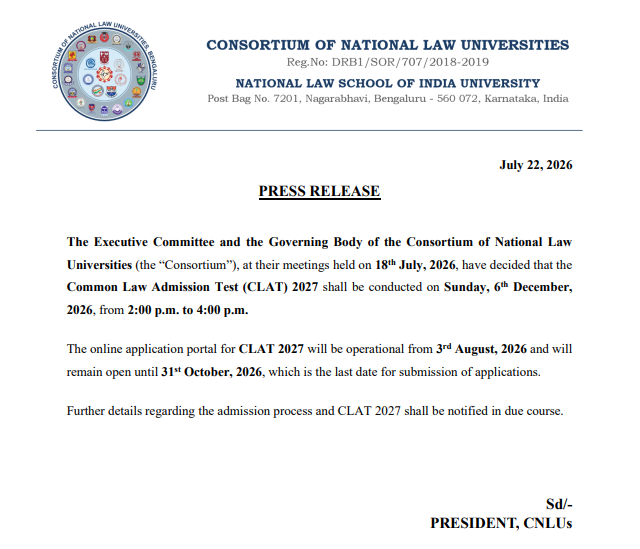
CLAT PG 2027 registration is now open at consortiumofnlus.ac.in. The application window opened on 3rd August 2026 and closes on 31st October 2026. The exam will be held offline on Sunday, 6th December 2026, from 2:00 PM to 4:00 PM.
CLAT PG 2027 (Common Law Admission Test – Postgraduate, also called CLAT LLM) is the national-level entrance exam conducted by the Consortium of NLUs for admission to LLM programs at 26 National Law Universities and IIULER Goa.
CLAT PG scores are also used by PSUs such as ONGC, IOCL and NTPC to recruit legal officers, and a valid score is required for the Indian Army's JAG entry scheme.
CLAT PG 2027 Notification at a Glance
- The CLAT 2027 notification was released by the Consortium of NLUs on 22nd July 2026; it covers both UG and PG (LLM) admissions.
- According to the notification CLAT PG registration is open from 3rd August to 31 October 2026.
- CLAT PG Exam 2027 is scheduled for 6th December 2026, from 2:00 PM to 4:00 PM. It will be an offline (pen-and-paper) exam.
- Clearing CLAT PG will help you get admission to 26 NLUs and IIULER Goa. These scores are also used for PSU legal officer recruitment and the Army's JAG entry.
The official notification PDF details eligibility, application steps, exam pattern, syllabus, fees, reservation and counselling. Read it fully before applying to avoid form errors that cannot be corrected after payment.
CLAT PG 2027 Highlights
Here are the most important highlights of CLAT PG 2027 according to the official notification.
| Particulars | Details |
|---|---|
| Full Form | Common Law Admission Test - Postgraduate (CLAT LLM) |
| Conducting Body | Consortium of National Law Universities |
| Notification Status | Released (22nd July 2026) |
| Exam Date | Sunday, 6th December 2026 |
| Exam Timing | 2:00 PM – 4:00 PM (single shift) |
| Exam Frequency | Once a year |
| Exam Level | National |
| Application Mode | Online (open 3rd Aug – 31st Oct 2026) |
| Exam Mode | Offline (pen-and-paper, OMR) |
| Duration | 2 hours |
| Participating Universities | 26 NLUs + IIULER Goa |
| Official Website | consortiumofnlus.ac.in |
What Does the CLAT PG 2027 Notification PDF Contain?
Along with the exam date, the official CLAT PG notification released on 22nd July 2026 includes all the important details regarding the exam. Here's what you need to know:
| Section | Details Included |
|---|---|
| Eligibility Criteria | Qualifying degree, minimum marks, final-year rules |
| Application Process | Registration steps and form-filling instructions |
| Important Dates | Registration, admit card, exam, counselling timeline |
| Exam Pattern | Question count, marking scheme, duration |
| Syllabus | Subject coverage for the PG paper |
| Application Fee | Category-wise fee structure (₹4,000 / ₹3,500) |
| Documents Required | Photograph, signature, category certificates |
| Reservation Policy | Category-wise reservation framework (NLU-wise seat matrices follow with counselling) |
| Counselling Process | Merit list, preference locking, seat allotment |
| General Instructions | Exam-day rules and candidate guidelines |
CLAT PG Registration Process 2027
CLAT PG registration 2027 opened on 3rd August 2026 at consortiumofnlus.ac.in and will close on 31st October 2026. The application fee is ₹4,000 for General/OBC/NRI candidates and ₹3,500 for SC/ST/BPL candidates. Final-year LLB students are eligible to apply.
The CLAT PG registration process 2027 is fully online and takes about 30-40 minutes if your documents are ready. Follow the give steps to successfully register for CLAT PG 2027:
Step 1- Register: Create your account with a working email ID and mobile number (verified by OTP).
Step 2 - Fill in the Details: Complete the application with personal, academic and exam-city preferences.
Step 3 - Upload Documents: Passport-size photograph, signature, and category/BPL/PwD certificates (PDF) if applicable.
Step 4 - Pay the application fee online
Before you hit submit, here are 5 things that disqualify or cost candidates every year. Take care of these mistakes:
- Spelling errors in your name or your parents' names can lead to rejection of candidature. Type exactly as per your certificates.
- After fee payment, no edits are allowed in the program (UG/PG), category, or BPL fields.
- If you submit multiple forms, only the last one counts and earlier fees are not refunded.
- Keep scanned copies of your documents ready before you start: photograph (recent, plain background), signature, and category certificates in PDF.
- Pay on a stable connection; a failed transaction close to 31st October can cost you the attempt.
CLAT PG Application Fee 2027
| Category | Application Fee |
|---|---|
| General / OBC / NRI / PIO / OCI | ₹4,000 |
| SC / ST / BPL | ₹3,500 |
Who is Eligible for CLAT PG 2027?
Before you apply, confirm you meet the CLAT PG eligibility criteria as mentioned by Consortium. The eligibility conditions include:
| Criteria | Requirement |
|---|---|
| Educational Qualification | 3-year LLB or 5-year integrated LLB from a recognized university |
| Minimum Marks | 50% for General/OBC/NRI/PIO/OCI; 45% for SC/ST/PwD (as per recent Consortium notifications) |
| Final-year Students | Eligible - must furnish proof of passing at the time of admission |
| Age Limit | None (no lower or upper age limit) |
- Can final-year LLB students apply? Yes. Final-year LLB students can apply, provided they submit evidence of passing the qualifying degree at the time of admission.
- Is there an attempt limit? No. You can attempt CLAT PG as many times as you wish.
CLAT PG Reservation Policy 2027
Reservation in CLAT PG admissions works differently from most national exams. There is no common all-India reservation matrix. Each participating NLU applies its own reservation policy according to its state's rules. What stays uniform is how you claim it:
| Reservation Type | How It Applies in CLAT PG |
|---|---|
| Vertical (SC / ST / OBC / EWS) | Applied NLU-wise; percentages vary by university and state policy |
| PwD (Persons with Disability) | Horizontal reservation across categories, per each NLU's norms |
| State Domicile Quotas | Most NLUs reserve a share of seats for candidates domiciled in their state |
| Other Horizontal Categories | Some NLUs provide quotas for women, wards of defence personnel, etc. |
Which college you get selected at, depends on your score and your CLAT PG counselling.
CLAT PG Exam Pattern 2027
CLAT PG 2027 is a 2-hour offline exam with 120 passage-based objective questions worth 1 mark each. There is negative marking of 0.25 per wrong answer and no sectional division. The paper draws 20-24 passages from primary legal materials like landmark judgments, acts and regulations with 4-6 questions per passage.
Here are the most important CLAT PG exam pattern highlights for 2027 exam:
| Particulars | Details |
|---|---|
| Mode | Offline (OMR) |
| Medium | English |
| Duration | 2 hours (2 PM to 4 PM) |
| Question type | Passage-based MCQs |
| Total questions / marks | 120 / 120 |
| Marking | +1 correct; −0.25 incorrect; 0 unattempted |
| Sections | None (single integrated paper since 2021) |
| Passages | 20-24 passages, 4-6 questions each |
CLAT PG 2027 - What's New This Year?
The Consortium has constituted an Expert Committee, chaired by Justice (Retd.) Indu Malhotra, to review the examination process and recommend reforms for both the UG and PG exams.
The committee includes eminent law professors from institutions such as Oxford, LSE, Columbia, Cambridge and BML Munjal University. Its mandate covers strengthening transparency, question quality and fairness across every stage of the exam.
What this means for your CLAT PG 2027 preparation:
- The CLAT PG exam pattern and syllabus for 2027 stand unchanged. The Consortium has confirmed the existing 120-question, passage-based format continues this cycle. Do not restructure your preparation around rumoured changes.
- Expect tighter question quality. The committee's remit follows the answer-key disputes of recent cycles. Cleaner, less contestable passages and keys are likely to be implemented.
- Any reform the committee recommends will be announced on consortiumofnlus.ac.in before it applies. Treat social-media claims of pattern changes as noise; we update this page the same day for every official announcement.
Beyond the committee, the 2027 notification continues the Consortium's push for clearly defined timelines, standardised admission procedures across participating NLUs, and better candidate communication through the official portal.
CLAT PG Syllabus 2027
The paper tests the substantive law you studied during your LLB. The CLAT PG syllabus 2027 covers:
- Constitutional Law (highest weightage, every year)
- Jurisprudence
- Criminal Law (including the new criminal codes: BNS, BNSS, BSA)
- Law of Contract & Specific Relief
- Administrative Law
- Torts
- Family Law
- Property Law
- Company Law
- Public International Law
- Tax Law
- Environmental Law
- Labour & Industrial Law
If you prepared sincerely for your LLB semester exams, you already know 70% of this syllabus. CLAT PG tests how well you can apply it to unseen passages under time pressure.
Best CLAT PG Preparation Books 2027
Your LLB textbooks remain the conceptual base. For exam-specific practice, these are the best CLAT PG preparation books and resources that our mentors recommend:
LEAC's CLAT LLM Mock Test Series 2027
Graduation books build concepts; mocks build scores. The LEAC series is curated by mentors who have themselves cracked CLAT PG, mirrors the current passage-based pattern, and includes detailed video solutions for every question. So, each mock doubles as a revision session.
Singhal's Handbook for LLM Entrance Exams by S.S. Singhal
It covers the full CLAT PG syllabus with topic-wise MCQs and includes solved previous-year papers for CLAT PG, AILET LLM and ILI CAT - the most exam-aligned single volume for structured revision.
Universal's Guide to LLM Entrance by Gaurav Mehta
Roughly 5,000 MCQs mapped to the recent pattern and difficulty. Use it after Singhal's handbook, as a volume-practice layer once concepts are in place.
CLAT PG Preparation Strategy 2027
With the exam on 6th December 2026, you have four months from registration to prepare for CLAT PG 2027. Here's a brief plan that works:
- August-September (concept phase): Cover Constitutional Law, Jurisprudence and Criminal Law first, the highest yielding subjects. Read Bare Acts alongside; passages quote statutory text verbatim.
- October (coverage + case law): Finish Contracts, Family, Property, Company and International Law. Maintain a running log of landmark judgments from 2025-26. Recent papers pull 5+ passages from the preceding year's decisions.
- November (mock phase): One full mock every 2–3 days with error analysis. Practise 120 questions in 120 minutes. Only taking one minute per question is the real difficulty of this exam.
- Final fortnight: Only revision, Bare Act reading and mock tests. Do not start any new topics.
CLAT PG Admit Card 2027
The CLAT PG admit card 2027 is expected in the 2nd week of November 2026, exclusively online. It is not posted physically. Follow the given steps to follow it:
Step 1: Visit consortiumofnlus.ac.in and open the CLAT 2027 login
Step 2: Sign in with your registered mobile/email and password
Step 3: Click the admit card download link, verify every detail (name, photo, centre, timing), and save a copy
Step 4: Take at least two printouts, entry without the hall ticket is not permitted
If any detail is wrong, raise it with the Consortium helpdesk immediately, corrections close fast in the exam run-up.
1766508002.webp)
1766507564.webp)
CLAT PG 2027 Cut Off
The moment your score is out, the question becomes: is it enough? Make sure you analyse the CLAT PG cut off marks round-wise and category-wise to set a realistic target NLU list.
Here are five factors move the cut off every year:
- Number of candidates appearing
- Difficulty level of the paper
- Total seats available (including new NLUs joining)
- Previous-year cut-off anchoring
- Overall score distribution
Note: NLU allotment runs on All-India Rank, not raw marks. You can use the official CLAT PG answer key to estimate your score within 48 hours of the exam.
CLAT PG 2027 Result & Merit List
The CLAT PG result 2027 is expected within weeks of the exam on consortiumofnlus.ac.in. To check it, follow the given steps:
Step 1: Log in with your credentials
Step 2: Open the scorecard link
Step 3: Verify your details and download the PDF.
The scorecard shows your name, roll number, category, CLAT score, All-India Rank and category rank. The Consortium then publishes a merit list, on which counselling invitations are based.
How Does the CLAT PG Counselling Process Work?
CLAT PG counselling is conducted online by the Consortium across multiple rounds. After each seat allotment, candidates choose:
- Freeze (confirm the seat and pay the confirmation fee),
- Float (hold the seat while staying eligible for upgrades in later rounds), or
- Exit (withdraw from the process)
Seats are allotted strictly on rank, category, and your NLU preference order.
Here's the step-by-step CLAT PG counselling process:
Step 1: Register for counselling on the Consortium portal once results are declared (separate counselling registration fee applies).
Step 2: Lock your NLU preferences carefully. Your order here decides your allotment; you cannot re-order later in that round.
Step 3: Seat allotment is published round wise on your CLAT login
Step 4: You choose Freeze / Float / Exit. Freezing requires paying the confirmation fee (₹20,000 in recent cycles, adjusted against university fees). Exiting after choosing freeze/float has attracted a ₹5,000 deduction.
Step 5: Document Verification: keep originals + photocopies of your CLAT admit card and scorecard, Class 10/12 marksheets, LLB degree/marksheets, category or PwD certificates, and photographs
Selected candidates should report to the allotted NLU on the notified date to complete admission.
CLAT PG 2027: Participating NLUs & Colleges
26 NLUs and IIULER Goa admit LLM students through CLAT PG 2027, offering approximately 1,200+ LLM seats collectively.
NLU Delhi is the major exception as it admits students through its own exam, AILET PG 2027.
Several private law schools, including JGLS Sonipat, Nirma University and NMIMS, also accept CLAT PG scores.
Here's what CLAT PG 2026 counselling data tells you about the rank you should target (General category, Round 1 closing ranks):
| Tier | NLUs | Closing Rank Range (General)* |
|---|---|---|
| Top | NLSIU Bengaluru, NALSAR Hyderabad | AIR 87 - 114 |
| Upper-mid | NLIU Bhopal, WBNUJS Kolkata, NLU Jodhpur, GNLU Gandhinagar, MNLU Mumbai, RMLNLU Lucknow | AIR ~290 - 460 |
| Mid | HNLU Raipur, RGNUL Patiala, NLU Odisha, CNLU Patna, RPNLU Prayagraj | AIR ~775 - 1,000 |
| Newer / emerging | NUALS Kochi, NUSRL Ranchi, NLUJA Assam, DSNLU, TNNLU, MNLU Nagpur, HPNLU Shimla, MPDNLU Jabalpur, DBRANLU Sonepat, NLUT Agartala, GNLU Silvassa, MNLU Chh. Sambhajinagar, IIULER Goa | AIR ~1,000 - 2,100 |
Here are the key takeaways based on the CLAT PG 2027 notification:
- Read the complete CLAT PG 2027 notification carefully
- Download the official notification PDF for reference
- Verify your eligibility, including category-wise minimum marks
- Keep all documents ready: photo, signature, and category/domicile certificates in PDF
- Decide your category and program fields carefully, they lock after fee payment
- Apply well before 31st October and started your CLAT PG preparation on the official schedule
Download Your Free CLAT PG Prep Material
Fill your details
Frequently Asked Questions
What is the minimum score to get in a good law school?

What is the CLAT PG 2027 exam date?
When does registration for CLAT PG 2027 begin and end?
Could the CLAT PG 2027 exam date change due to scheduling conflicts?
What is the duration of CLAT PG 2027 exam?
What is the Importance of knowing the CLAT PG 2027 exam date?

Mrunali Gaikwad
Full Stack Content Writer
SHARE