
1723534562.png)

NMAT Critical Reasoning Questions With Answers + Free Practice PDF
August 6, 2026
NMAT Critical Reasoning Questions test your ability to analyze short arguments - spotting assumptions, valid inferences, and what strengthens or weakens a claim. They sit inside the Logical Reasoning section of NMAT by GMAC, a 108-question, 120-minute exam with no negative marking. This guide covers every question type, solved critical reasoning questions for NMAT with answers, previous-year trends, and a downloadable practice PDF for NMAT 2026.
Most aspirants lose marks here not because the logic is hard, but because they misread what the question is actually asking. This article breaks down critical reasoning questions for NMAT step by step with solved examples, answer explanations, and a full NMAT preparation roadmap for both first-time and repeat test-takers.
What Are NMAT Critical Reasoning Questions 2026?
NMAT critical reasoning questions are short argument-based problems, usually 2-5 sentences long, where you evaluate the logical structure rather than the topic itself. Every passage has a premise (the given facts), a conclusion (the claim being made), and a gap an unstated assumption linking the two.
Your task is to identify, defend, or attack that gap. This is why critical reasoning questions for NMAT feel closer to GMAT-style critical reasoning than to the trickier, puzzle-like reasoning seen in CAT.
Key Takeaway: NMAT 2027 critical reasoning questions test logical structure, not general knowledge or vocabulary read for the argument, not the topic.
Importance of Critical Reasoning in the NMAT 2026 Exam
NMAT exam by GMAC is accepted by NMIMS, VIT, ICFAI, and other B-schools. It has 108 MCQs across Language Skills, Quantitative Skills, and Logical Reasoning, completed in 120 minutes with +3 marks per correct answer and no negative marking.
Critical reasoning sits inside Logical Reasoning, alongside syllogisms, coding-decoding, and seating arrangements. It matters because:
- It's fast: A well-practiced question takes 60-90 seconds versus several minutes for a puzzle.
- No negative marking: means every attempted question is low-risk.
- It's under-prepared: Most aspirants over-focus on arrangements, leaving NMAT critical reasoning questions as an easy differentiator.
- Adaptive scoring: means early accuracy in Logical Reasoning can shape the difficulty of what follows.
NMAT Critical Reasoning Question Types
Recognizing the question type before reading the options is the fastest accuracy booster for NMAT critical reasoning questions.
| Type | What It Asks | Typical Phrasing |
|---|---|---|
| Assumption | The unstated premise the argument needs | "Which of the following is assumed?" |
| Inference | What must be true given the passage | "Which of the following can be inferred?" |
| Strengthen | What supports the conclusion | "Which option strengthens the argument?" |
| Weaken | What damages the conclusion | "Which option most weakens the argument?" |
| Conclusion | The logical end-point of the argument | "Which best concludes the passage?" |
| Course of Action | Whether a suggested action logically follows | "Which course of action should be taken?" |
Topic-wise Breakdown and Weightage
Within the 36-question Logical Reasoning section, critical reasoning shares space with other topics in NMAT syllabus:
| Topic Area | Approx. Share |
|---|---|
| Critical Reasoning | 15-20% |
| Syllogisms | 15-20% |
| Puzzles & Seating Arrangements | 20-25% |
| Coding-Decoding | 10-15% |
| Blood Relations & Direction Sense | 10-15% |
| Series & Data Arrangement | 10-15% |
That translates to roughly 5-7 NMAT critical reasoning questions in a typical Logical Reasoning set. Difficulty is generally easy-to-moderate, closer to GMAT CR than CAT CR, with the ideal pace being 60-90 seconds per question.
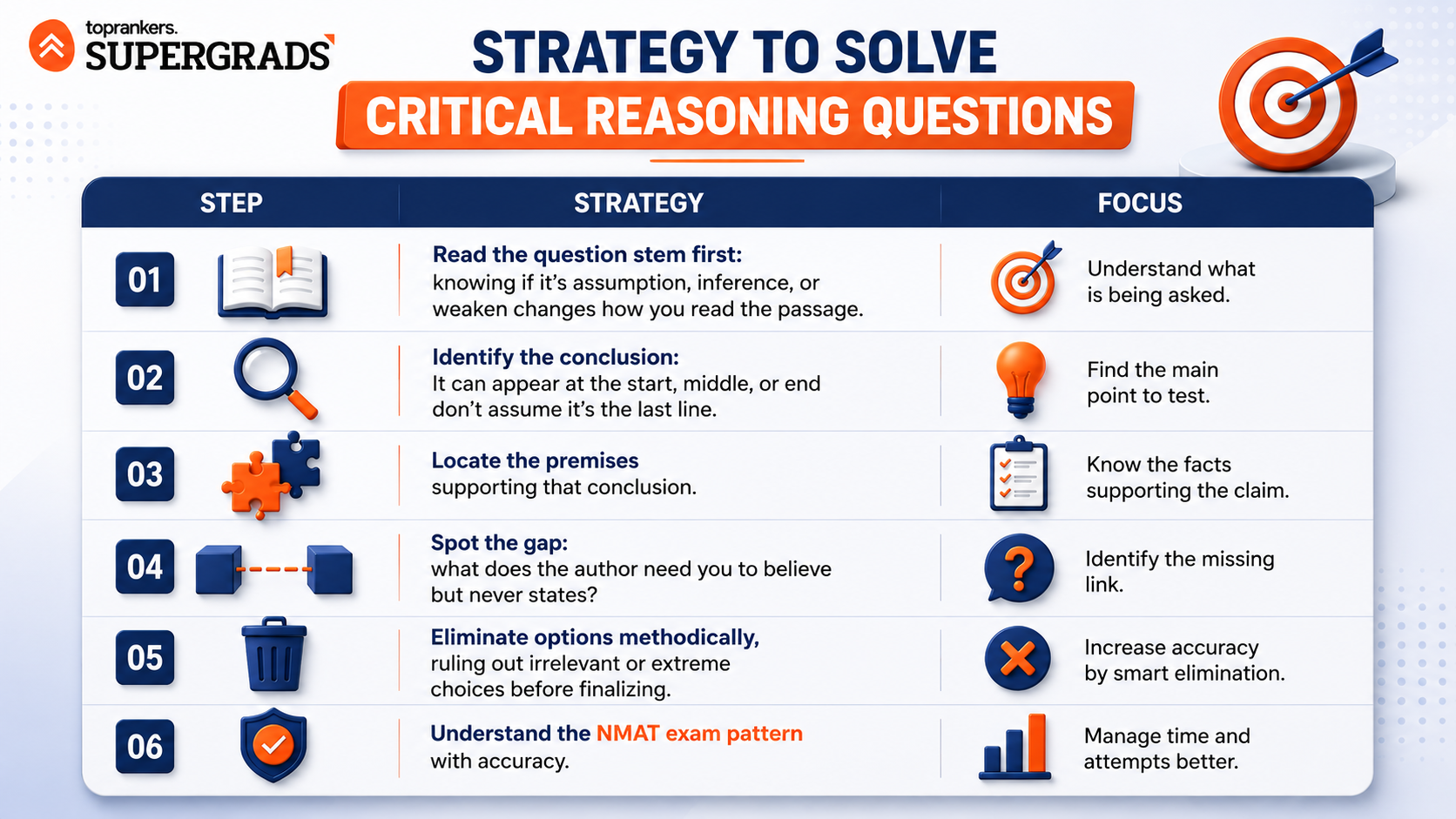
Strategy to Solve Critical Reasoning Questions
- Read the question stem first: knowing if it's assumption, inference, or weaken changes how you read the passage.
- Identify the conclusion: It can appear at the start, middle, or end don't assume it's the last line.
- Locate the premises supporting that conclusion.
- Spot the gap: what does the author need you to believe but never states?
- Eliminate options methodically, ruling out irrelevant or extreme choices before finalizing.
- Understand the NMAT exam pattern with accuracy.
NMAT Critical Reasoning Questions with Answers
Assumption-Based Question
1. A city raises downtown parking prices, expecting commuters to switch to public transport.
Which assumption underlies this plan?
(A) Parking revenue will fund new roads
(B) Commuters have a convenient public transport alternative
(C) Businesses support the hike
(D) Fares will stay unchanged
Answer: (B) the plan only works if a real alternative exists.
Inference-Based Question
2. All certified auditors passed the ethics exam. Meera passed the ethics exam.
What can be inferred?
(A) Meera is a certified auditor
(B) Meera may or may not be certified
(C) The exam is difficult
(D) Meera scored highest
Answer: (B) passing doesn't guarantee certification; the logic only runs one way.
Weaken-Based Question
3. A supplement's users scored higher on memory tests than non-users, and the company claims it improves memory.
What most weakens this claim?
(A) The supplement costs more
(B) Users also slept more during the study
(C) The study lasted six months
(D) Memory tests are hard to standardize
Answer: (B) this offers an alternative cause, breaking the causal link.
Conclusion-Based Question
4. EV sales rose 40% as government subsidies also increased in the same period.
What can be concluded?
(A) Subsidies are the only reason
(B) EV sales will keep rising
(C) There may be a correlation between subsidies and sales
(D) Petrol sales fell 40%
Answer: (C) the only option that doesn't over-claim beyond the evidence.
5. A city introduces dedicated bus lanes to reduce traffic congestion.
Which assumption underlies this decision?
(A) More people will choose buses over private cars
(B) Fuel prices will increase next year
(C) Bus fares will become free
(D) Roads will be widened
Answer: (A) the plan assumes commuters will switch to buses, making the dedicated lanes effective.
6. A company allows employees to work from home twice a week to improve productivity.
Which assumption underlies this decision?
(A) Employees will remain focused while working remotely
(B) Office rent will increase next year
(C) Internet providers will reduce prices
(D) All meetings can be cancelled
Answer: (A) the policy only works if employees stay productive while working remotely.
7. All members of the debate club attended the communication workshop. Rohan attended the communication workshop.
What can be inferred?
(A) Rohan is a debate club member
(B) Rohan may or may not be a debate club member
(C) Rohan won the debate competition
(D) Rohan organized the workshop
Answer: (B) attending the workshop alone does not prove club membership.
8. Every certified trainer completed the leadership course. Ananya completed the leadership course.
What can be inferred?
(A) Ananya is a certified trainer
(B) Ananya may or may not be a certified trainer
(C) Ananya scored the highest marks
(D) The course was difficult
Answer: (B) completing the course does not necessarily mean she became certified.
9. A school claims that introducing tablets in classrooms improved student performance because test scores increased.
What most weakens this claim?
(A) The tablets are expensive
(B) Students also received additional tuition during the same period
(C) The school bought new furniture
(D) Teachers liked using tablets
Answer: (B) extra tuition provides another possible reason for the improved scores.
10. A company claims its employees became healthier after introducing free gym memberships.
What most weakens this claim?
(A) The gym has modern equipment
(B) Many employees also started following nutrition plans during the same period
(C) The gym is close to the office
(D) Memberships are renewed annually
Answer: (B) improved diets could explain the health benefits instead.
11. A hospital starts sending appointment reminders by SMS to reduce missed appointments.
Which statement strengthens this argument?
(A) Missed appointments declined after the reminder system was introduced
(B) The hospital hired more doctors
(C) Patients received free parking
(D) The hospital cafeteria expanded
Answer: (A) fewer missed appointments after the reminders support the claim.
12. A city plants thousands of trees to improve air quality.
Which statement best strengthens this argument?
(A) Areas with higher tree cover recorded lower pollution levels over time
(B) Trees require regular watering
(C) The city increased its population
(D) Parks became more crowded
Answer: (A) it directly supports the idea that more trees improve air quality.
13. A company introduced an online customer support system, and customer satisfaction scores increased.
What can be concluded?
(A) The support system may have contributed to higher satisfaction
(B) The support system is the only reason satisfaction increased
(C) Customer complaints completely disappeared
(D) Sales doubled immediately
Answer: (A) the evidence suggests a possible connection without proving certainty.
14. The number of students using the library increased after its operating hours were extended.
What can be concluded?
(A) Longer hours may have encouraged more students to visit the library
(B) Every student now uses the library
(C) Students stopped buying books
(D) The library became larger
Answer: (A) this is the most reasonable conclusion based on the information given.
15. A company claims its social media campaign increased product sales.
Which question is most important in evaluating this claim?
(A) Did competitors also launch marketing campaigns during the same period?
(B) Which employee created the campaign?
(C) How many followers does the CEO have?
(D) What color was the advertisement?
Answer: (A) competing campaigns could also have influenced sales.
16. A principal believes extending school hours improves academic performance.
Which question best evaluates this argument?
(A) Were any changes made to the teaching methods at the same time?
(B) How old is the school building?
(C) How many classrooms are there?
(D) Does the school have a sports team?
Answer: (A) other academic changes could be responsible for better performance.
17. A restaurant begins accepting digital payments to attract more customers.
Which assumption underlies this decision?
(A) Many customers prefer cashless transactions
(B) Food prices will decrease next month
(C) The menu will become larger
(D) Competitors will stop accepting cash
Answer: (A) the strategy depends on customers valuing digital payment options.
18. Some employees in the company attended a leadership seminar. Neha is an employee of the company.
What can be inferred?
(A) Neha attended the seminar
(B) Neha may or may not have attended the seminar
(C) Neha organized the seminar
(D) Every employee attended the seminar
Answer: (B) the information only says that some employees attended.
19. A smartphone manufacturer claims its latest software update improved battery life.
What most weakens this claim?
(A) Many users reduced their screen brightness after installing the update
(B) The update added new wallpapers
(C) The phone comes in more colors
(D) The update was released globally
Answer: (A) lower screen brightness could be the real reason for better battery life.
20. A library launches a reading challenge to encourage students to read more books.
Which statement best strengthens this argument?
(A) Book borrowing increased significantly after the challenge began
(B) The library bought new chairs
(C) More computers were installed
(D) Library membership fees remained unchanged
Answer: (A) increased borrowing suggests the reading challenge was effective.
21. Online grocery orders increased during the past year, while visits to physical stores declined.
What can be concluded?
(A) More consumers may be choosing online grocery shopping
(B) Physical stores will permanently close
(C) Every shopper now buys groceries online
(D) Grocery prices fell sharply
Answer: (A) this conclusion fits the available evidence without making unsupported claims.
22. A fitness app claims its users lose weight because they receive daily workout reminders.
Which question is most useful in evaluating this claim?
(A) Did users also change their eating habits during the same period?
(B) What color is the app's logo?
(C) How many employees built the app?
(D) How much does the app cost?
Answer: (A) dietary changes could be the actual reason for weight loss.
23. A university makes attendance compulsory to improve student results.
Which assumption underlies this policy?
(A) Students who attend classes regularly perform better academically
(B) Professors enjoy taking attendance
(C) Campus facilities will improve next year
(D) Exams will become easier
Answer: (A) the policy depends on attendance leading to better learning outcomes.
24. A company launches a workplace wellness program to reduce employee absenteeism.
Which statement best strengthens this claim?
(A) Employees participating in the program took fewer sick leaves than before
(B) The company renovated its office cafeteria
(C) More parking spaces were added
(D) New employee uniforms were introduced
Answer: (A) fewer sick leaves among participants directly support the company's claim.
Previous Year NMAT Critical Reasoning Trends
The previous year NMAT trend are taken from the analysis of previous year NMAT question papers
| Trend | Observation |
|---|---|
| Style | Increasingly GMAT-style rather than CAT-style |
| Passage Length | Short - usually under 60 words |
| Popular Formats | Assumption and strengthen-weaken dominate |
| Difficulty | Stable at easy-to-moderate |
| Options | Less "trappy" than CAT-level CR |
This consistency means the skills built through critical reasoning questions for NMAT practice carry over reliably into the NMAT 2026 cycle.
Time Management Tips
- Attempt critical reasoning questions for NMAT early in the Logical Reasoning section if it's your strength they're usually faster than puzzles.
- Cap each question at 90 seconds; mark your best guess and move on if undecided.
- Read the passage once, carefully don't re-read multiple times.
- Eliminate wrong options rather than trying to prove the right one.
- Build pacing through timed mocks, not mental math during the exam.
- Revisit solved NMAT critical reasoning questions with answers weekly to keep pattern recognition sharp.
Watch Free Demo Classes by Supergrads
Expert Preparation Tips for NMAT 2026
- Build a "logic vocabulary" know the difference between correlation and causation, and premise versus conclusion.
- Spend as much time reviewing wrong answers as solving new questions.
- Practice attempting Logical Reasoning both first and last in mocks, since NMAT lets you pick section order.
- Log which question type trips you up most on critical reasoning questions for NMAT, and target it specifically.
- Faster reading in Language Skills indirectly speeds up how quickly you process critical reasoning passages too.
Key Takeaways for NMAT Critical Reasoning Questions 2026
- NMAT critical reasoning questions test logical structure - focus on the premise, conclusion, and the gap between them.
- Expect roughly 5-7 such questions out of 36 in Logical Reasoning, at easy-to-moderate difficulty.
- Master five formats: assumption, inference, strengthen, weaken, and conclusion.
- Practice with solved sets of NMAT 2027 critical reasoning questions with answers, a reliable nmat critical reasoning questions pdf, and timed mocks.
- With no negative marking on NMAT 2026, always attempt every question using elimination-based logic.
Explore More NMAT 2026 Resources
Treat critical reasoning as a learnable skill, not a guessing game. Master the five core formats, practice consistently with solved sets and a reliable NMAT critical reasoning questions pdf, and it becomes one of the most reliable scoring areas in NMAT 2026.
| NMAT Quant Questions | NMAT Exam Pattern 2026 |
| NMAT Sample Papers | NMAT Syllabus 2026 |
| NMAT Eligibility | NMAT Logical Reasoning Questions |
Frequently Asked Questions
How many critical reasoning questions come in NMAT Logical Reasoning?

What are the most common NMAT critical reasoning question types?
What is the best way to solve NMAT CR questions quickly?
Are NMAT critical reasoning questions similar to GMAT CR or CAT CR?
Where can I download NMAT critical reasoning questions PDF with solutions?

Zubeen Siddiqui
Content Writer | MBA & CAT Preparation
SHARE