
1723534562.png)

Probability Questions for NMAT 2026: Concepts, Formulas & 30 Practice Questions
June 15, 2026
Overview: Probability questions for NMAT exam are an important part of the Quantitative Skills section. With regular practice, students can improve speed, accuracy, and confidence in solving NMAT probability questions. Many aspirants find NMAT probability questions tricky at first because they involve formulas, logical interpretation, and careful calculation. However, with consistent practice of probability questions, students can easily score well in this topic.
In this blog, we will cover everything about probability questions for NMAT, including concepts, formulas, important question types, preparation tips, and 30 practice questions.
Key Takeaways
| Key Point | Details |
|---|---|
|
Topic Importance |
Probability is a scoring topic in NMAT Quant. |
|
Difficulty Level |
Easy to Moderate |
|
Expected Questions |
2-4 questions |
|
Important Areas |
Coins, Dice, Cards, Selection, Conditional Probability |
|
Best Strategy |
Learn formulas and practice timed questions. |
Table of Content
- What are Probability Questions for NMAT?
- Why are Probability Questions Important for NMAT?
- Important Probability Formulas for NMAT
- Types of Probability Questions for NMAT
- Preparation Strategy for Probability Questions for NMAT
- Common Mistakes in NMAT Probability Questions
- 30 Probability Questions for NMAT
- Tips to Solve Probability Questions Quickly
- Conclusion
What are Probability Questions for NMAT?
Probability questions for NMAT test your ability to calculate the chances of an event happening. These questions are usually based on coins, dice, cards, selections, and real-life situations.
Most NMAT probability questions are formula-based and can be solved quickly if your basics are clear. To score good you need to check the exam pattern and sample papers.
Why are Probability Questions Important for NMAT?
Probability questions for NMAT are important because they are usually less lengthy and can help students score well in Quant. And as we know that there is no negative marking so it's an additional point to score good in this exam.
| Reason | Explanation |
|---|---|
| Scoring Topic | Most questions are direct and concept-based. |
| Saves Time | With formulas, questions can be solved quickly. |
| Frequently Asked | NMAT probability questions appear regularly in practice sets and exams. |
| Improves Accuracy | Clear logic reduces guesswork. |
Important Probability Formulas for NMAT
Before solving probability questions for NMAT, students should revise the basic formulas.
| Concept | Formula |
|---|---|
| Basic Probability | P(E) = Favourable Outcomes / Total Outcomes |
| Complementary Probability | P(E') = 1 - P(E) |
| Probability of A or B | P(A∪B) = P(A) + P(B) - P(A∩B) |
| Conditional Probability | P(A/B) = P(A∩B) / P(B) |
| Independent Events | P(A∩B) = P(A) × P(B) |
Types of Probability Questions for NMAT
Students should practice different types of probability questions for NMAT to cover all possible patterns.
| Question Type | Examples |
|---|---|
| Coin Toss | Heads, tails, at least one head |
| Dice Questions | Even number, odd number, sum-based questions |
| Card Probability | Ace, king, red card, face card |
| Selection Probability | Choosing balls, students, letters |
| Conditional Probability | Probability based on given conditions |
Preparation Strategy for Probability Questions for NMAT
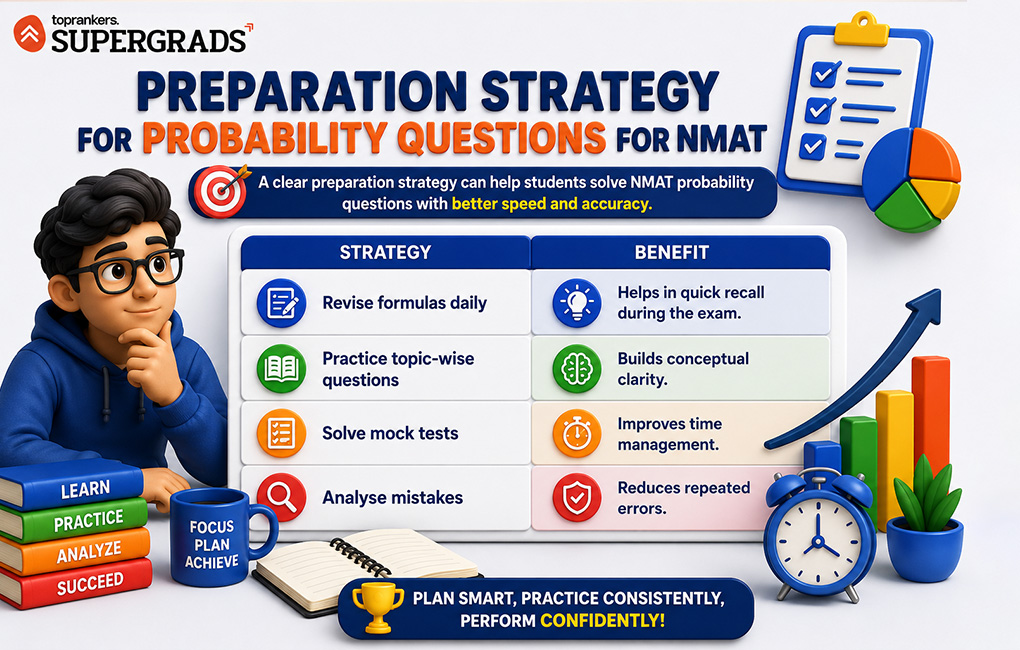
A clear preparation strategy can help students solve NMAT probability questions with better speed and accuracy.
| Strategy | Benefit |
|---|---|
| Revise formulas daily | Helps in quick recall during the exam. |
| Practice topic-wise questions | Builds conceptual clarity. |
| Solve mock tests | Improves time management. |
| Analyse mistakes | Reduces repeated errors. |
Common Mistakes in NMAT Probability Questions
Many students lose marks in probability questions for NMAT due to small calculation or concept-based errors.
| Mistake | Impact |
|---|---|
| Forgetting total outcomes | Leads to wrong probability. |
| Confusing independent and dependent events | Creates logical errors. |
| Not using complementary probability | Makes the solution longer. |
| Rushing calculations | Increases silly mistakes. |
30 Probability Questions for NMAT
Here are 30 important probability questions for NMAT practice. These NMAT probability questions will help you revise coins, dice, cards, and selection-based concepts.
Q1. A coin is tossed once. What is the probability of getting heads?
A. 1/4
B. 1/2
C. 3/4
D. 1
Answer: B
Q2. A die is rolled once. What is the probability of getting an even number?
A. 1/2
B. 1/3
C. 2/3
D. 1/6
Answer: A
Q3. A card is drawn from a standard deck of 52 cards. What is the probability of getting a king?
A. 1/13
B. 4/13
C. 1/4
D. 1/52
Answer: A
Q4. Two coins are tossed together. What is the probability of getting two heads?
A. 1/2
B. 1/3
C. 1/4
D. 3/4
Answer: C
Q5. A die is rolled once. What is the probability of getting a number greater than 4?
A. 1/6
B. 1/3
C. 1/2
D. 2/3
Answer: B
Q6. A card is drawn from a standard deck. What is the probability of drawing a red card?
A. 1/4
B. 1/2
C. 3/4
D. 1/13
Answer: B
Q7. A bag contains 5 red balls and 3 blue balls. What is the probability of drawing a blue ball?
A. 3/8
B. 5/8
C. 1/2
D. 2/3
Answer: A
Q8. A die is rolled once. What is the probability of getting an odd number?
A. 1/6
B. 1/3
C. 1/2
D. 2/3
Answer: C
Q9. Two dice are rolled together. What is the probability of getting a sum of 7?
A. 1/6
B. 1/12
C. 1/18
D. 1/36
Answer: A
Q10. A card is drawn from a standard deck. What is the probability of getting a queen?
A. 1/13
B. 1/26
C. 1/4
D. 4/13
Answer: A
Q11. A coin is tossed once. What is the probability of getting a tail?
A. 1/2
B. 1/3
C. 1/4
D. 1
Answer: A
Q12. A card is drawn from a deck of 52 cards. What is the probability of selecting an ace?
A. 1/52
B. 1/26
C. 1/13
D. 4/13
Answer: C
Q13. A die is rolled once. What is the probability of getting a number less than 3?
A. 1/6
B. 1/3
C. 1/2
D. 2/3
Answer: B
Q14. Two coins are tossed together. What is the probability of getting at least one head?
A. 1/4
B. 1/2
C. 3/4
D. 1
Answer: C
Q15. A card is drawn from a standard deck. What is the probability of drawing a black card?
A. 1/2
B. 1/4
C. 3/4
D. 1/13
Answer: A
Q16. One letter is selected randomly from the word “NMAT”. What is the probability of selecting a vowel?
A. 1/4
B. 1/2
C. 3/4
D. 1
Answer: A
Q17. A die is rolled once. What is the probability of getting a multiple of 3?
A. 1/6
B. 1/3
C. 1/2
D. 2/3
Answer: B
Q18. Two dice are rolled together. What is the probability of getting a sum of 12?
A. 1/6
B. 1/12
C. 1/18
D. 1/36
Answer: D
Q19. A card is drawn from a deck of 52 cards. What is the probability of drawing a heart card?
A. 1/4
B. 1/2
C. 1/13
D. 3/13
Answer: A
Q20. A die is rolled once. What is the probability of getting a prime number?
A. 1/6
B. 1/3
C. 1/2
D. 2/3
Answer: C
Q21. Two coins are tossed together. What is the probability of getting exactly one head?
A. 1/4
B. 1/2
C. 3/4
D. 1
Answer: B
Q22. A card is drawn from a deck of 52 cards. What is the probability of selecting a red king?
A. 1/13
B. 1/26
C. 1/52
D. 2/13
Answer: B
Q23. A die is rolled once. What is the probability of getting an even number greater than 2?
A. 1/6
B. 1/3
C. 1/2
D. 2/3
Answer: B
Q24. A card is drawn from a standard deck. What is the probability of drawing a face card?
A. 1/13
B. 2/13
C. 3/13
D. 4/13
Answer: C
Q25. One letter is selected randomly from the word “NMAT”. What is the probability of selecting a consonant?
A. 1/4
B. 1/2
C. 3/4
D. 1
Answer: C
Q26. A die is rolled once. What is the probability of getting a number less than 5?
A. 1/3
B. 1/2
C. 2/3
D. 5/6
Answer: C
Q27. Two coins are tossed together. What is the probability of getting at least one tail?
A. 1/4
B. 1/2
C. 3/4
D. 1
Answer: C
Q28. A card is drawn from a deck of 52 cards. What is the probability of drawing a spade card?
A. 1/4
B. 1/2
C. 1/13
D. 3/13
Answer: A
Q29. Two dice are rolled together. What is the probability of getting double six?
A. 1/6
B. 1/12
C. 1/18
D. 1/36
Answer: D
Q30. One number is selected randomly from 1 to 10. What is the probability of selecting an odd number?
A. 1/5
B. 1/4
C. 1/2
D. 3/5
Answer: C
Tips to Solve Probability Questions Quickly
Students can improve their performance in probability questions for NMAT by following a few smart preparation techniques. Since NMAT is a speed-based exam, having a proper approach can help candidates solve questions faster and with better accuracy.
The table below highlights some useful tips for solving NMAT probability questions effectively.
| Tips | Benefit | How It Helps in NMAT |
|---|---|---|
| Memorise Important Formulas | Faster solving | Knowing formulas for probability, complementary probability, and conditional probability helps students solve probability questions for NMAT quickly without wasting time during the exam. |
| Use Shortcuts and Logic | Saves time | Applying logical elimination methods and shortcut calculations reduces lengthy solving steps in nmat probability questions. |
| Practice Questions Daily | Improves accuracy | Regular practice of NMAT probability questions helps students identify patterns and reduce calculation mistakes. |
| Solve Mock Tests Regularly | Builds exam temperament | Mock tests help students manage pressure and improve speed while solving NMAT probability questions under timed conditions. |
| Analyse Mistakes After Practice | Avoids repetition of errors | Reviewing incorrect answers helps students understand weak areas and improve their approach to probability questions. |
| Focus on Concept Clarity | Strengthens fundamentals | Understanding concepts like favourable outcomes and total outcomes makes it easier to solve tricky nmat probability questions. |
| Revise Previous Year Questions | Improves exam familiarity | Practicing previous NMAT probability questions gives students a better understanding of question patterns and difficulty level. |
Conclusion
NMAT probability questions are scoring if your concepts and formulas are clear. Students should focus on coins, dice, cards, selection-based questions, and conditional probability to perform well in NMAT probability questions.
With daily practice of probability questions for NMAT and regular mock test analysis, you can improve your accuracy and solve questions faster in the actual NMAT exam.
Frequently Asked Questions
Are probability questions important for NMAT 2026?

What is the difficulty level of NMAT probability questions?
How many probability questions can appear in NMAT?
Is Probability difficult for NMAT beginners?
How can I solve probability questions faster in NMAT?

Zubeen Siddiqui
Content Writer | MBA & CAT Preparation
SHARE