


Maharashtra Judiciary Syllabus 2026 [JMFC Syllabus Download Pdf Here]
October 19, 2026
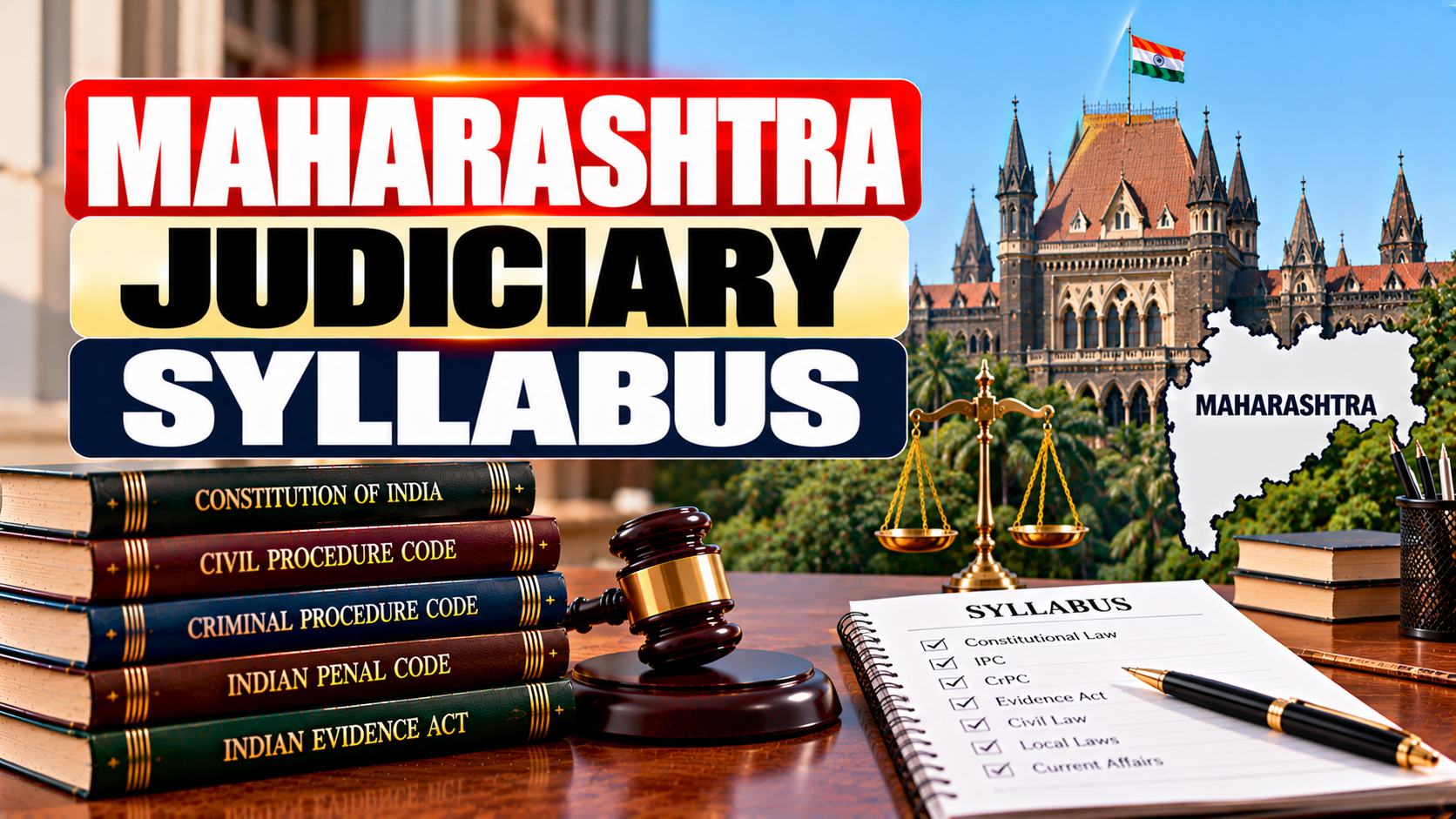
The Maharashtra Judiciary syllabus 2026 covers civil law, criminal law and specified special Acts for the Civil Judge (Junior Division) and Judicial Magistrate First Class (JMFC) selection process.
The Maharashtra Judiciary exam consist of 3 stages - Prelims, Mains and an Interview. The Prelims is only a screening test, so its marks do not count in the final merit list.
- The Prelims is a single objective paper of 100 marks, set in English, with 0.25 negative marking.
- The Mains has two descriptive papers of 100 marks each, and candidates can write them in Marathi or English.
- The Interview carries 50 marks.
- The Maharashtra Rent Control Act is the one state-specific Act in the Prelims syllabus.
Maharashtra Judiciary Syllabus 2026 Highlights
The Maharashtra Judiciary syllabus now includes the BNS, BNSS and BSA along with the IPC, CrPC and Evidence Act. The Maharashtra Public Service Commission (MPSC) conducts recruitment for Civil Judge (Junior Division) and JMFC.The Prelims originally scheduled for 2 August 2026 was postponed, no fresh date has been announced yet. Check for more information on Maharashtra Judiciary recruitment and vacancy details.
| Particulars | Details |
| Exam name | Civil Judge (Junior Division) and JMFC Examination |
| Conducting body | Maharashtra Public Service Commission (MPSC) |
| Advertisement | No. 013/2026 |
| Vacancies | 286 |
| Stages |
Prelims (objective), Mains (descriptive), Interview |
|
Prelims syllabus |
Civil and criminal procedure, evidence, constitutional law, property law, contracts, sale of goods, partnership, specific relief, limitation, Maharashtra rent control, IPC, BNS, BNSS and BSA |
|
Mains Paper I syllabus |
Civil Procedure Code, Transfer of Property Act, Specific Relief Act, Contract Law, Sale of Goods Act and Partnership Act |
|
Mains Paper II syllabus |
IPC, Criminal Procedure Code, Evidence Act, BNS, BNSS, BSA, SC/ST (Prevention of Atrocities) Act, Protection of Civil Rights Act and an essay on a current legal topic |
|
Prelims status |
Originally scheduled for 2 August 2026; New date awaited. |
|
Official website |
Maharashtra Judiciary Syllabus 2026 PDF Download Link
The Maharashtra Judiciary syllabus covers civil procedure, property, contracts and remedies on one side, and offences, criminal procedure and evidence on the other, along with the Constitution, the Limitation Act and the Maharashtra Rent Control Act.
Candidates can download the Maharashtra Judiciary syllabus from the link below.
Maharashtra Judiciary Syllabus 2026 for Prelims
The Prelims is a single paper of 100 multiple-choice questions, set in English. There is no general studies section, no aptitude and no language paper. The subject list below follows the syllabus notified in MPSC Advertisement No. 013/2026.
- Civil laws: Cover civil procedure, property transfers, contracts, sale of goods, partnership, specific relief and limitation.
- Criminal laws: Cover the IPC and BNS, along with criminal procedure under the CrPC and BNSS.
- Evidence laws: Prepare relevancy, burden of proof, confessions, witnesses and electronic records under the Evidence Act and BSA.
- Constitutional law: Prepare fundamental rights, Directive Principles, government institutions, the judiciary and amendments.
- State-specific law: Include the Maharashtra Rent Control Act in your preparation.
|
No. |
Subject |
Topics |
|
1 |
Code of Criminal Procedure |
Arrest, bail, cognizance, trial procedure, limitation for taking cognizance |
|
2 |
Civil Procedure Code |
Jurisdiction, pleadings, Orders and Rules, res judicata, execution |
|
3 |
Evidence Act |
Relevancy, burden of proof, confessions, presumptions, witnesses |
|
4 |
Transfer of Property Act |
Sale, mortgage, lease, gift, exchange, doctrines like lis pendens and part performance |
|
5 |
Specific Relief Act |
Specific performance, injunctions, rectification, cancellation |
|
6 |
Maharashtra Rent Control Act |
State-specific, so out-of-state candidates must read it separately |
|
7 |
Limitation Act |
Periods, computation, disability, acknowledgment, condonation of delay |
|
8 |
Constitution of India |
Preamble, fundamental rights, DPSPs, Union and State, judiciary, amendment |
|
9 |
Indian Penal Code |
General exceptions, offences against body and property, abetment, conspiracy |
|
10 |
Law of Contracts, Sale of Goods Act, Partnership Act |
Formation, performance, breach, conditions and warranties, partner liability |
|
11 |
Bharatiya Nyaya Sanhita, 2023 |
New numbering, new offences, community service as a punishment |
|
12 |
Bharatiya Sakshya Adhiniyam, 2023 |
Electronic records and the changes from the old Evidence Act |
|
13 |
Bharatiya Nagarik Suraksha Sanhita, 2023 |
Timelines, e-processes, zero FIR, revised procedures |
Maharashtra Judiciary Syllabus 2026 for Mains
The Mains has two descriptive papers of 100 marks each, so 200 marks in total. Each paper is three hours long. Candidates can write in Marathi or English.
Mains Paper I: Civil Law
- Civil Procedure Code
- Transfer of Property Act
- Specific Relief Act
- Law of Contracts, Sale of Goods Act and Partnership Act
Mains Paper II: Criminal Law and Essay
- Indian Penal Code
- Evidence Act
- Code of Criminal Procedure
- Scheduled Castes and Scheduled Tribes (Prevention of Atrocities) Act, 1989
- Protection of Civil Rights Act, 1955
- Bharatiya Nyaya Sanhita, 2023
- Bharatiya Sakshya Adhiniyam, 2023
- Bharatiya Nagarik Suraksha Sanhita, 2023
- Essay on a current legal topic
Maharashtra Judiciary Syllabus 2026 for Interview
The interview carries 50 marks. The following are suggested preparation areas, rather than an official interview subject list:
|
Topics |
Details |
|
Core legal knowledge |
Understanding of core laws, especially procedure and evidence |
|
Recent judgments |
Important Supreme Court and Bombay High Court judgments |
|
Maharashtra awareness |
State administration and relevant social issues |
|
Judicial temperament |
Impartiality, ethical reasoning and balanced decision-making |
|
Communication and motivation |
Clear expression and reasons for choosing the judiciary |
Maharashtra Judiciary 2026 Exam Pattern
The Maharashtra Judiciary examination has three stages: Prelims, Mains and Interview. Prelims is a screening examination, while Mains and Interview marks determine the final merit. Candidates should also know the Maharashtra Civil Judge Eligibility Criteria 2026 while preparing for the Maharashtra Judiciary.
|
Particulars |
Prelims |
Mains |
Interview |
|
Examination type |
Objective questions (MCQs) |
Descriptive written examination |
Viva voce |
|
Number of papers |
One |
Two |
Not applicable |
|
Maximum marks |
100 |
200 — 100 marks per paper |
50 |
|
Duration |
2 hours |
3 hours per paper |
As decided by the interview panel |
|
Medium |
English |
Marathi or English |
Refer to the applicable interview instructions |
|
Assessment areas |
Prescribed law subjects |
Paper I: Civil Law; Paper II: Criminal Law, specified special Acts and legal essay |
Legal understanding, suitability and judicial temperament |
|
Negative marking |
0.25 mark per incorrect answer* |
Not applicable |
Not applicable |
|
Role in selection |
Screening for Mains |
Counts towards final merit |
Counts towards final meri |
Maharashtra Judiciary Marks Distribution
The Maharashtra Judiciary marks distribution includes 100 marks for Prelims, 200 marks for Mains and 50 marks for the Interview. Prelims serves as a screening test, so its marks are excluded from the final merit list. Final selection is based on the combined 250 marks from Mains and the Interview.
|
Stage |
Particulars |
Marks |
Counts in final merit? |
|
Preliminary Examination |
One objective paper |
100 |
No (screening only) |
|
Main Examination |
Two descriptive papers |
200 |
Yes |
|
Interview |
Viva voce |
50 |
Yes |
|
Final merit |
Mains plus Interview |
250 |
Not applicable |
How to Prepare for Maharashtra Judiciary Exams 2026
Candidates can start their preparation by bare-Act reading, MCQ practice and written application for subjects shared by both stages. Also refer the Maharashtra Judiciary Preparation Tips for effective preparation of exams.
- Read the bare Act first, always. Focus on the wording, conditions and exceptions in each provision.
- Make answer-ready notes. For each section, write what it says, an illustration and a leading case. These notes serve MCQs and Mains alike.
- Set priorities from your diagnostic test. Allocate more time to weak subjects and Acts shared by Prelims and Mains. Do not assign official weightage where none is stated.
- Solve MCQs right after finishing an Act. It shows you what you really retained.
- Write, don't just read. Take one problem question a week and finish it in a timed sitting, in the language you plan to use on exam day.
- Take Marathi seriously. If you plan to write the Mains in Marathi, build legal vocabulary from the start. It is a skill that takes months, not weeks.
- Revise on a calendar. A short weekly revision of older Acts keeps them alive while you move to new ones.
Best Books for the Maharashtra Judiciary Exam 2026
Here are some of the best books candidates can use for the Maharashtra Judiciary Exam 2026. Most of candidates prefer standard Bare Acts and well-known commentaries for subjects like CPC, Contract, Property Law, and the new Bharatiya Nyaya Sanhita. These books help build strong concepts and are useful for both prelims and mains preparation.
|
Bare Act / Book Name |
Author or Publisher |
|
Code of Civil Procedure, 1908 — Bare Act |
Eastern Book Company (EBC) |
|
Civil Procedure |
C. K. Takwani — Eastern Book Company |
|
Law of Contract & Specific Relief |
Avtar Singh; revised by Rajesh Kapoor — Eastern Book Company |
|
Transfer of Property Act |
Mulla — LexisNexis |
|
The Bharatiya Nyaya Sanhita, 2023 |
Ratanlal & Dhirajlal — LexisNexis |
|
Maharashtra Rent Control Act, 1999 — Official Act Text |
Government of Maharashtra |
Must Know: Everything you need for Judiciary
The Maharashtra Judiciary syllabus 2026 requires preparation in subjects like civil law, criminal law, and specified special Acts. Check the official syllabus before starting preparations and study both sets of criminal laws where prescribed. Start with objective practice and Mains answer writing. Confirm examination dates and any revised rules directly with MPSC before making your final study schedule.
If you want a structured guidance, take a free demo online class or talk to a Judiciary Gold counsellor about the course.
Judiciary Practice Rule 2026 — Check where you stand
Fill your details
Frequently Asked Questions
How many months do I need to prepare for Maharashtra Judiciary 2026?

Do prelims marks count in the Maharashtra Judiciary final merit list?
What is the Maharashtra Judiciary exam date for 2026?
What is the Maharashtra Judiciary 2026 Exam Pattern?
Can I modify details if I make any mistakes in the Maharashtra Judiciary 2026 Online Application Form during registration?
Do new law graduates need a Certificate of Practice?
Do prelims marks count in the final merit?

Nancy Mahavir Sharma
Legal Writer
SHARE