
1723534562.png)

How to Prepare for IPMAT 2027 (IIM Indore): Study Plan, Books, Mocks
October 2, 2026
Preparing for IPMAT requires a combination of strong fundamentals, regular practice, effective time management, and consistent revision. If you are wondering how to prepare for IPMAT, the best approach is to start by understanding the exam pattern, topics and syllabus, identify your strengths and weaknesses, and then follow a structured preparation strategy.
Whether you are preparing for IPMAT after Class 10, starting in Class 11, or beginning your preparation after Class 12, having a clear plan can make your preparation more organised and manageable.
Preparing for IPMAT 2027 is easiest when you follow a phased plan: build fundamentals (QA + VA), move to topic-wise practice, then shift to mocks and analysis. In this guide, you’ll get a 12-month + 6-month roadmap, section-wise strategy, best books, and a weekly timetable you can follow from Class 11, Class 12, or as a dropper.
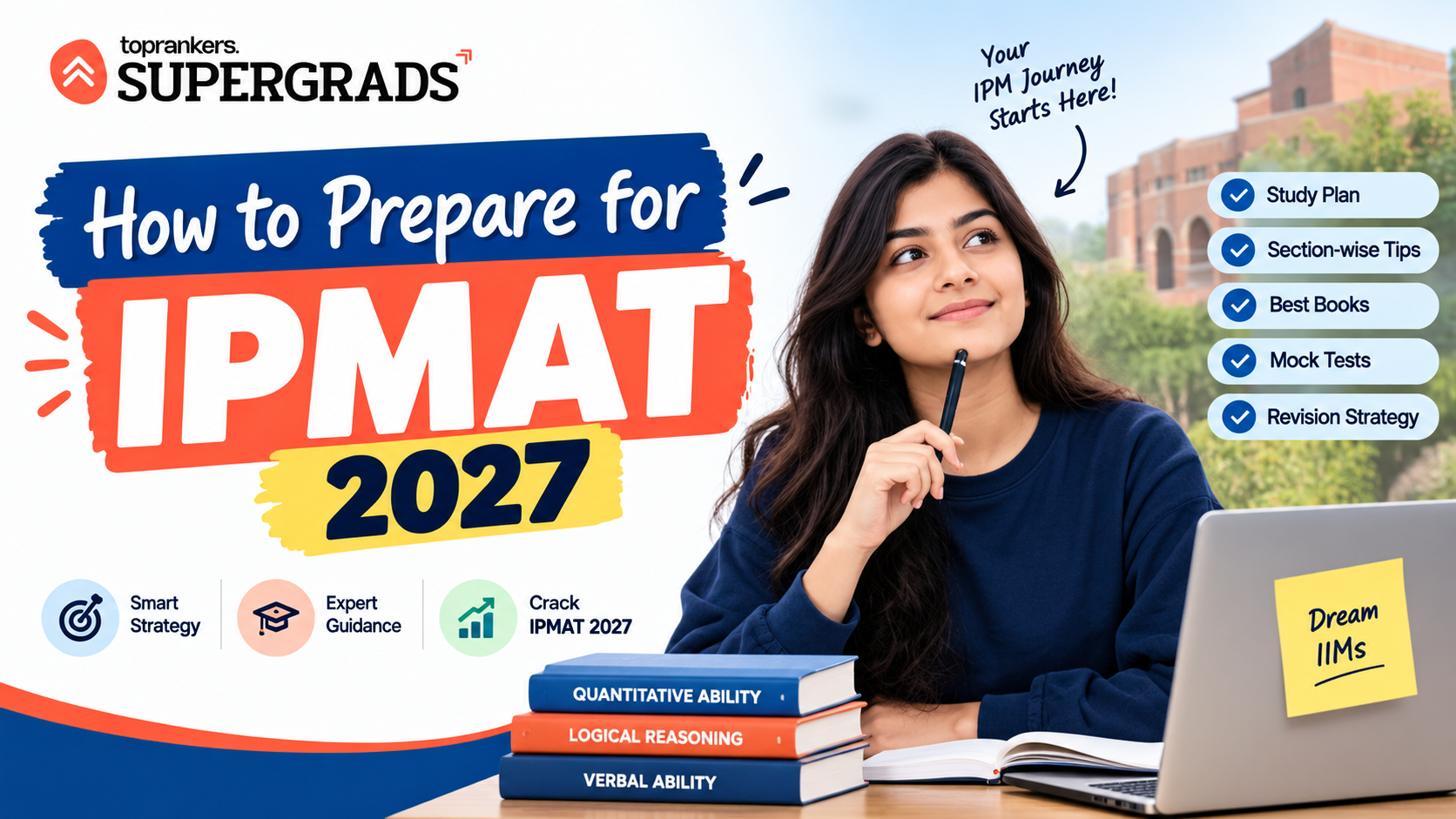
How to Prepare for IPMAT 2027: Overview
If you are wondering how to prepare for the IPMAT 2027 Exam, the first thing you need is a clear idea of what the exam expects from you. Instead of trying to study everything at once, start by understanding the syllabus, identify the areas where you need more practice, and then build your preparation around them.
Your IPMAT 2027 preparation plan should cover:
- Start by knowing the IPMAT 2027 exam pattern and syllabus
- Strengthening your Quantitative Ability fundamentals
- Improving Verbal Ability through regular reading, vocabulary building, grammar, and comprehension practice
- Preparing for Logical Reasoning if it is included in your target exam
- Solving questions regularly to build accuracy and confidence
- Taking sectional tests and IPMAT full-length mock tests
- Reviewing your mistakes and working on topics where you are struggling
- Revising important IPMAT concepts, formulas, and vocabulary at regular intervals
- Improving your speed and learning how to manage time during the exam
Remember, preparation isn't just about finishing the syllabus. You need to keep checking whether your preparation is actually improving your performance. A topic may seem easy while studying it, but timed practice can reveal gaps that you may not notice otherwise.
A simple way to approach your preparation is:
Understand → Learn → Practise → Test → Analyse → Revise
Follow this cycle throughout your preparation. As you practise more and learn from your mistakes, you will gradually become more comfortable with the questions and better at managing your time during the exam.
How to Start Preparing for IPMAT 2027
The biggest mistake you can make is trying to cover the entire syllabus in one go. It is much easier to stay on track when you break your preparation into smaller, manageable steps. Start by getting familiar with the exam, check where you currently stand, strengthen your basics, and then build a study routine that you can actually follow.
Step 1: Understand the IPMAT Exam Pattern
Before you start solving questions or choosing study material, take some time to understand the exam you are preparing for. Make a note of:
- The sections included in your target IPMAT
- The number and type of questions
- The time allotted to each section
- The IPMAT marking scheme
- The IPMAT 2027 syllabus
- The kind of questions that have appeared in previous years
This gives you a better idea of what your preparation should look like. Since the exam pattern and other details can change, check the latest official notification before finalising your study plan.
Step 2: Find Out Where You Stand
Once you understand the exam, take a basic mock test or IPMAT sample paper. Don’t worry too much about your score at this stage. This test is simply a way to understand your current level. Look at things such as:
- Which topics you can already handle comfortably
- Which concepts you have forgotten
- Where you tend to make repeated mistakes
- How quickly you can read and understand a passage
- How much time you take to solve IPMAT quantitative questions
- Whether you are able to finish questions within the given time
This small exercise can make your preparation much more focused because you’ll know what needs your attention from the beginning.
Step 3: Strengthen Your Fundamentals
Once you know your weak areas, start working on the basics. There is no need to jump straight into difficult questions. For Quantitative Ability, begin with topics such as:
- Number Systems
- Percentages
- Averages
- Ratios and Proportions
- Profit and Loss
- Simple and Compound Interest
- Time, Speed and Distance
- Time and Work
- Algebra
- Geometry
- Permutations and Combinations
- Probability
For Verbal Ability, work on:
- Reading Comprehension
- Vocabulary
- Grammar
- Sentence Completion
- Para Jumbles
- Error Spotting
- Synonyms and Antonyms
- Inference-Based Questions
If your target examination includes Logical Reasoning, make sure you give that section enough time as well. The idea is simple: get your basics right first, and then gradually move towards more challenging questions.
Step 4: Build a Study Routine You Can Follow
Your IPMAT 2027 study plan does not have to be complicated. What matters is that you can follow it consistently. Instead of spending an entire week on one subject, divide your time between different areas of the exam. For example:
| Day | Quantitative Ability | Verbal Ability | Other Preparation |
| Monday | Arithmetic | Reading | Vocabulary |
| Tuesday | Algebra | Grammar | Practice Questions |
| Wednesday | Geometry | Reading Comprehension | Revision |
| Thursday | Arithmetic | Vocabulary | Sectional Practice |
| Friday | Algebra | Grammar | Error Analysis |
| Saturday | Mixed Practice | RC Practice | Mock/Sectional Test |
| Sunday | Revision | Revision | Test Analysis |
This is only a sample schedule. If you are in school or college, adjust the timings and workload around your classes, assignments, and other commitments.
The important thing is to create a routine that you can stick to for months—not one that looks impressive on paper but becomes difficult to maintain after a few days.
For a more detailed approach to planning your preparation, you can also explore the IPMAT Study Plan.
How to Prepare for IPMAT Quantitative Aptitude 2027
Once you have built a basic foundation in mathematics, the next step is to start preparing specifically for the Quantitative Aptitude section of IPMAT.
If you are wondering how to start preparing for IPMAT Quantitative Aptitude, don’t jump straight into difficult questions. Start with the topics you are most likely to use regularly, make sure your basics are clear, and then gradually move towards more challenging areas.
Start With Arithmetic
Arithmetic is a good place to begin because it helps you develop the calculation and problem-solving skills you will need across different types of questions. Start with topics such as:
- Percentages
- Profit and Loss
- Ratios and Proportions
- Averages
- Simple and Compound Interest
- Time, Speed and Distance
- Time and Work
- Mixtures and Alligations
Don’t worry about solving questions quickly in the beginning. First, make sure you understand the underlying concept and know why a particular method works. Once you are comfortable with the basics, start solving questions of different difficulty levels.
Move on to Algebra
After getting comfortable with arithmetic, gradually introduce algebra into your preparation. You can work on:
- Linear Equations
- Quadratic Equations
- Inequalities
- Progressions
- Functions
- Roots, Indices and Surds
Algebra can seem difficult when you first encounter some of these topics, so give yourself enough time to understand the concepts before moving on to timed practice.
Add Geometry and Mensuration
Next, work on geometry and mensuration. These topics require you to understand relationships between different shapes, angles, lengths, and areas rather than simply applying a formula. Focus on:
- Lines and Angles
- Triangles
- Circles
- Polygons
- Mensuration
- Heights and Distances
Keep a separate list of important formulas and revise it regularly. More importantly, practise applying those formulas to different question types.
Cover Other Relevant Topics
Once your arithmetic, algebra, and geometry fundamentals are in place, move on to other areas included in the syllabus for your target examination. These may include:
- Permutations and Combinations
- Probability
- Sets
- Matrices and Determinants
- Sequences and Series
The exact topics you need to cover should always be checked against the latest syllabus of the IPMAT examination you are targeting.
Start Practising With a Time Limit
Once you are comfortable solving questions without pressure, introduce timed practice. There is no need to time yourself from the very first day. Initially, focus on getting the method right. As your accuracy improves, gradually reduce the time you allow yourself.
How to Prepare for IPMAT Verbal Ability 2027
After working on Quantitative Aptitude, it is equally important to give your IPMAT Verbal Ability preparation regular attention. If you are wondering how to start preparing for IPMAT Verbal Ability, start early and focus on building habits rather than trying to memorise everything at once.
Reading, vocabulary, grammar, and comprehension tend to improve gradually. The more consistently you work on them, the more comfortable you will become with different types of verbal questions.
Make Reading a Regular Part of Your Routine
Reading comprehension is not just about reading a passage quickly. You need to understand what the author is trying to say and identify how the ideas in the passage are connected. While practising, pay attention to:
- The main idea
- Supporting arguments
- The author’s purpose
- Tone
- Inferences
- Conclusions
Try reading passages from different subjects and writing down the main idea in your own words. This simple exercise can help you become better at identifying the central argument instead of getting stuck on individual sentences.
Build Your Vocabulary Through Context
You don’t have to memorise long lists of difficult words to improve your vocabulary. A better approach is to notice unfamiliar words while reading and learn them in context. Keep a small vocabulary journal where you can record new words, their meanings, and examples of how they are used.
For example:
Word → Meaning → Synonym → Antonym → Example sentence
Make time to revise the words you have already learned. Regular revision will help you retain them for longer.
Strengthen Your Grammar
A good understanding of grammar can help you handle different types of Verbal Ability questions with greater confidence. Start with the basics and gradually work on:
- Tenses
- Subject-Verb Agreement
- Pronouns
- Prepositions
- Conjunctions
- Modifiers
- Parallelism
- Sentence Structure
Rather than trying to memorise every grammar rule, practise applying the rules through questions. When you get something wrong, go back to the rule and understand why your answer was incorrect.
Practise Para Jumbles and Sentence Completion
Questions such as para jumbles and sentence completion require you to understand how ideas connect with one another. When solving these questions, look for clues such as:
- Pronoun references
- Transition words
- Cause-and-effect relationships
- Chronological order
- Repeated or connected ideas
For para jumbles, don’t simply arrange the sentences based on what sounds right. Look for logical links between them. A pronoun, transition word, or repeated idea can often give you a clue about which sentences belong together.
Combine Reading With Question Practice
Reading alone is useful, but you also need to become familiar with the way questions are framed. Once you are comfortable with the basics, include:
Reading → Concept Practice → Topic-wise Questions → Sectional Tests → Mock Tests
After every practice session, take a few minutes to review your mistakes. Over time, you will start recognising the question patterns that cause you the most difficulty.
A Simple Way to Improve Verbal Ability
You don’t need to spend several hours every day on Verbal Ability. A consistent routine can be more effective. For example, you could:
- Read for 20–30 minutes
- Note down a few new words.
- Revise previously learned vocabulary.
- Practise a few grammar or verbal questions.
- Solve a reading comprehension passage regularly.
If you want more detailed advice, you can look at the IPMAT Verbal Ability Preparation Tips & Study Plan.
How Much Minimum Time Is Required to Prepare for IPMAT?
Once you have understood the exam pattern, assessed your current level, and created a study routine, the next question is usually how much minimum time is required to prepare for IPMAT.
There is no fixed number of months that works for every student. Your preparation time will depend on your current level, how strong your basics are, how much time you can study each day, and how consistently you practise. If you start early, you can take your time with concepts and gradually build speed.
If you start closer to the exam, your preparation will need to be more focused, with greater emphasis on practice, previous-year questions, mock tests, and revision. Your preparation can broadly be planned according to the amount of time you have:
| Preparation Time | Main Focus |
| 12–18 Months | Build concepts, develop reading habits, practise topics gradually, improve speed, and revise regularly |
| 6–9 Months | Complete the syllabus, increase practice, solve previous-year questions, take sectional tests, and begin mock-test practice |
| 3–4 Months | Prioritise important topics, revise regularly, solve previous-year questions, take sectional and full-length tests, and improve time management |
| 60–90 Days | Follow a focused plan covering important concepts, practice, previous-year questions, mocks, analysis, and revision |
For a shorter preparation window, you can also refer to:
- 60 Days to IPMAT IIM Indore Preparation
- 100 Days IPMAT Preparation Plan
- How to Prepare for IPMAT in 90 Days
So, When Should You Start Preparing for IPMAT 2027?
Ideally, start as early as you can manage without affecting your school or college studies. Starting early gives you more time to build your fundamentals and develop the skills that take longer to improve, such as reading speed, vocabulary, calculation speed, and problem-solving.
But starting late does not mean you cannot prepare effectively. If you have less time, the key is to stop worrying about how much time you have lost and start working with the time available. Whether you have 18 months or 90 days, a realistic plan, consistent practice, and regular revision can make your preparation much more organised.
How to Prepare for IPMAT After 10th?
If you are finishing Class 10 and already thinking about IPMAT, you have something valuable on your side: time. At this stage, you don’t need to rush into an intensive IPMAT preparation schedule. Instead, use Class 11 and the years ahead to build the skills that will eventually make your entrance-exam preparation easier.
So, if you are wondering how to prepare for IPMAT after 10th, start with the basics. Strengthen your mathematics, build a regular reading habit, improve your vocabulary, and get comfortable solving different kinds of problems.
Strengthen Your Mathematics
A strong foundation in mathematics can make your Quantitative Ability preparation much easier later. Pay close attention to the concepts you learn in school and make sure you understand them instead of simply memorising formulas.
You don’t need to start with the toughest IPMAT questions. At this stage, the goal is to make your fundamentals strong and develop confidence with numbers. As you move into Class 11, you can gradually introduce more IPMAT-oriented questions alongside your regular academics.
Make Reading a Daily Habit
Verbal Ability is not something you can improve overnight. Reading regularly is one of the simplest ways to start developing the skills you will need later. You can read Newspapers, Non-fiction books, Essays, Magazines
- Opinion articles
- Good-quality novels and other books
Don’t worry about reading a specific number of pages every day. Even 20–30 minutes of focused reading can be useful if you do it consistently.
While reading, try to understand the main idea, notice how the author presents an argument, and look up unfamiliar words when necessary. Over time, this can improve both your comprehension and vocabulary.
Build Your Vocabulary Naturally
You don’t need to memorise hundreds of words every week. Instead, keep a simple vocabulary notebook and note down unfamiliar words you come across while reading. For each word, you can record:
Word → Meaning → Synonym → Antonym → Example sentence
For example, if you come across a new word in an article, don’t just memorise its meaning. Try using it in your own sentence. Most importantly, review the words you have already learned. It is better to remember 10 words well than to write down 50 and forget them after a week.
Develop Logical and Analytical Thinking
You can also use this stage to become more comfortable with problem-solving. Try solving:
- Puzzles
- Sudoku
- Number-based problems
- Logical reasoning questions
- Brain teasers
- Strategy-based games
You don’t need to turn this into another subject to study. The idea is simply to get used to looking at a problem from different angles and thinking through possible solutions.
Keep Your School Studies on Track
Starting IPMAT preparation after Class 10 does not mean you should ignore your school syllabus. In fact, your school studies can help strengthen several of the fundamentals you will need later. Give proper attention to your Class 11 and Class 12 academics while gradually building your entrance-exam skills.
A good approach is to prepare early without putting unnecessary pressure on yourself. You do not need to spend hours every day on IPMAT in Class 10. A steady routine of practising maths, reading, building vocabulary, and sometimes doing reasoning practice is enough to begin.
How to Prepare for IPMAT After 12th Class?
Starting IPMAT preparation after Class 12 means you need to make the most of the time available. Instead of trying to cover everything at once, first identify your weak areas and then build your preparation around them.
1. Assess Your Current Level
Begin with a sample paper or diagnostic test. Look beyond the score and identify:
- Topics you are comfortable with
- Concepts that need revision
- Questions that take too much time
- Areas where you make repeated mistakes
This will help you create a more focused study plan.
2. Prioritise Your Preparation
Once you know your weak areas, divide your time accordingly. Focus more on topics that need improvement while continuing to revise the areas you already know.
A simple approach is:
Complete the syllabus → Practise → Solve previous-year questions → Take mocks → Revise
3. Focus on Exam-Level Practice
As the exam approaches, shift from untimed practice to solving questions within a time limit. Use your mock tests to work on your question selection and time-management strategy.
4. Use the Final Weeks Wisely
Avoid starting multiple new books or changing your preparation strategy at the last minute. Instead, revise important concepts, formulas, vocabulary, and questions you have previously struggled with.
If you are starting after Class 12, you don't need to make your preparation unnecessarily complicated. Understand where you stand, focus on your gaps, practise consistently, and make the most of the time you have.
How to Prepare for IPMAT Without Coaching?
You don’t necessarily need a coaching programme to prepare for IPMAT. If you prefer studying on your own, you can build a preparation routine around your school or college schedule. The key is to give your self-study some structure.
You should know what you are studying, keep track of your progress, and regularly check whether your preparation is actually improving.
Make a Study Plan You Can Stick To
A study plan doesn’t have to fill every hour of your day. In fact, an overly packed timetable can be difficult to follow for more than a few days. Instead, set a few realistic targets for each week.
For example, your weekly plan could include:
- Covering 3–4 Quantitative Ability topics
- Reading regularly
- Revising vocabulary
- Practising Logical Reasoning, if required for your target exam
- Taking a sectional test
- Revising topics covered during the week
- Reviewing mistakes from your practice sessions
You can change the plan as you go. If a topic takes longer than expected, give it the extra time it needs and adjust the rest of your schedule. The best timetable is not the one that looks perfect. It is the one you can actually follow.
Don’t Keep Changing Your Study Material
One of the common problems with self-study is having too many resources. You might find a new book, a new video course, or a new question bank and feel that you should start using it immediately. But constantly switching resources can make your preparation scattered.
Pick a few reliable resources and stay with them for a while. If you need more questions on a particular topic, then look for additional practice. Otherwise, focus on completing and revising what you already have.
Practice IPMAT Mock Tests and Previous-Year Papers
As your preparation progresses, tests should become a regular part of your routine. Mock tests help you practise working under time pressure, while previous-year papers give you an opportunity to work with questions from earlier examinations. But there is one important thing to remember:
A mock test is useful only if you learn from it.
Taking a test, checking the score, and immediately moving on to the next one doesn’t tell you much about what you need to improve.
When Should You Start Taking IPMAT Mocks?
You don’t have to start with full-length mocks when you are still learning the basics. In the early stages, you can begin with:
- Topic-wise tests
- Chapter tests
- Sectional tests
These smaller tests help you check whether you have understood a particular topic. Once you have covered a good portion of the syllabus and are comfortable with different question types, start adding full-length mocks to your routine. This gives you time to get used to sitting through an entire paper and managing your time across sections.
Practise With Previous-Year Papers
Previous-year papers deserve a regular place in your preparation. They let you work through questions from earlier exams and get a better sense of the kinds of problems you may encounter.
Try solving them seriously rather than treating them like another casual practice set. Once you finish, review the questions you got wrong and the ones that took longer than expected. You can find additional practice through the IPMAT Question Papers resource.
Should You Use Multiple IPMAT Books?
Once you start preparing for IPMAT, you will probably come across plenty of book recommendations. One student may suggest one book, while another recommends a different one. Before long, you can end up with a stack of books that you barely have time to open.
Instead of collecting study material, choose a few resources and use them properly. A simple combination of one main preparation book, previous-year papers, mock tests, and extra practice for difficult topics can give you enough material to work with.
The important thing is to finish what you start. Before buying another book or joining another course, take a look at the resources you already have. Have you completed them? Have you revised the questions you got wrong? Have you gone back to the topics you found difficult?
If the answer is no, there is probably still plenty of work left to do with your existing material.
Conclusion
Knowing how to prepare for IPMAT is just the first step. The real challenge is sticking to your preparation strategy over time. Start by understanding the syllabus and exam pattern. Build strong fundamentals in Quantitative Ability and Verbal Ability, and prepare Logical Reasoning if it is part of your target examination. Practise regularly, develop your reading habit, revise important concepts, and gradually introduce timed tests and full-length mocks.
Most importantly, do not judge your preparation just by how many hours you study. Instead, look at how well you understand concepts, how accurately you solve questions, how many mistakes you fix, and the progress you make over time. Begin with a clear plan, practise regularly, review your mistakes, and keep improving your strategy as you prepare for IPMAT.
Attempt a Free IPMAT Mock Test
Fill your details
Frequently Asked Questions
What should be my first step in starting IPMAT preparation with one month left?

How many hours should I study daily in the last month of IPMAT preparation?
How important are mock tests in one month preparation of IPMAT?
What is the most effective revision technique for how to prepare for IPMAT in 90 days?
How should I prepare for IPMAT?
How to start preparing for IPMAT Quantitative Aptitude?
How much minimum time is required to prepare for IPMAT?
Are mock tests necessary for IPMAT preparation?

Lalita Vishwakarma
Content Writer
SHARE