


Hindu Law Notes for Judiciary [ Hindu Law Bare Act] Download PDF
October 14, 2026
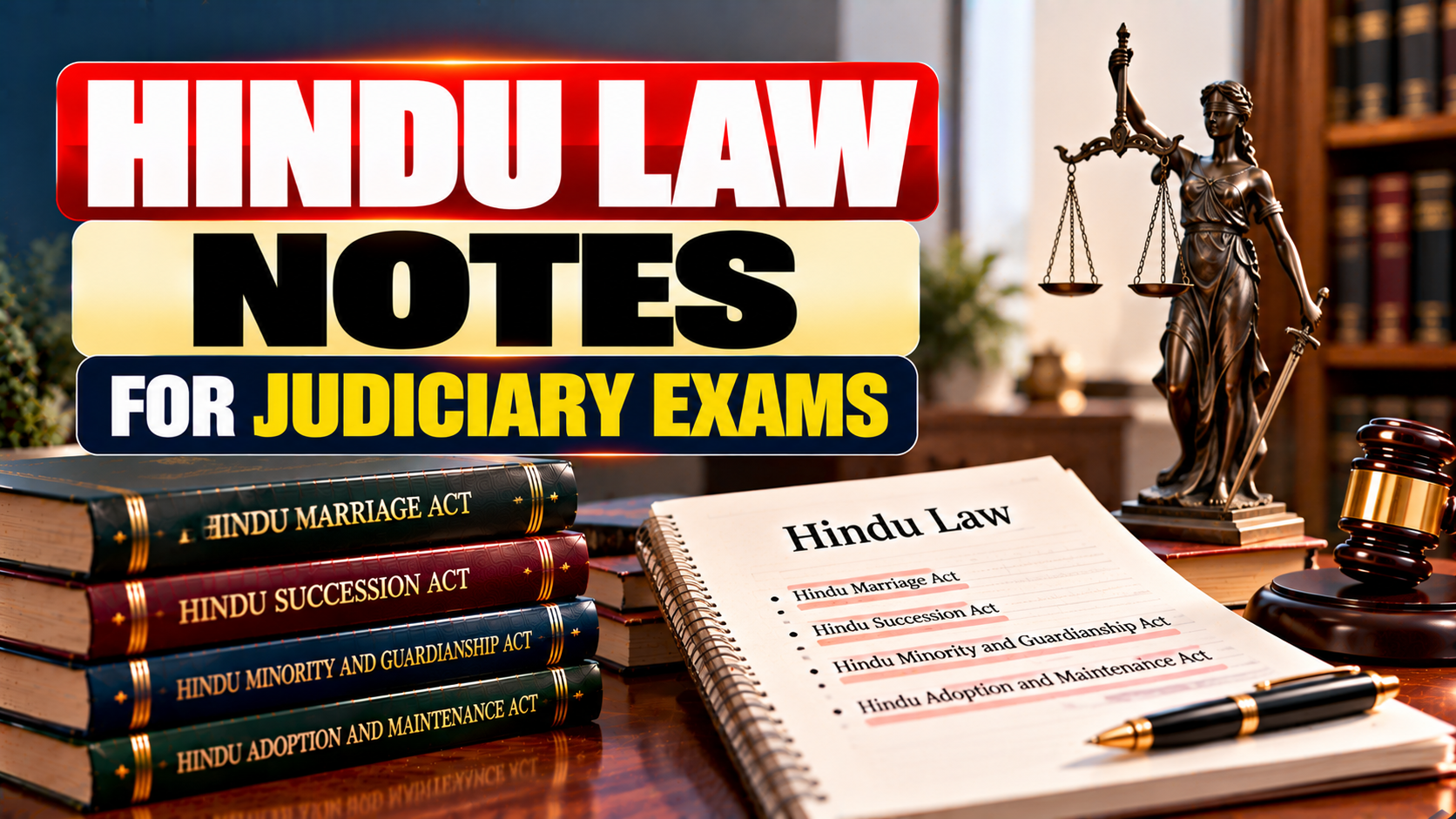
The Hindu law notes for Judiciary Exams cover only the points that judiciary exams test mostly: who Hindu law applies to, its sources and schools, the joint family, and the four 1955–56 Acts with the landmark cases.
Hindu Law remains one of the most important subjects in almost every state judicial service examination. It governs marriage, succession, adoption, maintenance, minority, and guardianship for Hindus, Buddhists, Jains, and Sikhs. A clear understanding of its sources, schools, and the major statutes is essential for both prelims and mains.
Candidates will also find focused explanations of the four key enactments that every judiciary aspirant must master:
- Hindu Marriage Act, 1955
- Hindu Succession Act, 1956 (including the 2005 amendment)
- Hindu Minority and Guardianship Act, 1956
- Hindu Adoptions and Maintenance Act, 1956
Whether preparing for Rajasthan, Uttar Pradesh, Madhya Pradesh, Uttarakhand, or any other state judiciary exam, these notes provide the essential provisions, important case references, and exam-oriented points in one place. Download the free PDF and revise systematically to strengthen your personal-law preparation.
Download Hindu Law Notes PDF for Judiciary Preparation
Download the complete Hindu law notes PDF to revise offline. It includes the full section-wise tables, all Class I and Class II heirs, every divorce ground and the complete list of landmark cases that this page summarises.
Check: Judiciary Exam Syllabus
Overview of Hindu Law Notes for Judiciary Exams
Hindu law notes for judiciary exams should cover four Acts in depth: the Hindu Marriage Act, 1955, the Hindu Succession Act, 1956, the Hindu Adoptions and Maintenance Act, 1956 and the Hindu Minority and Guardianship Act, 1956.
|
Topic |
Important Points to Remember |
Key provision |
|
Who is a Hindu |
Hindus by religion, by birth, converts, and anyone who is not a Muslim, Christian, Parsi or Jew |
Section 2, HMA / Section 2, HSA |
|
Sources |
Ancient: Shruti, Smriti, commentaries, custom. Modern: legislation, precedent, equity |
— |
|
Schools |
Mitakshara (most of India) and Dayabhaga (Bengal, Assam) |
— |
|
Valid marriage |
Five conditions |
Section 5, HMA |
|
Divorce |
Fault grounds, wife's special grounds, mutual consent |
Sections 13, 13B, HMA |
|
Daughter as coparcener |
Equal right by birth, same as a son |
Section 6, HSA (as amended in 2005) |
|
Adoption |
Capacity to adopt, to give, to be adopted, plus Section 11 conditions |
Sections 6–11, HAMA |
|
Natural guardian |
Father, then mother; mother for a child under 5 |
Section 6, HMGA |
Read about: Upcoming Judiciary Exams
Hindu Law Notes: Key Highlights
Hindu law applies to Hindus, Buddhists, Jains and Sikhs. Rajasthan, Uttar Pradesh, Madhya Pradesh, Uttarakhand, Bihar and several other state judiciary exams ask questions on it in both prelims and mains. These notes keep only what examiners actually ask: section numbers, conditions, exceptions and the judgments that changed the law.
Who Is a Hindu?
Hindu law governs marriage, succession, adoption, maintenance and guardianship of:
- Hindus, Buddhists, Jains and Sikhs by religion, including converts and reconverts.
- A child of two Hindu parents, or of one Hindu parent if brought up as a Hindu.
- Anyone who is not a Muslim, Christian, Parsi or Jew, unless proved otherwise.
The Acts do not apply to Scheduled Tribes unless the Central Government notifies otherwise.
Sources of Hindu Law
Valid custom: ancient, certain, reasonable, continuous, not against public policy, and not excluded by statute.
|
Ancient sources |
Modern sources |
|
Shruti (Vedas) |
Legislation (dominant today) |
|
Smriti (Manusmriti most cited) |
Judicial precedent (Article 141) |
|
Commentaries and digests |
Justice, equity and good conscience |
|
Custom (Section 3(a), HMA) |
Mitakshara vs Dayabhaga
|
Point |
Mitakshara |
Dayabhaga |
|
Author |
Vijnaneshwara (11th c.) |
Jimutavahana (12th c.) |
|
Applies in |
All India except Bengal and Assam |
Bengal and Assam |
|
Right in property |
By birth |
On father's death |
|
Devolution (pre-1956) |
Survivorship |
Succession |
|
Coparcener's share |
Fluctuates |
Fixed |
Joint Hindu Family and Karta
- Coparcenary: Since the 2005 amendment, a daughter is a coparcener by birth with the same rights as a son.
- Karta: Usually the senior-most member; a minor cannot be Karta. The eldest daughter can be Karta (Sujata Sharma v. Manu Gupta, Delhi HC, 2016).
- Alienation: Only for legal necessity or benefit of the estate, or with all coparceners' consent.
- Partition: A clear intention to separate ends joint status; for Section 6, only a registered deed or court decree counts.
Hindu Marriage Act, 1955
Section 5 conditions and effect of breach
|
Clause |
Condition |
Effect |
|
5(i) |
No living spouse |
Void; bigamy (S. 17) |
|
5(ii) |
Mental capacity |
Voidable |
|
5(iii) |
Groom 21, bride 18 |
Punishable (S. 18), not void |
|
5(iv) |
Not within prohibited degrees |
Void |
|
5(v) |
Not sapindas |
Void |
Read: Everything About Judiciary Exams
- Section 7: Marriage is complete on the seventh step of saptapadi.
- Section 12 (voidable): Impotence, breach of 5(ii), force or fraud, pre-marriage pregnancy by another man.
- Section 13 divorce grounds: Adultery, cruelty, desertion (2 years), conversion, mental disorder, venereal disease, renunciation, presumed death (7 years). Leprosy was removed in 2019.
- Section 13B: Mutual consent after 1 year of separation; the 6-month wait can be waived (Amardeep Singh, 2017).
- Section 14: No divorce petition within 1 year of marriage, except in hardship.
- Section 16: Children of void and voidable marriages are legitimate.
- Sections 24–25: Interim maintenance and permanent alimony for either spouse.
Hindu Succession Act, 1956
The important sections of HIndu Succession Act,1956 are -
- Section 6: From 9 September 2005, daughters are coparceners by birth, whether or not the father was alive then (Vineeta Sharma, 2020). Survivorship is replaced by testamentary or intestate succession.
- Class I heirs: 16 heirs (12 original + 4 added in 2005) who inherit together, e.g. son, daughter, widow and mother.
- Class II heirs: 9 entries, starting with the father; an earlier entry excludes a later one.
- Section 14: A Hindu woman is the absolute owner of property she possesses (V. Tulasamma, 1977).
- Sections 15–16: A woman's property goes first to children and husband; property from her parents goes back to her father's heirs if she has no children.
- Other rules: Murderer cannot inherit (S. 25); younger presumed to survive elder (S. 21); child in the womb inherits (S. 20).
Read about: Upcoming Judiciary Exams
Hindu Adoptions and Maintenance Act, 1956
The important sections of Hindu Adoptions and Maintenance Act, 1956 -
- Who can adopt: A sound-minded adult Hindu man (with wife's consent) or woman (with husband's consent, since 2010).
- Who can be adopted: A Hindu, unmarried, under 15, not already adopted.
- Section 11: no living son or daughter of the same sex; 21-year age gap for opposite-sex adoption.
- Section 15: A valid adoption cannot be cancelled.
- Maintenance: Wife (S. 18), widowed daughter-in-law (S. 19), children and aged parents (S. 20).
Read about: How to Prepare for Judiciary Exams from Scratch
Hindu Minority and Guardianship Act, 1956
The important sections of Hindu Minority and Guardianship Act, 1956 -
- Natural guardian: Father, then mother; for a child under 5, custody ordinarily stays with the mother.
- Gita Hariharan (1999): The mother can act as natural guardian when the father is absent.
- Section 8: Court permission is needed to sell, mortgage or gift a minor's immovable property.
- Section 13: The minor's welfare is the paramount consideration.
Know: How much does a judge earn
Check: Best books for Judiciary Exams
Landmark Hindu Law Cases For Judiciary Exams
The Landmark cases of Hindu Law for Judiciary Exams are given below -
|
Case |
Year |
Judgement |
|
Dastane v. Dastane |
1975 |
Cruelty need not endanger life |
|
V. Tulasamma v. Sesha Reddy |
1977 |
Property in lieu of maintenance becomes absolute |
|
Saroj Rani v. Sudarshan Kumar |
1984 |
Restitution of conjugal rights is valid |
|
Sarla Mudgal v. Union of India |
1995 |
Conversion to remarry is still bigamy |
|
Gita Hariharan v. RBI |
1999 |
Mother can be natural guardian |
|
Samar Ghosh v. Jaya Ghosh |
2007 |
Illustrations of mental cruelty |
|
Amardeep Singh v. Harveen Kaur |
2017 |
6-month cooling-off can be waived |
|
Vineeta Sharma v. Rakesh Sharma |
2020 |
Daughter is a coparcener by birth |
|
Shilpa Sailesh v. Varun Sreenivasan |
2023 |
SC can dissolve marriage on irretrievable breakdown |
|
Revanasiddappa v. Mallikarjun |
2023 |
Children of void marriages share in coparcenary share |
Read About: 50 most important topics for Essays for Judicairy
Which State Judiciary Aspirants Can Refer to These Hindu Law Notes?
These notes are useful for any state judiciary exam that includes Hindu law or personal laws in its syllabus. Aspirants preparing for the following exams can refer to them:
- UP PCS-J (Uttar Pradesh Civil Judge)
- Bihar Judicial Services
- Haryana Civil Services (Judicial Branch)
- Punjab Civil Services (Judicial Branch)
- Delhi Judicial Services (DJS)
- Rajasthan Judicial Services (RJS)
- MP Civil Judge
- Uttarakhand Judicial Services
- Jharkhand Judicial Services
- Chhattisgarh Civil Judge
- Himachal Pradesh Judicial Services
The syllabus and weightage of Hindu law differ from state to state, so check as per targeted state's latest official notification before planning for revision.
Solve: Previous year's Questions Papers for Judiciary Exams


Read: How to make a career in Judiciary
How to Make Use of Hindu Law Notes for Judiciary Exams
Candidates can do effective use of Hindu Law Notes for Judiciary Exams preparation by Short Tricks to Memorize Bare Acts and also by following the below given steps:
- Read the bare Acts first. - Use these notes after one reading of the four Acts, not instead of them.
- Learn the tables by heart - Section 5 conditions, void vs voidable, Class I and II heirs and Mitakshara vs Dayabhaga are frequent prelims questions.
- Attach a case to every section - In mains, quote the case name, year and principle with each section you cite.
- Revise amendments separately - Make a one-page list of changes from 1976, 2005, 2010 and 2019; examiners test them often.
- Practise with previous papers - After each topic, solve your state's past Hindu law questions and mark weak areas in the notes.
- Do a final 1-day revision - Go through only the highlights and the case table before the exam.
Download free: Judiciary Exams Question Paper
If you want a structured guidance, take a free demo online class or talk to a Judiciary Gold counsellor about the course.

Download Judiciary Study Material
Fill your details
Frequently Asked Questions
What are the stages in the Delhi Judiciary Exam Selection Process?

What is the marking scheme of Judiciary Prelims and Mains Exam?
What is the selection process of Karnataka Judiciary Recruitment 2026?
What is the Judiciary Exam Eligibility for Civil Judge?
How many attempts are there in Judiciary Exam?
If I complete my LLB degree with 2 years gap, will I be eligible for Judiciary Exam?
What are the subjects included in Punjab Judiciary Syllabus 2026?
What are the recommended books for the syllabus of judiciary exam in Bihar?
What are the eligibility criteria for appearing in the Rajasthan Judiciary Service Examination?
Which newspaper is best for Jharkhand Judiciary Service Examination?
Can I apply offline for Haryana Judiciary Exam?
How should one begin his/her preparation for the MP Judiciary Exam?
Which subjects are most important to focus on while preparing for the MP Judiciary Services Examination?
Which newspapers can be followed for the Delhi Judiciary examination?
What is the minimum percentage which is needed to appear for the Delhi Judiciary Service Examination?
What is the required eligibility criteria for the Bihar Judiciary Exam 2025?
How to challenge the answer key in case of error/mismatch?
What if I miss a Classroom Session?
The Study Material shall be provided in which format?

Nancy Mahavir Sharma
Legal Writer
SHARE