
1723534562.png)

CEED 2022 Question Paper PDF Download (Part A & Part B) + Answer Key
August 11, 2026
The CEED 2022 Question Paper is a useful practice resource for understanding the type of questions asked in the actual exam. It helps aspirants get familiar with the paper structure, difficulty level, design aptitude concepts, and the balance between analytical and creative thinking.
By solving the CEED 2022 question paper, you can practise important areas such as visualization, observation, logical reasoning, creativity, and problem-solving while also improving your speed and accuracy. Reviewing the paper carefully can also help you identify recurring question types and plan your CEED preparation more effectively.
Solving the CEED 2022 Question Paper PDF remains highly valuable for CEED exam aspirants as it helps understand IIT Bombay's question style, recurring topics, and the evolution of design aptitude testing over the years.
Key Highlights of CEED 2023 Question Paper
- Exam Name: CEED 2022 (Common Entrance Examination for Design)
- Conducting Institute: IIT Bombay
- Exam Date: 23 January 2022
- Total Marks & Duration: 200 Marks; 3 hours
- Part A Weightage: 100 Marks (NAT, MSQ, and MCQ questions)
- Part B Weightage: 100 Marks (Sketching, Creativity, Visual Sensitivity, Form Sensitivity, and Problem Identification)
- Total Part A Questions: 41 Questions (8 NAT + 10 MSQ + 23 MCQ)
- Total Part B Questions: 5 Subjective Questions
- Difficulty Level: Moderate to Difficult
- Most Tested Skills: Spatial visualization, observation, product mechanics, logical reasoning, ergonomics, design aptitude, and creativity
- Part A Highlights: Included cube visualization, pulley systems, wheelchair-accessible ramp design, rocking chair stability, mould design, biomimicry, folding mechanisms, shadows, and pattern recognition.
- Part B Highlights: Candidates had to sketch an RT-PCR testing scene, create visual concepts from abstract elements, design icons for an Indian mela, derive an electric iron from an architectural form, and identify design problems in a crowded train-boarding scenario.
- Best For: CEED 2027 and CEED 2028 aspirants looking to understand IIT Bombay's design aptitude testing approach and practice real exam-level questions.
CEED 2022 Question Paper PDF Download
Looking for the official CEED 2022 Question Paper PDF, answer key, and other important exam resources? Use the table below to access all CEED 2022 study materials in one place.
|
Resource |
Download Link |
|
CEED 2022 Question Paper PDF |
|
|
CEED 2022 Final Answer Key PDF |
Preparation Tip: Attempt the CEED 2022 Question Paper under actual exam conditions before checking the answer key. This will help you evaluate your visualization, observation, creativity, and time-management skills more accurately.
Links to Other CEED Previous Year Question Papers:
Table of Contents
- CEED 2022 Question Paper Download Link
- What is the CEED 2022 Question Paper?
- CEED 2022 Exam Pattern
- CEED 2022 Part A Analysis
- CEED 2022 Part B Analysis
- CEED 2022 Solved Paper: Expert Approaches & Solutions for Part B Questions
- CEED 2022 Overall Difficulty Level Analysis
- Recommended Good Attempts Strategy for CEED 2022
- CEED 2022 vs CEED 2023 vs CEED 2024 vs CEED 2025 vs CEED 2026 Question Papers
- How to Use the CEED 2022 Question Paper for Preparation
- Why Solving the CEED 2022 Question Paper is Important for CEED 2027 Aspirants
CEED 2022 Question Paper - Overview
The CEED 2022 Question Paper is the official entrance exam paper conducted by IIT Bombay in 2022, for admission to M.Des programs at leading design institutes.
It evaluates a candidate's design aptitude, spatial visualization, observation skills, creativity, sketching ability, and problem-solving approach through both objective and subjective questions.
|
Particulars |
Details |
|
Exam Name |
CEED 2022 |
|
Conducting Institute |
IIT Bombay |
|
Duration |
3 Hours |
|
Total Marks |
200 Marks |
|
Part A |
100 Marks |
|
Part B |
100 Marks |
|
Question Types |
NAT, MSQ, MCQ & Subjective Questions |
|
Difficulty Level |
Moderate to Difficult |
|
Major Focus Areas |
Visualization, Observation, Product Design, Creativity & Design Thinking |
CEED 2022 Exam Pattern
The CEED 2022 exam consisted of two parts- Part A (objective) and Part B (subjective).
Part A tested design aptitude, visualization, reasoning, and observation skills, while Part B evaluated creativity, sketching, visual communication, form development, and problem identification.
Part A Structure:
|
Question Type |
Number of Questions |
Marks |
|
NAT (Numerical Answer Type) |
8 |
24 Marks |
|
MSQ (Multiple Select Questions) |
10 |
30 Marks |
|
MCQ (Multiple Choice Questions) |
23 |
46 Marks |
|
Total |
41 Questions |
100 Marks |
Read More: CEED 2027 Exam Pattern in Detail
Part B Structure:
|
Question Type |
Skills Tested |
|
Sketching |
Perspective, composition, proportion, line quality, anatomy |
|
Creativity |
Original thinking, ideation, uniqueness, visual storytelling |
|
Form Sensitivity |
Product visualization, form development, design language |
|
Visual Sensitivity |
Visual communication, branding, aesthetics, composition |
|
Problem Identification |
Observation skills, user understanding, design thinking |
|
Total: 5 Questions × 20 Marks |
100 Marks |
Check: Complete CEED Syllabus for 2027 (Part A + Part B)
_(1)1764330056.webp)
CEED 2022 Part A Analysis
|
Section |
Question Type |
Questions |
What Was Asked? |
Difficulty Level |
|
Section I |
NAT |
8 |
Painted solids, 3D form reconstruction, shadow generation, geometry-based area calculation, pyramid stacking, wheelchair-accessible ramp design, pulley system, edge counting in 3D forms |
Moderate to Difficult |
|
Section II |
MSQ |
10 |
Data interpretation, school bus-stop planning, balance and equilibrium, graph identification, rocking chair stability, orthographic projections, tessellations, animated shape transformation, scissor mechanisms, pattern generation |
Difficult |
|
Section III |
MCQ |
23 |
Ergonomics, cube visualization, mould design, leaf motion, visual perception, pattern recognition, weaving structures, product mechanisms, packaging nets, rolling paths, biomimicry, air filtration systems, shadows, cylinder wrapping, folding furniture and more |
Moderate to Difficult |
Check: CEED Colleges
CEED 2022 Question Paper Sample Questions (Part A):
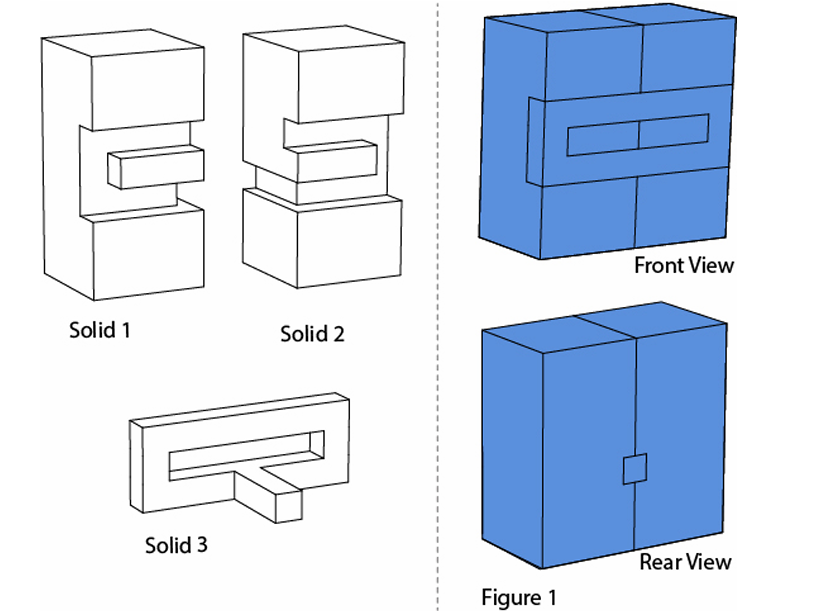
Q1) Solid 1, Solid 2 and Solid 3 are joined together to form a cuboid as shown in Figure 1. The cuboid is then painted from all the sides. How many surfaces are there without the paint when you separate all the three solids?
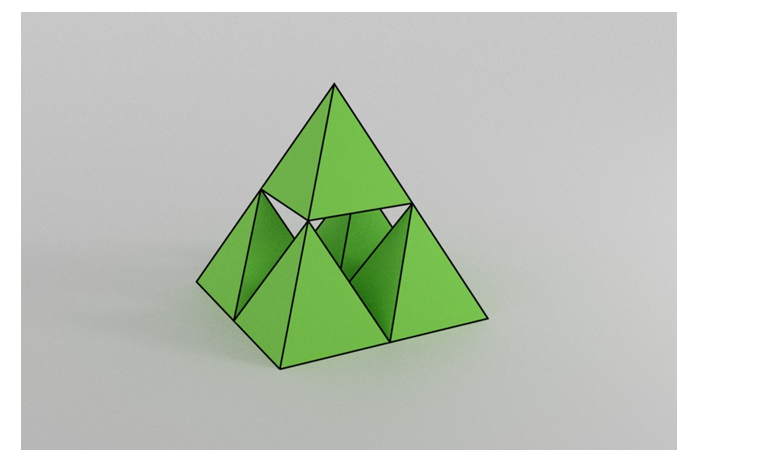
Q2) Five square pyramids are stacked as shown in the figure below with the bottom layer consisting of four pyramids in a 2 x 2 grid. If the bottom layer consists of pyramids in 6 x 7 grid, and they are stacked in a similar manner to its maximum height, how many pyramids will the formation contain?
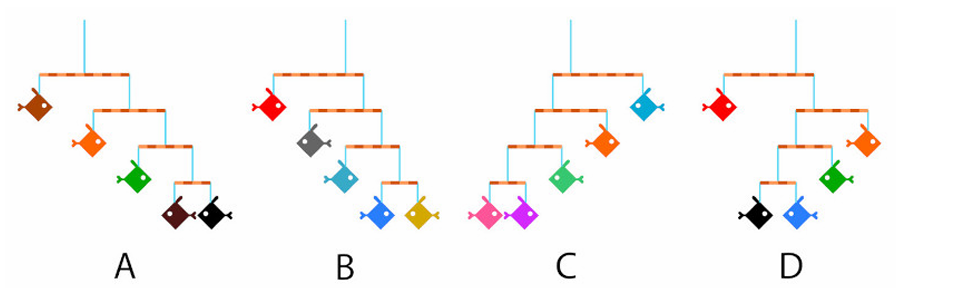
Q3) Mobile sculptures are created by tying fish-shaped cut-outs of different colours using blue strings on brown sticks of negligible weight, as shown below. All the fish cut-outs are of the same size and weight. Which of the options will remain balanced after suspending from a ceiling?
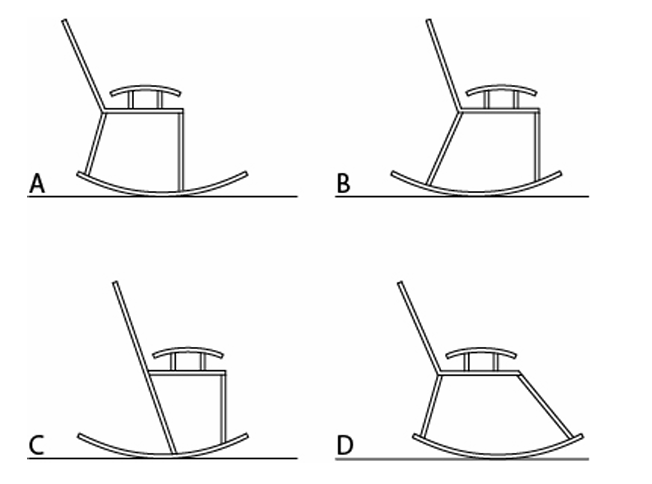
Q4) Which of the following rocking chairs will NOT topple while rocking 15 degree?
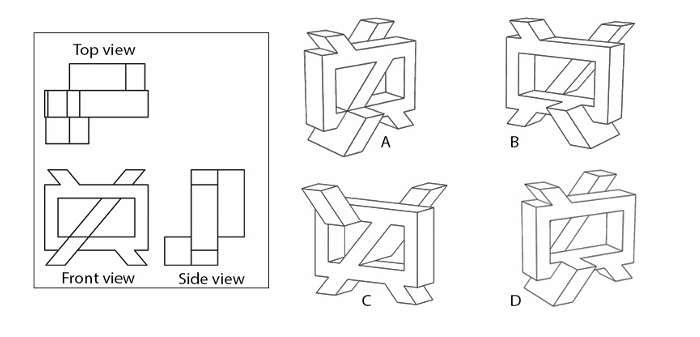
Q5) Shown in the box are the orthographic views of a 3D object. Which option represents that object?
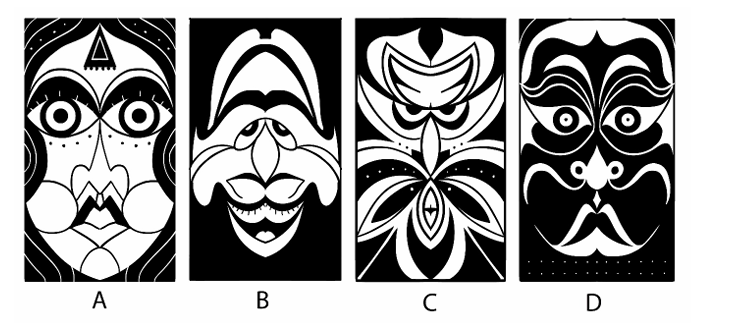
Q6) Which option resembles an angry person when flipped vertically?
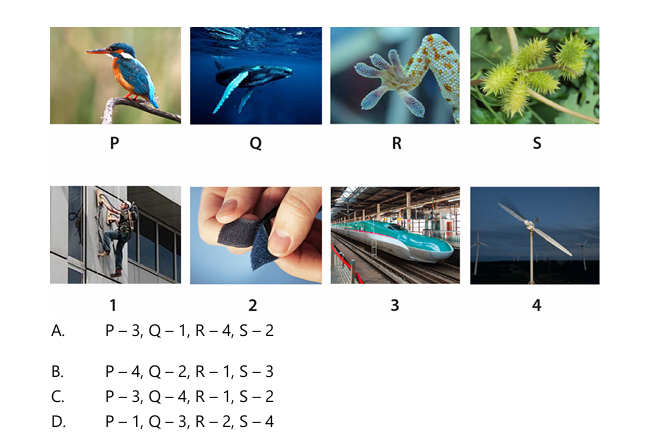
Q7) Biomimicry is the practice of looking to nature for inspiration to solve design problems. Shown below are plants and animals (top row) that have inspired the design of products (bottom row). Which of the options listed below correctly identifies the plant and/or animal with the product that it inspired?
Check: Best CEED Online Prep Courses
CEED 2022 Part B Analysis
|
Question |
Skill Area |
What Was Asked? |
Difficulty Level |
|
Q1 |
Sketching |
Draw an RT-PCR COVID-19 testing scene showing a healthcare worker in PPE collecting a sample from a seated woman |
Moderate |
|
Q2 |
Creativity |
Create recognizable images from given visual elements and provide suitable titles |
Moderate |
|
Q3 |
Visual Sensitivity |
Design a set of icons for an Indian mela (Information Desk, Craft Zone, Children Zone, Game Zone) |
Moderate |
|
Q4 |
Form Sensitivity |
Design an electric iron inspired by the form language of a given architectural structure |
Difficult |
|
Q5 |
Problem Identification |
Identify 10 design problems/opportunities in a crowded train-boarding scenario and illustrate two of them |
Moderate to Difficult |
Check: CEED 2027 preparation Strategy
CEED 2022 Solved Paper: Expert Approaches & Solutions
Unlike Part A, Part B does not have fixed answers. Candidates are evaluated on creativity, observation, visual communication, problem-solving, and design thinking.
The approaches below highlight what a high-scoring response would typically include.
Question 1: RT-PCR Testing Scene
What Was Asked?
Draw a healthcare worker in PPE collecting an RT-PCR sample from a seated woman in a testing facility.
High-Scoring Approach
✅ Establish a clear indoor testing environment.
✅ Maintain accurate proportions for both figures.
✅ Show correct PPE elements such as face shield, gloves, mask, and protective suit.
✅ Capture the interaction naturally rather than drawing static figures.
✅ Use basic shading and overlaps to create depth.
Question 2: Creativity Exercise
What Was Asked?
Create meaningful visuals using the given abstract shapes and provide suitable titles.
High-Scoring Approach
Instead of literal interpretations, transform the elements into unexpected yet recognizable concepts.
|
Average Response |
Strong Response |
|
Bird |
Migration |
|
Tree |
Growth of Ideas |
|
Fish |
Ocean Pollution |
|
Face |
Hidden Identity |
Check: CEED 2027 Expected Cut-off
Question 3: Indian Mela Icon Design
What Was Asked?
Design icons for:
- Information Desk
- Craft Zone
- Children Zone
- Game Zone
High-Scoring Approach
✅ Create a unified visual style across all icons.
✅ Keep symbols simple and instantly recognizable.
✅ Use consistent line weights and shapes.
Question 4: Electric Iron Design
What Was Asked?
Design an electric iron inspired by the form language of a given architectural structure.
High-Scoring Approach
Start by identifying the architectural characteristics:
- Curves or sharp edges
- Repetition patterns
- Structural rhythm
- Surface treatment
Then translate those features into:
- Handle design
- Body shape
- Soleplate form
- Control placement
Question 5: Train Boarding Scenario
What Was Asked?
Identify ten design problems or opportunities in a crowded train-boarding situation and illustrate two of them.
High-Scoring Approach
Look beyond obvious crowding issues.
Potential observations:
- Unsafe passenger movement
- Lack of queue management
- Accessibility concerns
- Poor signage
- Platform congestion
- Luggage obstruction
- Elderly passenger difficulties
- Entry-exit conflicts
For the illustrated problems:
✅ Clearly show the issue.
✅ Use annotations to communicate the problem.
✅ Focus on user experience rather than drawing quality.
Check: CEED Participating Colleges
CEED 2022 Overall Difficulty Level Analysis
The CEED 2022 Question Paper was generally considered moderate to difficult, with a strong focus on spatial visualization, product-mechanism understanding, observation skills, ergonomics, and design thinking.
While Part A required analytical and visual reasoning abilities, Part B tested creativity, sketching, visual communication, and problem identification in real-world contexts.
Difficulty Breakdown
|
Section |
Difficulty Level |
Key Challenges |
|
Part A – NAT |
Moderate |
Geometry, pulley systems, area calculations, 3D visualization |
|
Part A – MSQ |
Difficult |
Orthographic views, rocking chair stability, animated transformations, pattern generation |
|
Part A – MCQ |
Moderate to Difficult |
Cube visualization, mould design, biomimicry, shadows, folding mechanisms |
|
Part B – Sketching |
Moderate |
Human figures, composition, perspective, PPE-clad healthcare worker scene |
|
Part B – Creativity |
Moderate |
Generating original concepts from limited visual elements |
|
Part B – Visual Sensitivity |
Easy to Moderate |
Designing a consistent icon family for an Indian mela |
|
Part B – Form Sensitivity |
Difficult |
Translating an architectural form into an electric iron design |
|
Part B – Problem Identification |
Moderate to Difficult |
Identifying multiple user problems in a crowded train-boarding scenario |
Know More: CEED Fee Structure
Recommended Good Attempts Strategy for CEED 2022
Success in CEED 2022 depended more on accuracy and question selection than attempting every question. Since the paper included several visualization-heavy and mechanism-based questions, candidates who avoided blind guessing generally performed better.
Section-wise Attempt Strategy
|
Section |
Recommended Attempts |
Strategy |
|
NAT (8 Questions) |
7-8 Questions |
Attempt almost all questions since there is no negative marking. Use logical elimination and educated guesses whenever possible. |
|
MSQ (10 Questions) |
6-8 Questions |
Be selective. Attempt only when reasonably confident about all correct options. Avoid excessive guessing due to negative marking. |
|
MCQ (23 Questions) |
18-22 Questions |
Target maximum attempts. Use elimination techniques and prioritize easier observation and design-awareness questions first. |
Note: Good attempts assume reasonable accuracy, especially in MSQ questions where negative marking can significantly impact scores.
Attempt: Exam-like Full-length CEED Mock Tests

1757510491.webp)
CEED 2022 vs CEED 2023 vs CEED 2024 vs CEED 2025 vs CEED 2026 Question Papers
|
Parameter |
CEED 2022 |
CEED 2023 |
CEED 2024 |
CEED 2025 |
CEED 2026 |
|
Overall Difficulty |
Moderate-Difficult |
Moderate |
Difficult |
Difficult |
Very Difficult |
|
Part A Focus |
Visualization, ergonomics, mechanisms |
Logic, visualization, mathematical reasoning |
Pattern recognition, visualization, design aptitude |
Advanced visualization, analytical reasoning, manufacturing awareness |
High-level visualization, geometry, abstraction, complex problem-solving |
|
Part B Focus |
Observation, icon design, product form |
Sketching, storytelling, service design, creativity |
Design thinking, communication, product innovation |
User-centered design, systems thinking, advanced creativity |
Conceptual thinking, problem solving, visual communication, future-oriented design |
|
Mathematics Involvement |
Moderate |
Moderate |
Moderate-High |
High |
High |
|
Spatial Visualization |
High |
High |
Very High |
Very High |
Extremely High |
|
Design Thinking Weightage |
High |
High |
Very High |
Very High |
Very High |
|
Mechanical/Product Reasoning |
High |
Moderate |
High |
High |
High |
|
Observation-Based Questions |
High |
High |
Moderate |
Moderate |
Moderate |
|
Creativity Demand in Part B |
Moderate |
High |
High |
Very High |
Very High |
|
Best For Beginners? |
✅ Yes |
✅ Yes |
⚠ Moderate |
❌ No |
❌ No |
Difficulty Trend Analysis:
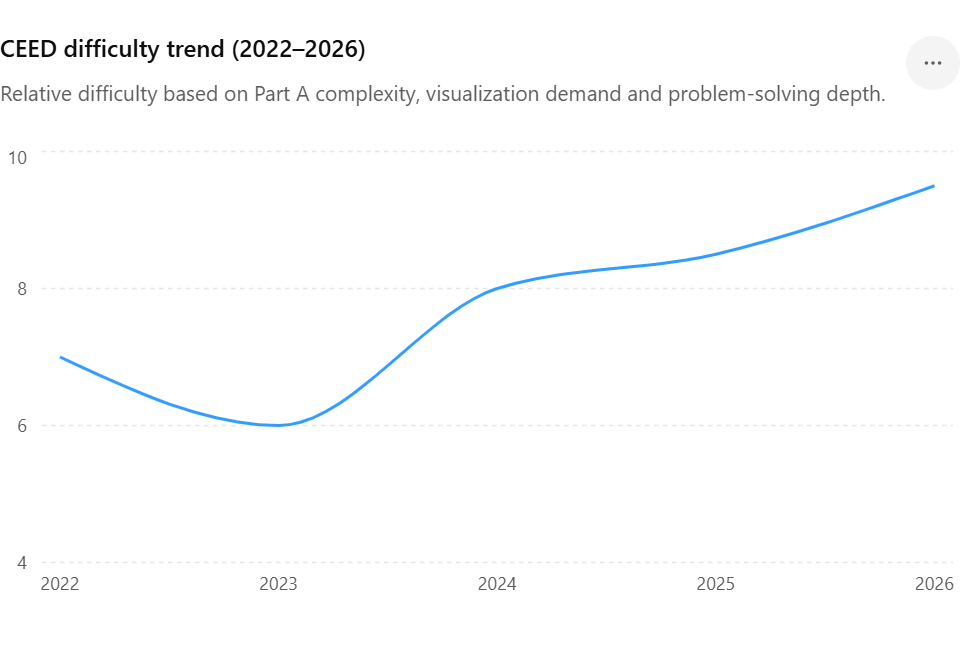
Also Read: CEED Admit Card
How to Use the CEED 2022 Question Paper for Preparation
|
Step |
What to Do |
Why It Helps |
|
1. Attempt Under Exam Conditions |
Solve the complete CEED 2022 paper in 3 hours without interruptions. |
Builds exam temperament and time-management skills. |
|
2. Analyze Your Mistakes |
Identify errors in visualization, logic, observation, and sketching questions. |
Reveals weak areas that need improvement. |
|
3. Compare with Official Solutions |
Check the answer key and evaluate your Part B responses critically. |
Helps understand IIT Bombay's expectations. |
|
4. Improve Sketching & Visualization |
Redraw Part B questions and practice alternative solutions. |
Strengthens spatial thinking and visual communication. |
|
5. Reattempt After 30 Days |
Solve the paper again without revisiting previous answers. |
Measures actual improvement and retention. |
Pro Tip: Don't just solve CEED 2022 once. Use it as a diagnostic tool to identify recurring weaknesses before moving on to more challenging papers like CEED 2025 and CEED 2026.
Also Check: Job Opportunities After CEED
Why Solving the CEED 2022 Question Paper is Important for CEED 2027 Aspirants
|
Benefit |
Why It Matters |
|
Understand IIT Bombay's Mindset |
Learn how CEED evaluates design aptitude, observation, creativity, and problem-solving. |
|
Identify Recurring Themes |
Topics such as visualization, ergonomics, product thinking, geometry, and design awareness appear repeatedly across years. |
|
Improve Speed & Accuracy |
Practicing under timed conditions helps optimize Part A performance. |
|
Strengthen Sketching Skills |
Part B offers valuable practice for sketching, visual communication, and form development. |
|
Develop Design Thinking |
Questions focus on user needs, functionality, and problem identification rather than artistic ability alone. |
|
Build Exam Confidence |
Solving an actual CEED paper reduces uncertainty and improves confidence before attempting recent papers. |
Check: CEED 2026 Question Paper with Full Part A & Part B Analysis
Final Takeaway
The biggest insight from analyzing the CEED 2022 Question Paper is that IIT Bombay was already emphasizing design thinking over rote aptitude.
While the paper included visualization, geometry, and logical reasoning questions, a significant portion of both Part A and Part B focused on ergonomics, accessibility, product understanding, visual communication, observation, and real-world problem identification.
If CEED 2025 and CEED 2026 show where the exam is heading, the CEED 2022 Question Paper explains the fundamentals on which those advanced questions are built.
That's why it remains one of the most valuable previous-year papers for developing the mindset required to secure a high CEED rank.
Preparing for CEED 2027? We can help you with exact strategic roadmap, study material and crucial feedback required to ace this exam.
Join best CEED Online Coaching by CreativEdge and get expert guidance on all CEED subjects.
Vineeta Agrawal
Communications Executive
SHARE