
1723534562.png)

BNS for CLAT PG and AILET PG 2027 Preparation: Key Topics, Landmark Cases, and Exam Relevance
February 5, 2026
Readers Insight: The Bharatiya Nyaya Sanhita (BNS), 2023 has created a new era in Indian criminal law by replacing the Indian Penal Code (IPC) after more than 160 years. This reform marks one of the biggest shifts in the history of Indian legal education. For aspirants preparing for CLAT PG 2027 and AILET PG 2027, the BNS is not just another subject to memorize it represents a high-weightage, scoring area that directly influences exam performance.
Highlight:
- Most important BNS topics for CLAT PG 2027 and AILET PG 2027
- Landmark cases that connect with contemporary criminal law
- The impact of BNS on law entrance exams
- Proven strategies to prepare effectively
By the end, you’ll have a clear understanding of why the BNS should be at the centre of your law exam preparation.
Looking for more details on the exam? Check out the CLAT PG Exam & AILET PG Exam page!
BNS for CLAT PG & AILET PG Preparation 2026 – Complete Guide
The Bharatiya Nyaya Sanhita consolidates criminal laws into 20 chapters and 358 sections, modernizing procedures, tightening punishments, and aligning provisions with 21st-century challenges. Some notable reforms include:
- Zero FIR and e-filing mechanisms to make justice more accessible
- Recognition of digital evidence, adapting to technological crimes
- Victim-centric safeguards, strengthening rights of survivors
- Sharpened sentencing policies with mandatory minimum punishments
For law entrance exams, this creates fresh opportunities for examiners to frame questions around interpretation, application, and reasoning rather than rote recall. Both CLAT PG 2027 and AILET PG 2027 are driven by understanding the law in context, and BNS fits perfectly as a current, high-utility subject.
Most Important BNS Topics for CLAT PG 2027 & AILET PG 2027
Not every provision of the BNS carries equal exam weightage. Based on exam patterns and expert advice, here are the priority areas to focus on:
| Topic Area | Key Provisions / Sub-Topics |
|---|---|
| Elements of Crime | Mens Rea, Actus Reus, Abetment, Criminal Conspiracy, Group Liability |
| Offenses Against the Body | Murder, Culpable Homicide, Hurt, Wrongful Confinement, Kidnapping, Abduction |
| Sexual Offenses & Social Crimes | Rape provisions, Unnatural Offenses, Crimes against dignity/socially destructive crimes |
| General Definitions | Foundational chapters defining criminal liability and responsibility |
| Procedural Provisions | Jurisdictional rules, Trial procedure, Investigation process, Bail and Bonds |
| New Provisions | Recognition of Digital Evidence, Electronic Communication in trials, Enhanced Investigation Powers |
| Punishments & Sentencing | Longer imprisonment terms, New fine structures, Mandatory minimum sentences |
Tip: For AILET PG, you must be extra vigilant in practicing application-based reasoning questions. The exam often presents legal fact situations where you need to use these BNS sections to analyze liability.
Landmark Cases to Strengthen BNS Preparation
No exam preparation is complete without integrating case law. Here are landmark Supreme Court cases that are especially relevant for interpreting BNS provisions:
| Case | Key Contribution / Relevance |
|---|---|
| Navtej Singh Johar v. Union of India | Decriminalized consensual same-sex conduct; reshaped interpretation of sexual offenses. |
| Joseph Shine v. Union of India | Struck down adultery law; highlighted personal liberty and autonomy in the context of criminal law. |
| Bilkis Yakub Rasool v. Union of India | Raised critical issues on remission policies and emphasized rights of victims. |
| State of Punjab v. Davinder Singh | Clarified principles of affirmative action and equality with implications for criminal justice. |
| Sarla Mudgal v. Union of India | Addressed bigamy under personal law; linked constitutional mandates with criminal liability. |
| Vishakha v. State of Rajasthan | Laid down guidelines on sexual harassment; bridged constitutional rights with criminal safeguards. |
| Aruna Shanbaug v. Union of India | Landmark case on euthanasia; merged constitutional principles with criminal responsibility. |
1766508002.webp)
1766507564.webp)
Preparation Tip: Do not merely memorize the outcomes. Focus on how these cases influence crime definitions, punishments, and rights of the accused or victims under the BNS framework.
Impact of BNS on Law Entrance Exams
The introduction of the Bharatiya Nyaya Sanhita has directly influenced the way CLAT PG 2027 and AILET PG 2027 will test aspirants:
| Aspect | Explanation |
|---|---|
| Contemporary Edge | As a newly introduced law, BNS is a favorite testing area since it reflects current legal reforms. |
| Shift from Recall to Application | Exams now emphasize reasoning-based passages and application of provisions rather than direct memory-based questions. |
| Integration with Other Subjects | Questions often combine BNS with constitutional law, victim rights, and landmark case law for a holistic approach. |
| High Scoring Potential | Since many aspirants are unfamiliar with the BNS, those who master it gain a clear competitive advantage. |
By understanding how examiners integrate new reforms into the paper, aspirants can build a targeted and effective preparation strategy.
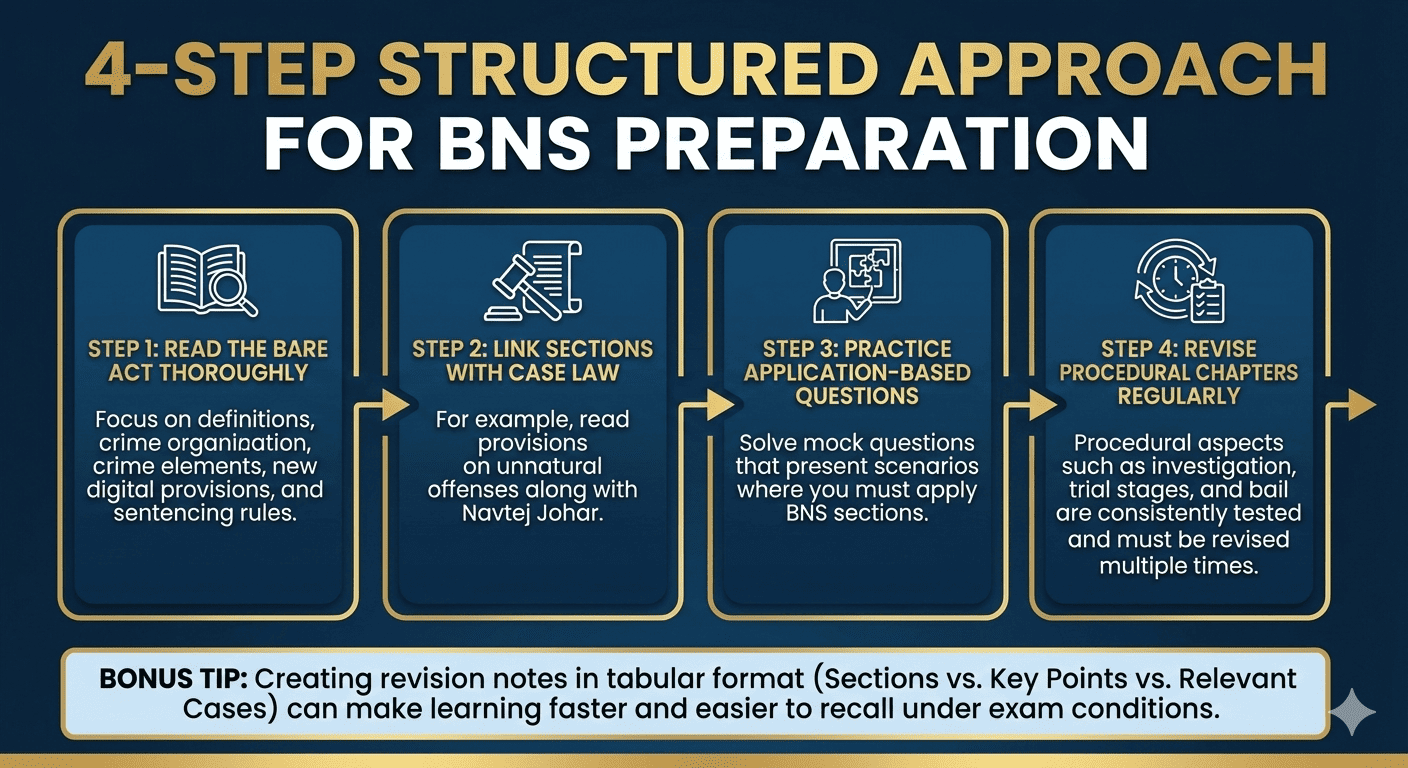
Here is a structured 4-step approach for BNS preparation:
Final Takeaway
The Bharatiya Nyaya Sanhita (BNS), 2023 is not just a replacement for the IPC; it is also a strategic subject for CLAT PG 2027 and AILET PG 2027 aspirants. By mastering crucial provisions on crime definitions, sentencing structures, and procedural safeguards—and pairing them with landmark cases you can turn BNS into a high-scoring subject.
The key lies in preparation that moves beyond memory into applied understanding and critical reasoning. If you approach the BNS with this mindset, you will not just perform better in CLAT PG 2027 or AILET PG 2027 but also build a solid foundation for your future in legal practice.

Pragati Pragi
Content writer
SHARE