
1723534562.png)

IIMB UG Syllabus 2027 (IIM Bangalore UG Test): Section-Wise Topics, Weightage
September 18, 2026
The IIMB UG syllabus 2027 for the IIM Bangalore UG admission test is broadly based on NCERT (Class 10–12) but focuses on application-based questions.
Below you’ll find the section-wise topic list for Quant & DI, English and Logical Reasoning, along with weightage (60 questions), duration (135 minutes) and negative marking.
Preparing for the IIM Bangalore UG admission test? This guide breaks down the IIMB UG syllabus 2027 into Quant & DI, English and LR with topic checklists, priority areas and a simple weekly plan so you can start preparation immediately.
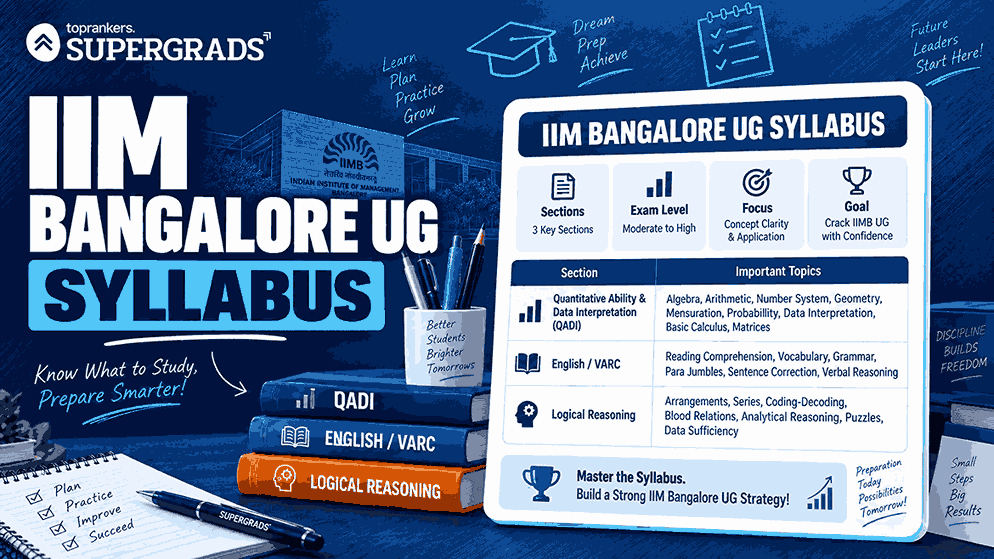
The IIMB UG Syllabus covers three major sections:
- Quantitative Aptitude & Data Interpretation
- English Comprehension
- Logical Reasoning
The Quantitative Aptitude & Data Interpretation section carries the highest number of questions, making the IIMB UG Quantitative & Data Interpretation Syllabus particularly important for aspirants.
Candidates preparing for the BSc (Honours) programmes in Data Science and Economics should understand the IIMB UG BSc Syllabus, identify their weak areas and practise application-based questions regularly.
For a complete overview of the admission journey, candidates can also check the IIMB UG Application Form 2027.
IIMB UG Syllabus 2027 Highlights
Before diving into the detailed IIMB UG Syllabus, let's look at the exam structure.
| Events | Details |
|---|---|
| Exam | IIMB UG Admission Test |
| Mode | Computer-Based Test |
| Duration | 135 minutes |
| Total Questions | 60 |
| Quantitative Aptitude & DI | 30 questions |
| English Comprehension | 15 questions |
| Logical Reasoning | 15 questions |
| Negative Marking | 1/3 mark for every incorrect answer |
| Academic Base | NCERT Classes 10, 11 & 12 |
The IIMB UG quantitative aptitude syllabus accounts for the largest portion of the examination because Quantitative Aptitude and Data Interpretation together contribute 30 questions.
There are no strict sectional time limits, allowing candidates to manage their 135 minutes across the three sections.
IIMB UG Syllabus 2027
The IIMB UG Entrance Exam Syllabus is divided into three sections:
- IIMB UG Quantitative & Data Interpretation Syllabus
- IIMB UG English Comprehension Syllabus
- IIMB UG Logical Reasoning Syllabus
The IIM bangalore ug entrance exam syllabus is primarily based on the NCERT curriculum for Classes 10, 11 and 12.
However, remember that the exam tests the application of concepts, not just textbook-style questions.
This means that understanding a formula is not enough. You should also know how to apply it to unfamiliar problems.
IIMB UG Syllabus Weightage 2027
The question distribution makes it easier to prioritise your preparation.
| Section | Questions | Approx. Share |
|---|---|---|
| Quantitative Aptitude & DI | 30 | 50% |
| English Comprehension | 15 | 25% |
| Logical Reasoning | 15 | 25% |
| Total | 60 | 100% |
Therefore, the IIMB UG quantitative aptitude syllabus deserves substantial preparation time.
However, don't ignore the other two sections. A balanced score across all three can be more useful than becoming highly specialised in only one area.
Candidates should also understand the complete IIMB UG Admission Process, including the admission test, interview and final selection.
IIMB UG Quantitative & Data Interpretation Syllabus 2027
The IIMB UG Quantitative & Data Interpretation Syllabus is the largest section of the examination, with 30 questions.
It tests numerical ability, mathematical concepts, problem-solving skills and the ability to interpret numerical information.
The major areas to prepare include:
IIMB UG Quantitative Aptitude Syllabus
| Topic | Important Sub-Topics |
|---|---|
| Number System |
|
| Arithmetic |
|
| Algebra |
|
| Geometry |
|
| Trigonometry |
|
| Calculus |
|
| Probability |
|
| Statistics |
|
IIMB UG Data Interpretation Syllabus
Data Interpretation is included within the Quantitative Aptitude & DI section.
The IIMB UG Quantitative & Data Interpretation Syllabus requires candidates to interpret numerical information presented through different formats.
Practise:
- Tables
- Bar graphs
- Line graphs
- Pie charts
- Caselets
- Data comparison
- Percentage-based data
- Ratio-based data
- Graph-based questions
The important skill here is accuracy under time pressure.
You should learn to identify relevant information quickly and avoid unnecessary calculations.
It is equally important to check the latest IIMB UG Eligibility Criteria before applying.
IIMB UG English Comprehension Syllabus
The IIMB UG English Comprehension Syllabus evaluates a candidate's ability to read, understand and interpret written information.
This section contains 15 questions.
The major areas of preparation include:
- Reading Comprehension
- Vocabulary
- Grammar
- Sentence correction
- Para jumbles
- Sentence completion
- Main idea
- Inference
- Author's tone
- Summary-based questions
Unlike vocabulary-heavy entrance examinations, candidates should focus on understanding English in context.
After completing the basic IIMB UG Syllabus, start solving IIMB UG Sample Papers.
IIMB UG Reading Comprehension Syllabus
Reading Comprehension is one of the most important components of the IIMB UG English Comprehension Syllabus.
Questions can test your ability to identify:
- Main idea
- Central argument
- Supporting details
- Inferences
- Author's purpose
- Tone
- Conclusions
- Relationship between ideas
A daily reading habit can significantly improve performance.
Read editorials, essays, business articles, science articles and other analytical content.
IIMB UG Vocabulary Syllabus
Vocabulary preparation should cover:
- Synonyms
- Antonyms
- Contextual meaning
- Word usage
- Idioms
- Phrases
Rather than memorising hundreds of words, focus on learning how words function in different contexts.
IIMB UG Grammar Syllabus
The IIMB UG English Comprehension Syllabus also requires a solid understanding of basic grammar.
Revise:
- Subject-verb agreement
- Tenses
- Pronouns
- Prepositions
- Articles
- Modifiers
- Parts of speech
- Sentence structure
- Parallelism
- Error detection
IIMB UG Logical Reasoning Syllabus
The IIMB UG Logical Reasoning Syllabus contains 15 questions and tests analytical thinking and problem-solving ability.
Important areas include:
- Number series
- Letter series
- Analogies
- Coding-decoding
- Syllogisms
- Statements and conclusions
- Critical reasoning
- Puzzles
- Seating arrangements
- Logical sequences
- Data sufficiency
- Directions
- Blood relations
- Grouping and selection
Logical Reasoning is less about memorising formulas and more about identifying patterns and relationships.
IIMB UG Critical Reasoning Syllabus
The IIMB UG Logical Reasoning Syllabus may require candidates to evaluate arguments and identify logical relationships.
Practise:
- Statements
- Arguments
- Assumptions
- Conclusions
- Cause and effect
- Strengthening arguments
- Weakening arguments
- Inferences
IIMB UG Puzzles & Arrangements Syllabus
Candidates should practise:
- Seating arrangements
- Linear arrangements
- Grouping
- Ordering
- Selection
- Scheduling
- Distribution-based puzzles
Use diagrams and tables whenever they help organise information.
IIMB UG Data Sufficiency Syllabus
Data Sufficiency questions test whether the information provided is enough to answer a question.
The important skill is to determine whether:
- Statement I alone is sufficient
- Statement II alone is sufficient
- Both statements are required
- Neither statement is sufficient
Once the examination is completed, candidates can follow the IIM Bangalore UG Result updates and prepare for the next stage.
IIMB UG Syllabus and NCERT 2027
The IIMB UG Syllabus 2027 is primarily based on the NCERT curriculum for Classes 10, 11 and 12.
This is good news for school students because their regular academic preparation can provide the foundation for the entrance test.
However, there is an important difference.
Board preparation: Understand and reproduce concepts.
IIMB UG preparation: Understand concepts and apply them to unfamiliar problems.
Therefore, students should use NCERT as the foundation and supplement it with aptitude questions, reasoning practice, reading comprehension and IIMB UG mock tests
IIMB UG Syllabus 2027: Important Topics
If you are starting preparation and want to prioritise the most important areas, begin with these topics.
| Quantitative Aptitude & DI | English Language | Logical Reasoning |
|---|---|---|
|
|
|
IIMB UG Syllabus 2027 Preparation Strategy
Once you understand the IIMB UG Syllabus, the next step is creating a practical preparation plan.
Step 1: Complete NCERT
Start with Mathematics from Classes 10, 11 and 12.
Make sure you understand the concepts before moving to advanced practice.
Step 2: Prioritise Quantitative Aptitude
Since Quantitative Aptitude & DI account for 30 of the 60 questions, dedicate significant preparation time to this section.
Step 3: Develop Reading Habits
Spend at least 20–30 minutes reading every day.
This will help with the IIMB UG English Comprehension Syllabus, particularly inference and vocabulary.
Step 4: Practise Logical Reasoning
Solve a few reasoning questions every day rather than studying LR only immediately before the examination.
Step 5: Solve Sample Papers
After completing the basic IIM bangalore ug entrance exam syllabus, start solving IIMB UG Practice Papers.
Sample papers can help you understand question types, identify weak areas and improve time management.
Step 6: Take Mock Tests
Regular mock tests are particularly useful once you have covered the major portions of the IIMB UG Syllabus.
For a structured preparation approach, students can also refer to IIMB UG Entrance Exam Preparation.
Conclusion
The IIMB UG Syllabus 2027 is not about studying hundreds of unrelated topics. It is about developing a strong foundation and learning how to apply what you already know.
Keep these five things in mind:
- Complete NCERT Classes 10–12 fundamentals.
- Give extra preparation time to the IIMB UG Quantitative & Data Interpretation Syllabus.
- Read regularly for the IIMB UG English Comprehension Syllabus.
- Practise Logical Reasoning consistently rather than at the last minute.
- Use IIMB UG Questions and mock tests to improve speed and accuracy.
Most importantly, don't measure your preparation only by how many chapters you've completed. Measure it by how accurately and confidently you can apply those concepts under exam conditions.
Download Free IIM Bangalore BBA Study Material
Fill your details
Frequently Asked Questions
What is the IIMB UG Syllabus 2027?

What is the IIMB UG Entrance Exam Syllabus based on?
What is the IIMB UG Quantitative & Data Interpretation Syllabus?
What is the IIMB UG English Comprehension Syllabus?
What is the IIMB UG Logical Reasoning Syllabus?
What is included in the IIMB UG quantitative aptitude syllabus?
Is NCERT enough for the IIMB UG Syllabus?

Lalita Vishwakarma
Content Writer
SHARE