
1723534562.png)

Sequence and Series Questions for CAT: 30 Practice Questions + Free PDF Download
June 18, 2026
Overview: Sequence and series questions for CAT are an important part of the Quantitative Aptitude section. These questions check how well a student can identify number patterns, apply formulas, and solve logic-based numerical problems.
In the CAT exam, this topic can appear directly or in combination with algebra, number system, and arithmetic. Practicing all CAT questions of sequences and series can help aspirants improve speed, accuracy, and confidence.
What You Will Get in This Blog
This blog covers the basic concepts, formulas, types of questions, and 25+ practice questions on sequence and series for CAT preparation.
You will also understand how to prepare this topic using mocks and mock test series, previous year question paper practice, and topic-wise revision.
Key Takeaways
- Sequence and series is an important topic in the CAT syllabus.
- Questions are usually based on patterns, AP, GP, HP, and special series.
- Regular practice of cat questions improves speed and accuracy.
- Solving cat important questions helps in better exam preparation.
- Mock tests and previous year question paper analysis are useful for revision.
Table of Contents
- What are Sequence and Series Questions for CAT?
- Importance of Sequence and Series Questions for CAT
- Important Concepts of Sequence and Series for CAT
- Important Formulas for Sequence and Series CAT Questions
- Types of Sequence and Series Questions for CAT
- Sequence and Series Questions for CAT Practice Set
- Tips to Solve Sequence and Series CAT Questions
- Common Mistakes to Avoid
- Best Resources to Practice Sequence and Series for CAT
- Conclusion
What are Sequence and Series Questions for CAT?
Sequence and Series questions for CAT are based on ordered numbers that follow a fixed rule or pattern. A sequence is a list of numbers arranged in a specific order, while a series is the sum of the terms of a sequence.
For example, 2, 4, 6, 8, 10 is a sequence because the numbers follow a pattern of adding 2. The sum 2 + 4 + 6 + 8 + 10 is a series.
This topic is included in the CAT syllabus and is often tested through direct pattern-based questions or formula-based problems.
Importance of Sequence and Series Questions for CAT
Sequence and series questions for CAT are important because they help students build logical thinking and numerical ability. These questions can be solved quickly if the student understands the pattern clearly.
In the CAT exam, even one correct question can make a difference in percentile. That is why students should practice cat important questions from this topic regularly.
Important Concepts of Sequence and Series for CAT
Before solving all CAT questions of sequences and series, students should understand the core concepts of this topic.
- Arithmetic Progression
- Geometric Progression
- Harmonic Progression
- Special number series
- Squares and cubes series
- Fibonacci series
- Mixed pattern series
- Alternate term series
Important Formulas for Sequence and Series CAT Questions
The table below covers some basic formulas that are useful while solving sequence and series questions for CAT. You can get best free resources by Supergrads too for the practice.
Students should revise these formulas regularly before attempting mocks and mock test series.
| Concept | Formula | Use |
|---|---|---|
| nth term of AP | an = a + (n - 1)d | Used to find any term in an arithmetic progression |
| Sum of AP | Sn = n/2 [2a + (n - 1)d] | Used to find the sum of terms in AP |
| nth term of GP | an = ar^(n - 1) | Used to find any term in a geometric progression |
| Sum of GP | Sn = a(r^n - 1)/(r - 1) | Used to find the sum of terms in GP |
| Sum of first n natural numbers | n(n + 1)/2 | Used in basic series questions |
| Sum of squares | n(n + 1)(2n + 1)/6 | Used in square-based series questions |
| Sum of cubes | [n(n + 1)/2]^2 | Used in cube-based series questions |
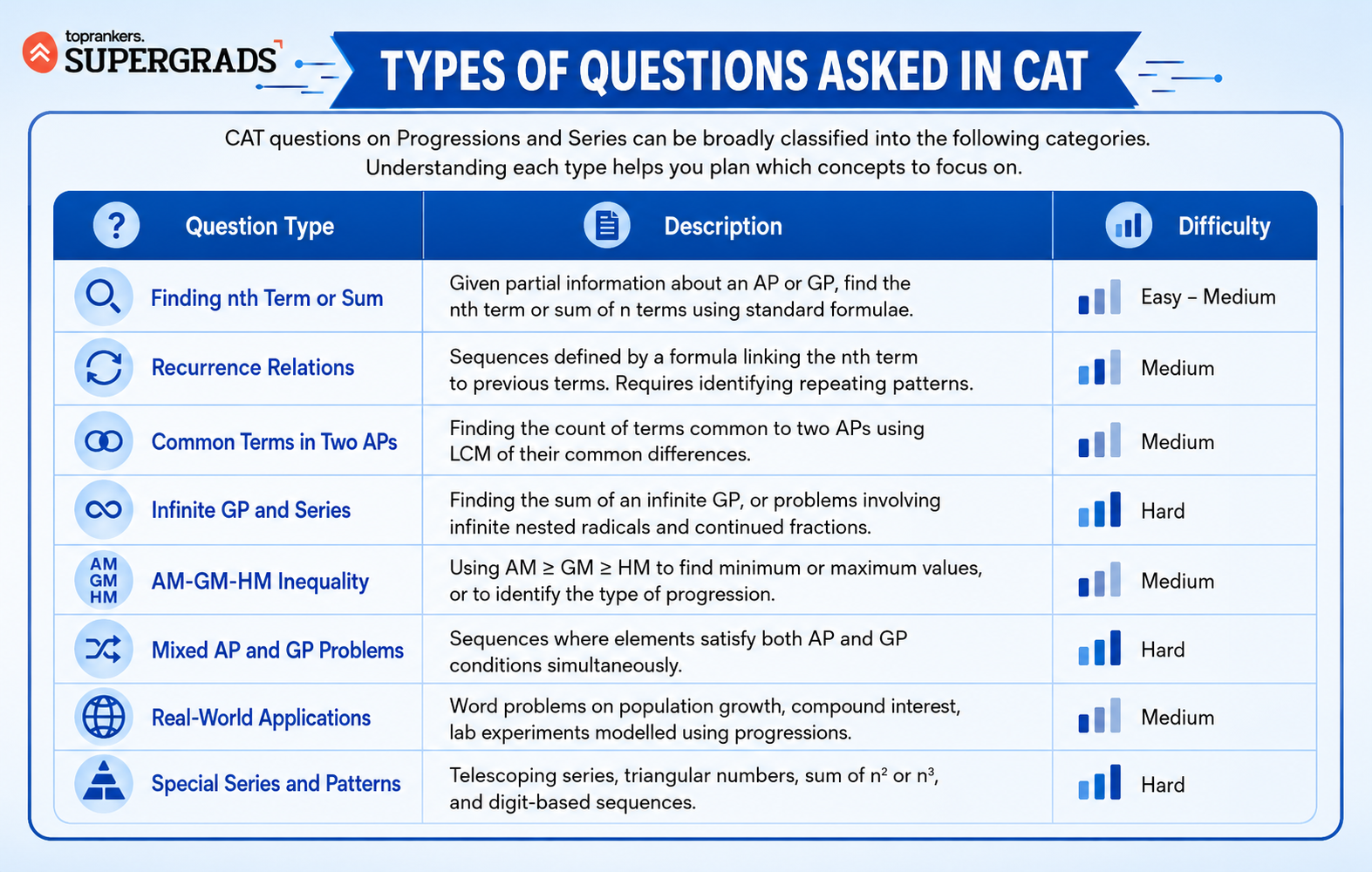
Types of Sequence and Series Questions for CAT
Different types of cat questions can be asked from sequence and series. Students should practice each type separately before moving to mixed practice.
These question types are also useful while revising CAT important questions and previous year question paper sets. Check with the CAT official mock test to understand the types of questions asked.
| Question Type | What It Tests |
|---|---|
| Missing term questions | Ability to identify patterns |
| Next term questions | Logical continuation of a sequence |
| AP-based questions | Use of common difference |
| GP-based questions | Use of common ratio |
| Sum-based questions | Application of series formulas |
| Mixed pattern questions | Advanced pattern recognition |
Sequence and Series Questions for CAT Practice Set
Here are 30 sequence and series questions for CAT preparation. These questions include easy, moderate, and slightly advanced patterns.
Students should solve these questions before checking the answers to improve accuracy and exam-level thinking.
Q1. Find the next term: 2, 5, 8, 11, 14, ?
A) 15
B) 16
C) 17
D) 18
Answer: C) 17
Q2. Find the next term: 3, 6, 12, 24, ?
A) 36
B) 48
C) 60
D) 72
Answer: B) 48
Q3. What is the 15th term of AP: 5, 8, 11, 14, ...?
A) 44
B) 47
C) 50
D) 52
Answer: B) 47
Q4. Find the sum of first 20 natural numbers.
A) 190
B) 200
C) 210
D) 220
Answer: C) 210
Q5. Find the next term: 1, 4, 9, 16, 25, ?
A) 30
B) 35
C) 36
D) 49
Answer: C) 36
Q6. Find the next term: 2, 6, 12, 20, 30, ?
A) 40
B) 42
C) 44
D) 46
Answer: B) 42
Q7. Find the next term: 1, 2, 6, 24, 120, ?
A) 600
B) 720
C) 840
D) 960
Answer: B) 720
Q8. Find the 10th term of GP: 2, 4, 8, 16, ...
A) 512
B) 1024
C) 2048
D) 4096
Answer: B) 1024
Q9. Find the next term: 7, 14, 28, 56, ?
A) 84
B) 98
C) 112
D) 120
Answer: C) 112
Q10. Find the sum: 1 + 2 + 3 + ... + 50
A) 1225
B) 1250
C) 1275
D) 1300
Answer: C) 1275
Q11. Find the next term: 1, 3, 6, 10, 15, ?
A) 18
B) 20
C) 21
D) 24
Answer: C) 21
Q12. Find the next term: 64, 32, 16, 8, ?
A) 2
B) 4
C) 6
D) 8
Answer: B) 4
Q13. Find the next term: 5, 10, 17, 26, 37, ?
A) 48
B) 49
C) 50
D) 52
Answer: C) 50
Q14. Find the next term: 1, 8, 27, 64, ?
A) 100
B) 121
C) 125
D) 144
Answer: C) 125
Q15. Find the next term: 13, 21, 34, 55, ?
A) 76
B) 81
C) 89
D) 91
Answer: C) 89
Q16. Find the sum of first 10 odd numbers.
A) 80
B) 90
C) 100
D) 110
Answer: C) 100
Q17. Find the next term: 2, 3, 5, 8, 13, ?
A) 18
B) 20
C) 21
D) 24
Answer: C) 21
Q18. Find the next term: 81, 27, 9, 3, ?
A) 0
B) 1
C) 2
D) 3
Answer: B) 1
Q19. Find the next term: 10, 20, 35, 55, 80, ?
A) 100
B) 105
C) 110
D) 115
Answer: C) 110
Q20. Find the next term: 4, 9, 19, 39, 79, ?
A) 149
B) 159
C) 169
D) 179
Answer: B) 159
Q21. Find the 20th term of AP: 2, 5, 8, 11, ...
A) 56
B) 57
C) 58
D) 59
Answer: D) 59
Q22. Find the next term: 2, 4, 7, 11, 16, ?
A) 20
B) 21
C) 22
D) 24
Answer: C) 22
Q23. Find the next term: 3, 9, 27, 81, ?
A) 162
B) 216
C) 243
D) 324
Answer: C) 243
Q24. Find the next term: 1, 1, 2, 3, 5, 8, ?
A) 11
B) 12
C) 13
D) 15
Answer: C) 13
Q25. Find the next term: 11, 22, 44, 88, ?
A) 132
B) 154
C) 176
D) 198
Answer: C) 176
Q26. Find the next term: 100, 90, 72, 48, ?
A) 20
B) 24
C) 28
D) 30
Answer: A) 20
Q27. Find the next term: 6, 11, 21, 41, 81, ?
A) 141
B) 151
C) 161
D) 171
Answer: C) 161
Q28. Find the next term: 2, 5, 10, 17, 26, ?
A) 35
B) 36
C) 37
D) 38
Answer: C) 37
Q29. Find the next term: 9, 18, 36, 72, ?
A) 108
B) 126
C) 144
D) 162
Answer: C) 144
Q30. Find the next term: 1, 4, 13, 40, 121, ?
A) 242
B) 302
C) 344
D) 364
Answer: D) 364
Tips to Solve Sequence and Series CAT Questions
Sequence and series questions for CAT become easier when students follow a structured approach. Instead of guessing the pattern randomly, check the difference, ratio, squares, cubes, and alternate positions.
These tips are also useful while solving cat questions in sectional tests, mocks and mock test series.
| Tip | How It Helps |
|---|---|
| Check the difference between terms | Helps identify arithmetic progression and second-level patterns |
| Check the ratio between terms | Useful for geometric progression questions |
| Look for squares and cubes | Many number series questions are based on square and cube patterns |
| Observe alternate terms | Some questions have two different patterns running together |
| Do not spend too much time | If the pattern is not clear within a minute, move ahead and return later |
| Practice through mock tests | Improves speed, accuracy, and exam temperament |
Common Mistakes to Avoid
Many students lose marks in sequence and series because they rush into calculations without understanding the pattern. A careful approach can help avoid these mistakes.
- Assuming every question is based on AP or GP
- Not checking alternate terms
- Ignoring second and third differences
- Not revising basic formulas
- Spending too much time on one difficult question
- Skipping previous year question paper practice
Best Resources to Practice Sequence and Series for CAT
To master sequence and series questions for CAT, students should use a mix of concept notes, practice sets, topic-wise tests, and mocks.
- CAT syllabus for understanding the complete Quant section
- CAT eligibility details before starting the admission journey
- CAT exam pattern for knowing section-wise structure
- CAT important questions for topic-wise revision
- Mocks and mock test series for exam-level practice
- Previous year question paper sets for understanding actual exam trends
- CAT questions from reliable preparation resources
Conclusion
Sequence and Series questions for CAT are scoring if practiced with the right method. Students should first understand the concepts, revise formulas, and then solve different types of questions regularly.
Practicing all CAT questions of sequences and series, attempting mocks and mock test series, and analyzing previous year question paper sets can help students improve accuracy and confidence for the CAT exam.

Smart Prep for CAT: Join Our Free Demo Class
Fill your details
Frequently Asked Questions
1. Are sequence and series questions important for CAT preparation?

What types of sequence and series questions are asked in CAT?
How can I improve my speed in solving sequence and series questions for CAT?
Are sequence and series questions difficult in the CAT exam?

Zubeen Siddiqui
Content Writer | MBA & CAT Preparation
SHARE