


SBI SO Law Officer Books 2026: Best Books for All Subjects
October 19, 2026
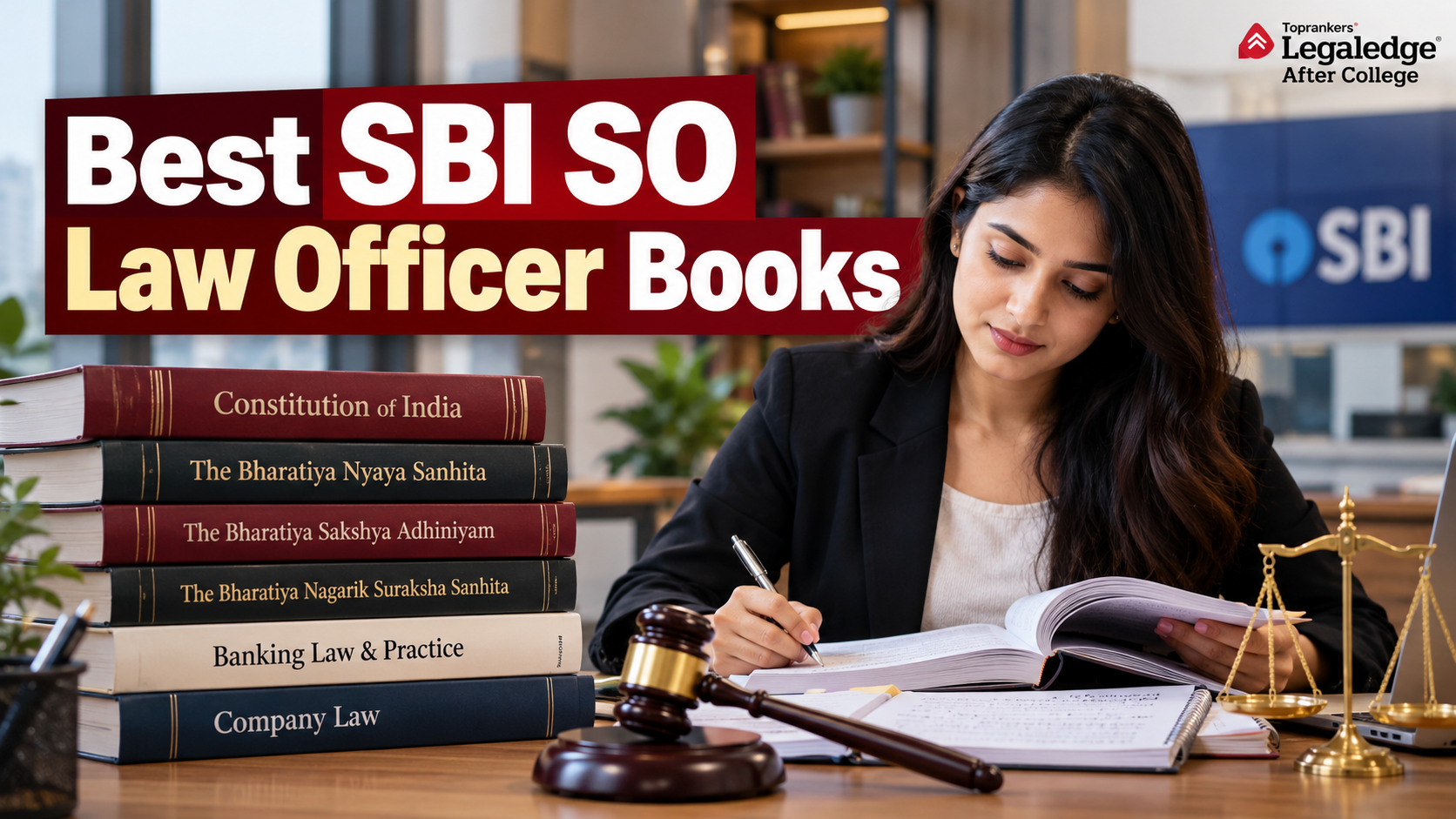
Choosing the right SBI SO Law Officer Books 2026 is an important step towards preparing for the State Bank of India's Specialist Cadre Officer examination. Some of the most useful resources include Law of Contract by Avtar Singh, Introduction to the Constitution of India by D.D. Basu, updated Bare Acts of important banking laws, and RBI regulatory guidelines.
Candidates preparing for Assistant Manager (Law) and Deputy Manager (Law) should focus on legal concepts, banking regulations, professional knowledge, and descriptive answer writing.
This article covers the best SBI SO Law Officer books, subject-wise study materials, essential Bare Acts, and preparation strategies to help candidates study effectively.
Which Are the Best Books for SBI SO Law Officer 2026?
The best preparation books for SBI SO Law Officer are those that explain legal concepts clearly, cover the relevant banking and financial laws, and help candidates apply their knowledge to practical legal problems.
For 2026, the emphasis should be on financial sector laws, Constitutional Law, Administrative Law, procedural laws, statutory interpretation and legal drafting. The official SBI syllabus is very indicative rather than exhaustive.
The following books and resources can form a useful preparation library.
| Book Name | Author | Best for |
| Law of Contract | Avtar Singh | Contract Law and contractual obligations |
| Introduction to the Constitution of India | D.D. Basu | Constitutional Law |
| Administrative Law | I.P. Massey | Administrative principles and judicial review |
| Banking Law and Practice | P.N. Varshney | Banking laws and financial operations |
| Company Law | Avtar Singh | Corporate and commercial legal concepts |
| Law of Crimes | Ratanlal & Dhirajlal | Criminal Law fundamentals |
| SARFAESI Act, 2002 | Updated Bare Act | Secured asset enforcement |
| Insolvency and Bankruptcy Code, 2016 | Updated Bare Act and IBBI regulations | Insolvency and resolution proceedings |
| Negotiable Instruments Act, 1881 | Updated Bare Act | Cheque dishonour and negotiable instruments |
| RBI Master Directions | Reserve Bank of India | Banking compliance and regulatory updates |
These are the resources we've recommended on the basis of the content they cover. They are not the official SBI prescribed book list. Candidates are advised to check the most recent editions and any applicable statutory amendments prior to purchase or study.
Check SBI SO Law Officer Vacancy
SBI SO Law Officer Books 2026: Subject-Wise List
Selecting books in accordance with the syllabus will help the candidate to avoid reading the irrelevant and concentrate on the material that is actually going to be on the exam.
The SBI SO Law Officer Professional Knowledge paper is all about a sound knowledge of the law and the ability to apply it. You need to be reading your standard textbooks as well as the current Bare Acts, important judgments and practice questions.
Best Books for Banking Law
Banking Law is a very useful area for those considering a career as a Law Officer, as the role is all about the legal issues of lending, recovery, banking contracts, regulations and financial transactions.
| Book | Author | Important Topics |
| Banking Law and Practice | P.N. Varshney | Banking principles and operations |
| Banking Law and Practice in India | M.L. Tannan | Banking legal framework |
| Banking Regulation Act, 1949 | Bare Act | Regulation of banking companies |
| RBI Act, 1934 | Bare Act | Reserve Bank powers and functions |
| RBI Master Directions | RBI | Banking compliance and regulatory requirements |
Preparation tip: start with the basics of banking before going on to the various legal provisions relating to lending, recovery, compliance and regulatory supervision.
Candidates should also be in the habit of going through the official RBI circulars as the regulatory environment in banking is subject to change.
Best Books for SARFAESI Act and DRT
The SARFAESI Act 2002 and the various laws relating to recovery of debts are of course the most relevant in terms of the legal mechanisms which are available to banks in the event of default by a borrower.
| Book | Important Topics |
| SARFAESI Act, 2002 Bare Act | Enforcement of security interests |
| Security Interest (Enforcement) Rules, 2002 | Procedures relating to enforcement |
| Recovery of Debts and Bankruptcy Act, 1993 | Debt Recovery Tribunals and appellate procedures |
| Updated banking recovery law commentary | Practical interpretation and case law |
Candidates should look at the position of secured creditors, the issue of demand notices, the matter of possession, the remedies available and the jurisdiction of the Debt Recovery Tribunals.
Focus on understanding the relationship between statutory provisions and practical bank recovery procedures.
Best Books for Insolvency and Bankruptcy Code (IBC)
The Insolvency and Bankruptcy Code is an important financial sector law that candidates should understand when preparing for banking-related legal work.
The following resources are very useful.
| Book Name | Topics |
| Insolvency and Bankruptcy Code, 2016 | Core legal framework |
| IBBI regulations | Insolvency resolution procedures |
| Updated IBC commentary | Interpretation and practical applications |
| Relevant NCLT and NCLAT decisions | Application of insolvency principles |
Key concepts are corporate insolvency resolution, financial creditors, operational creditors, the committee of creditors, moratorium, resolution plans and liquidation.
Candidates should look at the most recent IBBI notifications and amendments rather than just go by the older textbooks.
Best Books for Contract Law
Contract Law is relevant to banking agreements, loan documentation, guarantees, indemnities, and commercial transactions.
Recommended resources include:
- Law of Contract by Avtar Singh
- Indian Contract Act, 1872 Bare Act
- Updated commentaries covering contracts, guarantees, and indemnity
Important topics include offer and acceptance, consideration, capacity to contract, free consent, breach of contract, damages, guarantee, indemnity, and contractual obligations.
Candidates should practise applying these concepts to banking situations, such as loan agreements and guarantee enforcement.
Best Books for Company Law
Company Law helps candidates understand corporate borrowers, company management, financial transactions, and corporate legal obligations.
| Topic | Book |
| Company Law | Avtar Singh |
| Companies Act, 2013 | Updated Bare Act |
| Relevant MCA notifications | Ministry of Corporate Affairs |
Candidates should be familiar with corporate personality, the duties of directors, the duties of directors, corporate borrowing and the relevant compliance requirements.
Practical knowledge of corporate documentation is obviously of great value to anyone preparing for a banking legal role.
Best Books for Constitutional Law
Constitutional Law is specifically included in the indicative SBI Law Officer syllabus.
Recommended books include:
- Introduction to the Constitution of India by D.D. Basu
- Indian Constitutional Law by M.P. Jain
- Constitution of India Bare Act
Fundamental Rights, constitutional remedies, separation of powers, judicial review, constitutional bodies and key Supreme Court judgments.
Candidates should connect constitutional principles with Administrative Law and the functioning of statutory and regulatory authorities.
Best Books for Criminal Law and Procedure
Criminal Law and procedural concepts may be useful for legal issues involving fraud, investigations, and financial offences.
Recommended resources include:
- Updated texts on the Bharatiya Nyaya Sanhita, 2023
- Bharatiya Nagarik Suraksha Sanhita, 2023
- Bharatiya Sakshya Adhiniyam, 2023
- Relevant commentary on criminal law and procedure
Candidates should pay attention to applicable provisions relating to fraud, criminal liability, evidence, complaints, investigations, and court procedures.
Study the current statutory framework and the transitional application of earlier laws where relevant.
Best Books for the Negotiable Instruments Act
The Negotiable Instruments Act, 1881 is relevant to banking operations and legal disputes involving cheques and negotiable instruments.
The most useful resources are:
- Negotiable Instruments Act, 1881 Bare Act
- Updated commentary on negotiable instruments
- Relevant Supreme Court judgments
Candidates should particularly understand cheque dishonour under Section 138, statutory notices, liability of companies, presumptions, and procedural requirements.
Learning the practical legal steps involved in a cheque dishonour case can also help during the interview.
Check SBI SO Law Officer Exam Pattern
SBI SO Law Officer Books for Professional Knowledge
The Professional Knowledge section tests candidates' understanding of law and its practical application.
According to the SBI 2026 recruitment notification, the indicative syllabus includes Constitutional Law, Administrative Law, financial sector laws, procedural laws, new Labour Codes, statutory interpretation, and legal drafting.
Which Books Should You Prioritise for Professional Knowledge?
| Subject | Recommended Resource | Suggested Preparation Priority |
|---|---|---|
| Financial Sector Laws | Updated Bare Acts, banking law textbooks, RBI directions | High |
| Constitutional Law | D.D. Basu, M.P. Jain | High |
| Administrative Law | I.P. Massey | High |
| Procedural Laws | Updated procedural Bare Acts and commentary | High |
| Legal Drafting | Drafting manuals and practical exercises | High |
| Statutory Interpretation | G.P. Singh's Principles of Statutory Interpretation | High |
| Labour Codes | Current Labour Code texts and notifications | Medium to High |
| Contract and Commercial Law | Avtar Singh and relevant Bare Acts | High |
How to Choose the Best SBI SO Law Officer Books?
Candidates should not purchase every book recommended on the internet. Selecting a smaller number of suitable resources often makes preparation more manageable.
Consider the following factors.
1. Syllabus Coverage
Choose books that align with the SBI Law Officer syllabus. Prioritise subjects and concepts in the official recruitment notification.
2. Updated Legal Provisions
Always check if the book includes recent amendments, new legislation, and significant judicial developments.
3. Clear Explanations
A good preparation book should explain legal principles clearly and provide examples when necessary.
4. Practical Application
Prefer resources that help you understand how laws operate in banking, debt recovery, contracts, and compliance.
5. Practice Material
Use books and question banks containing MCQs, legal problems, and detailed explanations.
6. Available Study Time
Candidates preparing while working may benefit from concise study notes, updated Bare Acts, and targeted question practice.
SBI SO Law Officer 30-Day Study Plan
Candidates with a decent grasp of the law can use the 30 day plan for focused preparation.
| Day | Topics to Cover | Activites |
| 1–5 | Banking Law and RBI regulations | Read Bare Acts, revise concepts, solve MCQs |
| 6–10 | SARFAESI Act, DRT and IBC | Study statutory provisions and legal applications |
| 11–15 | Constitutional and Administrative Law | Revise principles and important judgments |
| 16–20 | Contract, Company and Procedural Laws | Practise concept-based questions |
| 21–24 | Labour Codes, interpretation and drafting | Practise short legal answers |
| 25–27 | Reasoning and English revision | Complete qualifying-section practice |
| 28–30 | Full revision and mock tests | Analyse mistakes and revise weak areas |
Daily preparation suggestion: candidates can split their 3-4 hours of study between legal concepts, statutory reading, MCQs and descriptive practice.
The plan is just indicative and will of course need to be modified in line with your prior knowledge and the amount of time you have available to study.
SBI SO Law Officer 60-Day Study Plan
A 60 day plan gives you more time to get the basics down and to revise them.
| Month | Topic | Activites |
| 1 | Constitutional Law | Concepts, Bare Acts and MCQs |
| 2 | Administrative Law | Principles, cases and practice questions |
| 3 | Banking and Financial Laws | RBI Act, Banking Regulation Act and regulatory material |
| 4 | SARFAESI, DRT and IBC | Statutory provisions and practical problems |
| 5 | Contract and Company Law | Concepts and banking applications |
| 6 | Procedural Laws and Labour Codes | Statutory reading and revision |
| 7 | Legal Drafting and Interpretation | Descriptive writing and legal analysis |
| 8 | Reasoning, English and Full Revision | Mock tests, error analysis and final revision |
Check SBI SO Law Officer Eligibility Criteria
Best Books for SBI SO Law Officer Interview Preparation
SBI SO Law Officer interview preparation requires both subject knowledge and an understanding of the practical responsibilities of a bank's legal department.
Candidates should look at key banking legislation, regulatory updates, the principles of legal drafting and their own professional experience.
| Resourcec | preparation Focus |
| Banking Law and Practice | Banking operations and legal responsibilities |
| SARFAESI Act | Loan recovery and enforcement |
| Insolvency and Bankruptcy Code | Insolvency proceedings |
| RBI Master Directions | Banking compliance |
| Indian Contract Act | Loan agreements and guarantees |
| Important judicial decisions | Legal reasoning and interpretation |
| Updated procedural law texts | Litigation and legal process |
What Questions Should You Prepare for the SBI SO Law Officer Interview?
Important areas for interview practice include:
- What are the responsibilities of an SBI Law Officer?
- How does the SARFAESI Act help banks recover secured loans?
- What is the role of the Debt Recovery Tribunal?
- What is the difference between a financial creditor and an operational creditor?
- How would you review a loan agreement?
- What legal issues should a bank consider before enforcing a security interest?
- How would you handle a legal dispute involving a borrower?
- What is the significance of Section 138 of the Negotiable Instruments Act?
- How does a bank minimise legal risk in lending?
- Why do you want to join SBI as a Law Officer?
Candidates should practise giving accurate, structured answers rather than memorising lengthy responses.
Common Mistakes to Avoid While Choosing SBI SO Law Officer Books
Selecting too many books or using out-of-date material will actually reduce your preparation efficiency.
Avoid these common mistakes:
- Buying too many textbooks: select your resources in accordance with the syllabus and your own level of knowledge.
- Ignoring Bare Acts: bare act language is absolutely essential for proper legal preparation.
- Using out-of-date editions: check the amendments and changes to the law.
- Study only the theoretical concepts: get your hands dirty with practical legal problems and case-based questions.
- Ignore the descriptive prep. You need to be prepared for both the objective and the written assessments.
- Don't ignore Reasoning and English as these are qualifying sections.
- Skip the mock tests? Timed practice will improve your performance in the exam.
- Stick to the old banking guidelines: check the latest RBI and other regulatory updates.
A focused booklist and regular revision are generally more useful than amassing a large number of resources without actually going through them.
Frequently Asked Questions
Which are the best books for SBI SO Law Officer 2026 preparation?

Which book is best for SBI SO Law Officer Professional Knowledge?
Are SBI SO Law Officer preparation books available in PDF format?
Which books should I study for SBI SO Law Officer Banking Law?
Are previous year question papers enough for SBI SO Law Officer 2026?
Which books are best for SBI SO Law Officer Reasoning and English?

Souvik Podder
Content Writer
SHARE