
1723534562.png)

20+ MAT Verbal Ability Question and Answers PDF Download
April 14, 2026
Overview: MAT verbal ability questions form one of the most critical sections of the Management Aptitude Test conducted by AIMA. Every year, thousands of aspirants struggle with this section because it evaluates a wide range of English language skills from grammar and vocabulary to reading comprehension and verbal reasoning. Scoring well here requires a structured preparation strategy, consistent practice, and a clear understanding of what the exam demands.
In this complete guide on MAT verbal ability questions, we cover topic-wise breakdowns, difficulty levels, preparation strategies, a Quick Answers section, and 20 fully solved practice MCQs. Whether you are just starting out or doing your final revision, this resource will help you maximise your sectional score and overall percentile.
Other Important Links
| MAT Exam Preparation | Best Books for MAT | MAT 2025 Question Paper |
| MAT 2026 Sample Paper | MAT GK Questions | MAT Aptitude Questions |
| MAT English Questions | Critical Reasoning for MAT | MAT Exam Analysis |
What Are MAT Verbal Ability Questions 2026?
The Language Comprehension section of MAT evaluates a candidate's command over English and communication skills. It typically contains 40 questions, carries equal marks to other sections, and rewards aspirants who read widely and practise regularly. Unlike quantitative problems, this section responds quickly to focused preparation consistent reading habits and a strong vocabulary foundation translate directly into marks. Performance here directly affects overall sectional percentile and the final composite score used by top B-schools for shortlisting.
The table below summarises the basic exam pattern for this section:
|
Parameter |
Details |
Remarks |
|
Section Name |
MAT verbal ability questions (Language Comprehension) |
Mandatory section |
|
No. of Questions |
40 |
MCQ format |
|
Marks per Question |
+1 |
No half marks |
|
Negative Marking |
-0.25 per wrong answer |
Applies to all |
|
Suggested Time |
25–30 minutes |
Out of 150 mins total |
|
Difficulty Level |
Easy to Moderate |
Manageable with practice |
Practice 20+ MAT verbal ability questions (MCQs with Answers)
The following 20 practice MAT verbal ability questions cover all major sub-topics. Attempt each item before checking the answer. All items are modelled on the actual difficulty and format of the MAT exam.
Q1: Choose the word most similar in meaning to BENEVOLENT.
- A) Hostile
- B) Generous
- C) Timid
- D) Reckless
✔ Answer: B) Generous
Explanation: BENEVOLENT means well-meaning and kindly. 'Generous' is the closest synonym.
Q2: Select the word OPPOSITE in meaning to OBSTINATE.
- A) Stubborn
- B) Determined
- C) Flexible
- D) Persistent
✔ Answer: C) Flexible
Explanation: OBSTINATE means stubbornly refusing to change. Its antonym is 'Flexible'.
Q3: The committee's decision was _______, as it failed to satisfy any of the stakeholders.
- A) judicious
- B) unanimous
- C) contentious
- D) pragmatic
✔ Answer: C) contentious
Explanation: CONTENTIOUS means likely to cause controversy — contextually accurate here.
Q4: What does the idiom 'Bite the bullet' mean?
- A) Avoid a problem
- B) Endure a painful situation
- C) Solve a problem quickly
- D) Make an impulsive decision
✔ Answer: B) Endure a painful situation
Explanation: 'Bite the bullet' means to stoically endure a painful or difficult situation.
Q5: A person who is unable to pay debts is called ___.
- A) Insolvent
- B) Affluent
- C) Creditor
- D) Philanthropist
✔ Answer: A) Insolvent
Explanation: INSOLVENT is the one-word substitute for a person unable to pay their debts.
Q6: Identify the error: 'She is one of the students who has completed the assignment on time.'
- A) She is one
- B) of the students
- C) who has completed
- D) on time
✔ Answer: C) who has completed
Explanation: 'Students' is plural; the verb should be 'who have completed'.
Q7: Choose the correct sentence.
- A) Neither the manager nor the employees was present.
- B) Neither the manager nor the employees were present.
- C) Neither the manager nor the employees has been present.
- D) Neither the manager nor employees are present.
✔ Answer: B) Neither the manager nor the employees were present.
Explanation: With 'Neither…nor', the verb agrees with the subject closest to it — 'employees' (plural), so 'were' is correct.
Q8: Arrange in correct order: P: However, the results were disappointing. Q: The scientists conducted an experiment. R: They hoped to find a cure for the disease. S: Funding was eventually withdrawn.
- A) QRPS
- B) QPRS
- C) RQPS
- D) PQRS
✔ Answer: A) QRPS
Explanation: Q (experiment) → R (hope for cure) → P (disappointing results) → S (funding withdrawn).
Q9: The word 'EPHEMERAL' most nearly means:
- A) Long-lasting
- B) Short-lived
- C) Extraordinary
- D) Dependable
✔ Answer: B) Short-lived
Explanation: EPHEMERAL means lasting for a very short time.
Q10: Passage: 'Urbanisation, while bringing economic growth, has exacerbated income inequality in developing nations.' What is the main idea?
- A) Urbanisation has no impact on inequality.
- B) Urban growth always helps developing nations.
- C) Urbanisation promotes economic growth but worsens inequality.
- D) Developing nations should avoid urbanisation.
✔ Answer: C) Urbanisation promotes economic growth but worsens inequality.
Explanation: The passage directly contrasts economic growth with worsened inequality — making C the main idea.
Q11: Stethoscope : Doctor :: Gavel : ___
- A) Teacher
- B) Judge
- C) Carpenter
- D) Surgeon
✔ Answer: B) Judge
Explanation: A stethoscope is the tool of a doctor; a gavel is the tool of a judge.
Q12: Fill in the blank: 'The government's new _______ aims to reduce carbon emissions by 40% over the next decade.'
- A) controversy
- B) legislation
- C) antagonism
- D) hypothesis
✔ Answer: B) legislation
Explanation: 'Legislation' fits the context of an official government policy targeting emissions.
Q13: Choose the word closest in meaning to TACITURN.
- A) Talkative
- B) Reserved
- C) Aggressive
- D) Joyful
✔ Answer: B) Reserved
Explanation: TACITURN means reserved or uncommunicative in speech.
Q14: Which sentence is grammatically correct?
- A) He has went to the market.
- B) She have been working here for five years.
- C) They are playing cricket since morning.
- D) He has been working on this project for two years.
✔ Answer: D) He has been working on this project for two years.
Explanation: Present perfect continuous is correctly formed with 'has been + V-ing + for'. Options A, B, and C have tense or agreement errors.
Q15: Her _______ attitude toward work made her indispensable to the team.
- A) lackadaisical
- B) diligent
- C) capricious
- D) indifferent
✔ Answer: B) diligent
Explanation: 'Diligent' (hardworking and careful) is the only option consistent with being 'indispensable'.
Q16: Select the word OPPOSITE in meaning to PROFLIGATE.
- A) Wasteful
- B) Extravagant
- C) Frugal
- D) Lavish
✔ Answer: C) Frugal
Explanation: PROFLIGATE means recklessly wasteful. Its antonym is FRUGAL — economical with money.
Q17: A speech delivered without prior preparation is called ___.
- A) Soliloquy
- B) Extempore
- C) Harangue
- D) Panegyric
✔ Answer: B) Extempore
Explanation: EXTEMPORE refers to a speech given without preparation or notes.
Q18: The idiom 'On the fence' means:
- A) To make a quick decision
- B) To be undecided
- C) To take a strong position
- D) To escape a problem
✔ Answer: B) To be undecided
Explanation: 'On the fence' means to be neutral or undecided about something.
Q19: Arrange in correct order: P: This led to widespread public outrage. Q: The company released faulty products. R: The CEO issued a formal apology. S: Investigations were ordered by the government.
- A) QPSR
- B) QPRS
- C) PQRS
- D) SQPR
✔ Answer: A) QPSR
Explanation: Q (faulty products) → P (public outrage) → S (government investigation) → R (CEO apology).
Q20: Passage: 'Mindfulness, though ancient in origin, has gained scientific validation in the modern era.' The author's tone is best described as:
- A) Critical
- B) Neutral and Informative
- C) Dismissive
- D) Enthusiastically partisan
✔ Answer: B) Neutral and Informative
Explanation: The passage acknowledges ancient origin and modern validation without bias — neutral and informative tone.
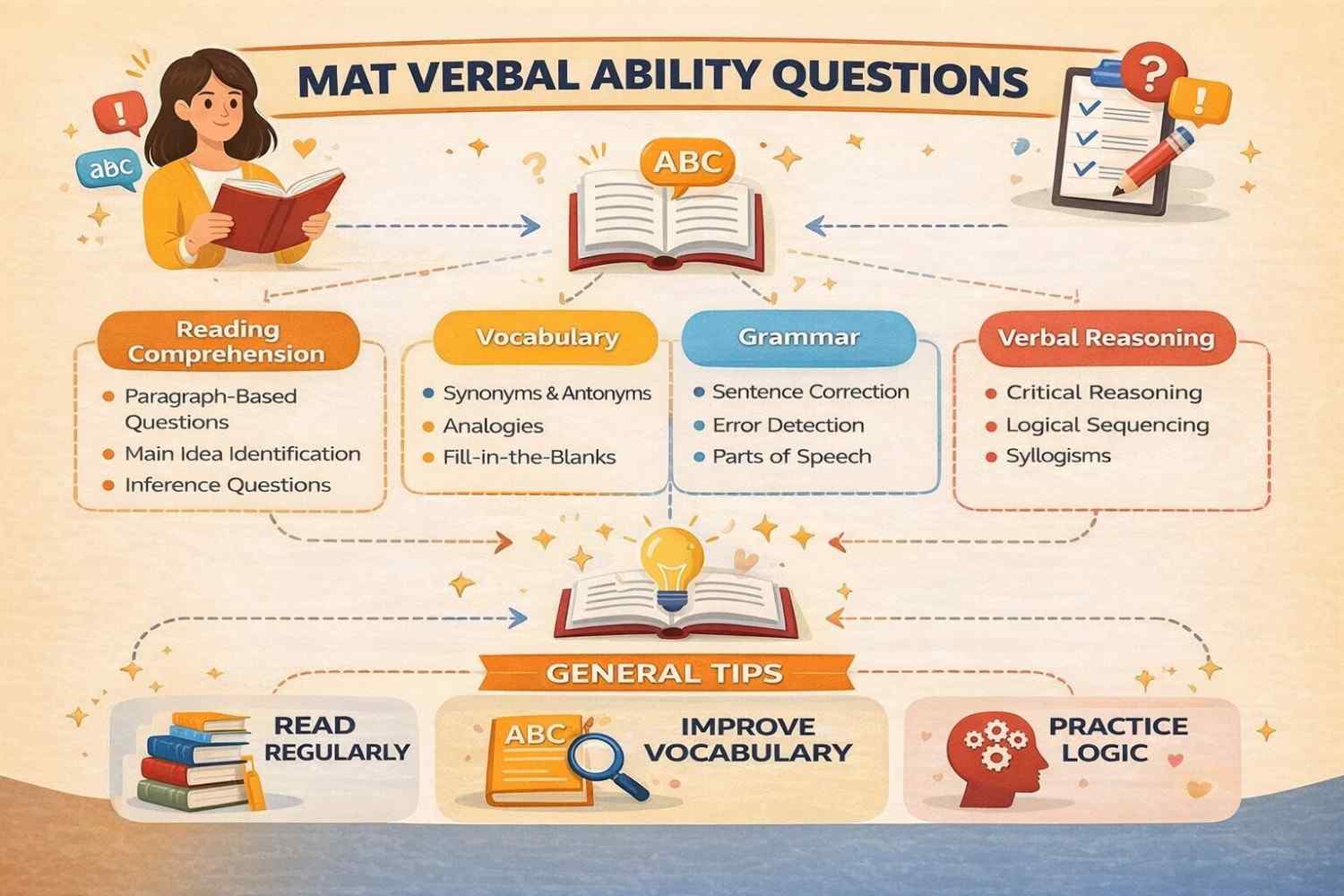
Topics Covered in MAT verbal ability questions 2026
The verbal ability section is divided into multiple sub-topics. The list below covers every area you will encounter, as well as MAT verbal ability questions typically draw from all of them in roughly equal measure:
- Reading Comprehension (RC) — Passage-based questions testing inferencing, vocabulary-in-context, and main idea identification. RC passages carry the highest aggregate weightage in the section.
- Para Jumbles — Questions asking you to arrange scrambled sentences into a coherent paragraph, testing logical sequencing and transition-word recognition.
- Fill in the Blanks — Vocabulary-focused items where one or two blanks appear in a sentence and you select the most contextually appropriate word.
- Synonyms & Antonyms — Direct word-knowledge items that reward a wide reading habit and regular vocabulary building.
- Idioms & Phrases — Fixed expressions whose meanings differ from the literal word combinations.
- One-Word Substitution — Items testing whether you know the precise single word that replaces a lengthy description.
- Error Spotting & Grammar — Identification of grammatical errors covering tense, subject–verb agreement, prepositions, and articles.
- Sentence Correction — Select the grammatically and contextually correct version of an underlined portion of a sentence.
- Cloze Test — A paragraph with multiple blanks; you must fill all blanks by reading the passage holistically.
- Verbal Analogies — Two related words are given; you identify the pair that shares the same relationship.
Approximate question distribution across sub-topics:
|
Sub-Topic |
Approx. Questions |
Difficulty |
Scoring Potential |
|
Reading Comprehension |
10–12 |
Moderate–High |
High |
|
Para Jumbles |
4–6 |
Moderate |
Medium |
|
Fill in the Blanks |
4–5 |
Easy–Moderate |
Medium |
|
Synonyms & Antonyms |
4–6 |
Easy |
High (quick wins) |
|
Grammar / Error Spotting |
4–5 |
Easy–Moderate |
High |
|
Idioms, Phrases & One-Word Sub. |
4–6 |
Easy |
Medium |
|
Cloze Test & Others |
4–5 |
Moderate |
Medium |
How to Prepare for MAT verbal ability questions: Step-by-Step Strategy
A disciplined plan is critical to scoring 90+ percentile in MAT verbal ability questions. The ten steps below form a comprehensive roadmap covering every sub-topic in this section:
- Understand the Syllabus: Map every sub-topic in this section against your current proficiency level. This gap analysis tells you exactly where to spend the most preparation time.
- Build Vocabulary Daily: Spend 20 minutes each day learning 10 new words. Strong vocabulary directly improves your accuracy on synonyms, antonyms, fill-in-the-blanks, and idiom-based items.
- Read Editorials Actively: Read The Hindu or Indian Express editorial every morning. Active reading sharpens the inferencing skills tested in all RC-based items.
- Practise Para Jumbles Timed: Solve at least 5 para-jumble items daily under a 3-minute timer. Speed here directly raises your overall Language Comprehension score.
- Revise Grammar Rules: Systematically revise tenses, voice, prepositions, and modifiers — the rules most frequently tested in error-spotting and sentence-correction items.
- Solve Full-Length Mock Tests: Attempt one complete mock paper per week. Review every item you got wrong, categorise errors as vocabulary, comprehension, or grammar, and address each type separately.
- Maintain an Error Log: For every incorrectly answered item, note the question, your answer, the correct answer, and the reason for your mistake. Reviewing this log weekly accelerates score improvement.
- Use Previous Year Papers: Solve the last 5–7 years' papers to understand recurring patterns, frequently tested vocabulary, and favourite RC themes.
- Time Your Attempts: The recommended time budget for this section is 25–30 minutes. Practise finishing the section consistently within this window during mock tests.
- Sectional Mock Tests: Supplement full mocks with targeted sectional tests. Focused practice on individual sub-topics sharpens both precision and accuracy.
Expert Tips to Master MAT verbal ability questions 2026
The table below consolidates high-impact tips to improve accuracy and speed in the verbal ability section:
|
Sub-Topic |
Expert Tip |
Expected Benefit |
|
Reading Comprehension |
Skim the questions first, then read the passage. |
Saves 2–3 minutes per RC set |
|
Vocabulary Items |
Use Latin/Greek root words to decode unfamiliar vocabulary. |
Solves ~40% of new vocabulary items |
|
Para Jumbles |
Identify the opening and closing sentences first. |
Reduces options from 4 to 2 quickly |
|
Error Spotting |
Read the sentence aloud mentally — the ear catches errors faster. |
Improves error-detection speed by ~30% |
|
Cloze Test |
Read the full passage once before attempting any blank. |
Ensures contextual consistency in answers |
|
Idioms & Phrases |
Maintain a personal idiom notebook — 5 new entries per day. |
Covers 95% of idiom items seen in past papers |
30-Day Score Improvement Plan for the Verbal Ability Section
Consistent daily practice is the single most reliable way to improve your Language Comprehension score. The table below outlines a four-week framework covering every question type:
|
Week |
Focus Area |
Daily Target |
|
Week 1 |
Vocabulary: Synonyms, Antonyms, One-Word Substitution — the easiest, highest-accuracy items in this section |
20 vocabulary items per day |
|
Week 2 |
Grammar & Error Spotting: Solidify rules for tense, voice, subject–verb agreement, and prepositions |
15 grammar items + 1 editorial read |
|
Week 3 |
RC & Para Jumbles: The highest-value items requiring comprehension depth and paragraph-logic skills |
1 RC passage + 5 para-jumble items |
|
Week 4 |
Full Mock Tests: Simulate the complete Language Comprehension section under timed exam conditions |
2 full mocks + error-log review |
Conclusion
MAT verbal ability questions are a scoring goldmine for well-prepared aspirants. Unlike the Data Sufficiency or Data Analysis sections, this part of the exam responds immediately to targeted preparation — vocabulary building, grammar revision, and timed practice translate directly into marks. The 20 solved MCQs, topic-wise tables, Quick Answers reference, and the 30-day plan in this guide together give you a complete resource to dominate the Language Comprehension section on exam day.
Bookmark this guide, revisit the practice questions regularly, and track your progress week by week. Even 30 minutes of focused daily practice compounds into a significant scoring advantage. With the right strategy and sustained effort, Language Comprehension can become your highest-scoring section on the MAT. Best of luck!
Frequently Asked Questions
How many MAT verbal ability questions appear in MAT?

Which books are best for verbal ability preparation?
How difficult are MAT verbal ability questions compared to CAT VARC?
Do question patterns repeat from MAT previous years?

Admin
Subject Matter Expert
SHARE