
1723534562.png)

MAT 2026 Syllabus PDF Download Subjects-wise Syllabus and Important Topics here
April 14, 2026
Overview: The Management Aptitude Test (MAT) is one of India's most widely accepted MBA entrance exams, conducted by the All India Management Association (AIMA) and approved by the Ministry of Education. More than 600 B-schools across India accept MAT scores, making it a critical gateway for management aspirants.
For every candidate planning to appear in MAT this year, understanding the MAT Syllabus is the most important first step before picking study material or a coaching programme. This guide covers the complete MAT 2026 Syllabus section by section with detailed topic tables, marking scheme, a step-by-step preparation roadmap, and the best resources to help you score competitively.
Quick Answer: MAT Syllabus 2026 at a Glance▸ The MAT Exam Syllabus covers five sections: Language Comprehension, Mathematical Skills, Data Analysis & Sufficiency, Intelligence & Critical Reasoning, and Indian & Global Environment. ▸ The paper has 200 questions (40 per section) — +1 mark for correct, −0.25 for wrong answers. ▸ The MAT 2026 Syllabus follows the same proven structure as previous years with no changes announced by AIMA. ▸ Only four sections count toward the composite scaled score (out of 800) used by B-schools; GK is excluded. |
What Is the MAT Exam Syllabus 2026?
The MAT Exam Syllabus is the officially prescribed framework of topics tested by AIMA across all four annual MAT sessions — February, May, September, and December. Unlike many aptitude exams that shift in pattern year to year, the MAT Syllabus is highly structured and consistent, which works in every candidate's favour.
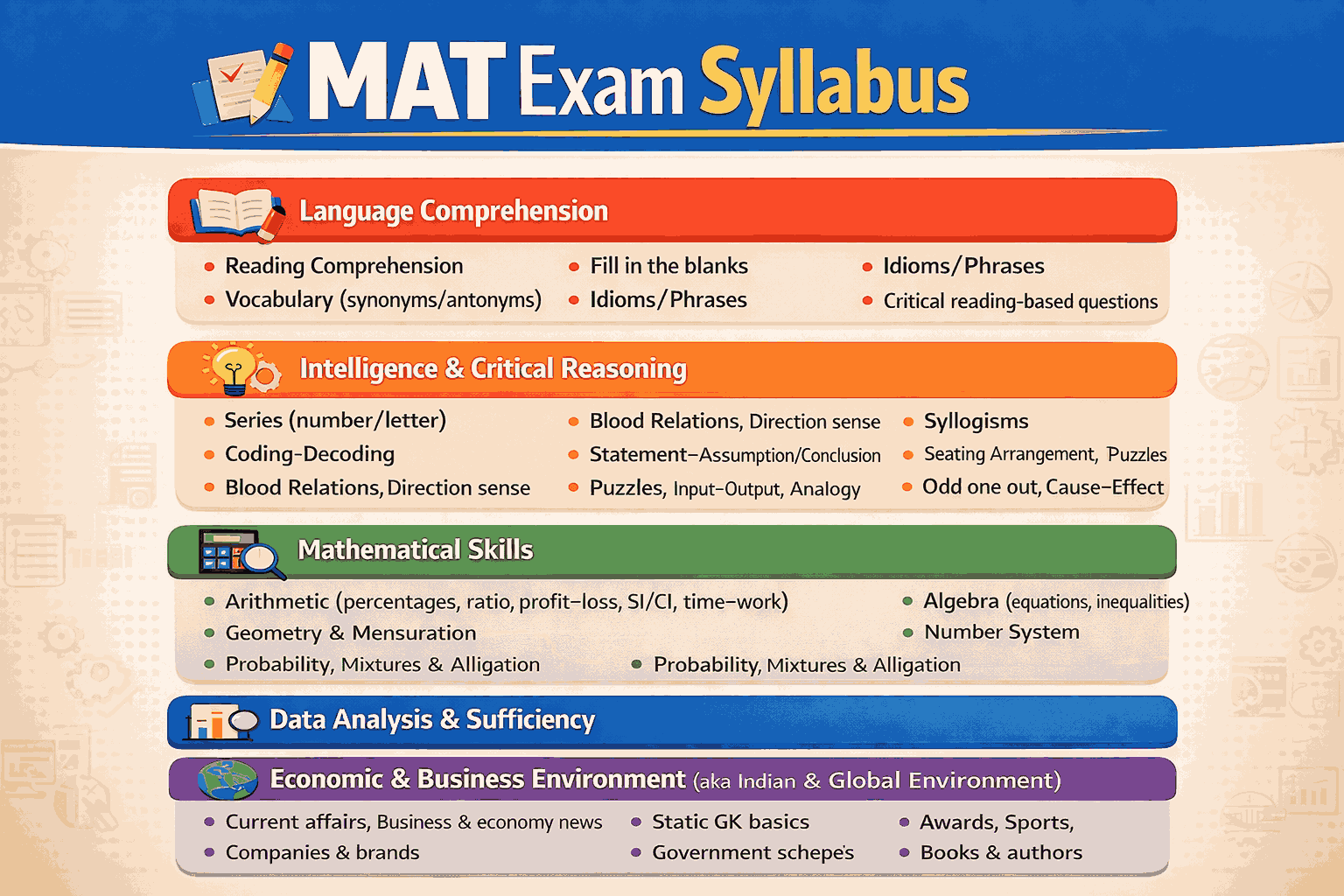
The MAT 2026 Syllabus evaluates candidates across five core domains: verbal ability, quantitative aptitude, data interpretation, logical reasoning, and general awareness. Understanding the full MAT Exam Syllabus before you begin ensures that you allocate your study hours strategically and enter the exam hall with zero blind spots.
MAT Syllabus 2026: Section-Wise Overview
The MAT Exam Syllabus is divided into five sections of equal question count. The table below provides a complete overview:
|
# |
Section Name |
Questions |
Time (Approx.) |
Scored? |
|
1 |
Language Comprehension |
40 |
~30 min |
Yes |
|
2 |
Mathematical Skills |
40 |
~40 min |
Yes |
|
3 |
Data Analysis & Sufficiency |
40 |
~35 min |
Yes |
|
4 |
Intelligence & Critical Reasoning |
40 |
~30 min |
Yes |
|
5 |
Indian & Global Environment |
40 |
~15 min |
No* |
|
— |
Total |
200 |
150 min |
4 sections |
* The Indian & Global Environment section score is not counted in the composite scaled score for most B-schools, though some institutes review it independently during admissions.
Section 1: Language Comprehension
Language Comprehension is the opening section of the MAT Syllabus and is a high-scoring area for candidates with strong reading habits. This section tests your ability to comprehend RC passages (400–600 words each), spot grammatical errors, and demonstrate vocabulary depth. The MAT Exam Syllabus includes 3–4 RC passages per paper, each with 4–5 questions covering factual, inferential, and vocabulary-based angles.
|
Topic |
Sub-topics / Focus Areas |
Weightage (Approx.) |
|
Reading Comprehension |
Factual, Inferential & Vocabulary-based Qs 3–4 passages, 400–600 words each |
16–20 Qs |
|
Vocabulary |
Synonyms, Antonyms, Analogies Contextual word usage |
6–8 Qs |
|
Grammar & Usage |
Sentence Correction, Error Spotting Fill in the Blanks |
6–8 Qs |
|
Verbal Logic |
Para Jumbles, Para Completion One-word Substitution, Idioms |
6–8 Qs |
Tip: Read one editorial daily from The Hindu or Business Standard. Focus on author tone and inference-based reasoning rather than rote vocabulary lists.
Section 2: Mathematical Skills
Mathematical Skills is the most time-intensive section of the MAT 2026 Syllabus. It covers Class 10–12 quantitative topics and demands both conceptual clarity and calculation speed. Since this part of the MAT Syllabus carries negative marking, accuracy is as important as pace.
|
Topic |
Sub-topics / Focus Areas |
Weightage (Approx.) |
|
Arithmetic |
Percentage, Profit & Loss, Discount SI & CI, Ratio, Mixtures |
12–14 Qs |
|
Number System |
HCF, LCM, Divisibility Rules Surds, Indices |
4–6 Qs |
|
Algebra |
Linear & Quadratic Equations Inequalities, Progressions |
4–6 Qs |
|
Geometry & Mensuration |
Triangles, Circles, Coordinate Geometry Area, Volume, Surface Area |
6–8 Qs |
|
Modern Math |
Permutation & Combination, Probability Statistics: Mean, Median, Mode |
4–6 Qs |
|
Time & Work / Speed |
Time, Speed & Distance, Trains, Boats Work, Pipes & Cisterns |
4–6 Qs |
Tip: Build a formula sheet for each topic and revise it weekly. The MAT Syllabus does not feature CAT-level complexity — mastering fundamentals and standard shortcuts is sufficient.
Section 3: Data Analysis and Sufficiency
Data Analysis and Sufficiency blends quantitative interpretation with logical decision-making. The MAT Exam Syllabus typically presents 4–5 DI sets (charts, tables, graphs) each with 5–8 questions, plus 8–10 standalone Data Sufficiency questions. The MAT 2026 Syllabus expects you to extract relevant data quickly and determine whether given information is sufficient to answer the question — without always solving it completely.
|
Topic |
Sub-topics / Focus Areas |
Weightage (Approx.) |
|
Data Interpretation |
Bar Graphs, Line Charts, Pie Charts Tables, Mixed / Combo Charts |
20–24 Qs |
|
Caselets |
Paragraph-embedded numerical data Multi-step calculations |
4–6 Qs |
|
Data Sufficiency |
Two-statement DS questions Determine sufficiency without solving |
8–10 Qs |
|
Venn Diagrams |
Set-based logic problems Overlap and union calculations |
2–4 Qs |
Tip: For Data Sufficiency questions in the MAT Syllabus, train yourself to determine sufficiency without solving the full problem — this saves significant time.
Section 4: Intelligence and Critical Reasoning
Intelligence and Critical Reasoning is one of the most scoring sections of the MAT Syllabus with consistent practice. It tests both logical reasoning (puzzles, series, arrangements) and critical reasoning (argument evaluation, assumption identification). This section of the MAT Exam Syllabus rewards candidates who can think systematically under time pressure.
|
Topic |
Sub-topics / Focus Areas |
Weightage (Approx.) |
|
Series & Analogies |
Number, Letter, Alphanumeric Series Analogies, Classifications |
6–8 Qs |
|
Arrangements |
Linear & Circular Seating Complex Multi-row Puzzles |
8–10 Qs |
|
Coding-Decoding |
Letter Coding, Number Coding Symbol-based Coding |
4–6 Qs |
|
Verbal Reasoning |
Syllogisms, Blood Relations Direction Sense, Input-Output |
6–8 Qs |
|
Critical Reasoning |
Assumptions, Conclusions, Inferences Statement-Argument, Strengthening / Weakening |
6–8 Qs |
Tip: For arrangement puzzles in the MAT Syllabus, always draw a grid to organise clues. For critical reasoning, focus on identifying the logical gap between premise and conclusion.
Section 5: Indian and Global Environment
The Indian and Global Environment section is a distinctive feature of the MAT Exam Syllabus and does not appear in most other aptitude exams. Although AIMA does not include it in the composite score, several B-schools set independent cutoffs for this section. The MAT 2026 Syllabus requires you to stay current with national and international affairs, business news, and static general knowledge.
|
Topic |
Key Areas |
Type |
|
Indian Economy & Finance |
GDP, Inflation, RBI Policy Union Budget Highlights |
Static + Current |
|
Business & Corporate GK |
Mergers & Acquisitions, CEOs Brand Taglines, Headquarters |
Static + Current |
|
Current Affairs |
National & International Events Last 6–12 months |
Current |
|
Awards & Appointments |
Padma Awards, Nobel, Filmfare Govt. Appointments & Elections |
Current |
|
History & Polity |
Constitutional Provisions Important Historical Events |
Static |
|
Science & Technology |
Space Missions, Tech News Health & Environment Updates |
Current |
Tip: Maintain a GK notebook from Day 1 of your preparation. Static GK from previous MAT papers is highly repeatable always include it in your revision schedule.
MAT Syllabus: Section-wise Weightage & Difficulty Level
One of the most useful aspects of the MAT Syllabus is that its difficulty level and question distribution remain largely consistent across sessions. The table below maps each section of the MAT Exam Syllabus to its weightage in the composite score, average difficulty, and recommended time allocation helping you prioritise your MAT preparation intelligently.
|
Section |
Questions |
Weightage |
Difficulty |
Ideal Time |
|
Language Comprehension |
40 |
25% |
Moderate |
~30 min |
|
Mathematical Skills |
40 |
25% |
High |
~40 min |
|
Data Analysis & Sufficiency |
40 |
25% |
High |
~35 min |
|
Intelligence & Critical Reasoning |
40 |
25% |
Moderate |
~30 min |
|
Indian & Global Environment |
40 |
Not scored* |
Low |
~15 min |
|
Total |
200 |
100% |
— |
150 min |
Key Insights from the MAT Syllabus Weightage Table:
|
📌 |
All four scored sections carry equal weightage (25% each) in the MAT Syllabus — no single section dominates the composite score. |
|
📌 |
Mathematical Skills and Data Analysis & Sufficiency are rated High difficulty, so they demand the most preparation time in the MAT 2026 Syllabus. |
|
📌 |
Language Comprehension and Reasoning are rated Moderate — strong candidates can score 30+ in each with focused practice on the MAT Exam Syllabus. |
|
📌 |
The GK section carries zero weightage in the composite score for most B-schools, but maintaining it at a basic level (15 minutes in the exam) keeps your options open. |
|
📌 |
Ideal time allocation across the MAT Syllabus leaves a 15-minute buffer for review — always attempt high-accuracy sections first to protect your scaled score. |
MAT Exam Syllabus: Marking Scheme and Scoring Pattern
A clear understanding of the scoring system is essential before you sit the exam. The MAT 2026 Syllabus follows a fixed and transparent marking pattern across all sessions:
|
Parameter |
Detail |
Note |
|
Total Questions |
200 (40 per section) |
5 equal sections |
|
Correct Answer |
+1 mark |
Same for all sections |
|
Wrong Answer |
−0.25 (negative marking) |
Applies to all sections |
|
Unattempted Question |
0 marks |
No penalty for skipping |
|
Scored Sections |
4 sections only |
GK section not included |
|
Composite Score |
Scaled score out of 800 |
Based on 4 scored sections |
|
Exam Duration |
150 minutes |
2 hours 30 minutes total |
AIMA reports a scaled score out of 800 based on the four scored sections. Most competitive B-schools require a scaled score of 600+, while premier institutes often set cutoffs of 700 or above.
Step-by-Step Preparation Plan for MAT 2026 Syllabus
Covering the entire MAT Syllabus requires a phased, disciplined approach. Follow these seven steps:
- Review the complete MAT Exam Syllabus and exam pattern before purchasing any study material.
- Take a full-length diagnostic mock in Week 1 to identify baseline strengths and weaknesses across all five sections.
- Phase 1 (Weeks 1–6): Concept-building. Study one section per week, starting with Mathematical Skills and Language Comprehension.
- Phase 2 (Weeks 7–14): Sectional practice. Solve 40–60 questions per section daily, focusing on weak areas from your diagnostic.
- Phase 3 (Weeks 15–20): Full-length mocks. Attempt two to three complete MAT mock tests per week under timed conditions.
- Analyse every mock test — review wrong answers, skipped questions, and time spent on each section of the MAT 2026 Syllabus.
- Final 2 Weeks: Consolidation only. Revise formulas, vocabulary, GK notes, and error logs. Do not introduce new topics.
Best Resources to Cover the MAT Syllabus
Choosing the right study material is critical for complete coverage of the MAT Exam Syllabus without wasting time on irrelevant content:
|
Section |
Recommended Resource |
Format |
|
Mathematical Skills |
Quantitative Aptitude — R.S. Aggarwal |
Book |
|
Language Comprehension |
Word Power Made Easy — Norman Lewis |
Book |
|
Reasoning |
Logical Reasoning — Arun Sharma |
Book |
|
Full MAT Syllabus |
MAT Guide — Arihant Publications |
Book + Papers |
|
Mock Tests |
AIMA Official Portal, Career Launcher, TIME |
Online |
|
GK Section |
The Economic Times + GKToday |
Daily Reading |
|
Previous Papers |
PDFs / Online |
Conclusion
The MAT Syllabus 2026 is well-structured, consistent, and entirely conquerable with the right strategy. Because the MAT 2026 Syllabus follows a predictable format year after year, aspirants benefit from a stable framework that rewards disciplined practice over last-minute preparation.
Begin by thoroughly understanding the MAT Exam Syllabus, take a diagnostic mock to know your starting point, and build a phased study plan that gives every section its due attention. Whether you are a first-time taker or retaking to improve your score, mastering the MAT Syllabus section by section — backed by regular mock analysis and honest performance reviews — is the most reliable path to a competitive scaled score and your target B-school admission.
Best of luck for MAT 2026!
Frequently Asked Questions
Is MAT online or offline?

Is there any specific topic excluded from the MAT 2025 syllabus?
Are there any specific areas omitted from the MAT 2025 syllabus?
Does the MAT Exam syllabus changes every year?
Is the Indian and Global Environment section included in the final MAT score calculation
What is MAT exam syllabus?

Lalita Vishwakarma
Content Writer
SHARE