
1723534562.png)

MAT Subjects 2026 [Official] Check Topics & Sub Topics
May 25, 2026
Overview: With its structured format encompassing key subject areas, a deeper understanding of these MAT subjects is essential. Let's dissect these subjects to provide a concise overview before you embark on your exam preparation journey.
The exam format includes paper-based and computer-based tests, providing options for candidates based on their preferences and convenience.
The Management Aptitude Test (MAT) is a standardized test conducted in India for admission to various management programs. It is administered by the All India Management Association (AIMA) and is recognized by over 600 business schools across India. The exam assesses candidates' aptitude and skills in language comprehension, mathematical reasoning, data analysis, critical thinking, and general knowledge.
How Many MAT Subjects are Included in MAT Exam 2026
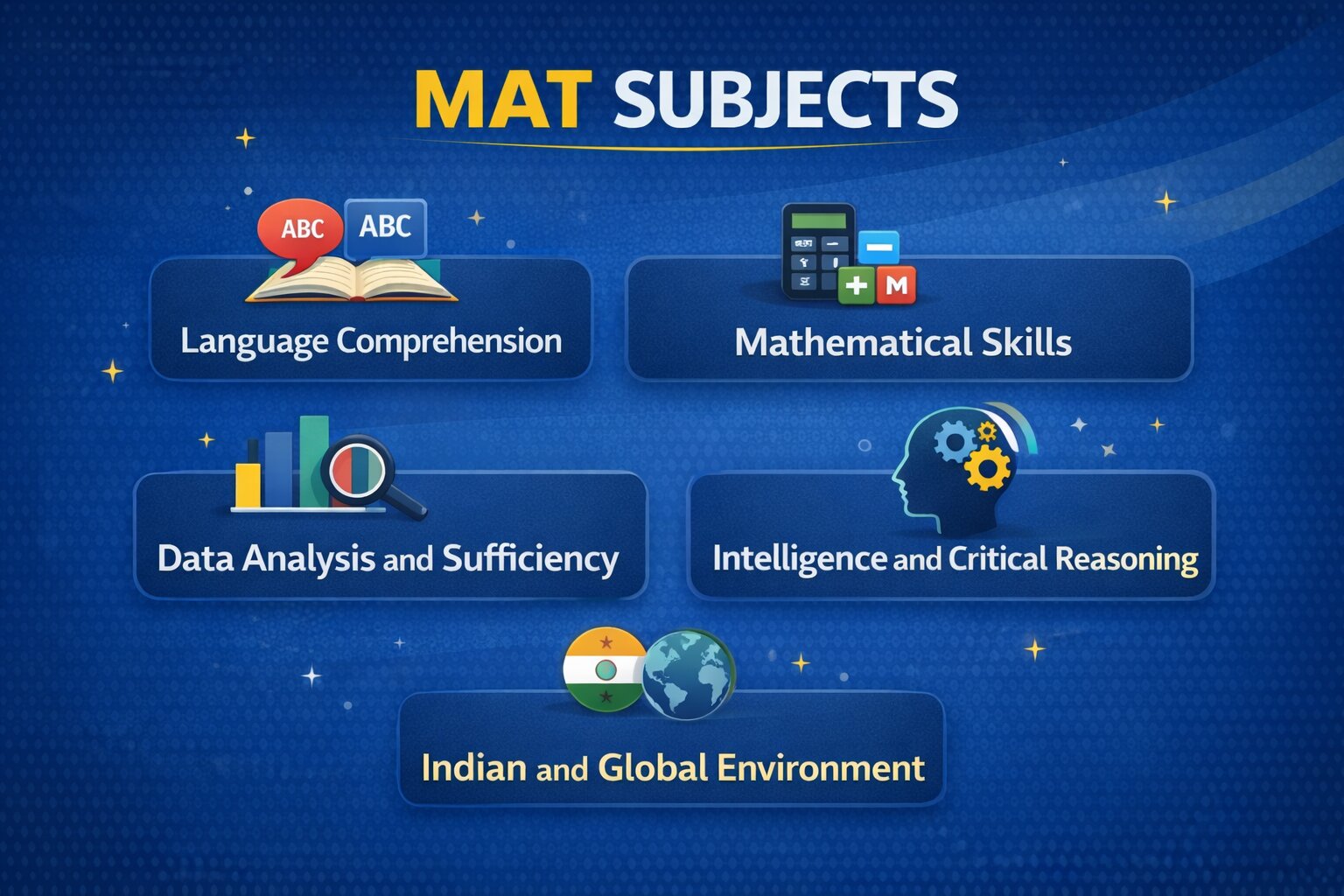
The MAT Exam 2026 consists of five subjects, each designed to evaluate different aspects of a candidate's aptitude for management studies. The subjects are:
- Language Comprehension
- Mathematical Skills
- Data Analysis and Sufficiency
- Intelligence and Critical Reasoning
- Indian and Global Environment
Check: MAT Exam Results
MAT Subjects List 2026 - Overview
| MAT Subject | Duration | No. of MCQs | No. of Non-MCQs | Overview |
|---|---|---|---|---|
| Language Comprehension | 30 Minutes | 40 | 0 | Tests English proficiency, including reading comprehension, grammar, vocabulary, para jumbles, and sentence correction. |
| Mathematical Skills | 40 Minutes | 40 | 0 | Assesses quantitative aptitude with topics such as arithmetic, algebra, geometry, percentages, profit & loss, and time & work. |
| Data Analysis & Sufficiency | 35 Minutes | 40 | 0 | Evaluates data interpretation skills using graphs, charts, tables, and caselets. |
| Intelligence & Critical Reasoning | 30 Minutes | 40 | 0 | Measures logical thinking with topics like coding-decoding, blood relations, direction sense, analogies, and puzzles. |
| Indian & Global Environment | 15 Minutes | 40 | 0 | Covers general knowledge, current affairs, business news, government policies, and economic developments. |
MAT Subjects 2026 For Language Comprehension:
TAmong the key MAT subjects, the Language Comprehension subject evaluates candidates' proficiency in English language comprehension. It assesses their ability to understand and analyze written passages and their command over grammar, vocabulary, and verbal reasoning. This section typically includes reading comprehension passages followed by questions based on them and questions testing grammar and vocabulary usage.
Types of Questions and Skills Assessed:
| Section | Description |
|---|---|
| Reading Comprehension | Candidates are presented with passages from various topics and genres, followed by multiple-choice questions testing their understanding of the passages, inference, central idea identification, and critical reasoning skills. |
| Grammar | Questions may include identifying sentence errors, completing sentences with appropriate words or phrases, and understanding grammatical rules such as tenses, parts of speech, and sentence structure. |
| Vocabulary | Candidates may encounter questions testing their knowledge of synonyms, antonyms, analogies, idiomatic expressions, and word usage in context. |
| Verbal Reasoning | This involves questions that assess the ability to draw logical conclusions, analyze arguments, and evaluate the effectiveness of written communication. |
Check: MAT Exam Questions and Answer
Tips for Preparation:
- Read Widely: Develop a habit of reading diverse materials such as newspapers, magazines, novels, and online articles to improve comprehension and vocabulary.
- Practice Regularly: Solve previous years' MAT question papers and practice mock tests to familiarize yourself with the exam pattern and improve speed and accuracy.
- Focus on Grammar and Vocabulary: Brush up on grammar rules and expand your vocabulary by learning new words and their meanings regularly.
- Understand Passage Structure: Learn to identify the main idea, supporting details, and tone of passages while practicing reading comprehension.
- Time Management: Allocate specific time for each question during practice to improve speed and ensure completion of the section within the allotted time during the exam.
Enroll in SuperGrads MAT Online Coaching 2026
MAT Subjects 2026 for Mathematical Skills
As one of the core MAT subjects, The Mathematical Skills subejct of the MAT exam evaluates candidates' quantitative aptitude and mathematical reasoning abilities. It assesses their proficiency in various mathematical concepts and their capability to apply them to solve problems efficiently. This section typically includes questions covering topics from arithmetic, algebra, geometry, and data interpretation.
Topics Covered in the Mathematics Subject:
| Section | Description |
|---|---|
| Arithmetic | This includes basic arithmetic operations such as addition, subtraction, multiplication, and division, as well as topics like percentages, averages, ratios, and proportions. |
| Algebra | Candidates may encounter questions on linear equations, quadratic equations, inequalities, polynomials, and simultaneous equations. |
| Geometry | Questions in this area may involve concepts related to lines, angles, triangles, circles, polygons, and solid figures. |
| Data Interpretation | Candidates are required to interpret data presented in various forms, such as tables, charts, graphs, and diagrams, to answer questions related to data analysis, including calculating averages, percentages, and ratios. |
Strategies for Tackling Math Problems Effectively:
- Understand Concepts: Students should ensure a thorough understanding of fundamental mathematical concepts and formulas for each topic covered in the syllabus.
- Practice Regularly: Solve various mathematical problems from different sources, including textbooks, practice books, and online resources, to gain familiarity with multiple question formats and enhance problem-solving skills.
- Address Weak Areas: It's essential to identify your weak areas and devote more time to practising and reviewing those topics. This targeted approach will significantly strengthen your understanding and performance.
- Master Calculation Techniques: Improve your speed and accuracy by practising mental math techniques and shortcut calculation methods.
- Time Management: Manage your time effectively during the exam by allocating specific time for each question and avoiding spending too much time on any question. Skip difficult questions and come back to them later if time permits.
Learn: CAT AND MAT EXAM
MAT Subjects 2026 for Data Analysis and Sufficiency:
The Data Analysis and Sufficiency subject in the MAT exam, one of the core MAT subjects, evaluates candidates' ability to interpret and analyze data presented in various formats. It assesses their proficiency in understanding data patterns, drawing conclusions, and making decisions based on the information provided. This section tests candidates' quantitative reasoning skills and capability to solve problems using data-driven approaches
Types of Data Presented in the Exam:
| Tables | Data presented in tabular format, containing rows and columns with numerical values, percentages, or other relevant information. |
| Charts and Graphs | Data is represented visually through different charts, such as bar graphs, line graphs, pie charts, histograms, and scatter plots. |
| Diagrams | Data presented in diagrammatic form, including flowcharts, network diagrams, Venn diagrams, and organizational charts. |
| Textual Data | Data provided in textual format, such as written descriptions, case studies, scenarios, and numerical information. |
Approaches to Solving Data-Related Questions:
- Understand the Data: Carefully read and analyze the data provided to understand the context, variables, and relationships between different data points.
- Identify the Question Type: Determine the type of question being asked, whether it requires simple calculations, data interpretation, comparison of multiple datasets, or application of mathematical concepts.
- Use Visual Aids: Utilize visual aids such as charts, graphs, and tables to interpret data more effectively and identify patterns or trends.
- Apply Mathematical Concepts: Use relevant mathematical concepts and formulas to solve numerical problems or perform calculations based on the given data.
- Evaluate Sufficiency: For data sufficiency questions, assess whether the information provided is adequate to answer the question and determine whether additional data is required to reach a conclusion.
- Practice Problem-Solving: Practice solving a variety of data-related questions from previous years' MAT papers and other practice resources to improve proficiency and accuracy.
Learn More: MAT EXAM FOR MBA
MAT Subjects 2026 for Intelligence and Critical Reasoning:
The Intelligence and Critical Reasoning subject in the MAT exam evaluates candidates' ability to think logically, analyze information, and draw valid conclusions. It assesses their aptitude for critical thinking and problem-solving, essential skills for success in management and business environments. This section typically includes questions that challenge candidates to evaluate arguments, draw logical inferences, and solve problems using deductive and inductive reasoning.
Types of Reasoning Questions Asked:
| Analytical Reasoning | Questions that require candidates to analyze and draw conclusions from given information, often presented in the form of logical puzzles, seating arrangement problems, or other types of arrangements. |
| Critical Reasoning | Questions that test candidates' ability to evaluate arguments, identify assumptions, recognize logical flaws, and draw logical inferences from written passages or statements. |
| Syllogisms | Questions based on deductive reasoning involving two or more statements (premises) and a conclusion, where candidates must determine the conclusion's validity based on the given premises. |
| Coding-Decoding | Questions that assess candidates' ability to decipher codes or patterns and apply logical rules to decode or encode information. |
| Series Completion | Questions that test the ability to identify the pattern or sequence in a given series of numbers, letters, or symbols and predict the next item in the series. |
Techniques for Enhancing Logical and Critical Thinking Abilities:
- Practice Analytical Puzzles: Solve various types of analytical puzzles and logical reasoning problems regularly to improve analytical skills and pattern recognition abilities.
- Read Critically: Practice reading and critically analyzing written passages, articles, and arguments to identify assumptions, evaluate evidence, and recognize logical fallacies.
- Develop Logical Frameworks: Learn to structure arguments and reasoning processes logically by breaking down complex problems into simpler components and identifying relationships between them.
- Evaluate Arguments: Practice evaluating arguments by assessing the validity of premises, identifying unstated assumptions, and evaluating the strength of evidence provided to support conclusions.
- Enhance Problem-Solving Skills: Strengthen problem-solving abilities by approaching problems systematically, considering alternative solutions, and evaluating the consequences of different courses of action.
MAT Subjects 2026 for Indian and Global Environment:
The Indian and Global Environment subject in the MAT exam evaluates candidates' awareness and understanding of current affairs, general knowledge, and events shaping the Indian and global socio-economic, political, and cultural landscape. This section assesses candidates' ability to stay informed about significant developments and trends at both national and international levels, which is crucial for effective decision-making and leadership roles in the business world.
Scope of Topics Covered, Including Current Affairs and General Knowledge:
| Indian Economy | Topics related to economic policies, government initiatives, budgetary provisions, major economic indicators, and sectors contributing to India's economic growth. |
| Indian Polity | Questions on the Indian Constitution, governance structure, important constitutional bodies, recent political developments, and issues related to governance and administration. |
| World Economy and International Affairs | Coverage of global economic trends, international trade agreements, major global organizations (e.g., UN, WTO, IMF), geopolitical developments, and international relations. |
| Business and Corporate Affairs | Knowledge of corporate events, mergers and acquisitions, business expansions, industry updates, and corporate governance practices. |
| Science and Technology | Recent advancements in science and technology, major scientific discoveries, technological innovations, and their impact on society and the economy. |
| Environment and Ecology | Awareness of environmental issues, conservation efforts, climate change initiatives, sustainable development practices, and global environmental agreements. |
| Sports and Entertainment | Updates on major sports events, achievements of Indian and international athletes, entertainment industry news, and cultural events. |
Also Check: MAT EXAM ELIGIBILITY CRITERIA
Staying Updated on MAT Exam Subjects Relevant Information:
- Newspapers: Regularly read reputable newspapers such as The Hindu, The Indian Express, or The Times of India to stay updated on current affairs and important developments.
- Magazines: Subscribe to magazines like India Today, Outlook, or The Economist for in-depth analysis of current events, economic trends, and global affairs.
- Online Portals: Follow reliable online news portals and websites such as BBC News, Al Jazeera, or Reuters for international news coverage and analysis.
- Government Websites: Visit official government websites such as the Ministry of Finance, Ministry of External Affairs, and Ministry of Environment for policy updates and official announcements.
- Social Media: Follow credible social media accounts of news agencies, government departments, and renowned journalists for real-time updates and insights on current affairs and global events.
General Tips for the MAT Exam 2026 Preparation:
- Understand the Exam Pattern: Familiarize yourself with the MAT exam pattern, including the number of sections, types of questions, and marking scheme.
- Create a Study Plan: Develop a structured study plan that allocates sufficient time for each section of the exam and includes regular practice sessions.
- Practice Regularly: Practice solving previous years' MAT question papers and mock tests to get accustomed to the exam format and improve time management skills.
- Focus on Weak Areas: Identify your strengths and weaknesses in each subject and dedicate more time to improving weak areas.
- Stay Consistent: Maintain a consistent study routine and avoid last-minute cramming by spreading out your study sessions over several weeks or months.
- Review and Revise: Regularly review and revise the concepts, formulas, and techniques covered in the exam syllabus to reinforce learning and retention.
Sample Study Schedules and Practice Strategies:
- Daily Practice Routine: Allocate specific time slots each day for studying different subjects, practicing questions, and reviewing concepts.
- Weekly Mock Tests: Schedule weekly mock tests to simulate the exam environment and assess your progress. Analyze your performance after each mock test to identify areas for improvement.
- Subject-wise Focus: Devote specific days or sessions to focus on each subject individually, covering theory, practice questions, and revision.
- Revision Sessions: Set aside time for regular revision sessions to reinforce learning and ensure retention of important concepts.
- Time Management Practice: Practice solving questions under timed conditions to improve speed and accuracy. Allocate time for each question based on its complexity and importance.
Read More: MAT EXAM COLLEGES
Conclusion:
In conclusion, each MAT subjects of the MAT exam plays a crucial role in evaluating candidates' aptitude and readiness for management education:
- Language Comprehension: Tests candidates' proficiency in English language comprehension, essential for effective communication and comprehension skills.
- Mathematical Skills: Evaluates candidates' quantitative aptitude and mathematical reasoning abilities, vital for analytical thinking and problem-solving in business scenarios.
- Data Analysis and Sufficiency: Assesses candidates' ability to interpret and analyze data, crucial for decision-making and problem-solving skills in managerial roles.
- Intelligence and Critical Reasoning: Measures candidates' critical thinking and logical reasoning abilities, essential for effective decision-making and problem-solving in complex situations.
- Indian and Global Environment: Tests candidates' awareness of current affairs, general knowledge, and socio-economic trends, important for understanding the business environment and global perspectives.
Frequently Asked Questions
What is the weightage of each MAT exam subject?

Can I use a calculator during the MAT exam for the Mathematical Skills section?
Are there negative marks for wrong answers in the MAT exam?
How should I prepare for the Data Analysis and Sufficiency section of the MAT exam?
Is there a specific syllabus for the Indian and Global Environment section of the MAT exam?

Lalita Vishwakarma
Content Writer
SHARE