


Haryana Judiciary Syllabus 2026 [Prelims & Mains] Subject-wise List
October 24, 2026
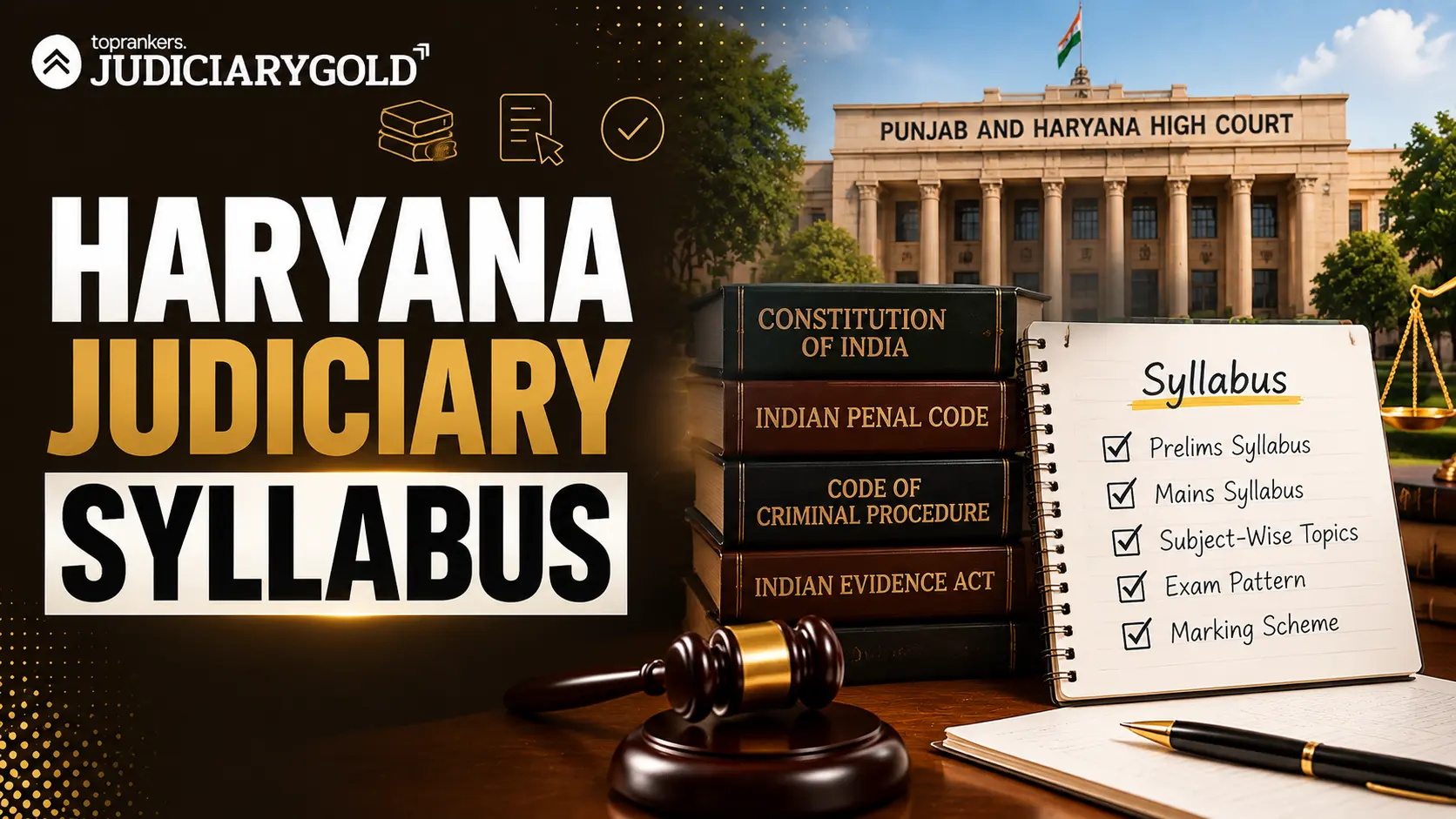
The Haryana Judiciary Syllabus 2026 covers three stages of the HCS (Judicial Branch) exam: a 125-question objective Prelims, five descriptive Mains papers worth 900 marks, and a 200-mark Interview (Viva-Voce).
- The law portion is built around Civil Law I, Civil Law II and Criminal Law.
- The non-law portion tests current events, Indian legal and constitutional history, governance, reasoning, English and Hindi.
- Prelims is about accuracy under negative marking, where one wrong answer costs 0.8 marks.
- Mains is about legal reasoning, structured answers written with a bare act in hand, and language papers that many law graduates underestimate.
Haryana Judiciary Syllabus 2026 Highlights
HPSC has not released the HCS (Judicial Branch) notification, so the 2024 exam is the base syllabus to prepare for the candidates. The exam is conducted under the Punjab Civil Services (Judicial Branch) Rules, 1951, as applicable to Haryana and amended on 7 November 2023.
| Particular | Details |
|---|---|
| Exam Conducting Body | Haryana Public Service Commission (HPSC), Panchkula |
| Exam Name | HCS (Judicial Branch) Examination, for Civil Judge (Junior Division) |
| Application Mode | Online, at hpsc.gov.in |
| Vacancies | 2026 cycle: not yet notified. Last cycle (Advt. 01/2024): 174 posts |
| Eligibility | Bachelor of Laws from a BCI-recognised university that entitles enrolment as an advocate; age 21 to 42 years (cut-off date is fixed in each notification). Practice rule: see note below. |
| Selection Process | Prelims (screening) → Mains (5 written papers) → Interview (Viva-Voce) |
| Prelims Syllabus | Acts in the Mains syllabus at a basic level, plus current events, Indian legal and constitutional history, governance, analytical skills, reasoning and aptitude |
| Mains Syllabus |
Civil Law I: Code of Civil Procedure (also touching the Limitation Act), Punjab Courts Act, Indian Contract Act, Indian Partnership Act, Sale of Goods Act, Specific Relief Act, Indian Evidence Act / BSA, 2023, Haryana Urban (Control of Rent and Eviction) Act, 1973 Civil Law II: Hindu Law (marriage, adoption, inheritance, other personal and family laws), Mohammedan Law, Customary Law, Law of Registration, Law of Limitation Criminal Law: Indian Penal Code / BNS, 2023, Code of Criminal Procedure / BNSS, 2023, Indian Evidence Act / BSA, 2023 English and Hindi (Devanagari) |
| Job Location | Haryana |
| Official Website | hpsc.gov.in |
Check the full Haryana Judiciary eligibility criteria once HPSC publishes the next advertisement.
Haryana Judiciary Syllabus 2026 PDF Download Link
HPSC does not publish a separate syllabus PDF. Candidates can download the syllabus from the below link.
Haryana Judiciary Syllabus 2026 for Prelims
The Haryana Judiciary Prelims is a single objective paper of 125 questions carrying 500 marks, with no Paper I and Paper II split.
- The Prelims is a single objective paper of 125 multiple-choice questions for 500 marks, to be completed in 2 hours.
- Each correct answer carries 4 marks, and 0.8 marks are deducted for every wrong answer.
- Each question has five options (A to E), and option E must be darkened if a question is not attempted.
- Leaving all five circles blank costs 0.8 marks, and leaving more than 13 questions (10%) fully blank leads to disqualification.
- Questions come from the acts in the Mains syllabus, along with current events, Indian legal and constitutional history, governance, and analytical skills, reasoning and aptitude.
- The standard of questions is Law Graduate level.
- Candidates need at least 150 marks (100 for reserved categories excluding EWS) to qualify for Mains.
- Prelims is a screening test only, and its marks are not counted in the final merit list.
| Paper | Subject |
|---|---|
| Single paper (General Studies) | Current events of national and international importance; Indian legal and constitutional history; governance; analytical skills, reasoning and aptitude |
| Single paper (Law) | All acts listed in the Mains syllabus (Civil Law I, Civil Law II, Criminal Law), at Law Graduate level |
| Total | 125 MCQs × 4 marks |
Prelims Subject-Wise Syllabus
General Studies
| Paper | Subjects | Topics Covered |
|---|---|---|
| General Studies | Current events | National and international events, with emphasis on legal developments, landmark judgments and new legislation |
| General Studies | Indian legal history | Courts under the East India Company, Regulating Act 1773, Adalat system, codification and Law Commissions, Privy Council and Federal Court |
| General Studies | Constitutional history and governance | Government of India Acts 1858 to 1935, Indian Independence Act 1947, Constituent Assembly, working of the Union and State governments |
| General Studies | Analytical skills, reasoning and aptitude | Logical and analytical reasoning questions; HPSC does not publish a sub-topic list |
Law paper
| Paper | Subjects | Topics Covered |
|---|---|---|
| Law | Code of Civil Procedure, 1908 | Jurisdiction (Section 9), res judicata, pleadings, temporary injunctions (Order XXXIX), execution (Order XXI), appeals, review and revision |
| Law | Limitation Act, 1963 | Bar of limitation (Section 3), condonation of delay (Section 5), legal disability, acknowledgment, key Schedule articles |
| Law | Punjab Courts Act, 1918 (as applicable to Haryana) | Classes of civil courts, pecuniary jurisdiction, appeals from civil courts |
| Law | Indian Contract Act, 1872 | Offer and acceptance, consideration, void agreements, quasi-contracts, damages, indemnity and guarantee, bailment, agency |
| Law | Indian Partnership Act, 1932 | Nature of partnership, rights of partners, effect of non-registration (Section 69), dissolution |
| Law | Sale of Goods Act, 1930 | Conditions and warranties, transfer of property, sale by non-owners, unpaid seller's rights |
| Law | Specific Relief Act, 1963 | Recovery of possession, specific performance (as amended in 2018), rectification and cancellation, declaratory decrees, injunctions |
| Law | Evidence: Indian Evidence Act, 1872 / Bharatiya Sakshya Adhiniyam, 2023 | Relevancy, admissions and confessions, dying declarations, electronic records, burden of proof, estoppel, examination of witnesses |
| Law | Haryana Urban (Control of Rent and Eviction) Act, 1973 | Landlord and tenant definitions, fair rent, grounds of eviction, Rent Controller and appellate authority |
| Law | Hindu Law | Hindu Marriage Act 1955, Hindu Succession Act 1956 (with 2005 amendment), Hindu Adoptions and Maintenance Act 1956, Hindu Minority and Guardianship Act 1956 |
| Law | Mohammedan Law | Marriage, mahr, dissolution of marriage, maintenance, gifts (hiba), wills, wakf, inheritance |
| Law | Customary Law | Custom as a rule of decision in Punjab and Haryana, proof of custom, customary succession and adoption |
| Law | Registration Act, 1908 | Compulsory and optional registration, time for presentation, effect of non-registration |
| Law | Criminal law: IPC / Bharatiya Nyaya Sanhita, 2023 | General exceptions, offences against the body, property, women and children, offences against the State |
| Law | Criminal procedure: CrPC / Bharatiya Nagarik Suraksha Sanhita, 2023 | FIR, arrest, bail, investigation, cognizance, charge, trial procedure, plea bargaining, appeals |
Haryana Judiciary Syllabus 2026 for Mains
Candidates who score at least 150 marks in Prelims (100 for reserved categories other than EWS) and fall within 10 times the number of vacancies, category-wise, write five Mains papers; all five are compulsory and there are no optional papers.
- The Mains has five compulsory descriptive papers carrying 900 marks in total, each of 3 hours.
- Civil Law I (200 marks) covers CPC, Punjab Courts Act, Contract Act, Partnership Act, Sale of Goods Act, Specific Relief Act, Evidence Act and Haryana Urban (Control of Rent and Eviction) Act, 1973.
- Civil Law II (200 marks) covers Hindu Law, Mohammedan Law, Customary Law, Law of Registration and Law of Limitation.
- Criminal Law (200 marks) covers the IPC, CrPC and Evidence Act, now replaced by BNS, BNSS and BSA from 1 July 2024.
- English (200 marks) includes an essay of 1,000 to 1,100 words (100 marks), plus precis, words and phrases, comprehension and corrections (25 marks each).
- Hindi in Devanagari (100 marks) includes translation (20), explanation of a prose and poetry passage (30), and composition (50), at Matriculation level.
- There are no optional subjects in the Haryana Judiciary Mains.
- The exam is written in English except the Hindi paper, and bare acts are supplied in the exam hall.
- Candidates must score at least 33% in a paper for its marks to count, and 50% aggregate (45% for SC, ST, BC, PwBD and ESM) to be called for interview.
| Category | Subject |
|---|---|
| Compulsory | Paper I: Civil Law I |
| Compulsory | Paper II: Civil Law II |
| Compulsory | Paper III: Criminal Law |
| Compulsory | Paper IV: English |
| Compulsory | Paper V: Language (Hindi in Devanagari script) |
| Optional (choose any three) | Not applicable in Haryana |
Syllabus for Compulsory Subjects
All five Mains papers are compulsory, and the acts below are exactly those named in the HPSC notification (with the new criminal laws shown beside the old codes).
| Subject | Topics Covered |
|---|---|
| Paper I: Civil Law I (200 marks) |
Code of Civil Procedure, 1908 (also touching the Limitation Act), Punjab Courts Act, 1918 (as applicable to Haryana), Indian Contract Act, 1872, Indian Partnership Act, 1932, Sale of Goods Act, 1930, Specific Relief Act, 1963, Indian Evidence Act, 1872 / Bharatiya Sakshya Adhiniyam, 2023, Haryana Urban (Control of Rent and Eviction) Act, 1973 |
| Paper II: Civil Law II (200 marks) |
Hindu Law (marriage, adoption, inheritance and other personal and family laws), Mohammedan Law (marriage, dower, divorce, gifts, wills, inheritance), Customary Law as applied in Haryana, Law of Registration (Registration Act, 1908), Law of Limitation (Limitation Act, 1963) |
| Paper III: Criminal Law (200 marks) |
Indian Penal Code, 1860 / Bharatiya Nyaya Sanhita, 2023, Code of Criminal Procedure, 1973 / Bharatiya Nagarik Suraksha Sanhita, 2023, Indian Evidence Act, 1872 / Bharatiya Sakshya Adhiniyam, 2023 |
| Paper IV: English (200 marks) |
English essay of 1,000 to 1,100 words: 100 marks, Precis: 25 marks, Words and phrases (make sentences with given words and phrases): 25 marks, Comprehension: 25 marks, Corrections: 25 marks |
| Paper V: Hindi in Devanagari (100 marks) |
Translation of an English passage into Hindi: 20 marks, Explanation of a Hindi passage in prose and poetry, in Hindi: 30 marks, Composition (essay, idioms, corrections): 50 marks, Standard: Matriculation level of the Board of School Education, Haryana |
Syllabus for Optional Subjects
The Haryana Judiciary Mains has no optional subjects; candidates do not choose three out of five papers as in some other states. Several subjects that are optional elsewhere are either compulsory in Haryana or not part of its syllabus at all, as the table shows.
| Subject | Topics Covered (status in the Haryana syllabus) |
|---|---|
| Constitutional and Administrative Law | Not a Mains paper. Constitutional history and governance are asked only in Prelims. Articles, writs and judicial review can still surface in Prelims through the governance and legal history portion |
| Hindu and Mohammedan Law | Compulsory, inside Paper II (Civil Law II), together with Customary Law |
| Transfer of Property Act, Equity, Trusts | Not named in the HPSC notification. Specific Relief Act is compulsory in Civil Law I |
| Contract and Torts | Indian Contract Act is compulsory in Civil Law I. Law of Torts is not named in the notification |
| Commercial Law | Partnership Act and Sale of Goods Act are compulsory in Civil Law I. Negotiable Instruments and Company Law are not named |
Haryana Judiciary Syllabus 2026 for Interview
The Interview (Viva-Voce) is the final stage, carries 200 marks, is conducted in English and is mandatory. HPSC states that it judges personal qualities and covers matters of general interest, testing alertness, intelligence and general outlook; it does not publish a topic list.
Only candidates with at least 50% aggregate in the written papers (45% for SC, ST, BC, PwBD and ESM candidates) are called, up to three times the number of vacancies.
- The Interview (Viva-Voce) carries 200 marks and is the final stage of selection.
- It is conducted in English, and appearing in it is mandatory.
- HPSC does not prescribe a topic list for the interview.
- The interview judges personal qualities and covers matters of general interest.
- It tests the candidate’s alertness, intelligence and general outlook.
- Up to three times the number of vacancies are called for the Viva-Voce, in order of Mains marks.
- Final selection requires 50% aggregate (45% for SC, ST, BC, PwBD and ESM) in Mains and Viva-Voce combined.
- The final merit list is prepared out of 1,100 marks (Mains 900 + Viva-Voce 200).
| Assessment Area | Focus Points |
|---|---|
| Legal Knowledge and Awareness |
Recent Supreme Court and Punjab and Haryana High Court judgments, Changes brought by BNS, BNSS and BSA, Basic working of civil and criminal courts in Haryana |
| Personal Profile and General Awareness |
Your law school, practice or work experience, and why you want to be a judge, Haryana's districts, economy and social issues, National and international events of the last year |
| Communication and Analytical Skills |
Clear, concise answers in English, Reasoning through a hypothetical case or ethical dilemma, Composure when a panel member disagrees with you |
Haryana Judiciary Exam Pattern 2026
The Haryana Judiciary exam pattern has three stages, and only Mains and Viva-Voce marks (1,100 in total) count towards the final merit list.
| Exam Stage | Exam Type | No. of Papers | Duration |
|---|---|---|---|
| Prelims | Objective MCQ on OMR sheet, 5 options (A to E) | 1 | 2 hours |
| Mains | Subjective / narrative | 5 | 3 hours per paper |
| Interview (Viva-Voce) | Personal interview in English | Not applicable | Not specified |
Read the full Haryana Judiciary exam pattern for stage-wise details.
Haryana Judiciary Syllabus 2026 Marks Distribution
The marks distribution below follows HPSC Advertisement No. 01/2024, including the internal split of the two language papers.
| Exam Stage | Subject / Section | Marks | Exam Type |
|---|---|---|---|
| Prelims | Law subjects, current events, legal and constitutional history, governance, reasoning (125 questions × 4) | 500 | MCQ |
| Mains (compulsory) | Civil Law I | 200 | Descriptive |
| Mains (compulsory) | Civil Law II | 200 | Descriptive |
| Mains (compulsory) | Criminal Law | 200 | Descriptive |
| Mains (compulsory) | English: essay 100, precis 25, words and phrases 25, comprehension 25, corrections 25 | 200 | Descriptive |
| Mains (compulsory) | Hindi: translation 20, explanation 30, composition 50 | 100 | Descriptive |
| Mains (optional, choose 3) | Not applicable in Haryana | 0 | Not applicable |
| Interview | Viva-Voce (personal qualities, general interest) | 200 | Viva-Voce |
How to Prepare for the Haryana Judiciary Exam 2026?
Prepare for Prelims and Mains together, because the Prelims law questions come straight from the Mains acts; these eight steps turn the syllabus into a working plan.
- Understand the exam pattern: Prelims is screening only, so aim to clear 150 comfortably rather than chase a topper’s score. Mains decides your rank, and language papers carry one-third of its marks. Learn the E-option rule before your first mock, not on exam day.
- Divide the syllabus: Group the acts by paper: Civil Law I, Civil Law II and Criminal Law. Study evidence law once, deeply, since it serves both Civil Law I and Criminal Law. Keep Haryana-specific laws (Punjab Courts Act, Haryana Urban Rent Act, customary law) as a separate block, because national books cover them thinly.
- Make a study plan: Give procedural laws (CPC, BNSS) and evidence the longest slots, as they feed questions across papers. Fix one daily slot for English and Hindi writing from week one, and plan a weekly revision day so older acts do not fade.
- Keep notes handy: Write short notes against bare act sections, since bare acts are supplied in Mains. Maintain an IPC-to-BNS, CrPC-to-BNSS and Evidence Act-to-BSA mapping sheet, and note landmark judgments with one line on what each decided.
- Practise previous year papers: Solve Haryana Judiciary previous year question papers to see how HPSC frames questions. Mark which acts repeat most often and revise those first, then re-attempt wrong questions after a week to check real learning.
- Time management and answer writing: Write full timed Mains papers (three hours) at least twice a month in the final phase. Structure answers as provision, explanation, case law and conclusion, and practise finding sections in a bare act quickly, as it saves real minutes in the exam hall.
- Revision strategy: Run three revision cycles: the full syllabus, then high-weight acts, then notes only. Revise through mock tests rather than rereading chapters, and in the last month take Prelims mocks under the 0.8 negative marking rule.
For a stage-wise timetable, see these Haryana Judiciary preparation tips.
Best Books for Haryana Judiciary Exam 2026
Candidates can use one standard textbook per act alongside its bare act, and buy the latest edition so criminal law books cover BNS, BNSS and BSA.
| Book Name | Author / Publisher |
|---|---|
| Bare Acts of all syllabus statutes (latest amended editions) | Any standard bare act publisher |
| Civil Procedure with Limitation Act, 1963 | C.K. Takwani / Eastern Book Company |
| Law of Contract and Specific Relief | Avtar Singh / Eastern Book Company |
| Principles of Mercantile Law (Partnership, Sale of Goods) | Avtar Singh / Eastern Book Company |
| The Law of Evidence (edition covering BSA, 2023) | Ratanlal & Dhirajlal / LexisNexis |
| Criminal law: BNS commentary (latest edition) | Ratanlal & Dhirajlal / LexisNexis |
| Criminal Procedure (edition covering BNSS, 2023) | R.V. Kelkar / Eastern Book Company |
| Principles of Hindu Law | Mulla / LexisNexis |
| Modern Hindu Law | Paras Diwan / Allahabad Law Agency |
| Principles of Mahomedan Law | Mulla / LexisNexis |
| A Digest of Civil Law for the Punjab, chiefly based on the Customary Law | Sir W.H. Rattigan |
| Landmarks in Indian Legal and Constitutional History | V.D. Kulshreshtha / Eastern Book Company |
| Indian Polity | M. Laxmikanth / McGraw Hill |
| High School English Grammar and Composition | Wren & Martin / S. Chand |
| Samanya Hindi | Lucent Publications |
| General Knowledge (static) plus a monthly current affairs magazine | Lucent Publications |
There is no General Science book here because Haryana does not test General Science. For a longer subject-wise list, see the best books for Haryana Judiciary, and pair them with judiciary notes and study material for quick revision.
If you want a structured guidance, take a free demo online class or talk to a Judiciary Gold counsellor about the course.
Download Judiciary Study Material
Fill your details
Frequently Asked Questions
What is the syllabus for Haryana Judiciary Prelims Exam 2026?

What are the important topics that need to be prepared for the Aptitude section of the Haryana Judiciary Syllabus 2026?
List some of the best books that cover the complete Haryana Judiciary Syllabus 2026.
What is the Haryana Judiciary Syllabus 2026 for prelims exam in regards to English language?
Can I complete the Haryana Judiciary Pre Syllabus in 3 months?
Is the Haryana Judiciary syllabus 2026 updated with BNS, BNSS and BSA?
Does Haryana Judiciary Syllabus 2026 Prelims have separate General Studies and Law papers?
Nancy Mahavir Sharma
Legal Writer
SHARE